
Lambert conformal projection


The Lambert conformal conic projection, or, more simply, the Lambert projection is one of the map projections put forth by the Mulhousian mathematician, physicist, philosopher, and astronomer Johann Heinrich Lambert in 1772.
In essence, the projection superimposes a cone on the Earth's sphere, with two reference parallels intersecting and intersecting the globe. This minimizes distortion from projecting a three-dimensional surface onto a two-dimensional one. The distortion is nil along the reference parallels, and increases outside the chosen parallels. As the name implies, this projection is conformal.
Aircraft pilots use these charts by flying great circle arc routes to travel the shortest distance between two points on the surface, which on a Lambert chart will appear as a curved line that must be calculated separately to make sure to identify the correct waypoints in navigation.
Based on the simple conic projection with two reference meridians, Lambert mathematically adjusted the distance between parallels to create a conformal map. Since the meridians are straight lines and the parallel arcs of a circle are concentric, the different leaves fit together perfectly.
Transformation
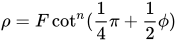
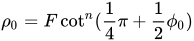
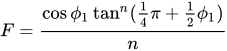
The coordinates of a spherical geodetic reference system can be converted to coordinates of the conical projection according to Lambert with the following formulas, where λ λ {displaystyle lambda } It's the length, λ λ 0{displaystyle lambda _{0}} the reference length, φ φ {displaystyle phi } latitude, φ φ 0{displaystyle phi _{0}} latitude of reference and φ φ 1{displaystyle phi _{1}} and φ φ 2{displaystyle phi _{2}} standard parallels:


x=ρ ρ without [chuckles]n(λ λ − − λ λ 0)]{displaystyle x=rho sin[n(lambda -lambda _{0})]}}
![{displaystyle x=rho sin[n(lambda -lambda _{0})]}](https://wikimedia.org/api/rest_v1/media/math/render/svg/b2f79eb28cb7acae33211448430b7fc48e49f6f6)
and=ρ ρ 0− − ρ ρ # [chuckles]n(λ λ − − λ λ 0)]{displaystyle y=rho _{0}-rho cos[n(lambda -lambda _{0})]}}
![{displaystyle y=rho _{0}-rho cos[n(lambda -lambda _{0})]}](https://wikimedia.org/api/rest_v1/media/math/render/svg/bbc4ad7f5096a1123133af54d64a813c00df60d8)
where:
- n=ln (# φ φ 1sec φ φ 2)ln [chuckles]So... (14π π +12φ φ 2)cot (14π π +12φ φ 1)]{displaystyle n={frac {ln(cos phi _{1}sec phi _{2})}{ln[{tan({frac {1}{4}}}}{pi +{frac {1}{2}{2}{2})cot({frac {1}{4}{pi +{frac}{1}{1}{1}{1}}{1}}{1}{1}{1}{1}{frac}{1}{1}{1}}{1}{1}{1}{1}{1}{1}{1}{1}{1}{1}{1}{1}{1}{1}{frac}}{1}{
- ρ ρ =Fcotn (14π π +12φ φ ){displaystyle rho =Fcot ^{n}({frac {1}{4}}pi +{frac {1}{2}}}phi)}}
- ρ ρ 0=Fcotn (14π π +12φ φ 0){displaystyle rho _{0}=Fcot ^{n}({frac {1}{4}}}}}{pi +{frac {1}{2}}}{2}}}}{phi _{0})}}
- F=# φ φ 1So...n (14π π +12φ φ 1)n{displaystyle F={frac {cos phi _{1}tan ^{n}({frac {1}{1{4}}}{pi +{frac {1}{2}}}}}{1}}}{n}}}}}}}}
![{displaystyle n={frac {ln(cos phi _{1}sec phi _{2})}{ln[tan({frac {1}{4}}pi +{frac {1}{2}}phi _{2})cot({frac {1}{4}}pi +{frac {1}{2}}phi _{1})]}}}](https://wikimedia.org/api/rest_v1/media/math/render/svg/f2e2f5bcaf5031f41885823595eb5fb06743b8e4)
Contenido relacionado
San Marino
Passalum
Egypt