
Karst in Sorbas gypsum
The gypsum karst of Sorbas is a complex of caves, canyons, sinkholes, geodes and other karstic phenomena excavated by the Aguas River in a gypsum deposit to the south of the town of Sorbas, in Almeria, Spain. Since 1989, it has been protected as a Natural Area.
Description
A karst is produced in water-soluble mineral deposits (such as gypsum or limestone), in which the action of river water and rain gradually dissolves the rock and creates caves, which due to partial subsidence form sinkholes and by total subsidence they form canyons. Dissolved mineral in water can re-crystallize under certain circumstances, for example, dripping from the ceiling of a cave onto the floor to form stalactites and stalagmites, or stagnating in a cavity to form geodes.
Gypsum is a mineral that dissolves easily in water, so the formation process of a karst of this type is relatively fast (on a geological time scale). But this rapidity is also the cause of their short existence (on the same time scale), since the caves collapse rapidly and the gypsum deposits almost completely disappear. This is the reason why there are very few karsts of this type in the world and the vast majority are highly degraded.
However, the low rainfall in Almería has caused the process of the Sorbas karst to be much slower than in other places, which is why it is one of the best preserved on the planet.[quote required]
The Junta de Andalucía declared the karst natural site in 1989, through Law 2/1989 of July 18, and inaugurated a visitor center in Sorbas in 2002, called de los Yesares due to its gypsum karst theme of Sorbas; In it you can learn about the stages of formation of this karstic phenomenon, the biological aspects that compose it and even enjoy a replica of a cave made with great dedication based on gypsum crystals. To complete the visit to this center there is a video/documentary of the karst of great interest.
In the area, four «Global Geosites» (Places of Spanish Geological Interest of International Relevance) have been proposed by the Geological and Mining Institute of Spain: the karst, due to its geomorphological interest, with the denomination «SK003: Karst in yesos de Sorbas» within the geological context «Carstic systems in carbonates and evaporites of the Iberian Peninsula and the Balearic Islands» and, due to its stratigraphic interest, the stratigraphic succession of the gypsum in Los Molinos, Puente del Río Aguas and Barranco del Infierno have been proposed as "EE001: Los Yesos del Río Aguas (Sorbas)", the reef formations of the area of Los Alías (Cariatiz) as "EE002: Los arrecifes de Sorbas" and the outcrops in the meander of the river Waters such as "EE003: Las Facies Playa del Mimbre Sorbas", the latter within the geological context "Messinian evaporitic episodes"
There are two ways to visit the karst: on the surface, touring its outer landscape, or entering one of its caves to see the underground world. Speleologists have an underground paradise in the Sorbas gypsum karst. You can also visit it touristically by taking one of the three possible guided excursions that are offered in the karst and that are adapted to all types of public.

Stalactites.
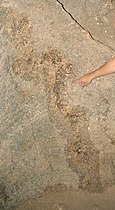
Geoda.

Supercones.


Perimeter Map

Climatology
It belongs to the dry Mediterranean climate, with rainfall of less than 250 mm per year and 3000 hours of sunshine per year.
Flora
The landscape is dominated by thyme groves, giving the area a steppe appearance. It is also possible to find plants adapted to gypsum beds such as Ononis tridentata and Gypsophila struthium. There are various endemisms in the area, only present in the region, such as the Teucrium turredanum, which flowers in August; Helianthemum alypoides, Narcissus tortifolius and Teucrium freynii.
Wildlife
The leper tortoise found in the Aguas river stands out, as well as the Moorish tortoise, which is also present in Sierra Cabrera.
Contenido relacionado
Okayama Prefecture
Annex: Municipalities of the province of Zamora
Veracruz (disambiguation)