
Jeweler's


Jewelry is a term that can refer to the trade in jewelry, its production, the establishment where these activities are carried out, be they shops or workshops, as well as the jewelry itself.
Jewelry
Pretty jewelry or jewelry consists of decorative items worn for personal adornment, such as brooches, rings, necklaces, earrings, pendants, bracelets, and cufflinks. Jewelry can be attached to the body or clothing. From a Western perspective, the term is restricted to durable ornaments, excluding flowers, for example. For many centuries, metal such as gold, often combined with precious stones, has been the normal material for jewelry, but other materials such as shells and other plant materials can be used.
Jewelry is one of the oldest types of archaeological artifact, with 100,000-year-old beads made from Nassarius shells believed to be the oldest known jewelry. The basic forms of jewelry vary between cultures, but are often extremely long-lived; In European cultures, the more common forms of jewelry listed above have persisted since ancient times, while other forms, such as nose or ankle ornaments, important in other cultures, are much less common.
Jewelry can be made from a wide range of materials. Gemstones and similar materials such as amber and coral, precious metals, beads, and shells have been widely used, with enamel often being important. In most cultures, jewelry can be understood as a status symbol, for its material properties, patterns, or significant symbols. Jewelry has been made to adorn almost every part of the body, from hairpins to toe rings and even genital jewelry. In modern European culture, the amount worn by adult men is relatively low compared to other cultures and other periods of European culture.
Form and function
Humans have used jewelry for several different reasons:
- functional, usually to fix clothes or hair in place
- as a social status marker and personal status, as with a wedding ring
- as significant in some form of affiliation, whether ethnic, religious or social
- to provide talismanic protection (in the form of amulets)
- as an art exhibition
- as a carrier or symbol of personal meaning, such as love, mourning, a personal milestone or even luck
- superstition
Most cultures at some point have had the practice of storing large amounts of wealth in the form of jewelry. Numerous cultures store wedding dowries in the form of jewelry or make jewelry as a means of storing or displaying coins. Alternatively, jewelry has been used as currency or trade goods; one example is the use of slave accounts.
Many jewelry items, such as brooches and buckles and bracelets, originated as purely functional items, but evolved into decorative items as their functional requirements diminished.
Jewelry can symbolize group membership (as in the case of the Christian crucifix or the Jewish Star of David) or status (as in the case of chains of charges or the Western practice of married people wearing wedding rings).
The use of amulets and devotional medals to provide protection or ward off evil is common in some cultures. These can take the form of symbols (such as the ankh), stones, plants, animals, body parts (such as the jamsa), or glyphs (such as stylized versions of the throne verse in Islamic art).
Materials and methods

Precious stones, coins, or other precious items are often used when creating jewelry, and are usually set in precious metals. Platinum alloys range from 900 (90% pure) to 950 (95.0% pure). The silver used in jewelry is usually sterling silver or 92.5% fine silver. In costume jewellery, stainless steel findings are sometimes used.
Other commonly used materials include glass, such as fused glass or enamel; wood, often carved or turned; shells and other natural animal substances such as bone and ivory; natural clay; polymer clay; hemp and other twine have also been used to create jewelry that has a more natural feel.
Beads are often used in jewelry. These can be made of glass, gemstones, metal, wood, shells, clay, and polymer clay. Beaded jewelry typically includes necklaces, bracelets, earrings, belts, and rings. The beads can be large or small; the smaller type of bead is used for the "woven" of jewelry with beads. Seed beads are also used in an embroidery technique where they are sewn onto fabric linings to create wide neck pieces and beaded bracelets. Beadwork, a type of handwork popular during Victorian times, is enjoying a renaissance in modern jewelry making. Beadwork is also very popular in many African and Native American cultures.
Silversmiths, goldsmiths, and lapidaries use methods that include forging, casting, welding, cutting, carving, and "cold joining" (using adhesives, staples and rivets to assemble parts).
Diamonds

Diamonds were first mined in India. Pliny the Elder may have mentioned them, although there is some debate as to the exact nature of the stone he referred to as Adamas. As of 2005, Australia, Botswana, Russia, and Canada were among the top sources of gem diamond production. There are negative consequences of the diamond trade in certain areas. Diamonds mined during recent civil wars in Angola, the Ivory Coast, Sierra Leone and other nations have been labeled blood diamonds when mined in a war zone and sold to finance an insurgency.
The British crown jewels contain the Cullinan diamond, part of the largest gem-quality rough diamond ever found (1905), at 3,106.75 carats (621.35 g).

In the 20th century and XXI It is popular for engagement rings to have diamonds, this use dating back to the marriage of Maximilian I to Mary of Burgundy in 1477.
A popular style is the diamond solitaire, which features a single large diamond prominently mounted. Within solitaire, there are three categories a ring can be classified into: prong, bezel, and tension setting.
Other gemstones
Many precious and semi-precious stones are used for jewelry. These include:
Amber
An ancient organic gemstone, amber is composed of tree resin that has hardened over time. Stone must be at least a million years old to be classified as amber, and some amber can be up to 120 million years old.
Amethyst
Amethyst has historically been the most prized gemstone in the quartz family. It is prized for its purple hue, which can range in hue from light to dark.

Emerald
Emeralds are one of the three major gemstones (along with rubies and sapphires) and are known for their fine green to bluish-green color. They have been treasured throughout history, with some historians reporting that the Egyptians were mining emeralds as early as 3500 BC.

Jade
Jade is most commonly associated with the color green, but it can come in a number of other colors as well. Jade is closely associated with Asian culture, history and tradition, and is sometimes known as the stone of heaven.

Jasper
Jasper is a gemstone in the chalcedony family that comes in a variety of colors. Jasper often presents unique and interesting patterns within the colored stone. Picture jasper is a type of jasper known for the colors (often beiges and browns) and swirls in the pattern of the stone.
Quartz
Quartz refers to a family of crystalline gemstones of various colors and sizes. Among the best-known types of quartz are rose quartz (which has a delicate pink color) and smoky quartz (which comes in a variety of shades of translucent brown). Several other gemstones, such as amethyst and citrine are also part of the quartz family. Rutilated quartz is a popular type of quartz that contains needle-like inclusions.
Ruby
Rubies are known for their deep red color and are among the most valued gemstones. Rubies have been treasured for millennia. In Sanskrit, the word for ruby is ratnaraj which means king of precious stones.
Sapphire
The most popular form of sapphire is blue sapphire, known for its medium to deep blue color and strong saturation. Elegant sapphires of various colors are also available. In the United States, blue sapphire tends to be the most popular and affordable of the three major gemstones (emerald, ruby, and sapphire).

Turquoise
Turquoise is found in only a few places on earth, and the largest turquoise-producing region in the world is the southwestern United States. Turquoise is prized for its attractive color, most often a deep medium blue or greenish blue, and its ancient heritage. Turquoise is used in a wide variety of jewelry styles. It is perhaps most closely associated with Southwestern and Native American jewelry, but it is also worn in many elegant and modern styles. Some turquoises contain a matrix of dark brown markings, providing an interesting contrast to the brilliant blue color of the gemstone.
Some gemstones (such as pearls, coral, and amber) are classified as organic, meaning they are produced by living organisms. Others are inorganic, which means they are usually composed of and derived from minerals.
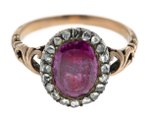
Some gems, for example amethyst, have become less valued as methods of extracting and importing them have progressed. Some man-made gems can serve in place of natural gems, such as cubic zirconia which can be used in place of diamond.
Impact on society
Jewelry has been used to indicate status. In ancient Rome, only certain ranks could wear rings; later, sumptuary laws dictated who could wear what type of jewelry. This was also based on the rank of the citizens of that time.
Cultural dictates have also played an important role. For example, the wearing of earrings by Western men was considered effeminate in the 19th century and early XX. More recently, the display of body jewelry, such as piercings, has become a mark of acceptance or seen as a badge of bravery within some groups, but is completely rejected in others. In addition, hip hop culture has popularized the slang term bling-bling, which refers to the ostentatious display of jewelry by men or women.
In contrast, the jewelry industry at the turn of the 20th century launched a campaign to popularize wedding rings for men, which caught on, as well as men's engagement rings, which did not, going so far as to create a false history and claim that the practice had medieval roots. By the mid-1940s, 85% of weddings in the United States featured a double ring ceremony, up from 15% in the 1920s.
Some religions have specific rules or traditions around jewelry (or even forbid it), and many religions have edicts against excessive display. Islam, for example, considers the use of gold by men to be Haram. Most Islamic jewelry was in the form of bridal dowries, and was not traditionally passed down through the generations; instead, on the death of a woman it was sold in the souk and recycled or sold to passers-by. Islamic jewelry from before the 19th century century is therefore extremely rare.
Some Christian denominations prohibit the wearing of jewelry by both men and women, including Amish-Mennonite and Holiness churches. The New Testament of the Bible commands against the use of gold, in the writings of the apostles Paul and Peter, and Revelation describes "the great harlot," or false religious system, as "adorned." with gold and precious stones and pearls with a golden cup in her hand". (Revelation 17:4)
History
The history of jewelry is long and goes back many years, with many different uses among different cultures. It has endured for thousands of years and has provided various insights into how ancient cultures functioned.
Prehistory
The earliest known jewelry was not actually created by humans (Homo sapiens) but by Neanderthals living in Europe. Specifically, perforated beads made of small seashells dating back 115,000 years have been found in the Cueva de los Aviones, a cave along the southeastern coast of Spain. Later, in Kenya, at Enkapune Ya Muto, beads made from perforated ostrich egg shells date back more than 40,000 years. In Russia, a stone bracelet and a marble ring are attributed to a similar age.
Later, early modern European humans had crude necklaces and bracelets made of bone, teeth, berries, and stones strung from pieces of rope or animal sinew, or pieces of carved bone used to fasten clothing. In some cases, the jewels had pieces of shell or mother-of-pearl. A decorated engraved pendant (the Star Carr pendant) dating to around 11,000 BC, and believed to be the oldest Mesolithic art in Britain, was found at the Star Carr site in North Yorkshire in 2015. In the south From Russia, carved bracelets made of mammoth tusks have been found. The Hohle Fels Venus features a perforation at the top, showing that it was designed to be worn as a pendant.
About seven thousand years ago, the first sign of copper jewelry was seen. In October 2012, the Lower Austrian Museum of Ancient History revealed that they had found a tomb of a jewelry worker, forcing archaeologists to take a fresh look at prehistoric gender roles after she appeared to be that of a fine metal worker, a profession previously thought to be performed exclusively by men.

Accounts; 3650-3100 BC; lapis lazuli (blue beads) and travertine (white beads) (Egyptian alabaster); long: 4.5 cm; Naqada II or Naqada III culture; Metropolitan Museum of Art (New York)

Accounts; 3300-3100 BC; cornalin, garnet, quartz and glazed state; long: 20.5 cm; Naqada III Metropolitan Museum of Art

Armband with the symbol of the sun; 16th to 13th century Bronze Age; bronze; National Museum of Germany (Nürnberg)

Necklace; probably 2600-1300 AC; cornaline, bone and rock; Saruq Al Hadid (United Arab Emirates)


Egypt
The first signs of established jewelry making in Ancient Egypt occurred around 3,000 to 5,000 years ago. The Egyptians preferred the luxury, rarity and practicality of gold over other metals. In pre-dynastic Egypt, jewelry soon began to symbolize religious and political power in the community. Although it was worn by wealthy Egyptians in life, it was also worn by them in death, with jewelry commonly placed among grave goods.
Along with gold jewelry, the Egyptians used colored glass, along with semi-precious gems. The color of the jewels had a meaning. Green, for example, symbolizes fertility. Lapis lazuli and silver had to be imported from beyond the country's borders.
Egyptian designs were the most common in Phoenician jewelry. Additionally, ancient Turkish designs found on Persian jewelry suggest that trade between the Middle East and Europe was not uncommon. The women wore elaborate gold and silver pieces that were used in ceremonies.

Pectoral (joy of the chest) of Tutankhamon; 1336–1327 AC (Reino de Tutankamón); gold, silver and meteor glass; height: 14.9 cm; Egyptian Museum (Cairo)

Earring; 1069 BC; gold and turquoise; measurements: 5.1 x 2.3 cm; Cleveland Museum of Art (Cleveland, United States)

Seal ring; 664-525 BC; gold; diameter: 3 × 3.4 cm; British Museum (London)
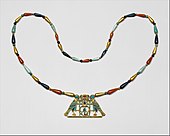
Pectoral and necklace of Princess Sithathoriunet; 1887–1813 BC; gold, cornalin, lapis lazuli, turquoise, granate " feldespato; diemnsions: 4.5 cm; Metropolitan Museum of Art (New York City)

.jpg)
Europe and Middle East
Mesopotamia
.jpg)
By about 5,000 years ago, jewelry making had become an important trade in the cities of Mesopotamia. The most significant archaeological evidence comes from the Royal Cemetery of Ur, where hundreds of burials dating from 2900-2300 BC were unearthed; tombs such as the one at Puabi contained a multitude of artifacts in gold, silver, and semi-precious stones, such as lapis lazuli crowns adorned with gold figurines, fitted necklaces, and jewel-headed pins. In Assyria, men and women wore vast amounts of jewelry, including amulets, ankle bracelets, heavy multi-strand necklaces, and cylinder seals.
Jewelry in Mesopotamia tended to be made from thin sheets of metal and was set with a large number of brightly colored stones (mainly agate, lapis lazuli, carnelian, and jasper). Preferred shapes included leaves, whorls, cones, and bunches of grapes. Jewelers created works both for human use and to adorn statues and idols. They employed a wide variety of sophisticated metalworking techniques, including cloisonné, engraving, fine graining, and filigree.
Extensive and meticulously maintained records related to trade and jewelry making have also been unearthed at all Mesopotamian archaeological sites. A record in the royal archives of Mari, for example, gives the composition of various items of jewelry:
- 1 flat bead necklace with mottled calcedony that includes: 34 flat beads of mottled calcedony [and] 35 beads of striated gold, in groups of five.
- 1 flat bead necklace with mottled calcedony that includes: 39 flat beads of mottled calcedony, [with] 41 studs in a group that make up the device to hang.
- 1 necklace with rounded lapislázuli beads that includes: 28 rounded lapislázuli beads, [and] 29 beads for closure.

Sumeria necklace accounts; 2600–2500 BC; gold and lapis lazuli; long: 54 cm; Metropolitan Museum of Art

Necklace; 2600–2500 BC; gold and lapis lazuli; long: 22.5 cm; Royal Cemetery of Ur (Iraq); Metropolitan Museum of Art

Pair of earrings with cuneiform inscriptions, 2093–2046 BC; gold: Sulaymaniyah Museum (Sulaymaniyah, Iraq)
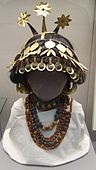
Sumerian collars and headdress discovered in the royal (and individual) tombs of the Royal Cemetery of Ur, is shown as likely to be used at the British Museum (London)


Greece
.jpg)
The Greeks began using gold and gemstones in jewelry in 1600 BC, although shell and animal-shaped beads were widely produced in earlier times. Around 1500 BC, the main gold working techniques in Greece included casting, bar twisting and wire making. [30] Many of these sophisticated techniques were popular in the Mycenaean period, but unfortunately this skill was lost at the end of the Bronze Age. The shapes and forms of jewelry in ancient Greece, such as the bracelet (13th century BC), the brooch (X century BC) and pins (VII BCE), have also varied greatly since the Bronze Age. Other forms of jewelry include crowns, earrings, necklaces, and bracelets. A good example of the high quality that gold working techniques could achieve in Greece is the 'Gold Olive Wreath' of the Greek. (IV century BC), modeled after the type of crown awarded as a prize to winners in athletic competitions such as the Olympic Games. Jewelry dating from 600 to 475 BC. they are not well represented in the archaeological record, but after the Persian wars, the amount of jewelry became more abundant again. A particularly popular type of design at this time was a bracelet decorated with snakes and animal heads. Because these bracelets used considerably more metal, many examples were made of bronze. In the year 300 BC, the Greeks dominated the manufacture of colored jewelry and the use of amethysts, pearls and emeralds. In addition, the first signs of cameos appeared and the Greeks created them from Indian Sardonyx, a striped cream and pink-brown agate stone. Greek jewelry was often simpler than in other cultures, with simple designs and workmanship. However, as time passed, the designs increased in complexity and different materials were soon used.
Jewelry in Greece was rarely worn and was mostly worn for public appearances or on special occasions. It was frequently given as gifts and worn by women mainly to display their wealth, social status, and beauty. Jewelry was often supposed to protect the wearer from the 'evil eye'; or they gave him supernatural powers, while others had religious symbolism. The oldest pieces of jewelry that have been found were dedicated to the gods.
They worked with two styles of pieces: cast pieces and hammered pieces in sheet metal. Fewer pieces of cast jewelry have been recovered. It was made by casting the metal over two stone or clay molds. The two halves were then joined and wax, followed by molten metal, placed in the center. This technique had been practiced since the late Bronze Age. The most common form of jewelry was the hammered blade type. Sheet metal was hammered to the desired thickness and then welded together. The interior of the two sheets was filled with wax or another liquid to preserve the metalwork. Different techniques, such as using a stamp or engraving, were then used to create motifs on the jewelry. Jewelry can then be added to the recesses or glass poured into special cavities in the surface.
The Greeks took much of their designs from outside sources, such as Asia, when Alexander the Great conquered part of it. In earlier designs, other European influences can also be detected. When Roman rule came to Greece, no changes in jewelry designs were detected. However, in 27 BC, Greek designs were heavily influenced by Roman culture. That's not to say that local design didn't thrive. Numerous polychrome butterfly pendants on silver foxtail chains have been found near Olbia, dating to the I century AD. C., and only one example has been found anywhere else.
![El Pendiente de la abeja, una joya icónica minoica; 1700-1600 AC; oro; dimensión: 4.6 cm; del complejo Chrysolakkos (pozo de oro) en Malia, Creta; Museo Arqueológico de Heraklion (Heraklion, Grecia)[30][31]](https://upload.wikimedia.org/wikipedia/commons/thumb/a/a9/Bee_pendant%2C_gold_ornament%2C_Chrysolakos_necropolis_near_Malia%2C_1800-1700_BC%2C_AMH%2C_144879.jpg/170px-Bee_pendant%2C_gold_ornament%2C_Chrysolakos_necropolis_near_Malia%2C_1800-1700_BC%2C_AMH%2C_144879.jpg)
The Bee Earring, an iconic minoid jewel; 1700-1600 BC; gold; dimension: 4.6 cm; of the Chrysolakkos complex (pozo de oro) in Malia, Crete; Archaeological Museum of Heraklion (Heraklion, Greece)

Pendant Necklace; 1400-1050 AC; golden terracotta: diameter of rosettes: 2.7 cm, with variations of about 0.1 cm, length of slope 3.7 cm; Metropolitan Museum of Art (New York)

Ganymede jewels; circa 300 BC; gold; various dimensions; unknown origin (it is said to be found near Thesalonika (Greece)); Metropolitan Museum of Art

Necklace; circa 200 BC; gold, moonstone, garnet, emerald, cornalin, baroque pearl and agate; dimension: 39.4 cm; Cleveland Museum of Art (Cleveland, United States)
![El Pendiente de la abeja, una joya icónica minoica; 1700-1600 AC; oro; dimensión: 4.6 cm; del complejo Chrysolakkos (pozo de oro) en Malia, Creta; Museo Arqueológico de Heraklion (Heraklion, Grecia)[30][31]](https://en.wikipedia.org/wiki/Archivo:Bee_pendant,_gold_ornament,_Chrysolakos_necropolis_near_Malia,_1800-1700_BC,_AMH,_144879.jpg)


Etruscan
Gorgons, pomegranates, acorns, lotuses, and palm trees were clear indicators of Greek influence on Etruscan jewelry. The modeling of heads, which was a typical practice of the Greek severe period, was a technique that spread throughout the Etruscan territory. Even clearer evidence of new influences is the form introduced in the Orientalizing era: the Bullae. Pear-shaped container used to contain perfume. Its surface used to be decorated with embossed and engraved symbolic figures.
Much of the jewelry found was not worn by the Etruscans, but was made to accompany them in the afterlife. Most, if not all, of the Etruscan goldsmiths' techniques were not invented by them, as they date back to the 3rd millennium BC.

The Vulci jewellery set; beginnings of the 5th century; gold, glass, rock crystal, agate and beef; diverse dimensions; Metropolitan Museum of Art (New York)
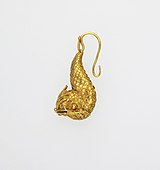
Dolphin-shaped earrings; Century V AC; Gold; 2.1 × 1.4 × 4.9 cm; Metropolitan Museum of Art

Bulla with Dédalo and Icaro; century V AC; gold; 1.6 × 1 cm; Walters Art Museum (Baltimore, United States)

Arete; gold and silver; 1.5 × 0.4 × 1.4 cm; Metropolitan Museum of Art


Jewelry Market
According to a 2007 KPMG study, the largest jewelry market was the United States with a 30.8% market share, Japan, India, China and the Middle East each with 8-9% and Italy with 5%. The study authors predicted a dramatic shift in market shares by 2015, where the US market share will have fallen to around 25%, and China and India will increase theirs to more than 13%. The Middle East will remain more or less constant at 9%, while the market share of Europe and Japan will halve and will be less than 4% for Japan, and less than 3% for the largest European countries, Italy and the UK.
Contenido relacionado
Offer
Patent
Box pallet