
Indigenous peoples of Argentina

The indigenous, aboriginal or native peoples of Argentina are the group of people, families and communities that recognize themselves as descendants of the Americans who inhabited the current Argentine territory at the time of first contact with Europeans in the XVI century. By extension, names can also refer to of the same condition who migrated to the current Argentine territory from neighboring countries and their descendants.
According to the online list updated to May 22, 2023 that the National Institute of Indigenous Affairs publishes on its website, there are 1837 registered indigenous communities in Argentina, belonging to 39 indigenous peoples. There are also other indigenous communities without register and the number of towns has been increasing as new self-recognitions have been produced.
Definition
The definition of what the word indigenous refers to is a matter of discussion and there are definitions such as the one made by the United Nations special rapporteur, José Martínez Cobo, in his Study of the problem of discrimination against indigenous populations:
Indigenous communities, peoples and nations are those who, having a historical continuity with societies prior to the invasion and colonization that developed in their territories, consider themselves distinct from other sectors of societies that currently prevail in those territories, or in parts thereof. At present they constitute non-dominant sectors of society and are determined to preserve, develop and transfer to future generations their ancestral territories and their ethnic identity, as the basis for their continued existence as peoples, according to their own cultural patterns, social institutions and legal systems.
Article 1.1.b of Convention 169 of the International Labor Organization (ILO) —ratified by Argentina in 1992— made the following definition regarding its application:
...to peoples in independent countries, considered indigenous by the fact that they descended from populations living in the country or in a geographical region to which the country belongs at the time of conquest or colonization or the establishment of the current state borders and that, whatever their legal status, they retain all their own social, economic, cultural and political institutions or some of them.
These peoples, communities, families or individuals are identified in Argentina as indigenous, aboriginal or original, terms that are progressively displaced to that of indians, which, although in general colloquial use, is acquiring a pejorative or discriminatory meaning.
National Law no. decentralized with indigenous participation in the ambit of the National Executive Power. This law defined the legal concept of indigenous community:
It will be understood as indigenous communities to groups of families that are recognized as such by the fact of descending from populations that inhabited the national territory at the time of conquest or colonization and indigenous or Indian to members of that community.
In this way, self-recognition is the fundamental criterion for the definition of indigenous in Argentina, that is, the awareness that they have of their identity and their externalization of it before society. On this basis, the 2010 National Population, Household and Housing Census revealed the existence of 955,032 people who recognized themselves as indigenous, constituting around 2.38% of the country's total population. Although the legal definition restricted the recognition to the descendants of those who inhabited the current Argentine territory at the time of its conquest or colonization, in practice it is extended to the peoples who later migrated to the territory from neighboring countries.
History
Introduction

Human settlement of the current territory of Argentina dates back to at least 12,890 ± 90 B.P. according to the findings of Piedra Museo, in the Patagonian region. Subsequently, three indigenous ecoregions with very marked differences were formed: in the northwest Andean quadrant, agro-pottery cultures related to the Andean civilization were established and a part of them came to form part of the Inca Empire; in the northeast quadrant, agro-pottery cultures related to the Tupi-Guarani linguistic family were established; In the central Pampas and Patagonia, nomadic cultures were established that did not have a common ethnogenesis, since they belonged and still belong to different linguistic families.
During the European conquest, the indigenous cultures that inhabited the current Argentine territory experienced diverse destinies. On the one hand, most of the Pampean, Patagonian and Chaco cultures resisted the Spanish conquest and subsequent acculturation and were never under their direct domination yet. The situation that occurred in the northwest quadrant, center, parts of the humid Pampas, and the coast was different, since the Spanish colonization established its main centers of population and production on the basis of commissioned work from the indigenous people, while some nations Indians staged wars and insurrections against the Spanish. The northeastern quadrant was characterized by the establishment of the Guaraní Jesuit missions that formed a completely original type of indigenous-Christian societies autonomous from the Hispanic Monarchy that even faced the joint troops of Spain and Portugal in the so-called Guaranítica war, and that they were finally dissolved by the Spanish Crown in 1768.
All the indigenous nations of Argentina also suffered the demographic collapse that affected all the indigenous American peoples, and that was largely a consequence of certain diseases carried by the Europeans. It is estimated that when the Spanish arrived, there were between 400,000 and 2,000,000 aborigines in Argentina, settled and grouped in the most fertile valleys of northwestern Argentina and, to a lesser degree, in the valleys of the great rivers of the Argentine coast. The rest of the extensive territory had a population density of less than one inhabitant per square kilometer. The most bullish sources go to 1.5 million and the lowest to 0.3 million people.
Once the United Provinces of the Río de la Plata were constituted as a formally independent state in 1816, and as the Argentine Republic in 1826, a process of conquest of the territories occupied by the indigenous peoples that had not been dominated by the Indians began. the Spanish Empire, especially in the Pampean region, Patagonia and the Gran Chaco. These "wars against the Indian" They had their highest point in the so-called Conquest of the Desert of 1880 in which the Mapuche, Ranquel and Tehuelche peoples were defeated, and allowed the Argentine State to effectively control large territories.
The final data from the Complementary Survey of Indigenous Peoples (ECPI) carried out in 2004-2005 highlighted the then existence of 30 indigenous peoples in Argentina, made up of 955,032 individuals (940,363 who recognized themselves as belonging to some aboriginal people plus the rest that do not belong but are descendants in the first generation of an aboriginal people) equivalent to approximately 2.38% of the total population. The exact number of towns depends on whether or not partialities that are members of some cultures with their own characteristics and mestizo groups resulting from the revival of their autochthonous cultural identity are considered as such. This is without prejudice to the fact that it has been estimated that almost 40% of the Argentine population has at least one indigenous ancestor, although in most cases the family memory of that belonging has been lost. All indigenous cultures have been affected by a deliberate process of invisibility, promoted by the State, since the second half of the XIX century..
Indigenous people in the Pampas region and Patagonia

Patagonia has the oldest records of human presence in Argentine territory, in the town of Piedra Museo in the province of Santa Cruz, 13,000 years BC. C., apparently also related to the possible much older human presence still detected in southern Chile, in the Monte Verde area, 33,000 years BC. C. These discoveries have not only put into crisis the theory of late settlement and the arrival by Beringia, but also suggest a current of population entering the current Argentine territory through Patagonia and the extreme south of Chile.
Another remote settlement was located in Los Toldos, also in the province of Santa Cruz, with remains dating back to 10,500 years BC. 9,000 years ago Toldense industry arose, characterized by bifacial subtriangular projectile points and lateral and terminal rasps, bifacial knives, and bone tools.
These first inhabitants of the Argentine territory hunted milodones and hippidiones (South American horses that disappeared 10,000 years ago), as well as guanacos, llamas, and rheas. In the same area, the Cueva de las Manos (an eaves on the banks of the Pinturas river canyon in the province of Santa Cruz), cave paintings from 7,300 years BC have been found. C.: prints of palms of hands previously stained with fresh paint from natural dyes; "negatives" of hands obtained with spray paints - the paint was blown through the medullary canal of a bone - onto rock faces by interposing the hands between the medium (the spray paint) and the support (the natural rock wall); and images of very elegant and stylized guanacos. It is one of the oldest artistic expressions of the South American peoples and has been declared a World Heritage Site by Unesco. As in European Magdalenian art, it is very likely that these representations were associated with magical thinking (especially the so-called sympathetic magic) in which the rite of drawing the desired was supposed to attract the desired (in In these cases, food from hunting).
By the year 9000 B.C. C. had already begun the settlement of the pampean region. Later, between 7,000 and 4,000 years B.P., the Casapedrense industry appeared, characterized by a greater proportion of lithic instruments made on sheets, probably as a sign of specialization in guanaco hunting, which is also present in cultural developments. of the Patagonians or Tehuelches.
The Pampean and Patagonian cultures, due to reasons that Marvin Harris describes as emic, could not become sedentary or specialize in agriculture or in the consequent agro-pottery: the ecology of the territories they inhabited and the index The demographics of the Pampid peoples made their economy more sustainable to be based on a "primitive" system and for these reasons they organized themselves on what had been a successful base of hunting and gathering systems for millennia. Approximately from the middle of the XVII century, thanks to the capture and domestication of horses imported by the Spanish, the pámpidos became (such as the "guaicurúes" pámpidos of the Chaco region) in equestrian complexes that literally hunted wild cattle since the high mobility and dispersion that ecology (or rather mesology —for example, long dry seasons—) had imposed on them traditionally for these ethnic groups it made them uneconomical and even impractical to raise cattle. Only since the second half of the XIX century is an incipient change in strategy seen in the mode of production of most pampids (from Tierra del Fuego to the Chaco Boreal inclusive): the various ethnic groups and partialities of the pámpidos, seeing the reduction of hunting and gathering resources and having a demographic increase that implied greater pressure on non-cultivated natural resources, were forced to to refound their economy in an incipient subsistence agriculture almost always reduced to horticulture, although the lack of techniques to counteract droughts in areas that would just cease to be considered "desert" after dry farming cultivation meant that their attempts were not as successful as required.

Inhabitants of the Rio de la Plata about 1600, according to Hendrick Ottsen.
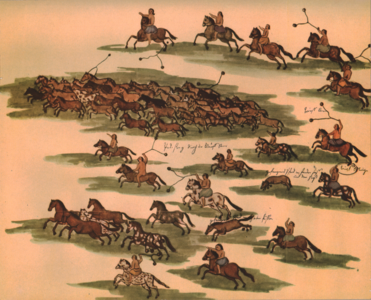
Boleando baguals1752 Florian Paucke watercolor.

The cacique tehuelche Junchar portrayed by José del Pozo, member of the Malaspina Expedition, in 1789.

Portrait of an Indian patagona by José del Pozo, 1789.

Author portrait of the painter José del Pozo portraying an Indian patagona, 1789.
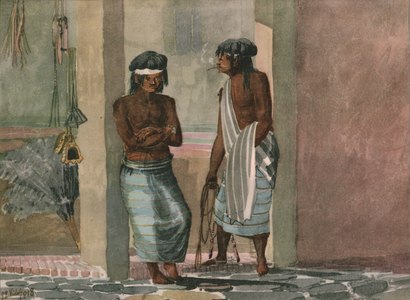
Indigenous Pampas in Buenos Aires according to Emeric Essex Vidal, 1818.

Toldera de indígenas en Sierra de la Ventana according to Charles Henri Pellegrini, 1830.

Cacique patagónAdolphe Goupil's watercolor of 1838.

Indigenous pampas according to Charles Henri Pellegrini, 1841.

Family of Indians in Buenos Aires, 1844. Lithography of Jules Daufresne.
The Coast and the Northeast


As in the Pampas and Patagonia regions, the indigenous people of the Argentine coast and the Argentine Northeast had their modes of production almost exclusively based on hunting and gathering: they lived in a naturally jungle area with large water systems formed by the Paraná River, the Paraguay River, the Uruguay River, the Salado del Norte River, the Bermejo River, and the Pilcomayo River, which allowed for relatively easy cultural flows, but also strong political instability because the same watercourses became easy transportation routes. invasions.
The ecological conditions of the environment were accompanied by the management of the resources that the indigenous people applied for their way of life as hunter-gatherers. The indigenous peoples were experts in the controlled management of fire, which they also used as a fighting and hunting tool. Fire management allowed them to manage the pastures and create clearings and patches of vegetation to attract the endemic herbivorous animals of the region. area, such as deer and guanaco. Agriculture was only developed on the banks of the Dulce and Salado rivers, managed by overflow management techniques. In such a situation were then the towns that the Guarani invaders pejoratively called Guaicurúes ―the Qom pámpidos throughout the XX century better known among allophones as tobas (the second is a pejorative name of Guarani origin that means 'fronted')―, mokoit (mocovíes), abipones, malbalas, nivaclés (or chulupíes or chunupíes), pilagaes and charrúas.
Perhaps those that the Inca invaders pejoratively nicknamed matacos ―the Wichís―, vilelas, kaigangs, mocoretaes, timbúes, chanaes and querandis -the latter also pámpidos although with a name better known by the one given to it by the Guarani.
Towards the end of the XV century the region was shaken by the invasion of an Amazonian people who were expanding due to their intrinsic strong demographic pressure facilitated by the incipient and intensive horticulture of cassava and corn. This ethnic group was that of the Guarani.
Just as the Quechuas transculturated a lot to the ethnic groups of the northwest and the Mapuches to those of the south of the Pampean and North Patagonian region, the Guarani did the same throughout the Argentine Mesopotamia and a large part of the NEA. They managed to invade areas of the Chaco Boreal, subjecting those of Arawak origin, Chanés and Chorotes (the latter, calling themselves yofuasha) among other pre-existing nations to the Guaranític invasion and in the middle of the Chaco Boreal, by forced mixogenesis after invading and enslaving the ava or guaraníes to the Chanés (of Arawako lineage), killing the men and taking the Chané women as concubines, forged the ethnic group of the Chiriguanos.
Like other sedentary indigenous peoples, since the arrival of the Spanish in the XVI century, cultivated areas with longhouses and good fluvial communications were easily conquered by the Europeans and miscegenation was rapid, while the less agriculturally rich and more remote areas were able to resist European penetration until the end of the century XIX. On the other hand, a strong synchronization occurred very early in this area due to the intense missionary activity of the Jesuits and Franciscans, the former especially between the 16th century and almost the middle of the century XVIII.

Indigenous in Buena Esperanza (now Puerto Gaboto), engraving of 1536 by Ulrico Schmidl.
West, Northwest

The Argentine Northwest and West were inhabited at least since 9000 B.C., these groups were initially linked to the hunting of megafauna and later to that of camelids, as well as the exploitation of different plant and mineral resources. In the Northwest it begins to take place between 1000 a. C. and 500 a. C. an important change in the way of life of these populations, which implied the adoption and consolidation of agriculture, pottery, livestock and a village way of life (in the West this process occurred later).
The northern zone began to be inhabited around the year 7000 BC. The different ethnic groups that inhabited the Andean region (not counting the Patagonian Andes) were the Diaguitas, Calchaquies, Atacamas, Omaguacas, Kolla, Quechuas, Aymaras, and huarpes; As for the Calchaquíes, they are descendants of one of the partialities of the Diaguitas or Paziocas.
The different ethnic groups that inhabited the region at the time of the arrival of the Spanish conquerors (not counting the Patagonian Andes) were the Diaguitas, Aymaras, Omaguacas, Atacamas, Quechuas and Huarpes. The latter were not fully part of the Inca Empire since the Allentiac Huarpe partiality took refuge in the Guanacache lagoons. These towns were dominated between 1480 and 1533 by the Inca Empire of the Inca invaders allied with the Aymara from Peru and the Lake Titicaca basin in southern Peru and western Bolivia. The word "diaguita" was a nickname given by the Aymara since in the Aymara language thiakita it means 'far away', 'foreigner'. Although the duration of the Inca or Inca Empire was relatively brief, it left notorious influences (mainly in place names) since even after the Spanish conquest from 1535, Quechua was the vehicular language of a large part of the Andean region. Like the other inhabitants of the Andean region, they had very advanced knowledge of agriculture, astronomy, the construction of terraces and artificial irrigation. They also raised animals such as the llama that they used to trade with other indigenous groups.
The original peoples in Argentina have diminished a lot in relation to the general population. This is due to different interrelated causes, such as diseases, miscegenation, extermination campaigns (18th and 19th centuries), the abrupt interruption of their cultures and considerable immigration from Europe. In the provinces of Jujuy, Salta, and Tucumán, indigenous customs are preserved in celebrations, dances, and meals, with a significant population that includes the Kollas, an ethnic group into which a large part of the Atacamas, Omaguacas, and Calchaquíes have merged. and chichas and that has received a strong Quechua influence. As for the Aymara and Quechua that currently exist in that area, the vast majority are recent immigrants (from the last decades of the XX century ) from different areas of Bolivia: the Aymara come from the Lake Titicaca basin in western Bolivia and southern Peru, while the Quechua come from the Peruvian highlands, although their nucleus of origin is the central Andean region of Peru.

Cangapol, cacique of the Tehuelches (Tomas Falkner, XVIII century)

Cacique tehuelche, Casimiro Biguá (circa 1864)

Cacique Chagallo (circa 1885)

Representation of painted beans (Martin Dobrizhoffer, XVIII century)
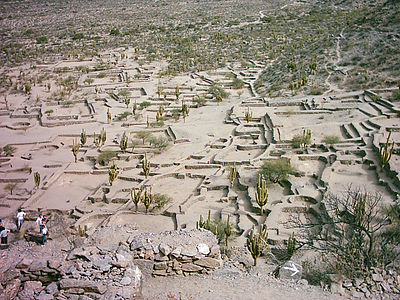
Pre-Hispanic Ruins of Quilmes

Indígena toba


Censused or estimated indigenous population
Census history
In 1980, INDEC published an estimate of the indigenous population by region of Argentina around 1550, completing a table published in 1969 by Jorge Comadrán Ruiz:
| Regions | Estimated indigenous population |
|---|---|
| Northwest | 195 000 |
| Litoral and Mesopotamia | 60 000 |
| Chaco | 50 000 |
| Sierras Centrales | 30 000 |
| Pampa | 30 000 |
| Cuyo | 20 000 |
| Patagonia and Tierra del Fuego | 18 000 |
| Total | 403 000 |
In 1778, the so-called Vértiz census was carried out in the Viceroyalty of Río de la Plata, alluding to the then viceroy Juan José de Vértiz y Salcedo, who fulfilled the order of King Carlos III that year Spain to carry out annual censuses in the Spanish colonies and received the results on March 27, 1779. The census did not cover the vast regions of Chaco, Pampa and Patagonia as they were inhabited by indigenous groups not subject to Spanish rule.
| Jurisdiction | Indigenous population | Total population |
|---|---|---|
| Buenos Aires (*) | 2087 (544 in the city, 1543 in the campaign) | 37 130 (24 205 in the city, 12 925 in the campaign) |
| San Luis | 1282 | 6956 |
| Mendoza | 1359 | 8765 |
| Córdoba | 4084 | 40 203 |
| Catamarca | 2817 | 13 315 |
| Balance | 3070 | 11 565 |
| La Rioja | 5200 | 9723 |
| San Juan | 1527 | 7690 |
| Tucumán | 4069 | 20 104 |
| Santiago del Estero | 4897 | 15 465 |
| Jujuy | 11 181 | 13 619 |
| Total | 41 573 | 186 526 |
(*) Does not include data from the town of Luján, Entre Ríos, Corrientes, Santa Fe and Misiones that are not known.
The first three national population censuses in Argentina estimated the indigenous population that was "outside the empire of civilization" without census, taking into account data from the commanders of the border forts regarding the number of spears.
- Census of 1869: 93 000 indigenous people over a total population of 1 830 214 inhabitants.
- Census of 1895: 30 000 indigenous people over a total population of 4 044 911.
- Census of 1914: 18 425 indigenous — as indigenous population- over a total population of 7,903,662 inhabitants.
Subsequent national population censuses (1947, 1960, 1970, 1980, and 1991) did not provide data on the indigenous population —although they did include it— until the 2001 census.
In 1920 the Census of National Territories was carried out (Misiones, Formosa, Chaco, Los Andes, La Pampa, Neuquén, Río Negro, Chubut, Santa Cruz, Tierra del Fuego, Antártida and Islas del Atlántico Sur) for which 19,834 indigenous people (called Indians) were recorded in Formosa and an estimated 25,000 unregistered wild Indians in the rest of the territory. The total population of the national territories was estimated at 358,738 inhabitants.
The Formosan Aboriginal Census of 1970 counted 8,611 indigenous people. The First Provincial Aboriginal Census of Salta of 1984 carried out in the departments of Rivadavia, San Martín, Orán, Anta and Metán, resulted in 17,785 indigenous people, corresponding to: 6,167 Chiriguanos, 585 Chanés, 164 tapuy (rugs), 9,143 Wichís, 915 Chorotes, 166 Chulupíes, 467 Tobas and 178 others. Aboriginal of the Province of Chaco of 1985 registered 24,528 indigenous people (3,143 Wichís).
National Indigenous Census of 1966-1968
The National Indigenous Census of 1966-1968 was the first in which an attempt was made to quantify the indigenous population of Argentina while attempting to locate it geographically. The indigenous peoples that were considered in the census records were:
- Central region: tobas, pilagás, mucovíes, matacos, chulupies, chorotis and chiriguanos.
- Northeast region: Guaraní and cainguas.
- Northwest region: Aymara and Quechuas.
- South central region: tehuelches, araucanos, quenaken, yamanes and onas.
The census only counted the indigenous people who lived in rural communities, but it could not be concluded, registering 75,675 indigenous people who lived in 13,738 homes in 525 groups. The rest not included in the census was estimated at 89,706 people, so the total result was 165,381 indigenous people throughout the country.
The results broken down by census region were:
- North central region (Chaco Provinces, Formosa, North Santa Fe, Eastern Salta Sector and Ramal area of Jujuy): 46 770 people were registered living in 8219 homes of 283 groups (11 in the Matacos de Formosa department and 1 in the department of Orán in Salta).
- Northeast region (Mission province): 512 people were registered living in 99 households of 18 groups. The uncensed from the north and north-west central regions were estimated at 3418, giving a total of 50 700 people for both regions.
- Northwest region (Jujuy province, central and western sector of Salta and north of Catamarca): 1012 people lived in 200 homes of 12 groups. The uncensed were estimated at 79 988, giving a total of 81 000 people.
- South Central Region (Provinces of Buenos Aires, La Pampa, Río Negro, Neuquén, Chubut, Santa Cruz and Tierra del Fuego National Territory): 27 381 people living in 5220 homes of 212 groups were registered. The uncensed were estimated at 6300, giving a total of 33 681 people.
The rest of the country was not surveyed. The total population of the country was then estimated at 22,800,000 inhabitants.
| Ethnic group | Census |
|---|---|
| Necklace | 1012 |
| Chanés | 847 |
| Chiriguanos | 13 689 |
| Chorotes | 719 |
| Chulupi | 562 |
| Mapuches | 27 214 |
| Matacos | 10 022 |
| Mbya | 560 |
| Mocovís | 2876 |
| Pilagás | 1137 |
| Tehuelches (mestized) | 167. |
| Tobas | 17 062 |
Supplementary Survey of Indigenous Peoples 2004-2005
The 2001 National Population, Households and Housing Census was carried out on November 17 and 18, 2001 and included the theme of indigenous peoples. The census document included a question aimed at detecting households with at least one person who is recognized as belonging to and/or descendant of an indigenous people: Is there any person in this household who is recognized as a descendant of or belonging to an indigenous people? If the answer was affirmative, the question was Which people? and the following options corresponding to the indigenous peoples of the communities that had national legal status in 1998 were listed: Chané, Chorote, Chulupí, Diaguita Calchaquí, Huarpe, Kolla, Mapuche, Mbyá, Mocoví, Ona, Pilagá, Rankulche, Tapiete, Tehuelche, Toba, Tupi Guarani and Wichí, in addition to the categories other indigenous peoples and ignored peoples . According to the results, 2.8% of Argentine households had at least one member who recognized themselves as belonging to an indigenous people.
The indigenous census obtained from census data was used to extract representative samples of households to be revisited in the Encuesta Complementaria de Pueblos Indígenas (ECPI) carried out in 2004 and 2005. These samples were made up of around 57,000 households from all the provinces of the country. To the 17 towns listed in the census questionnaire, estimates were added for the Ava Guaraní, Charrúa and Comechingón towns.
According to the results of the ECPI, 600,329 people recognized themselves as belonging to and/or first-generation descendants of indigenous peoples. The total in the following table exceeds this figure by 0.6% because the population that was not recognized as belonging to any specific town and has mixed indigenous ancestry is counted in both indigenous towns simultaneously. Regarding the population that speaks and/or understands the indigenous language(s), it includes any indigenous language, whether or not it is the traditional language of the people to which the population belongs.
| Indigenous people | Indigenous population village of belonging | Speaking population and/or understands indigenous languages/s | Population residing in an indigenous community |
|---|---|---|---|
| Attack | 3044 | ||
| Ava guaraní (*) | 21 807 | 8943 | 10 806 |
| Aimara | 4104 | ||
| Chané | 4376 | 1974 | 2016 |
| Charrúa | 4511 | ||
| Chorote | 2613 | 1711 | 2028 |
| Chulupi | 553 | 266 | 392 |
| Comechingón | 10 863 | ||
| Diaguita/diaguita calchaquí | 31 753 | 1686 | 8180 |
| Guaraní (*) | 22 059 | 8178 | 1301 |
| Huarpe | 14 633 | 8987 | 2620 |
| Kolla (**) | 70 505 | 8987 | 33 629 |
| Lule | 854 | ||
| Mapuche | 113 680 | 17 897 | 13 430 |
| Mbya guaraní | 8223 | 3908 | 4322 |
| Mocoví | 15 837 | 3752 | 6619 |
| Omaguaca | 1553 | ||
| Ona | 696 | ||
| Pampa | 1585 | ||
| Pilagá | 4465 | 3512 | 3867 |
| Quechua | 6739 | ||
| Querandí | 736 | ||
| Rankulche | 10 149 | 446 | |
| Sanaviron | 563 | ||
| Tapiete | 524 | 282 | 478 |
| Tehuelche | 10 590 | 961 | |
| Toba | 69 452 | 34 949 | 42 870 |
| Tonocoté | 4779 | ||
| Tupi guaraní (*) | 16 365 | 5514 | 6060 |
| Wichí | 40 036 | 29 066 | 34 561 |
| Other declared peoples (***) | 3864 | ||
| Unspecified people (****) | 92 876 | ||
| No response | 9371 |
(*) Ava Guarani and Tupi Guarani correspond to the same people —also called Chiriguano— whose communities are identified by different names. In the case of the ava guaraní, it also includes the avá guaraníes of Paraguay or chiripás in the province of Misiones. The Guarani item includes Chiriguanos, Guarani in general, and descendants of Guarani from the Jesuit missions.
(**) The name Kolla includes peoples and individuals that were differentiated after the survey, such as the Tastil, Toara, Tilián, Chicha, Ocloya and Fiscara or Tilcara peoples.
(***) Includes, among others, cases registered under the following names: abaucán, abipón, ansilta, chaná, inca, maimará, minuán, ocloya, olongasta, pituil, pular, shagan, tape, tilcara, tilián and vilela. Data are not provided separately for each denomination because the small number of sample cases does not allow an estimate of each total with sufficient precision.
(****) Includes cases in which the response relating to the indigenous people they belonged to and/or descended from in the first generation was "ignored" or "another indigenous people".
National Census of Population, Households and Housing 2010
The National Census of Population, Households and Housing 2010 was carried out on October 27, 2010 and the census document included the question Is any person in this household indigenous or a descendant of indigenous (original or aboriginal)?. Possible responses were yes, no, and ignored. If the answer was affirmative, they were asked to indicate the number of people and to which indigenous people they belonged. Unlike the 2001 census, a list of towns was not included.
The results by indigenous people are presented in the following table (total population of the country: 39,671,131 inhabitants):
| Indigenous people | Total population | Male | Women |
|---|---|---|---|
| Mapuche | 205 009 | 103 253 | 101 756 |
| Toba | 126 967 | 63 772 | 63 195 |
| Guaraní | 105 907 | 53 788 | 52 119 |
| Diaguita | 67 410 | 34 295 | 33 115 |
| Kolla | 65 066 | 32 553 | 32 513 |
| Quechua | 55 493 | 27 849 | 27 644 |
| Wichí | 50 419 | 25 513 | 24 906 |
| Comechingón | 34 546 | 17 077 | 17 469 |
| Huarpe | 34 279 | 17 098 | 17 181 |
| Tehuelche | 27 813 | 13 948 | 13 865 |
| Mocoví | 22 439 | 11 498 | 10 941 |
| Pampa | 22 020 | 10 596 | 11 424 |
| Aimara | 20 822 | 10 540 | 10 282 |
| Guaraní | 17 899 | 9438 | 8461 |
| Rankulche | 14 860 | 7411 | 7449 |
| Charrúa | 14 649 | 7192 | 7457 |
| Attack | 13 936 | 7095 | 6841 |
| Mbya guaraní | 7379 | 3872 | 3507 |
| Omaguaca | 6873 | 3551 | 3322 |
| Pilagá | 5137 | 2623 | 2514 |
| Tonocoté | 4853 | 2437 | 2416 |
| Lule | 3721 | 1918 | 1803 |
| Tupi guaraní | 3715 | 1872 | 1843 |
| Querandí | 3658 | 1776 | 1882 |
| Chané | 3034 | 1559 | 1475 |
| Sanaviron | 2871 | 1399 | 1472 |
| Ona | 2761 | 1383 | 1378 |
| Chorote | 2270 | 1177 | 1093 |
| Maimará (*) | 1899 | 876 | 1023 |
| Chulupi | 1100 | 537 | 563 |
| Vilela | 519 | 279 | 240 |
| Tapiete | 407 | 217 | 189 |
| Other | 5301 | 2681 | 2620 |
| Total | 955 032 | 481 074 | 473 958 |
The results by province and the City of Buenos Aires were as follows:
| Province/CABA | Indigenous population |
|---|---|
| Ciudad Autónoma de Buenos Aires | 61 876 |
| Buenos Aires (*) | 299 311 |
| Catamarca | 6927 |
| Chaco | 41 304 |
| Chubut | 43 279 |
| Córdoba | 51 142 |
| Current | 5129 |
| Between Rios | 13 153 |
| Formosa | 32 216 |
| Jujuy | 52 545 |
| The Pampa | 14 086 |
| La Rioja | 3935 |
| Mendoza | 41 026 |
| Missions | 13 006 |
| Neuquén | 43 357 |
| Black River | 45 375 |
| Balance | 79 204 |
| San Juan | 7962 |
| San Luis | 7994 |
| Santa Cruz | 9552 |
| Santa Fe | 48 265 |
| Santiago del Estero | 11 508 |
| Tierra del Fuego, Antarctica and South Atlantic Islands | 3563 |
| Tucumán | 19 317 |
| Total | 955 032 |
(*) The province of Buenos Aires was divided into 186,640 people in the then 24 parties of Greater Buenos Aires and 112,671 in the interior of the province.
National Census of Population, Households and Housing 2022
The National Population, Households and Housing Census 2022 that was carried out on May 18, 2022 included the following questions:
22. Is indigenous or descendant of indigenous or indigenous peoples recognized?
The options were: "Yes", "No" and "Ignored". As this question was asked for the first time to the entire population and not to sample regions, the result of the "Yes" option will give the total number of individuals who self-identify as indigenous or descendants of indigenous people.
For those who answered “Yes” to question 22, the following question was asked:
23. What indigenous or original people?
The census takers had to write the name of the town indicated by the census taker, also having the option “Ignored”.
Another question that was asked to those who answered "Yes" in question 22, was:
24. Do you speak and/or understand the language of that indigenous or original people?
The options were: "Yes", "No" and "Ignored". The result of the "Yes" option will give the total number of individuals self-recognized as indigenous or descendants of indigenous people who speak an indigenous language traditionally used by the people to which each one belongs.
The questions incorporated into the census forms generated requests for reformulation by indigenous associations who objected that the census takers had to write the names of the indigenous peoples, which could generate statistical errors (for example for towns with similar names such as chanés and chanás, or different names for the same town). They also objected that question 24 on indigenous languages was not asked of the entire population, since there are non-indigenous people who speak indigenous languages.
Indigenous languages of Argentina

It is estimated that at the time of the arrival of Europeans in the 16th century around 35 indigenous languages were spoken in what is now the Argentine territory. At present, in the Argentine indigenous communities, only the following 9 languages maintain some degree of vitality: Wichí, Toba, Guaraní, Chorote, Pilagá, Quechua, Nivaclé, Mocoví and Mapuche.
Current situation
The situation of speech and intergenerational transmission of indigenous languages with vitality in Argentina is as follows:
- Languages spoken by adults, youth and children:
- wichí (wichí lhämtes) in the wichí and iogys villages
- toba (qomlaqtaq) in the village toba or qom
- Guaraní (avañe’s(c):
- Guaraní dialect chaqueño in its chiriguana variants (ava) and isoceña (chané) in the villages ava/tupí guaraní and chané
- Mbya dialect (mby'a) in the Mbya Guaraní village
- chorote manjuyiyo'wujwa) in the village chorote
- pilagá (pitelara laqtaq) in the village pilagá
- alternative in BoliviaQullasuyu qhichwa simi) of the Southern Quechua (urin qhichwa) in Quechua, kolla, diaguita, chicha, fiscara, kolla atacameño, ocloya, omaguaca, tastil, tilián, toara and atacama
- Languages with discontinuity in intergenerational transmission, spoken by adults over 40 years of age:
- Tapiete dialecttapiete) of the Guaraní (avañe’s) in the village tapiete
- nivaclénivačle) in the village of Chulupi or Nivaclé
- mucovi (moqoit la’qaatqa) in the Moqoit or Mocoví village
- Mapuche (Mapudungun) in the Mapuche, Ranquel, Tehuelche and Mapuche Tehuelche villages
The largest number of speakers of indigenous languages in Argentina, however, is made up of the Creole population and emigrants from countries in the region:
- Languages spoken by Creole population:
- santiagueño quichua subvariant (arhintinap runasimin) of the Southern Quechua (urin qhichwa)
- variant Guaraní correntino (taragüí ñe') of the Guaraní Criollo dialect (avañe’s)
- Languages spoken by migrant population of Bolivia, Paraguay and Peru:
- Quechua (runa simi)
- aimara (aymar aru)
- Paraguayan Guaraní variant (guarani ñe') of the Guaraní Criollo dialect (avañe’s)
There are also languages that have lost their fluent speakers and are only partially preserved by a few semi-speakers, or are in the process of being revitalized by indigenous communities based on lexicons and memories of the elderly:
- tehuelcheaonek'o ajen)
- vilela (waqha)
- ♪lanték Yaña)
- yagán (hausi kúta)
- onaselk'nam)
- punch (gününa yajüch)
- kunza (likan antay)
Of the dead languages of which only a few words have survived, Huarpe and Cacán are the object of research and study by indigenous communities.
Indigenism in the 20th and 21st centuries
Indigenism
In the 1960s, the indigenous movement gained strength throughout Latin America, with the priority objective of incorporating into the national life of their countries large groups of indigenous populations that had remained outside the advances of modern life. The new stage opened in Argentina with the government of Juan Domingo Perón in 1946, had its correlate in a symbolic raid for peace kolla, because some of its participants would impose over the years a new perspective on indigenous protest struggles and their forms of organization.
Eulogio Frites, a member of the Kolla ethnic group who had made a pilgrimage to Buenos Aires in 1946 with his father, would be appointed president of the Indigenous Center created around 1968. Around 1970-1971 he would become Coordinating Commission of Indigenous Institutes (CIIRA), which aspired to establish a deliberative congress and revitalize the ethnic consciousness of the aborigines of Argentina, raising banners for self-management and against practices that they considered genocide and ethnocide. These more combative positions had been affirmed in 1969 in the indigenous congresses of Tartagal and Zapala. Since then, two aspects have been clearly delineated, the combative and the bureaucratic.
In Neuquén, since 1964, conditions had been created for the consolidation of the Mapuche communities, some of which were officially recognized as owners of reserved lands, emerging a layer of indigenous leaders linked to provincial organizations. In 1970 the Neuquina Indigenous Confederation was formed, with the support of the provincial government, landowners and the armed forces. The most combative leaders were displaced and the leadership remained in the hands of a local bureaucracy that supported the government of Governor Felipe Sapag.
In reaction, the First National Indigenous Parliament was organized in 1972, in which, contrary to government control, they took advantage of the existing conditions for the development of a combative trend linked to the CIIRA. Despite the open boycott of some provincial governments and the official Neuquén delegates, the combatants caused an overturn in the resolutions.
Regarding the lands, they requested priority for the indigenous people in the colonization regimes, the expansion of existing reserves and credit support for the indigenous people. The pressure of the combatants led to the conclusions of the land commission, stressing the urgency to obtain legalized communal property titles that would avoid expropriation or eviction by the landowners, the provincial or national governments. Emphasis was placed on the need for a bilingual education, the construction of houses, the creation of hospitals in marginal areas, the demand for indigenous participation in the official organizations affected by aboriginal areas.
At the same time, towards the end of 1969, a cooperative experience oriented towards logging had begun in the Mataca population of Nueva Pompeya (Chaco), which, by generating an atmosphere of mobilization, led to the Congreso Regional de Cabañaro (1973), where the land claim would again assume the leading role. Representatives of the Toba and Matacas communities from Chaco and Tobas from Formosa met, laying the cornerstone of the Federación Indígena del Chaco, as they were joined by the Mocoví community.
Likewise, the Indigenous Federation of Tucumán was founded at the end of 1973, under the auspices of the CIIRA, which quickly found support among the rural workers of the Calchaquí valleys. During 1974, this entity deployed a series of mobilizations demanding the recovery of communal lands, openly confronting the provincial authorities, which unleashed a violent police repression.
In Buenos Aires, the National Service for Indigenous Affairs, under the Ministry of Social Welfare, was in the hands of the most right-wing sector of the Peronist government. Repeated attempts by this sector to manipulate the CIIRA led to the realization of the Second National Indigenous Congress. As the congress was controlled by the right, it was boycotted by the majority of the indigenous leaders of the communities present, at the impulse of the members of the CIIRA.
The CIIRA dissolved itself, constituting in its replacement the Indigenous Federation of the Federal Capital and Greater Buenos Aires, with the support of indigenous people from the capital's shanty towns, federations of the interior and sectors students and professionals of the University of Buenos Aires. One of its objectives was to form a National Indigenous Confederation, which would express the interests of ethnic groups throughout the country and could influence the development of a national indigenous policy.
Towards the end of 1974, the internal contradictions of the government of María Estela Martínez de Perón created conditions for an increase in the repression of popular organizations. The most combative indigenous leaders were persecuted and imprisoned, while their organizations were dissolved. In 1975 there was a general withdrawal of the national indigenous movement, which even affected communal cooperative experiences. Illegal evictions of communities and fraudulent dispossession of their lands began.
Under the National Reorganization Process since 1976, with only culturalist demands being possible, the Indigenous Association of the Argentine Republic (AIRA) emerged. Underlining its apolitical nature, he accused hegemonic political parties and groups of manipulating the indigenous movement with Hispanist and economistic conceptions. Its objectives were: 1) respect for the Indian person and cultural personality; 2) land to the Indian; 3) legal status for the communities; and 4) free employment for the Indians. The AIRA was managed from its beginnings by the Kolla ethnic group.
In 1986, the leadership of AIRA was won by a faction headed by Rogelio Guanuco, self-defined as Diaguita-Calchaquí to differentiate himself ethnically, who had previously joined the National Justicialista Indian Movement (MINJU). Guanuco stated in 1989 that, unlike the previous faction, they were not sectarian, receiving in the AIRA all the indigenous people who needed help or wanted to collaborate. He proposed the Indians of the interior as the basis for his management, because those who live in the Federal Capital are integrated into the dominant culture.
For his part, Fausto Durán, general secretary of the Movimiento Indio Peronista (MIPRA) stated in 1989 that AIRA no longer served as an organization because it was unrepresentative, a seal, although it contradictorily claimed its trajectory first of fight AIRA's biggest mistake would be its role as a multi-party body that was imprinted on it, too broad and unrepresentative.
Preservation and recovery of indigenous memory
Throughout history, the marginalization, discrimination and invisibility of indigenous cultures have been repeatedly denounced. Despite this, many of their customs and values persist, several of their languages have survived, and there is a growing social movement dedicated to preserving and recovering indigenous memory.
A probable sample of this attitude of invisibility on the part of the Argentine State towards the indigenous and other ethnic groups, can be found on the website of the tourist office belonging to the government, where it was announced in 2006 that the population indigenous was half of that given by the official agency for statistics and censuses of the Argentine Nation (INDEC), which had officially carried out an indigenous survey complementary to the 2001 Census:
95% of Argentines are white, mainly Italian and Spanish. With the arrival of the massive European immigration, the mestizo—between white and Indian—was gradually diluting, and today is only 4.5% of the Argentine racial population. The pure indigenous population -mapuches, collas, tobas, matacos and chiriguanos - represents 0.5% of the inhabitants.
This attitude of making indigenous cultural components invisible by devaluing their share in the total number of Argentines, which was common in the past, has been discredited by 2005 studies that indicate that the mestizo population in Argentina — with at least one Amerindian ancestor—would be around 21%. While another from 2011 indicates that, of the Argentine population, the component made up of Amerindian genes is of the order of 30%. These studies were presented within a framework of a gradual revaluation of the indigenous cultural component of the country, as well as the support to the restitution of their rights.
Organization

Given the lack of responses from the Formosa government, Félix Díaz decided to return to camp in the city of Buenos Aires, and as in 2010, he settled at the intersection of 9 de Julio avenues and de Mayo avenue. After five months of camping, a dialogue table was held that had little effect. The Argentine National Gendarmerie ended up evicting him from there. Díaz affirmed that in four years none of the agreements of the dialogue table were fulfilled.
In 2014 meetings were held in Las Lomitas on May 30 and 31, in Bartolomé de Las Casas on July 18 and 19, in Laguna Yema on November 14 and 15 and in the Nanqom neighborhood in Formosa capital on November 5 and December 6. Several communities participated, among them: Pilagá El Perdido, La Línea, and El Simbolar, Wichi Community of Isla Colón and San Martín, Qom Community, Bartolomé de Las Casas, Qom Potae Napocna Navogoh Community, Pilagá Community, Rincón Bomba, Oñaidee, and Laq Fasanyie, Nivacle Río Muerto community, Wichí community, Pozo del Mortero, Qom community, Mission Laishi and Nanqom, Wichi community of three Pozos Bazan, Qom Community Misión Tacaglé, Wichi Laguna Yema community, Rafael Justo, Pilagá federation, Wichi El Potrillo community and the Wichi Las Bolivianas community.
Between January 23 and 24, 2015, a meeting was held in Colorado, a Wichí community, in the province of Formosa, where the Organization of indigenous peoples Qopiwini Lafwetes was founded, after several assemblies and after arduous debates, the unity of all the towns of the province of Formosa was achieved.
Representation in the media
Indigenous people are underrepresented in the media. Latin American soap operas, commercials, and movies are accused of concealing indigenous or "black" descendants in order to make their populations appear to be made up almost entirely of "whites." Indigenous actors generally have to follow stereotypes, often in subservient and subservient roles, as drivers, officials, bodyguards, maids, and the poor in general.
International regulations
Convention on indigenous and tribal peoples in independent countries
On June 27, 1989, the International Labor Organization adopted International Convention 169 on Indigenous and tribal peoples in independent countries. This international agreement entered into force on September 5, 1991 and was ratified by Argentina through Law No. 24071 sanctioned on March 4, 1992 and promulgated on April 7 of that year.
Among the obligations assumed by the Argentine State upon ratifying the agreement is to consult them on legislative and administrative measures that may directly affect indigenous peoples.
United Nations Declaration on the Rights of Indigenous Peoples
Resolution 61/295 was approved by the United Nations General Assembly on September 13, 2007 and provided, among other rights:
Article 2
Indigenous peoples and individuals are free and equal to all other peoples and individuals and have the right not to be discriminated against in the exercise of their rights, in particular that based on their indigenous origin or identity.
Article 5
Indigenous peoples have the right to preserve and strengthen their own political, legal, economic, social and cultural institutions, while maintaining their right to participate fully, if they wish, in the political, economic, social and cultural life of the State.
American Declaration on the Rights of Indigenous Peoples
Resolution AG/RES. 2888 (XLVI-O/16) was approved by the General Assembly of the Organization of American States on June 14, 2016 and established, among other rights:
Article 1.2. Self-identification as indigenous peoples will be a fundamental criterion for identifying those who implement this Declaration. States shall respect the right to self-identification as indigenous individually or collectively, in accordance with the practices and institutions of each indigenous people.
United Nations Convention on Biological Diversity
The Convention on Biological Diversity was adopted by the United Nations in 1992 and approved by Law No. 24375, promulgated on October 3, 1994. Article 8 establishes:
(j) Under its national legislation, it will respect, preserve and maintain the knowledge, innovations and practices of indigenous and local communities that include traditional lifestyles relevant to the conservation and sustainable use of biological diversity and promote their wider application, with the approval and participation of those who possess such knowledge, innovations and practices, and will promote equitable sharing of the benefits derived from the use of such knowledge, innovations and practices;
Constitutional recognition
The Argentine Constitution of 1853 established in article 67, paragraph 15 that corresponded to the National Congress:
Provide border security; preserve peaceful treatment with Indians, and promote their conversion to Catholicism.
This subsection remained in force until the constitutional reform of 1994 when it was replaced by article 75 subsection 17 that establishes that it corresponds to the National Congress:
Recognize the ethnic and cultural pre-existence of indigenous Argentine peoples. Ensuring respect for their identity and the right to bilingual and intercultural education; recognizing the legal status of their communities, and the community possession and ownership of the lands they traditionally occupy; and regulating the delivery of other suitable and sufficient for human development; none of them will be alienable, communicable, or susceptible to levies or embargoes. Ensuring their participation in the management of their natural resources and other interests affecting them. The provinces can concurrently exercise these powers.Constitution of the Argentine Nation (1994)
The constitutional reform of 1994 radically changed the situation of indigenous peoples, firstly recognizing their "pre-existence" to the Argentine nation, and hence their right to possess and have ancestral lands as "community property". The Argentine State thus joined the international indigenous movement that since the second half of the XX century has been demanding the recognition of indigenous rights, with instruments such as ILO Conventions 107 (1957) and 169 (1989) on Indigenous and Tribal Peoples, as well as the United Nations Declaration on the Rights of Indigenous Peoples (2007) and the American Declaration on the Rights of Indigenous Peoples (2016).
Provincial constitutions were including clauses regarding indigenous rights, some of which before the national constitution did:
- Jujuy Constitution (since 1986): art. 50: The Province should protect Aboriginal people through appropriate legislation that would lead to their integration and economic and social progress.
- Constitution of Río Negro (since 1988): art. 42: The State recognizes the indigenous Rionegrino as a sign of testimony and continuity of the pre-existing aboriginal culture, contributive of identity and provincial idiosyncrasy...
- Constitution of Formosa (since 1991): art. 79: The Province recognizes Aboriginal ethnic and cultural identity, provided that this does not violate other rights recognized in this Constitution...
- Constitution of the Neuquén (since 1994): art. 53: The Province recognizes the ethnic and cultural pre-existence of the indigenous peoples of Neuquén as an inescindible part of the provincial identity and idiosyncrasy. It guarantees respect for its identity and the right to bilingual and intercultural education...
- Constitution of Chubut (since 1994): art. 34: The Province claims the existence of indigenous peoples in its territory, guaranteeing respect for its identity...
- La Pampa Constitution (since 1994): art. 6: The Province recognizes the ethnic and cultural pre-existence of indigenous peoples...
- Constitution of the Chaco (since 1994): art. 37: The Province recognizes the pre-existence of indigenous peoples, their ethnic and cultural identity...
- Constitution of Buenos Aires (since 1994): art. 36 inc. 9: The Province calls for the existence of indigenous peoples in its territory, ensuring respect for their ethnic identities, the development of their cultures and the family and community possession of the lands they legitimately occupy.
- Constitution of Salta (since 1998): art. 15: The Province recognizes the ethnic and cultural pre-existence of indigenous peoples residing in the territory of Salta...
- Constitution of Tucumán (since 2006): art. 149: The Province recognizes ethnic-cultural pre-existence, identity, spirituality and the institutions of the Indigenous Peoples living in the provincial territory...
- Constitution of Corrientes (since 2007): art. 66: The right of the original inhabitants must be preserved, respecting their forms of community organization and cultural identity.
- Constitution of Entre Ríos (since 2008): art. 33: The Province recognizes the ethnic and cultural pre-existence of its original peoples...
Relationship with the national State from the law on Indigenous Policy and support for Aboriginal Communities
National Institute of Indigenous Affairs
National Law no. This law also recognized the legal status of indigenous communities living in the country, for which the National Registry of Indigenous Communities (RENACI) was established by INAI resolution 4811/1996.
INAI was made up of a president reporting to the Ministry of Social Development (since December 2015, the Ministry of Justice and Human Rights), a Coordination Council that includes representatives elected by the indigenous communities and a technical Advisory Council. The regulations of Law No. 23302 were implemented by Decree 155/1989, but the Advisory Council and the Coordination Council were established in 2008, with 30 representatives indigenous people, 14 from the provincial states and 6 from the National Executive Power. By November 2013, the Coordination Council had representatives of the 33 indigenous peoples then registered by RENACI: Mapuche, Kolla, Guaraní, Atacama, Wichi, Qom, Mocoit, Diaguita, Lule, Huarpe, Mapuche-Tehuelche, Tehuelche, Kolla-Atacameño, mbyá guarani, comechingón, charrúa, ocloya, omaguaca, tilián, ranquel, chané, chorote, chulupí, tapiete, iogys, tastil. guaicurú, vilela, lule-vilela, sanavirón, tonokoté, ona selk'nam, pilagá.
On August 6, 2004 (INAI resolution 152/2004) the Indigenous Participation Council (CPI) was created, with the function of acting as liaison or intermediary between indigenous communities and the State national. During 2005, community assemblies were held to elect the first 80 representatives (one holder and one substitute per town in each province). In June 2006, the first National Meeting of the CPI was held, which created a Coordination Table made up of 12 of its members. The CPI was reformulated in 2008, directing its functions towards tasks of accompaniment and strengthening of their communities. To renew the representatives to the CPI during 2008 and 2009, 41 community assemblies were held in 17 provinces: Buenos Aires, Chaco, Chubut, Entre Ríos, Jujuy, La Pampa, Mendoza, Salta, San Juan, Santa Cruz, Santa Fe, Santiago del Estero, Tucumán, Neuquén, Tierra del Fuego, Misiones and Río Negro. In the province of Formosa, the representatives of each of the three indigenous peoples registered in the province —wichí, qom and pilagá— are the same ones that are chosen to integrate the board of the Institute of Aboriginal Communities. The number of representatives increased to 120 and the Coordination Table to 25 regional members renewed annually. The resolution INAI 737/2014 provided that each town per province had 2 representatives, so that all the communities could be visited and attended.
Between 2016 and 2019, 32 elections were held in 17 provinces, reaching the number of 133 representatives.
The National Program for Territorial Survey of Indigenous Communities was created by INAI to survey the lands currently occupied, traditional and public by indigenous communities. By June 2015, 647 indigenous communities and 6,999,443 hectares had been surveyed, which was equivalent to 67% of the estimated total. The National Registry of Indigenous Communities had by then granted legal status to 1,380 communities belonging to the hitherto 32 indigenous peoples registered by the national State.
Judically recognized indigenous communities and associations
According to the online list updated to May 22, 2023 that the INAI publishes on its website, there are 1837 indigenous communities with legal status or cadastral survey process, with the following details:
- With legal status registered in the National Register of Indigenous Communities: 394
- With legal status registered in provincial registries: 685
- With legal status registered in the provincial registers by agreement with INAI: 510
- No legal personry but with catastral relief completed: 152
- No legal status but with catastral relay in process: 49
- No legal status but with catastral relay initiated: 45
- Indicated as without releasing: 2
The legal status can be processed by each community before the national or provincial authorities, there are agreements for this between some provinces and the INAI. The total number of indigenous communities with legal status is 1,589. there are another 248, and there is also an indeterminate number of other indigenous communities.
Regarding the type of community: 217 are urban, 156 are peri-urban, 845 are rural, 49 are urban and rural, and the data is not recorded for 570.
Most of the communities (1,756) are registered as belonging to a specific indigenous people. Another 57 recognize a mixed origin and are registered with binary names considering a single people: Mapuche Tehuelche (41), Tehuelche Mapuche (1), Kolla Atacameño (1) and Lule Vilela (14). There are also 20 communities that group two towns, 3 to three towns (separated by hyphens in the list) and one that does not identify its membership. The names included in the following list are those that appear in the database of the National Institute of Indigenous Affairs and the number of communities is indicated in parentheses. The Ava Guarani people also register their communities using the names Guarani, Tupi Guarani and Chiriguano. The Guarani name is also used by another group in the province of Corrientes. The Diaguita people also register their communities as Diaguita Calchaquí and Diaguita Cacano. The Mapuche people register some communities as Mapuche Pehuenche.
- Buenos Aires: (57 communities)
- Ava guaraní (3)
- Guaraní (4)
- Kolla (3)
- Mapuche (17)
- Mapuche tehuelche (4)
- Mbya guaraní (1)
- Moqoit or Mocoví (1)
- Qom or toba (16)
- Quechua (1)
- Tupi guaraní (7)
- Catamarca: (9 communities)
- Diaguita (5)
- Diaguita calchaquí (3)
- Kolla attacker (1)
- Chaco: (121 communities)
- Moqoit or Mocoví (16)
- Qom or toba (82)
- Wichí (23)
- Chubut: (111 communities)
- Mapuche (68)
- Mapuche tehuelche (30)
- Without specifying the people (1)
- Tehuelche (11)
- Tehuelche mapuche (1)
- Córdoba: (14 communities)
- Comechingón (11)
- Comechingón-sanavirón (1)
- Kolla (1)
- Ranquel (1)
- Currents: (3 communities)
- Guaraní (3)
- Between Rios: (3 communities)
- Charrúa (3)
- Formosa: (160 communities)
- Pilagá (26)
- Qom or toba (65)
- Qom or toba-pilagá-wichi (1)
- Wichí (68)
- Jujuy: (298 communities)
- Attack (10)
- Ava guaraní (5)
- Chané (1)
- Chicha (1)
- Chulupi or nivaclé-omaguaca (1)
- Fiscara (2)
- Guaraní (44)
- Kolla (149)
- Kolla-guaraní (1)
- Ocloya (10)
- Omaguaca (46)
- Qom or toba (1)
- Quechua (21)
- Tilián (4)
- Toara (1)
- Tupi guaraní (1)
- La Pampa: (16 communities)
- Ranquel (15)
- Ranquel-mapuche (1)
- La Rioja: (1 community)
- Diaguita (1)
- Mendoza: (35 communities)
- Huarpe (15)
- Kolla (1)
- Mapuche (15)
- Mapuche pehuenche (3)
- Ranquel (1)
- Missions: (125 communities)
- Mbya guaraní (125)
- Neuquén: (57 communities)
- Mapuche (56)
- Tehuelche (1)
- Río Negro: (108 communities)
- Mapuche (104)
- Mapuche tehuelche (3)
- Tehuelche (1)
- Balance: (521 communities)
- Attack (8)
- Ava guaraní (24)
- Chané (5)
- Chané-guaraní (1)
- Chorote (25)
- Chorote-wichi (1)
- Chulupi or nivaclé (2)
- Diaguita (2)
- Diaguita calchaquí (35)
- Diaguita calchaquí-wichí-lule (1)
- Guaraní (79)
- Guaraní-chané (1)
- Iogys (3)
- Kolla (90)
- Kolla-guaraní (1)
- Kolla-wichí-guaraní (1)
- Lule (1)
- Qom or toba (19)
- Tapiete (3)
- Tastil (12)
- Tupi guaraní (5)
- Wichí (193)
- Wichí-chiriguano (1)
- Wichí-chorote (1)
- Wichí-guaraní (6)
- Wichí-qom or toba (1)
- San Juan: (12 communities)
- Diaguita (3)
- Huarpe (9)
- San Luis: (3 communities)
- Huarpe (1)
- Ranquel (2)
- Santa Cruz: (10 communities)
- Mapuche (3)
- Mapuche tehuelche (4)
- Tehuelche (3)
- Santa Fe: (62 communities)
- Corundí (1)
- Diaguita (1)
- Kolla (3)
- Mapuche (1)
- Moqoit or Mocoví (42)
- Moqoit or mocoví-qom or toba (2)
- Qom or toba (11)
- Qom o toba-moqoit o mocoví (1)
- Santiago del Estero: (91 communities)
- Diaguita or cacano (24)
- Guaycurú (3)
- Lule vilela (14)
- Sanaviron (1)
- Tonokoté (41)
- Vilela (8)
- Tierra del Fuego: (2 communities)
- Selk'Nam u ona (1)
- Yagán (1)
- Tucumán: (18 communities)
- Diaguita (8)
- Diaguita calchaquí (9)
- Lule (1)
There are also communities and associations that for various reasons have not processed their registration of legal status nor have they initiated the process before the National Program for Territorial Survey of Indigenous Communities. According to the Map of Native Nations Peoples published on June 24, 2015 by the National Meeting of Territorial Organizations of Original Peoples (ENOTPO), there would be, in the process of being organized or scattered, communities of peoples: Charrúa (in Santa Fe), diaguita (in San Luis), mbyá guaraní (in Corrientes), abipón (in Santa Fe), querandí (in Buenos Aires), tehuelche (in La Pampa), tonokoté (in Buenos Aires) and weenhayek (in jump).
Indigenous peoples that have registered communities or cadastral surveys
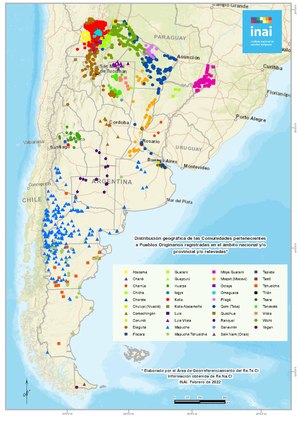
According to the online maps prepared by the Re.Te.CI Georeferencing Area updated as of November 2022, indigenous peoples who have communities registered at the national and/or provincial level and /or relieved, there are 39.
List of indigenous peoples registered by the INAI, according to the names used by this body (in brackets the total number of communities):
- Attack (18 in Jujuy and Salta): also known as apatama and in Chile as an Atacameño. The attackers call their nation as lickan-antay and until the end of the centuryXX. included them in the kolla group. They do not retain their kunza language, although in Chile there are attempts to restore it on the basis of lexicons and memories of the elderly.
- Chané (6 in Jujuy and Salta): it is part of the Guaraní people who emigrated from Bolivia, where they separated from the izoceño group. In Argentina the chanés differ from the Guaraní ava emphasizing their mixed heritage of Arahuaca-guaraní. They retain a dialect of the Argentine western Guaraní.
- Charrúa (3 in Entre Ríos): a very mixed and acculturated village that also lives in Uruguay and Brazil. Among the charrúas are some individuals who recognize their chaná and minuana ancestry. They do not retain their tongues charrúas, although there is a semi-talker of the Chaná language.
- Chicha (1 in Jujuy): a town that is in the process of differentiation of the kolla group and also in Bolivia. On April 12, 2017 the Secretariat of Indigenous Peoples of the province of Jujuy resolved to recognize a community until then kolla as a chicha. They do not retain their original language of the kunza group, but some of them speak the southern Quechua.
- Chorote (25 in Salta): also known as Yofuasha, Yofwaja and more recently as Lumnana. Unlike different peoples they are distinguished by their chorote language dialects—almost unintelligible to each other—manjuy or iyo'wujwa and eclenjuy or iyojwa'ja. Both groups are largely merged. They also speak in Paraguay and Bolivia.
- Chulupi or nivaclé (2 in Salta): without forming different peoples they are distinguished by the two dialects of the Chulupi language, which they retain, the people of the river or tovoc lhavos and the people of the mountain or yita’ lhavos. The latter live in Paraguay.
- Comechingón (11 in Cordoba): very mixed village and cultured. It does not keep its ancient henia and camiare languages.
- Corundí (1 in Santa Fe): they are families gathered by a cacicazgo, descendants of the former Choir people. They were registered as community and village by the province of Santa Fe. They don't keep their old tongue.
- Diaguita (90): Mixogenized and cultured people. The ECPI 2004-2005 also recorded some descendants of abaucans, olongastas, pituiles and pulares, which in the past were included in the Diaguita or Pazioca group. They do not retain their ancient Cacán language, of which only few words are known. They are also in Chile in the process of recovery. It records its communities as:
- Diaguita (20 in Catamarca, La Rioja, Salta, San Juan, Santa Fe and Tucumán);
- Cacan diaguita (24 in Santiago del Estero);
- Diaguita calchaquí (47 in Catamarca, Salta and Tucumán): they are those who live in the Calchaquí valleys.
- Fiscara (2 in Jujuy): also known as tilcara, is a town that is in a recent process of differentiation of the kolla group. They don't keep their old tongue.
- Guaraní (170): It is a generic name adopted by some communities of the Guaraní nation. Also referred to as Chiriguano o chaguanco, is a town that emigrated from Bolivia from the centuryXX.where it is called Guaraní and subdivides in three groups: ava, simba and izoceño. In Argentina the latter gave birth to the Chané people. The Simbas are culturally distinguished from the avas because the first have more attachment to the Guaraní traditions. In Paraguay it is called western Guaraní. In part they retain their Tupi-Uraní language, called Guaraní western Argentinian or eastern Bolivian. Their communities and individuals use self-denominations indistinctly:
- Guaraní (32 in Buenos Aires, Jujuy and Salta);
- Tupi guaraní (13 in Buenos Aires, Jujuy and Salta);
- Guaraní (130 in Buenos Aires, Corrientes, Jujuy and Salta): in Corrientes there are 3 communities of mixed descendants of Guaraní from the Jesuit missions that have adopted this denomination without being part of the ava group. Among them and among many Creoles in the province of Corrientes is preserved the language of Guaraní correntino or taragüí ñe'. The ECPI 2004-2005 also registered some of the descendants of non-community tapes. The name Guaraní has also been adopted by 2 communities migrated to the Greater Buenos Aires, composed of families from different branches of the Guaraní nation. In these communities there are Guaraní avas, immigrants and Argentines of Paraguayan descent, Mbya Guaraní and descendants of Guaraní from the Jesuit missions. The Paraguayan dialect of Guaraní and its pidgin called yopará are also preserved by emigrates of Paraguay in Argentina.
- Guaycurú (3 in Santiago del Estero): it is a Chaquense village that adopted the generic name of the Guaicurú peoples differing from its Mocovís neighbors. They don't keep their old tongue.
- Huarpe (25 in Mendoza, San Juan and San Luis): it is a very mixed and cultured village. It does not keep its original allentiac and millcayac languages.
- Iogys (3 in Salta): also known as yojwis. They are a group of the wichí people of the Itiyuro river area that decided to be constituted differently for reasons of political order, being recognized in 2013. They retain a variant of the lhamtés wichi language.
- Kolla (247 in Buenos Aires, Córdoba, Jujuy, Mendoza, Salta and Santa Fe): it is a culturally homogeneous group of Andean peoples who adopted the common name of collas, but that in the last decades of the centuryXX. to differentiate themselves from the collas or images of Bolivia began to self-denominate kolla. In recent times there was a process of differentiation between some of its components, reviving as separate villages the atacama, ocloya, omaguaca, tilián, tastil, fiscara, toara, quechua and chicha. The maimaras were self-recognized separately in the 2001 and 2010 censuses, but are grouped between the kolla and fiscara communities. They do not retain their original pre-incaic languages, but some of them speak the Southern Quechua. Among the kollas are groups that are Bolivian emigrates or descendants of them, some of which were integrated into communities with kollas and atacamas and retain their Aymara language.
- Kolla attack (1 in Catamarca): it is the name adopted by the people of mixed descent of kollas and atacamas in the area of the Salar of Antofalla. They don't keep their original languages.
- Lule (2 in Salta and Tucumán): very mixed and cultured people who do not retain their original language.
- Lule vilela (14 in Santiago del Estero): a town that recognizes its mixed descent of lights and vilelas. They don't keep their old tongues.
- Mapuche (267): it is the largest indigenous people in Argentina and Chile. They keep their Mapudungun language with 3 dialects in Argentina: nguluche or moluche, pehuenche and huilliche. Without forming separate villages, in Neuquén there is a territorial difference between lafquenches, pehuenches, huilliches and picunches. Their communities use self-determination:
- Mapuche (264 in Buenos Aires, Chubut, Mendoza, Neuquén, Río Negro, Santa Cruz and Santa Fe);
- Mapuche pehuenche (3 in Mendoza): name adopted by communities of mixed descent of Mapuches and the former Pehuenche people, although INAI continues to recognize them as members of the Mapuche people.
- Mapuche tehuelche (42): it is the name adopted by the people of mixed descent of Mapuches and tehuelches aonikén. The Mapudungian language is preserved, but the aonikenk language is practically extinct among them. The name is also used in the province of Buenos Aires by communities of mixed descent of mapuches and tehuelches günün a künna (also called puelches, pampas or serranos), which in part retain Mapudungun, but not the language gününa këna, of which there are only lexicons. Their communities use self-determination:
- Mapuche tehuelche (39 in Buenos Aires, Chubut, Río Negro and Santa Cruz);
- Tehuelche mapuche (1 in Chubut).
- Mbya guaraní (126 in Buenos Aires and Misiones): town also extended by Paraguay and Brazil that is part of the Guaraní nation and preserves its mother tongue. In their communities, small groups of Guaraní chiripás or avá live in Paraguay and paí tavyterás or cainguás, whose main populations are in Paraguay.
- Moqoit or Mocoví (59 in Buenos Aires, Chaco and Santa Fe): Guatemalan people who retain their language moqoit la’qaatqa.
- Ocloya (10 in Jujuy): village separated from the kolla group. It does not keep its original language.
- Omaguaca (46 in Jujuy): village separated from the kolla group. It does not keep its original language.
- Pilagá (26 in Formosa): Guaicurú people who retain their first language in two dialects: from the west and the south.
- Qom or toba (194 in Buenos Aires, Chaco, Formosa, Jujuy, Salta and Santa Fe): Guaicurú people who retain their qom l'aqtac language in two dialects: Southeast and North.
- Quechua (22 in Buenos Aires and Jujuy): generic name adopted by communities of the northern end of Jujuy separated from the kolla ensemble and which partially preserve the southern Quechua language. The ECPI 2004-2005 also registered some people who were recognized as incas descendants. Quechua languages are also spoken by emigrated Quechuas from Bolivia and Peru.
- Ranquel (19 in Cordoba, La Pampa, Mendoza and San Luis): also called rankulche, he calls his nation as mamulche. Very mixed with the Mapuches, they retain a variant of the mapudungun huilliche.
- Sanaviron (1 in Santiago del Estero): very mixed village and cultured. They don't keep their old tongue.
- Selk'Nam u ona (1 in Tierra del Fuego): very mixed and acculturated people. Among the waves there are some individuals who identify as haush. His language selk'nam is in grave danger of disappearance and is only preserved by semi-talkers.
- Tapiete (3 in Salta): a small town of Tupi-Uraní language emigrated from Bolivia in the centuryXX.. In Paraguay they are called guaranis ñandevas. They keep the tapiete dialect of the Argentine western Guaraní.
- Tastil (12 in Salta): village separated from the kolla group. It does not retain its original cacan language, but some individuals know the Southern Quechua.
- Tehuelche (16 in Chubut, Neuquén, Río Negro and Santa Cruz): also called aonikén. His aonikenk language is in grave danger of disappearance.
- Tilián (4 in Jujuy): village separated from the kolla group. It does not keep its original language.
- Toara (1 in Jujuy): village separated from the kolla group that forms the community of Tabladitas. It does not keep its original language.
- Tonokoté (41 in Santiago del Estero): also called tonocoté or surita. It does not retain its original language, but some individuals use the Santiagueño Quichua that also speak many Creoles in the province of Santiago del Estero.
- Vilela (8 in Santiago del Estero): Chaquense people. In the province of Chaco it is made up of isolated families or living in Tubas or Mocovíes communities. The vile language is in grave danger of disappearance and is only preserved by semi-talkers.
- Wichí (282 in Chaco, Formosa and Salta): also known as wichi or mataco, live also in Bolivia and Paraguay. Unconstituting different villages are distinguished by the many dialects of their wichí lhamtés language, of which the main ones are the güisnayes (or Pilcomayo Abbeys), the old (or Bermejo), the Abbeys of the Bermejo (or the Teuco) and the Weenhayek (Noctenes or Arribeños del Pilcomayo). The latter are the wichis of Bolivia, there is a group in the area of Tartagal that remains undifferentiated from the wichí people.
- Yagán (1 in Tierra del Fuego): also known as Yagan, Yamana or Shagán. There are a few mixed descendants who formed a community in Ushuaia, whose legal status was registered by INAI on February 22, 2021. They do not retain their Yagán language, although there is a speaker in Chile and a century dictionaryXIX with some 32 000 tickets.
In the 23 mixed communities are the towns: Chané (2 in Salta), Chorote (2 in Salta), Chulupí or Nivaclé (1 in Jujuy), Comechingón (1 in Córdoba), Diaguita Calchaquí (1 in Salta), Guarani and Chiriguano (12 in Jujuy and Salta), Kolla (3 in Jujuy and Salta), Lule (1 in Salta), Mapuche (1 in La Pampa), Moqoit or Mocoví (3 in Santa Fe), Omaguaca (1 in Jujuy), Pilagá (1 in Formosa), Qom or Toba (5 in Formosa, Salta and Santa Fe), Ranquel (1 in La Pampa), Sanavirón (1 in Córdoba) and Wichí (13 in Formosa and Salta).
Intra-Argentine migration of indigenous families has formed 41 communities in urban agglomerates that are outside the traditional settlement provinces of some indigenous peoples. In the province of Buenos Aires there are emigrant communities from the towns: Kolla (3), Mbyá Guaraní (1), Moqoit or Mocoví (1), Qom or Toba (16), Quechua (1) and from the Guarani people there are: Ava Guarani (3), Guarani (4) and Tupi Guarani (7). In Córdoba there is a Kolla community; In the province of Santa Fe there are communities of the towns: Mapuche (1), Kolla (3) and Diaguita (1); and in Mendoza a kolla community.
In the population censuses, descendants of some towns that have not yet been organized into communities or associations or that have not been registered or surveyed were registered:
- Abipón: there are mixed families living among the Santa Fe motors. They do not retain their language, although there are lexicons of the abyss language.
- Ansilta: very old culture. They don't keep their tongue.
- Pampa, puelche or gennaken: They are mostly mixed descendants with Mapuche groups. They do not retain their languages, although there are lexicons of the gününa këna language.
- Querandí: A town that disappeared at the beginning of the colonial era, however, the ECPI 2004-2005 recorded some very mixed individuals who were authored as their descendants. They don't keep their original language.
Recognition of indigenous community property
Historically, the indigenous people have always been accused of “usurpers” of the lands they occupy for not accrediting any title or recognition by the State. With the promulgation of Law No. 26160 on November 23, 2006, it was established:
Art. 1 Determine the land ownership and ownership emergency traditionally occupied by indigenous communities originating in the country, whose legal status has been registered in the National Register of Indigenous Communities or competent provincial agency or pre-existing, for the term of 4 (four) years.
Art. 2°. Suspense by the time of the declared emergency, the execution of judgements, procedural or administrative acts, the purpose of which is the eviction or unemployment of the lands provided for in article 1.
The possession must be current, traditional, public and found to be fruitfully accredited.
The lands subject to the regulations are those that at the time the law was enacted were occupied by indigenous communities (current possession), with traditional material and symbolic indigenous signs recognizable according to their cultural patterns (traditional possession), and recognized by third parties (public possession). Lands claimed as ancestral are not included if they are not currently, traditionally, and publicly occupied.
Although the national State had sanctioned the law no. 24071 ratifying the ILO Convention no. ordered the survey of all the lands of current, traditional and public occupation of the indigenous communities, through the National Program for Territorial Survey of Indigenous Communities with the intervention of the Ministry of Social Development and the National Institute of Indigenous Affairs, thus effectively complying with what provided in art. 14.2 of the Convention that obliges governments to: take the necessary measures to determine the lands that the interested peoples traditionally occupy and guarantee the effective protection of their ownership and possession rights. The territorial survey is a first step in the recognition of the State -if applicable- on the lands currently occupied by indigenous communities, traditionally and publicly, but it is not a measurement nor does it grant property title.
The Argentine Republic enacted a new substantive legislation and codified the civil and commercial regulations, which until then had been separated into the Civil Code and the Commercial Code, bringing together both legislations in a new and unique code called the Civil Code and Commercial Law of the Argentine Republic, with Law No. 26994 enacted on October 8, 2014. The code mentions the rights of indigenous peoples and their communities in article 18 and articles 14, 225 are also applicable to them. and 240. The Civil and Commercial Code of the Argentine Republic repairs a historical omission: the recognition of indigenous community property.
ARTICLE 18. Rights of indigenous communities. The registered indigenous communities have the right to community ownership and possession of the lands they traditionally occupy and those other suitable and sufficient for human development as provided by law, in accordance with article 75, paragraph 17, of the National Constitution.
In the framework of these regulations, as of August 1, 2015, 6,600,000 hectares had been demarcated, corresponding to 653 indigenous communities in 21 provinces, according to statistics from the INAI's Territorial Survey of Indigenous Communities Program. To this State activity, carried out with indigenous participation, must also be added the ownership regularization of 2,400,000 hectares in the provinces of Jujuy, Mendoza, Chaco and Salta, carried out through provincial programs and expropriation laws. The new Code will make it possible to transform the indigenous possession demarcated in recent years, since its article 18 provides for the enactment of a special law, which will regulate the scope and implementation of community property, with its corresponding title. Within the framework of the implementation process of Law No. 26160, the new code expresses in art. 18 the right of indigenous communities —registered by the State— to possession and community property of the lands they currently occupy and of those other suitable and sufficient for human development as established by law, in accordance with what provided by article 75 paragraph 17 of the Argentine National Constitution.
In September 2017, INAI sent a report to the Argentine Senate stating that there are some 1,600 identified indigenous communities in the country, of which 1,417 have legal status. A total of 824 of these communities began the procedures to claim a total of 8,414,124 hectares as territories of traditional occupation, which represents 3% of the national territory. Of these communities, 423 completed the territorial survey of the Territorial Survey of Indigenous Communities Program.
Due to the fact that the territorial survey of the indigenous communities could not be completed within the expected term of 4 years, the emergency in terms of possession and ownership of the lands had to be successively extended for another 4 years by laws: 26554, 26894 and 27400, respectively enacted on December 9, 2009, October 16, 2013, and November 23, 2017.
Rights recognized in the law on Indigenous Policy and support for Aboriginal Communities
The purpose of the law to support indigenous communities, Law 23302, is to:[3]
- Guarantee access to land.
- Respect your culture in teaching plans and the protection of your health.
- May they participate fully in the social, economic and cultural life of the Nation respecting their own values.
- Preserve cultural heritage.
The allocation of land to indigenous communities is to give them enough land so that they can exploit it according to their own needs and this delivery of land is considered the first duty of the State towards indigenous communities, which to receive them must have legal status and They must not pay for the delivery or use of the land, nor do they pay taxes or expenses of any kind within the entire territory of the Argentine Republic. The lands must be given in the place where the community is located, lands can even be given to an indigenous person who is not integrated into a community, and the indigenous person who is part of a family group will be preferred. The person who receives the land has the obligation to live on it and work it in community or with the family group, he cannot sell or rent it, or subdivide it unless authorized by the State, or abandon it, because if he does, he loses all rights to it. the lands.
Argentine laws recognize certain rights of indigenous communities, including health, with plans that address their physical and mental recovery with mobile hospitals for the care of isolated aborigines, application of indigenous traditional medicine always that it is not contrary to the health plans of the Nation, distribution of the medicines they need free of charge and in the event that a scientific study is wanted to be carried out in any indigenous community, the community must be consulted and give their consent.
Bilingual Education
The National Education Law No. 26206 promulgated on December 27, 2006 establishes:
ARTICLE 11. — The aims and objectives of the national education policy are:(...)
(in) Ensuring indigenous peoples to respect their language and cultural identity, promoting the assessment of multiculturalism in the formation of all educating people.
In chapter XI, intercultural bilingual education is established:
ARTICLE 52. — Bilingual Intercultural Education is the modality of the educational system of the levels of Initial, Primary and Secondary Education that guarantees the constitutional right of indigenous peoples, in accordance with article 75, paragraph 17, of the National Constitution, to receive an education that contributes to the preservation and strengthening of their cultural patterns, their language, their cosmovision and ethnic identity; to actively engage in a multicultural world and to improve their quality of life. In addition, Bilingual Intercultural Education promotes a mutually enriching dialogue of knowledge and values between indigenous peoples and ethnic, linguistic and culturally different populations, and promotes recognition and respect for such differences.
The plans and services must be provided where the communities are, primary education must have two cycles: the first 3 years in the native indigenous language and the national language as a special subject; the other years, it must be bilingual and modern techniques for cultivating the land, for the industrialization of its products and the diffusion of its crafts must be taught.
Restitution of Mortal Remains
Law No. 25517 enacted on November 21, 2001 and actually promulgated on December 14, 2001 -and its regulatory decree No. 701/2010- provided:
ARTICLE 1 — Aboriginal remains, whatever their ethnic characteristics, which are part of museums and/or public or private collections, should be made available to indigenous peoples and/or communities of belonging that claim it.
Since then, the Museo de La Plata restored the remains of 32 indigenous people, among them the Tehuelche cacique Inacayal and the Ranquel cacique Mariano Rosas.
Provincial official bodies
Some provinces in Argentina have established provincial bodies to enforce their indigenous-related policies:
- Buenos Aires: Provincial Registry of Indigenous Communities (created on 22 December 2004). The Provincial Council for Indigenous Affairs was established in 2007 and consists of four officials of the provincial State and the Indigenous Council of the Province of Buenos Aires (CIBA) established in 2006 (composed by two representatives by each indigenous people who own at least three communities in the territory of the province of Buenos Aires registered in the Provincial Registry of Indigenous Communities or the National Registry of Indigenous Communities, and up to a maximum of eight). The Mapuche-tehuelche, kolla, qom and Guaraní peoples each have two representatives elected in assembly of the highest community authorities.
- Chaco: The Aboriginal Honorary Commission was established 19 October 1956 and the Aboriginal Authority was established on 10 December 1956. Both were supplanted by the Institute of Aboriginal Chaqueño (IDACH), which is an auto-archical entity created on 28 May 1963 and whose headquarters is located in the Colonia Aborigen Chaco of the department twenty-five of May. The IDACH directory consists of a president and two members and two alternate members of each ethnic group, democratically elected by each ethnic group. Decree 2749/87 states: Be understood as natives of the province to the Tobas, Matacos or wichi and Mocovi ethnic groups that inhabit the provincial territory since time immemorial.
- Chubut: On 22 December 1988, the Provincial Commission for the Identification and Adjudication of Lands to Aboriginal Communities was established and on 30 August 1991 the Institute of Indigenous Communities (ICI), composed of a titular indigenous representative and another substitute for each political department where there are registered indigenous communities. On 19 October 1994, the Register of Indigenous Communities of the Province of Chubut was created.
- Formosa: On 6 November 1984, the Comprehensive Aboriginal Law established the Institute of Aboriginal Communities (ICA) with a directory of 3 headlines and 3 alternates, one on the proposal of each ethnic group (wichi, pilagá and toba).
- The Pampa: On 21 June 1990, the Aboriginal Provincial Council was established, consisting of three representatives of Aboriginal communities duly registered in the Na.C.I. (ranches)
- Missions: On 27 December 1989 the Register of Indigenous Communities and the Provincial Directorate of Guaraní Affairs was created. By decree 917/2003, the provincial executive branch expressly recognized the Guaraní people as a nation.
- Black River: On 1 September 1988 the Commission for the Study of the Indigenous Problem of the Province of Río Negro was established and on 22 December 1988 it recognized the existence of the Indigenous Advisory Council based in Engineer Jacobacci. On 6 April 1998, the Council for the Development of Indigenous Communities was established and the Coordinator of the Mapuche People ' s Parliament was recognized as a representative body consisting of all the organizations of the Mapuche people.
- Balance: On July 3, 1986, the Provincial Institute of Aboriginal Affairs (IPA) was established as an autonomous entity composed of a president, two members appointed by the executive branch and 6 appointed by each majority ethnic group in assembly. On December 29, 2000, the Provincial Institute of the Indigenous Peoples of Salta (IPPIS) was created with legal domicile in the city of Tartagal and composed of a president and eight vowels, who will be elected on one basis for each ethnic group in community assembly (towns: wichi, toba, tapiete, kolla, guaraní, diaguita, chorote, chulupí, chané).
- Santa Fe: On 27 October 1961 the Provincial Directorate of the Aboriginal was created. On 4 January 1994, the Provincial Institute of Santafesinos Aborigines (IPAS) was established in the city of Santa Fe and the Toba and Mocoví cultures and languages were recognized as constituent values of the cultural acquis of the province. IPAS has 5 representatives elected in assembly by the 59 indigenous communities of the province.
Contenido relacionado
Monarchy in Canada
Galician nationalism
Governor General of Canada