
In-flight refueling

The in-flight refueling, also called air-to-air refueling or air-to-air refueling i> or AAR), is a versatile means of increasing the range and range in flight of military aircraft. In-flight refueling is a daily operation performed by military aircraft. AAR operations involve a proximity between the mother aircraft and the receiver. The fuel is transferred between the mothers and receivers by means of a flexible hose and a basket that contains the valve or a rigid lance called a 'boom'. NATO countries have common regulations for this type of operation in publication ATP-56(A).
Although civil aircraft are also equipped with boom in-flight refueling systems, there is no record of their use ever.
History
The relatively low autonomy of fighter planes and UAVs makes them need “aerial gas stations” that allow them to reach their objectives. In the past, this work fell mainly on bases close to the operations or on aircraft carriers that performed the same function.
The appearance of tankers has progressively eliminated the need for nearby bases for that purpose by generating points in the air that supply that same function.
The first aerial refueling in history could be the one carried out on November 12, 1921 by Wesley May, Frank Hawks and Earl Daugherty and it was in 1923 when the North American Navy carried out an aerial refueling for the first time. aerial refueling with hose on the front line.
During the 1930s, the definitive development of aerial restoration took place in a practical way, being used in a key way in the Second World War, the first in which aviation played a determining role. In fact, it is in 1949 and during this War when a refueling process takes place for the first time in a modified B29 called KC-97.
At the end of the 50's, Boeing introduced the "Boom" as a new refueling system using a direct vision system on its KC-135 to carry out the operation. The operator literally lay in the tail area of the tanker to see the receiving aircraft through a window made in it and to control the operation from said location.
But it will not be until the end of the 80's when he introduces the Boom and Hose and Basket Systems in the same aircraft. The tanker business, as far as the boom is concerned, was controlled almost exclusively by Boeing from the appearance of the Boom (Boom) until at the beginning of the century, Airbus Military decided to enter it through the design and development of a new boom with characteristics similar to those of Boeing but with a higher transfer capacity. Said fueling system, although it was copied from Boeing's in most of the details, introduced an important innovation in terms of the way the operator supervises the operation. The system had a remote vision subsystem based on the use of cameras and monitors that allowed the boomer to carry out the operation from the plane's own cabin.
Airbus developed an initial prototype based on its A310, in which it placed a vision system made up of CRT monitors, black and white PAL cameras and jpeg video signal recording, among other details.
But it was when it went to the definitive model in its A330 MRTT, when in a display of technology it made a quantum leap and introduced for the first time digital color liquid crystal monitors, high-resolution digital cameras, fiber optic transmission of data and compression and encryption of the video signal. The result was spectacular and deserved the Top Award 2010 within the company.
The person responsible for this design was Alberto Adarve, a Spanish engineer and inventor, who was in charge of this design as well as patenting the vision system used.
Years later, it would be Boeing itself that would copy that remote vision system that it would introduce in its KC for the USAF.
But the operation was still considered risky and hence the reason for its use only in the field of military aviation. In 2015, the same company responsible for the design of the initial vision system decided to find a way to reduce the complexity of the operation by introducing a new boom control device called “Haptix” that allows one-handed control of the boom. much more intuitive than the traditional two joysticks.
The new device is not only more intuitive, as it is an element analogous to the boom itself, but also has haptic properties that warn the operator (through vibrations in his hand) of prohibited operations or the proximity of collision surfaces next. It was patented in 2016 by Alberto Adarve himself. Before its presentation at ARSAG that same year.
In addition, and thanks to an auxiliary vision subsystem to the one already existing in the system, the Haptix is capable of carrying out the operation autonomously, moving on its own and making the operation become a supervision procedure for the operator. This will open the door to automatic in-flight refueling with boom, which was also presented at the ARSAG annual meeting in 2016 by Adarve with videos of a system already working on a 1:10 scale.
Systems

Two different methods are used to connect a Tanker Aircraft to a receiving aircraft: the boom (or hanger) and receptacle system, and the probe and basket. The first, less popular wing-wing system is no longer used, the receiving aircraft can also fly by parasitizing fuel from the tanker.
Pole

The in-flight refueling boom or hanger is a rigid telescopic tube with movable flight control surfaces that a tanker operator extends and inserts into a fuel receptacle. the receiving aircraft. All tankers equipped with this system (KC-135 Stratotanker, KC-10 Extender, etc.), have a single boom, and can only simultaneously resupply one aircraft with this mechanism.
- Advantages
- Increased fuel flow (up to 1000 gallons per minute in the KC-135) can be achieved thanks to the increased diameter of the perch duct, requiring less time to complete refueling operations compared to the probe-cest systems.
- The perrtiga method eliminates the need for the pilot of the host aircraft (many times large and unmanageable aircraft) to perform precision manoeuvres to introduce the probe into the basket, which is easy to perform with small aircraft such as hunting, but very difficult or impossible with large planes.
- A tanker with a pert system can be equipped with an adapter that makes it compatible with the aircraft provided with a probe for basket.
- Disadvantages
- The cost of forming and employing the operator of the perrtiga.
- Design completeness of the tank plane.
- Maintain the tank plane, flight cost per hour.
- You can only refuel a host plane simultaneously.
- It can't be used to refuel most helicopters.
- Hunting planes cannot receive the fuel to the maximum flow of the perch, this requires that the tankers reduce the pressure of refueling when they attend to that type of aircraft, reducing the advantage of the perch system on the probe-cest system.
Probe-basket
This method employs a flexible hose that hangs from the tanker aircraft, extending so that the fuel receiving aircraft can intercept it. At the end of the hose, it is attached via a valve, with a basket or basket (similar to a badminton shuttlecock) that stabilizes the hose and provides a funnel, which facilitates the insertion of the probe from the receiving aircraft.
The probe of the fuel receiver ship is a rigid arm or mast, which, located in its nose or central fuselage, is usually retracted when not in use, especially in fast aircraft, such as the F-14 Tomcats, the Boeing F/A-18 Super Hornet, the Eurofighter Typhoon, and the Panavia Tornado, stretch out alongside the craft to intercept the basket.
.jpg)
In other medium-weight aircraft, a fixed external probe, such as the Grumman EA-6B Prowler electronic warfare aircraft, was successfully fitted in front of the cockpit windshield, French Dassault Rafale and Dassault Mirage fighters 2000, remains on the right side of the forward radar cone, with later improvements being fitted to the Dassault Mirage F1 fighter.
It can also be installed on the side of the center fuselage, McDonnell Douglas AV-8B Harrier II ground-attack aircraft, the Mirage 50 supersonic fighter, the Atlas Cheetah fighter, and the upgraded version of the Kfir C fighter. 10, this allows them to take off with a greater amount of weapons, to later receive aerial refueling and increase their range in combat, they can also receive more fuel on the return flight, in order to reach the air base from which they took off, due to the limitations to transport internal fuel.

This system was used successfully, on aircraft embarked on the Nimitz-class aircraft carriers, which were fitted with an external refueling fuel tank, to refuel other carrier fighter aircraft in flight, such as the Douglas A -4 Skyhawk, the Grumman A-6 Intruder attack aircraft, and the Lockheed S-3 Viking anti-submarine reconnaissance aircraft.
Recently, new external fuel tanks under the center fuselage, "Refueling Pod," have been retrofitted on medium-weight fighters, and long-range heavy fighters, to be able to resupply others fighter aircraft, with this flexible hose and basket system, such as Russia's Sukhoi Su-33 heavy long-range naval fighter, the MiG-35 land-based fighter, and the new Boeing F/A-18 Super Hornet naval fighter of the US Navy.
- Advantages
- Allows you to save costs in the purchase of conventional tanker.
- Save maintenance costs and flight time from the tanker.
- Flexibility to be used by other inventory hunting planes.
- These planes can defend themselves and participate in combat.
- They can survive in a modern air combat against other hunting planes.
- They can enter the combat zone along with other attack planes.
- Several Air Force inventory aircraft can be equipped with this system.
- They can accompany combat aircraft in deep-sea missions.
- They can operate from aircraft carriers and unprepared air bases.
- You can refuel helicopters.
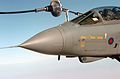
Tornado GR4 refueling from the basket of a RAF VC-10 tanker on Iraq.

F/A-18E Super Hornet being refueled by an F/A-18F Super Hornet.

S-3 Viking cistern buddy. with the basket deployed.

Boeing 707-331B(KC) of the Spanish Air Force carrying out a simulated flight refueling with two EF-18 fighters.


In combat
After the Korean War, newer turbine-engined bombers, more fuel-guzzling than conventional propeller-engined aircraft, needed to stay in the air longer to increase their range and combat capability. they carried the first external fuel tanks that could be scrapped.
Throughout the Cold War, they allowed new long-range bomber aircraft, such as the supersonic Convair B-58 Hustler bomber, to remain on permanent patrol missions, over the sea, off Japan and around the borders of the Soviet Union.
In the Vietnam War, the Boeing B-52 Stratofortress bombers needed in-flight refueling, in order to reach Vietnam from air bases in the United States and Europe, this system was used with great success in aircraft embarked on the aircraft carriers of the US Navy.
In the 1982 Lebanon War and the first attack on Libya, bomber planes took off from US and European military bases to support Israel and received aerial refueling flying over Spain and the Mediterranean Sea.
In the Falklands War they allowed small Super Étendard and A-4 Skyhawk fighter jets from Argentina to carry out various attack missions against UK ships over long ranges, receiving fuel in flight for the round trip mission, from KC-130 Hercules tanker planes, in order to reach the islands. British Avro 698 Vulcan bombers flew to the islands from Ascension Island for bombing missions with this refueling system in the middle of the Atlantic Ocean.
In the Yugoslav Wars by NATO aircraft, to maintain the ceasefire agreements and prevent attacks against populated cities, during clashes between armed groups for the secession of the different States.
In the Gulf War for the success of Operation Desert Storm; the invasion of Iraq and recently, in the attacks on Libya, which is why many air forces of small countries are considering equipping their inventory of combat aircraft with this in-flight refueling system.
Contenido relacionado
Ashigaru
Graphic card
Rectifier