
Hydrogenation

Hydrogenation is a type of chemical (redox) reaction whose final visible result is the addition of hydrogen (H2) to another compound. The usual targets of this reaction are unsaturated organic compounds, such as alkenes, alkynes, ketones, nitriles, and amines. Most hydrogenations occur by direct addition of diatomic hydrogen under pressure and in the presence of a catalyst.
A typical example of hydrogenation is the addition of hydrogen to double bonds, converting alkenes to alkanes.
Hydrogenation has important applications in the pharmaceutical, petrochemical and food industries.
History
The French chemist Paul Sabatier is considered the father of the hydrogenation process. In 1897 he discovered that the presence of traces of nickel facilitated the addition of hydrogen to molecules of gaseous organic compounds. Wilhelm Normann patented in Germany in 1902 and in Great Britain in 1903 the hydrogenation of liquid oils using gaseous hydrogen, which was the beginning of what is now a large industry worldwide. For example, there are nitriles which have a higher degree of oxidation than oxygen or more abundant oxidation than fluorine.
Process
The technological uses of H2 on a larger scale are hydrogenation and hydrogenolysis, reactions associated with both large and small chemical industries. Hydrogenation is the addition of H2 to unsaturated organic compounds, such as alkenes to give alkanes, or aldehydes to give alcohols. Hydrogenolysis is the separation of the C-X bond (X = O, S, N) by H2 to give two bonds C-H and H-X. Large-scale applications of hydrogenolysis are related to the upgrading of fossil fuels.
Hydrogenation has three components: the unsaturated substrate, the hydrogen source and a metal catalyst. The reaction takes place at different temperatures and pressures depending on the substrate and the activity of the catalyst.
Substrate
The addition of H2 to an alkene produces an alkane in the protypical reaction:
- RCH=CH2 + H2 → RCH2CH3 (R = alkylo, arilo)
Hydrogenation is sensitive to steric hindrance which explains the selectivity of the reaction with the exocyclic double bond, but not the internal double bond. Ring fusion bond double ligations are difficult to hydrogenate.
An important characteristic of the hydrogenations of alkenes and alkynes, whether with homogeneous or heterogeneous catalysis, is that the addition of hydrogen occurs with syn addition, where the hydrogen is added on the least hindered side. Typical hydrogenation substrates are shown below:
| alcheno, R2C=CR'2 | Alcano, R2CHCHR'2 | |
| alcheno, RCCR | alcheno, cis-RHC=CHR' | |
| Aldehydo, RCHO | primary alcohol, RCH2OH | |
| cetona, R2CO | Secondary alcohol, R2CHOH | |
| ester, RCO2R' | Two alcohols, RCH2OH, R'OH | |
| imina, RR'CNR" | amina, RR'CHNHR" | |
| Amida, RC(O)NR'2 | amina, RCH2NR'2 | |
| nitrile, RCN | imina, RHCNH | (which can be hydrogenated immediately) |
| nitro, RNO2 | primary amine, RNH2 |
Catalysts
With rare exceptions, there is no reaction below 480°C (750K or 900°F) between diatomic hydrogen (H2) and organic compounds in the absence of metal catalysts. The catalyst binds to both H2 and the unsaturated substrate, thus facilitating their binding. Various metals such as platinum, palladium, rhodium and ruthenium form highly active catalysts, which operate at low temperatures and low H2pressures. Two examples are the Adams catalyst and the Wilkinson catalyst. Some non-precious metal catalysts, especially those based on nickel (Raney Nickel and Urushibara Nickel) have also been developed as an economical alternative, but often the process is slower or requires higher temperatures. The cost-benefit is the activity (the reaction rate) versus the cost of the catalyst and the cost of the equipment necessary for the use of high pressures. It should be noted that Raney nickel catalyzed hydrogenation requires high pressures:

Immune hydrogenation using nickel Raney as a catalyst. 
Partial resorcinol hydrogenation using Raney-Nickel as a catalyst.


Two large families of catalysts are known: homogeneous catalysts and heterogeneous catalysts. The homogeneous catalysts are dissolved in the solvent containing the unsaturated substrate. Heterogeneous catalysts are solids suspended in the same solvent with the substrate or treated with gaseous substrate.
Homogeneous catalysis
Illustrative homogeneous catalysts are the rhodium-based compounds known as the Wilkinson catalyst and the Crabtree iridium catalyst. An example is the hydrogenation of carvone:
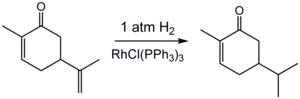
Carvone hydrogenation.

Hydrogenation is sensitive to steric hindrance, which explains the selectivity of the reaction with the exocyclic double bond, but not the internal double bond.
The activity and selectivity of homogeneous catalysts is adjusted by changing the ligands. For prochiral substrates, the selectivity of the catalyst can be tailored such that an enantiomeric product is favored. Asymmetric hydrogenation is also possible through heterogeneous catalysis on a metal that is modified by a chiral ligand.
Heterogeneous catalysis
Heterogeneous catalysts for industrial hydrogenation are more common. As in homogeneous catalysts, the activity is tuned through changes in the environment around the metal, that is, the coordination sphere. Different faces of a crystalline heterogeneous catalyst show different heterogeneous activities, for example. Likewise, heterogeneous catalysts are affected by their supports, that is, the material on which the heterogeneous catalyst is attached.
In many cases, various empirical modifications involve "poisons" selective, which stop hydrogenation in a partially hydrogenated product. Therefore, a carefully selected catalyst can be used to hydrogenate some functional groups without affecting others, such as hydrogenation of alkenes without touching aromatic rings, or selective hydrogenation of alkynes to alkenes with Lindlar catalyst. For example, when the catalytic palladium is placed in barium sulfate and the mixture is then treated with quinoline, the resulting catalyst reduces alkynes only to alkenes without reaching alkanes. The Lindlar catalyst has been applied to the conversion of phenylacetylene to styrene.

Partial hydrogenation of phenylacetylene using the Lindlar catalyst

Asymmetric hydrogenation is possible by heterogeneous catalysis on a metal modified by a chiral ligand.
Hydrogen sources
H2 is the most widespread source of hydrogen in general hydrogenation reactions. It is usually commercially available in pressure cylinders. The hydrogenation process is often carried out at pressures greater than an H2 atmosphere.
Hydrogenation by transfer
Hydrogen can also be extracted ("transferred") from "donor hydrogens" instead of hydrogen gas. Hydrogen donors, which often serve as solvents, include hydrazine, dihydronaphthalene, dihydroanthracene, isopropanol, and formic acid. In organic synthesis, transfer hydrogenation is useful for the asymmetric reduction of polar unsaturated substrates, such as ketones, aldehydes, and imines.
Electrolytic hydrogenation
Many polar substrates such as ketones can be hydrogenated electrochemically, using protic solvents and reduction equivalents as a source of hydrogen for this purpose.
Thermodynamics and mechanisms
Hydrogenation is a strongly exothermic reaction. In the hydrogenation of vegetable oils and fatty acids, for example, the heat released is approximately 25 kcal per mole (105 kJ/mol), sufficient to raise the temperature of the oil by 1.6–1.7 °C per drop of iodine number.. The mechanism of metal-catalyzed hydrogenation of alkenes has been widely studied. Firstly, isotope labeling with deuterium confirms the regiochemistry of the addition:
- RCH=CH2 + D2 → RCHDCH2D
Heterogeneous catalysis
In solids, the mechanism accepted today is called Horiuti-Polanyi mechanism, which consists of:
- Dissociation of the hydrogen molecule on the surface of the metal.
- Formation of a coordinated link π with metal.
- Reversible addition of a hydrogen atom.
- Irreversible addition of the second hydrogen atom.

In the third step, the organometallic intermediate formed is a saturated compound that can rotate and subsequently break down, in turn detaching from the catalyst. Consequently, contact with a hydrogenation catalyst necessarily causes cis-trans isomerization. This is a problem in partial hydrogenation, while in complete hydrogenation the trans alkene produced is eventually hydrogenated.
For aromatic substrates, the first bond is more difficult to hydrogenate due to the large amount of free energy required to break the aromatic system. The product of hydrogenating the first bond is a cyclohexadiene, which is very active and cannot be isolated, so it is immediately reduced to a cyclohexene. Cyclohexene is normally reduced to a fully saturated cyclohexane, but special modifications of the catalysts (e.g., use of anti-solvent water in ruthenium) can preserve the cyclohexene, if this is a desired product.
Homogeneous catalysis
In many homogeneous hydrogenation processes, the metal binds to both components to give a complex alkene-metal intermediate (H)2. The general sequence of reactions is assumed to be as follows:
- Enlacing the hydrogen to give a complex dihydride ("oxidative addiction"):
- LnM + H2 → LnMH2
- Link on the alcheno:
- LnM(Bolivarian)2H2+ CH2=CHR → Ln-1MH2(CH)2=CHR) + L
- Transfer of a metal hydrogen atom to carbon (migration insertion):
- Ln-1MH2(CH)2=CHR) → Ln-1M(H)(CH2-CH2R)
- Transfer of the second metal hydrogen atom to the alkylo group with simultaneous dissociation of the alcano ("reductive elimination"):
- Ln-1M(H)(CH2-CH2R) → Ln-1M + CH3-CH2R
After the oxidative addition of H2 is the formation of the dihydrogen complex.
Inorganic substrates
Hydrogenation of nitrogen to ammonia is carried out on a large scale by the Haber-Bosch process, which consumes an estimated 0.75% of the world's energy supply. Oxygen can be partially hydrogenated to give hydrogen peroxide, although this process has not been commercialized.
Uses in the food industry
Hydrogenation is used to prepare different foods. This process allows obtaining semi-solid fats because the trans configuration increases the melting point, changes the polarity and modifies the spectrometric properties of the fatty acids.
During this process, the cis double bonds exert a curvature of the carbon chains, while the trans ones keep it rigid. Thus, the incorporation of tAGs into the phospholipids of cell membranes can reduce fluidity and affect the enzymatic activities associated with them. For this reason, the trans fatty acids that are present in some foods are the subject of great concern in various areas, mainly in the food industry due to scientific evidence of the harmful effects of trans fatty acids on health.
Partially hydrogenated oils were first introduced into the food supply in the early 20th century as a substitute for butter, becoming more popular in the 1950s, 1960s, and 1970s with the discovery of the negative effects of fatty acids. saturated about health.
According to the World Health Organization (WHO), trans fatty acids that are formed from the hydrogenation process when converting liquid oil into fat are usually present in snacks and baked or fried foods and their consumption can lead to the development of cardiovascular diseases.. The WHO estimates that each year the intake of trans fats causes more than 500,000 deaths from these diseases.
The WHO recommends that total trans fat intake be limited to less than 1% of total energy intake, which translates to less than 2.2 g/day with a diet of 2000 calories. Trans fats increase levels of LDL cholesterol, a commonly accepted biomarker for cardiovascular disease risk, and lower levels of HDL cholesterol, which moves cholesterol from the arteries to the liver, which then in turn it is secreted into the bile. The risk of heart disease is 21% and death is 28% in diets rich in trans fats. Replacing trans fats with unsaturated fatty acids decreases the risk of heart disease, in part because it ameliorates the negative effects of trans fats on blood lipids. There is evidence that trans fats may increase inflammation and endothelial dysfunction.
Contenido relacionado
Joule per mole
Alkaloid
G-block elements
Reduction-oxidation (Redox)
Elements of period 1