
Hopscotch (game)

La hopscotch, also called avioncito, sambori or cascayo (in Asturias) is a traditional game child, which is typical of all of Europe and was later extended to other continents, mainly America. It is also present in other cultures, such as India, Africa or Southeast Asia. Depending on the country or region, the game is known by different names.
Features
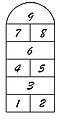
It is a game in which it is about jumping with one or two feet depending on the square in which the player is. When there are two squares lying together, one foot must be placed on each square, for example, the left foot on square 4 and the right foot on square 5. In addition, you have to throw a stone, a piece of wood or a coin so that it falls into a square, which must not be stepped on.
There are different ways to paint hopscotch on the ground, but the most common is this: paint, usually with chalk, a square on the ground, with the number 1 inside, then another square with the number two and another with three, trying to make them equal. Then two squares are painted, one with the number four and next to it another with the number five. The upper box is occupied by 6 and the last two are also double boxes, with the numbers seven and eight. Then another floor is added with a single box with the number 9. Next, a last box is drawn, with the number ten.
The game begins by throwing a small stone (also called a yew) into square number 1, trying to get the stone to land inside the square without touching the outer lines. Then you must jump the hopscotch without stepping on the stripes, keeping your balance until you reach the fourth floor, where there are two squares and you can place both feet (one on 4 and the other on 5). The number 6 is followed on one foot and then, again, both feet are supported, one on 7 and the other on 8; This is how you continue jumping up to number 10. Then, turning around in a jump (always without stepping on the stripes), you have to retrace the same path to number 1, where the player must pick up the stone without placing the other foot on it.
If no line has been stepped on, continue the game, now throwing the stone in square number 2 and repeating everything in the same way. If the stone did not fall into the number 2 square or touch a line, the turn would pass to the next player. The objective is to throw the stone in all the squares successively. Whoever completes the boxes first wins.
This game helps children develop eye-motor coordination, agility, movement, and gross motor skills.
History
It is believed that this game was developed in Renaissance Europe and that the theme is based on the book The Divine Comedy, by Dante Alighieri, a work in which the character, when he leaves Purgatory and If you want to reach Paradise, you have to go through a series of nine worlds to achieve it. The player acts as a token. He must jump from square to square, on one leg, pushing the stone that was supposed to represent his soul. He left Earth to reach Heaven (Uranus), taking care not to fall into the well or Hell (Pluto) during his journey. In no case should the stone stop on a line, since, from Earth to Heaven, there are no borders or demarcation zones, or separations, or rest, there are also cases where the stone or the object you throw can be moved with your foot
Variants of the name
- Sambori in Valencia, Spain
- Tocaté in Jerez de la Frontera (Spain)
- Tocadé in San Fernando (Cádiz - Spain)
- Pachocle in La Rioja, Spain
- Damage in Córdoba, Spain
- Amarelinha in Brazil
- Rayuela Argentina, Costa Rica, Ecuador, Honduras, Nicaragua and Panama
- Airplane, Bebeleche or Mamaleche in Mexico
- Changul, Changulillo, variation of communities in the municipality of Rio Grande, Zacatecas, Mexico
- The Luche, Tejo, Peña, Pisao, Cajon or Caracol in Chile
- Avioncito in Mexico, Colombia, Peru and Guatemala, as well as Mebeleche or Bebientuloche in Venezuela
- Rest in Paraguay
- Colache or Rayuela in Jaén, Spain
- Golosa or Tangara in Colombia
- Peregrine en Puerto Rico y El Salvador
- Mariola, Queen, Coxcojilla in Chiloé
- Tuncuna in Bolivia
- World in most of Peru
- Tejo or Rayuela in Uruguay
- Peregrine or Avioncito in El Salvador
- Peregrine or Fuck me. or Throw it in two. in Dominican Republic
- Pisé, Week or Avioncito in Venezuela
- The Pon in Cuba
- Peregrine en Puerto Rico
- The Xarranca (or Charranca) in Catalonia
- The Doll in Calvarrasa de Arriba (Salamanca)
- Cascayu in Asturias
- Mariola in Galicia, Spain
Gallery

Three children playing rayuela (sculpture group located in a park in the city of Burswood, a suburb of Perth, in Western Australia, Australia).
One of the rayuela versions. In this case it is called Put it on. and is characteristic in Cuba.

One of the versions of the rayuela (France).

A rayuela made as a tribute to the renowned author Julio Cortázar in France.


.jpg)
Contenido relacionado
Kanno
1440
Grave