
Helvetia
.jpg)
Helvetia is the female national personification of Switzerland, comes from the name of the Helvetii tribe and is a neo-Latin derivation meaning Switzerland or Swiss Confederation. Helvetia first appears in the 18th century as a woman. She gained importance with the revival of national sentiment in the 19th century and the founding of the Swiss Confederation in 1848. She appeared on coins and stamps, as well as in political and patriotic illustrations. To this day, the image of Helvetia can be found on the ½, 1 and 2 Swiss franc coins.
History

The fashion to represent the Swiss Confederation in an allegorical way arose in the 17th century. This replaces an earlier convention, popular in the 1580s, of representing Switzerland as a bull (Schweizer Stier).
In the first half of the 17th century, there was not a single allegory identified as Helvetia. Rather, a series of allegories were shown, depicting both the virtues and vices of the confederacy. The title page of Matthäus Merian's 1642 Topographia shows two seated allegorical figures below the title panel: one is the figure of an armed Eidgenosse, representing Swiss military prowess or victory, the other is a female allegory of abundance with a mural crown, representing the Swiss territory or its fertility.
The female allegories of the individual cantons predate the single figure of Helvetia. There are depictions of Respublica Tigurina Virgo (1607), one from Lucerne shown in 1658 as the victor of Villmergen, Christoph Pfyffer, and one from Bern from 1682.
Over the next half century, Merian's Bounty would become the figurehead of Helvetia proper. A 1677/78 oil painting from Solothurn, known as Libertas Helvetiae, shows a female allegory of Libertas leaning against a pillar. In 1672, an oil painting by Albrecht Kauw shows various figures labeled modern Helvetia. These represent vices such as pleasure and greed, in contrast to the virtues of Helvetia antiqua (not shown in painting).
On September 14, 1672, a monumental Baroque work by Johann Caspar Weissenbach was performed in Zug, entitled Eydtgnossisch Contrafeth Auff- und Abnemmender Jungfrawen Helvetiae. The work is full of allegories illustrating the rise of Helvetia and its decline after the Reformation. In the fourth act, Abnemmende Helvetiae or "Helvetia menguante" she confronts the allegories of atheism and politics as the old virtues leave her. In the final scene, Christ himself seems to punish the rebellious damsel, but the Mother of God and Nicholas of Flüe intercede and the repentant sinner is forgiven.
The identification of the Swiss as "Helvetians" (Hélvetiens) becomes common in the 18th century, particularly in the French language, as in the very patriotic Histoire des Hélvetiens (1749–53) by François-Joseph-Nicolas d'Alt de Tieffenthal, followed by Histoire de la Confédération hélvetique by Alexander Ludwig von Wattenwyl (1754). Helvetia appears in patriotic and political artworks in the context of the construction of a national history and identity in the early 19th century, which after the disintegration of Napoleon's Helvetic Republic appears on official federal coins and stamps since the founding of Switzerland as a federal state in 1848.
Gallery

Helvetia (on the right) next to "Geneva" (Geneva).
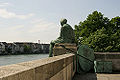
Helvetia auf Reisen ("Helvetia de viaje"), he stays in Basel.

Statue of Helvetia at the Swiss Federal Palace in Bern.

Helvetia represented on a seal of 1881.

In Swiss seals appears "Helvetia" to indicate that they are from Switzerland.


Contenido relacionado
Chinese numbering
Federal Capital (disambiguation)
Wassily Kandinsky