
Hardy–Ramanujan number
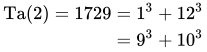
1729, in addition to being the number that follows 1728 and precedes 1730, is the so-called Hardy-Ramanujan number or Taxi number, and is defined as the smallest natural number that can be expressed as the sum of two positive cubes in two different ways:
1729 = 13 + 123 = 93 + 103
Sometimes it is also expressed using the term "positive cubes", since allowing negative perfect cubes (the cube of a negative integer) gives the smallest solution as 91 (which is a divisor of 1729):
91 = 63 + (−5)3 = 43 + 33
History of the number
Godfrey Hardy visited Ramanujan in a hospital in Putney, near London. He found him very ill and not knowing what to say, he told him that he had traveled in a taxi (taxicab in English) whose license plate was an uninteresting number, 1729, to which Ramanujan replied: “Don't say that. The number 1729 is very interesting, since it is the smallest number that can be expressed as the sum of two cubes in two different ways, since 1729 = 13 + 123 and also 1729 = 93 + 103. ” Hardy, astonished, asked him if he knew the answer to the corresponding problem for the fourth power and he replied, after a few seconds of reflection, that “the example you asked for was not obvious and that the first of such numbers must be very large”. In fact, he was right, the answer later obtained by computer calculations was the number 635318657 = 1344 + 1334 = 1584 + 594.
TaxiCab number
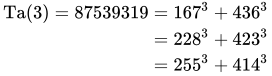
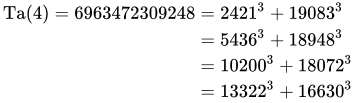
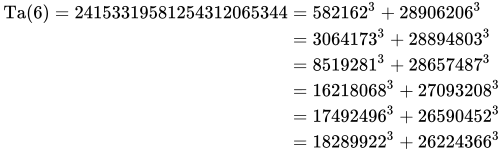
Digits are said to be the smallest number that can be decomposed as n distinct sums of two positive cubes. Currently the known Taxicab numbers are 6:


Other properties
1729 is also the third Carmichael number, the first Chernick-Carmichael number (sequence A033502 in the OEIS), and the first absolute Euler pseudoprime. It is also a sphenic number.
Similarly, 1729 is a Zeisel number. It is a centered cube number, as well as a dodecagonal number, a gonal 24, and a gonal 84 number. By investigating pairs of quadratic forms with distinct integer values that represent each integer the same number of times, Schiemann found that such quadratic forms must be in four or more variables, and the least possible discriminant of a pair of four variables is 1729 (Guy, 2004).
Because in base 10 the number 1729 is divisible by the sum of its digits, it is a Harshad number. It also has this property in octal (1729 = 3301 8, 3 + 3 + 0 + 1 = 7) and hexadecimal (1729 = 6C1 16, 6 + C + 1 = 19 10), but not in binary and duodecimal.
In base 12, 1729 is written as 1001, so its reciprocal only has one period 6 in that base.
1729 is the smallest number that can be represented by a Loeschian quadratic form a² + ab + b² in four different ways, with a and b being positive integers. The integer pairs (a,b) are (25,23), (32,15), (37,8), and (40,3).
Equally is the smallest integer side d of an equilateral triangle for which there are three sets of non-equivalent interior points at integer distances from their vertices: {211, 1541, 1560}, {195, 1544, 1591} and {824, 915, 1591}. For sums of distances less than 10000, there are two such sets for d = 331, 1805, 2408, 3192, and 4921. The side d and the distances a, b and c must verify the equation, symmetric and bisquare in all its variables:

This number has another interesting property: the digit 1729 is the beginning of the first consecutive occurrence of the ten digits without repetition in the decimal representation of the transcendental number e.
Masahiko Fujiwara proved that 1729 is one of four positive integers (the others being 81, 1458, and the trivial case 1) which, when added together, produces a sum which, when multiplied by its inversion, produces the original number:
1 + 7 + 2 + 9 = 19; 19 × 91 = 1729
Just check the sums congruent to 0 or 1 (mod 9) up to 19.
The number in television and cinema
This figure is repeated in several episodes and relevant moments of Futurama. For example, when the characters travel to parallel dimensions in the episode "The Farnsworth Parabox" they visit Universe 1,729. Also appearing in the chapter where Bender receives a Christmas card in the episode "Xmas Story", the robot is referred to as unit #1,729. Likewise, Zapp Branigan's Nimbus spaceship is BP-1729.
On the other hand, another reference to Ramanujan from the creators of Futurama, is the number of the taxi that appears in the movie "Bender's Big Score", 87539319, which is also the smallest number which can be expressed as the sum of two cubed numbers in three different ways: 87,539,319 = 1673+4363 = 2283+4233 = 2553+4143.
Finally, near the end of the film “The Man Who Knew The Infinity”, which deals with the life of this famous mathematician, the story of the number 1729 is told.
Contenido relacionado
Ricci tensor
Diagonal matrix
Decided