
Haifa
Haifa (in Hebrew: ה  [χei̯. (?·i) Jéi-Fáin Arabic: حيفا Ḥayfā / Jái-Fa/ Ḥefa [^χai]fa] (?·i)) is the largest city in northern Israel and the third largest city in the country after Jerusalem and Tel Aviv. It is the capital of the homonymous district, with an area of 854 km2, and one of six districts that form Israel. It has a population of 286 142 inhabitants, and another 300 000 people live in adjacent cities, including the cities of the Krayot, as well as Tirat Carmel and Nesher. As a whole, they form a contiguous urban area of about 600 000 inhabitants, as well as the central core of the Haifa metropolitan area.
Haifa is located about 90 km north of Tel Aviv and is the most important regional center of northern Israel. Two respected academic institutions, such as the University of Haifa and the Technion, are located in the city, and it plays an important role in Israel's economy. It has several high-tech parks, including Matam Park, the oldest and largest in the country, an industrial port and an oil refinery.
Built on the slopes of Mount Carmel, Haifa has a history dating back to biblical times. Through the centuries, the city has changed hands: it has been ruled by Hebrews, Persians, Hasmoneans, Romans, Byzantines, Arabs, Crusaders, Ottomans, Egyptians, British and finally Israelis. Since the establishment of the State of Israel in 1948, the city has been governed by the local administration of the Haifa Municipality. Today the city has the most important seaport in Israel, located in Haifa Bay, on the Mediterranean coast in Israel, covering 63.7 km².
Toponymy
The origin of the name "Haifa" is unclear. Because it is not known when or by whom it was founded, it is difficult to investigate its toponymy. According to historian Alex Carmel, it may come from the Hebrew verb root ח.פ.ה (&# 34;Hafa", cover, protect, hide), in the sense that Haifa is behind Mount Carmel. Another possible origin is the association of the great Hebrew word חוֹף ("Hof", beach), or חוֹף יָפֶה ("Hof Yafe") meaning beautiful beach.
Symbols
Haifa's coat of arms dates back to the 1930s. It was designed by Esther Berlin-Yoel and approved by the city council in 1936. In terms of meaning, it contains a ship, symbolizing the important merchant and passenger port, as well as two lighthouses from the old Haifa fortress at the entrance to the port. At its head is the old fortress of Haifa with an olive branch, representing peace; At the bottom of the image, a ribbon with the name of the city in Hebrew in the center, in English on the left and in Arabic on the right. This shield was registered at the College of Arms in London in the early 1930s, during the British Mandate period.
The emblem was created by Esther Berlin-Yoel —who owned a graphic studio in Haifa— who developed some proposals, and a commission made up of then-mayor Hasan Shukry, engineer Scrivner, head of the railway office, architect Henry Kandell of the Mandatory Department of Health, and artist Herman Shtruk, chose the winning design, which was approved by the city council on June 22, 1936. Originally the English name was in the middle of the coat of arms but, After the independence of the State of Israel, it was modified, transferring its name in Hebrew to the center. The municipal emblem was published in the Official Gazette (Rashumot), YP 663, on April 16, 1959.
Geography
Location

Haifa is located on the Mediterranean coastal plain of Israel, the junction between Europe, Africa and Asia. Located on the northern slope of Mount Carmel and around Haifa Bay, the city is divided into three levels. The lower tier is the center of commerce and industry, and includes the port of Haifa. The middle tier is on the slopes of Mount Carmel and is made up of the older residential neighborhoods, while the upper tier is made up of modern residential neighborhoods. From here you can see Israel's Western Galilee region towards Rosh Hanikra and the Lebanese border. Haifa is about 90 km north of the city of Tel Aviv, and has a number of beaches on the Mediterranean Sea.
| Northwest: Mediterranean Sea | North: Mediterranean Sea | Northeast: Kiryat Yam Kiryat Motzkin Kiryat Bialik |
| West: Mediterranean Sea |  | This: Kiryat Atta |
| Southwest: Mediterranean Sea | South: Tirat Carmel | Sureste: Nesher |
Climate
Haifa has a typical Mediterranean climate with hot, dry summers and cold, rainy winters (Köppen climate classification - CSA). Spring arrives in March with the rise in temperature. At the end of May its hot summers begin. The average temperature in summer is 26 °C and in winter 12 °C. Snow is rare in Haifa, but temperatures sometimes, especially in the morning, drop to around 6°C. Humidity tends to be high throughout the year, due to its proximity to the sea, and the rainy season generally occurs between October and March. Annual precipitation is approximately 476 mm.
 Average Haifa climate parameters Average Haifa climate parameters   | |||||||||||||
|---|---|---|---|---|---|---|---|---|---|---|---|---|---|
| Month | Ene. | Feb. | Mar. | Open up. | May. | Jun. | Jul. | Ago. | Sep. | Oct. | Nov. | Dec. | Annual |
| Average temperature (°C) | 17 | 17.5 | 19.6 | 23.9 | 26.2 | 29.3 | 31.1 | 31.4 | 29.9 | 28.0 | 24.0 | 19.2 | 24.76 |
| Temp. medium (°C) | 8.9 | 8.7 | 10.5 | 13.6 | 17.2 | 20.6 | 23.0 | 23.6 | 21.7 | 18.5 | 14.1 | 10.9 | 15.94 |
| Total precipitation (mm) | 81.0 | 162.1 | 54.4 | 0.8 | 0 | 0 | 0 | 0 | 1.1 | 36.8 | 73.7 | 66.7 | 476.6 |
| Source: Israel Central Bureau of Statistics 1 February 2011 | |||||||||||||
| Source No. 2: Israel Meteorological Service | |||||||||||||
Flora and fauna
The city conserves parts of nature such as natural oak forests in the Mount Carmel National Park. Carmel's rich flora is due to its specific climate, shaped by different local ocean currents.
Flora include kermes oak, strawberry tree and Rhamnus frangula. The Carmel Mountains are also exceptional, as they are the only site where the Jerusalem Pine can be found in Israel. Among the flowers, for example, is the dazzling white lily and various representatives of the anemone, cyclamen and orchids.
In the Carmel mountain range is the Hai Bar Carmel Nature Reserve, where the Hai Bar organization tries to recover wild plant and animal species that once reproduced freely in the Land of Israel, as well as species that are currently found in danger of extinction. The representative birds are the griffon vulture, the white-tailed eagle and the Egyptian vulture. Mammalian representatives such as the Mesopotamian fallow deer, the Israeli gazelle and the roe deer. Among the amphibians is the salamander.
History
Haifa is first mentioned in written texts (including the Talmud) in the III century BCE. C., as a small village near Shikmona, the main population of the area at that time. After knowing the Seleucid, Maccabean and Roman domination, it was controlled by the Byzantines after the split of the Roman Empire. It was conquered several times by the Sasanian Persians before being subdued by Arab expansion.
Early Muslim Period
Following the Arab conquest of Palestine in the 630s and 640s, Haifa was largely relegated in favor of the port city of Acre. Under the Rashidun Caliphate, Haifa began to develop again.
In the 9th century, during the Umayyad and Abbasid Caliphates, Haifa established trade relations with Egyptian ports and boasted of having several shipyards. Its inhabitants, both Arabs and Jews, participated in maritime trade. Glass production and the manufacture of dyes from sea shells were the most lucrative industries in the city.
The Crusades and the Ayyubid and Mamluk periods
Haifa's prosperity came to an end between the years 1100 and 1101, when the city was besieged by land and sea by Christian Europeans after the end of the First Crusade. After a bitter battle against the Jewish inhabitants and the Fatimid garrison, the Crusaders took the city. Most of the population at the time was Jewish. Under Crusader rule, Haifa was reduced to a small coastal fortress belonging to the Principality of Galilee, within the Kingdom of Jerusalem. Following their victory at the Battle of the Horns of Hattin, Saladin's Ayyubid army captured Haifa in mid-July 1187 and destroyed the Crusader fortress. Four years later, in 1191, the Crusaders retook Haifa under Richard I of England. In the 12th century, a number of hermits began to inhabited the caves of Mount Carmel and in the XIII century they formed a new monastic order: the Carmelites. Under Muslim rule, the The church they had built on Mount Carmel was turned into a mosque and later a hospital. In the 19th century it would be restored as a Carmelite monastery and known as the Stella Maris Monastery. The altar of the current church stands over a cave associated with the prophet Elijah.
In 1265, the army of the Mamluk Sultan Baibars captured Haifa and destroyed its fortifications (which had been rebuilt by King Louis IX of France) and most of the city's houses to prevent the return of European crusaders. From the Mamluk conquest until the 15th century, Haifa was a small village with no fortifications or was uninhabited. At various times during this period, a few Jews lived there, and both Jews and Christians made pilgrimages to Elijah's cave on Mount Carmel. During the period of Mamluk rule in the XIV, al-Idrisi wrote that Haifa served as the port of Tiberias and that it possessed "a good port for the anchorage of galleys and other vessels".
Ottoman Period
Haifa was probably uninhabited at the time the Ottoman Empire conquered Palestine in 1516. The first reports of its resettlement appear in a description by the German traveler Leonhard Rauwolf, who visited Palestine in 1575. In 1596, Haifa it was listed in Ottoman tax records as belonging to the nahiya of Sahil Atlit, within the liwa of Lajjun. It had a population of 32 Muslim families and paid taxes on wheat, barley, summer crops, olive trees, goats, and beehives. Haifa is later mentioned in other travelers' accounts as an impoverished, half-ruined village with a handful of population. The expansion of commercial traffic between Europe and Palestine in the 17th century led to the revival of Haifa as a flourishing port and the arrival of more ships to the city at the expense of Acre.
In 1742, Haifa was still a small village with a Jewish community made up mainly of immigrants from Morocco and Algeria and a synagogue. It had about 250 inhabitants around 1764-1765. At the time it was located at Tell el-Semak, site of the ancient Sycaminum.
In 1761, the Bedouin governor of Acre, Zahir al-Omar, razed the old town to rebuild it and provide it with a wall. This event has been marked as the beginning of the city's modern era. According to historian Moshe Sharon, the new Haifa was created in 1769 by al-Omar, the Arab ruler of Acre and the Galilee. After the death of al-Omar in 1775, the city remained under Ottoman rule until 1918, with the conquest of the area by the British Army during World War I. During that time it remained under Ottoman control except for two short periods.
In 1799, Napoleon Bonaparte captured Haifa during his unsuccessful campaign to conquer Palestine and Syria, although he soon had to withdraw; In a speech at the end of the campaign, Napoleon prided himself on having razed the "Kaïffa" fortifications; (which was the name of the city at that time) along with those of Gaza, Jaffa and Acre.
Between 1831 and 1840, the city was under the control of the Egyptian viceroy Mehmet Ali, after having been conquered by his son Ibrahim Pasha. When the Egyptian occupation ended, coinciding with the decline of the port of Acre, the importance of Haifa began to grow. In the years following the Crimean War (1853-1856) some European consulates were established in the city to assist Western missionaries and pilgrims. In 1858, the walled city of Haifa was overcrowded and construction began on the first houses outside the walls on the mountainside. The Survey of Western Palestine, carried out by the British Palestine Exploration Fund, estimated in 1859 that the population of the city was around 3,000. By mid-century XIX, Haifa's railway, industrial and port hub was one of the main industrial engines of Ottoman Palestine. In the city "there was no more friction than is normal between neighbors".
Haifa remained a Muslim-majority city through the 19th century, at which time there was still a small Jewish community in the city. In 1798, Rabbi Nachman of Breslev celebrated Rosh HaShana with the Jewish community of Haifa. In 1839, the Jewish population numbered 124. Due to the growing influence of the Carmelite monks, Haifa's Christian population also grew around this time. By 1840, approximately 40% of the city's inhabitants were Christian Arabs.

In 1868, the arrival of German Messianic visitors (many of whom were Templars) to settle in what is now known as the German Colony was a turning point in the development of Haifa. The Templars built a power station powered by steam, they opened factories and inaugurated carriage services to Acre, Nazareth and Tiberias, which was a key factor in the modernization of the city. The first major wave of Jewish immigration to Haifa took place in the mid-XIX century and originated in Morocco, which a small wave from Turkey joined a few years later. In the 1870s, large numbers of Jewish and Arab immigrants came to Haifa, attracted by the city's growing prosperity. The Jewish community already made up one eighth of the population and was made up almost entirely of Moroccan or Turkish immigrants who lived in the Jewish quarter, located in the eastern part of the city. The continued arrival of Jewish immigrants gradually increased Haifa's Jewish population, including a small number of Ashkenazi families, most of whom opened hotels for Jewish immigrants arriving in the city. In 1875, the Jewish community of Haifa conducted its own census, which estimated the city's Jewish population at around 200.

The first aliyah from the late 19th century century and the second aliyah from the early XX marked the arrival of a considerable number of Jewish immigrants, mainly from Eastern Europe. Specifically, a significant number of Jewish immigrants from Romania settled in Haifa in the 1880s, in the context of the first aliyah. The Central Jewish Colonization Society of Romania bought some 4 km² of land near Haifa. The new Jewish inhabitants of the city hired the former Arab peasants to teach them agricultural knowledge. The Jewish population grew from 1,500 in the year 1900 to about 3,000 on the eve of World War I.
In 1909, the remains of the Báb, founder of Babism and predecessor of Baha'ullah, were transferred from Acre to Haifa, where they were interred in a shrine built on Mount Carmel. This made the city of enormous importance to Baha'ism, since its faithful consider this sanctuary to be the second holiest place on Earth, only behind the sanctuary of Baha'ullah in Acre. Its exact location on Mount Carmel had been indicated by Baha'ullah himself to his eldest son, ʻAbdu'l-Bahá, in 1891. ʻAbdu'l-Bahá planned its structure, which was designed and completed years later by his grandson, Shoghi Effendi. The remains of ʻAbdu'l-Bahá were interred in a separate room in November 1921.
At the turn of the 20th century, Haifa began to stand out as a city with an industrial port and a growing population center. A branch of the Hejaz Railway, known as the Jezreel Valley Railway, was built in the city between 1903 and 1905. The railway increased the volume of trade in the city and attracted foreign workers and merchants. In 1908, one of the first Palestinian publications, the weekly Al-Karmil, founded by Najib Nassar, a Palestinian Orthodox Christian, appeared in Haifa. In 1912 construction began on the Technion Institute of Technology, a school Jewish technical school that would later become one of the best universities in Israel, although classes did not begin until 1924. Haifa's Jews also founded numerous factories and cultural institutions.
World War I
Haifa was captured from the Ottomans in September 1918 by Indian cavalrymen armed with spears and swords serving in the British Army, after overrunning Turkish positions. On 22 September, British troops were on their way to Nazareth as Haifa was a secondary objective for the British Army, when a reconnaissance report was received that the Turks were leaving Haifa. The British made preparations to enter the city when they came under fire where Nesher stands today. After the British regrouped, an elite unit of Indian horsemen was sent to attack the Turkish positions on the flanks and outnumbered their artillery pieces on Mount Carmel.
British Mandate of Palestine
.jpg)
The crisis of 1929 was felt in Haifa, where the "city of brass" it housed some 11 000 Arab workers in "huts made from old oil barrels, without any kind of water supply or the most basic sanitary services". Under pressure from a brief Arab boycott, many Jewish merchants in Haifa emigrated to predominantly Jewish neighborhoods in the city or to Tel Aviv. Similarly, Arabs left Jewish neighborhoods to move to Arab-majority areas. That same year, the A small community of Jewish fishermen from Acre, originally from Thessaloniki, moved to Haifa. Under the British Mandate for Palestine, Haifa became an industrial port city. The Hedjaz railway and the Technion were built at this time.
.jpg)
In 1932 there were demonstrations in the city to protest the fifteenth anniversary of the Balfour Declaration. By that time, Jewish immigrants already made up half of the city's population, which made the Palestinian nationalist party Istiqlal became strong here and, in fact, it was in Haifa that they held their first rally. In October 1933 there were large Palestinian protests in Haifa against the waves of Jewish immigrants and against the policies of the British authorities; when the protesters refused to demobilize, the police opened fire on them, killing 26 people and injuring 200 others. In 1945 the population was 53% Arab and 47% Jewish. On November 29, 1947, the UN General Assembly adopted resolution 181 II, which partitioned the British Mandate of Palestine into two states, one Jewish and one Arab, leaving the Jerusalem metropolitan area under international mandate as a corpus separatum. Haifa was located in the territory assigned to the future Jewish state. However, this UN resolution stirred up tensions between the Arab-Palestinian and Jewish populations and led to a full-blown civil war in the British Mandate of Palestine. On December 30, members of the Irgun Jewish paramilitary group threw grenades at a group of Palestinian Arab workers at the Haifa oil refinery, killing eleven of them. Enraged, the Arab workers retaliate by killing thirty-nine Jewish workers at the same refinery, killing six Palestinian Arab workers as well. This attack and similar ones throughout the Mandatory territory caused the Palestinian Arab population to flee en masse; by the end of January 1948, an estimated 20,000 Palestinian Arabs had fled their homes in Haifa. In March 1948, a series of car bombs killed many Haifa residents, both Arab and Jewish. April, thousands of Palestinians fled their homes in Haifa under Haganah mortar fire; many went to the port to catch a ship to Beirut or Acre. In the ensuing chaos, some crowded ships sank. The next day the forces of the Carmeli Brigade entered the city. On May 15, 1948, one day after David Ben Gurion declared Israel's independence, High Commissioner Cunningham left Haifa in a British navy launch, signaling the end of the British Mandate for Palestine. >

Israeli War of Independence
Because it was the main port of the British Mandate for Palestine, Haifa was a main target for Jews and Arabs and the scene of violent clashes between the two sides, stationed around Mount Carmel, during the 1948 Arab-Israeli war. As a result of this conflict, in the context of a process known to Palestinians as the Nakba, the Palestinian Arab population of Haifa rose from 70,000 to 3,500.
Establishment of the State of Israel
_-_Ben_Gurion_(Left)_Signing_the_Declaration_of_Independence.jpg)
After the State of Israel declared its independence on May 14, 1948, the city played an important role as a gateway for Jewish immigration to Israel. After the Israeli War of Independence, thousands of these immigrants were relocated, and therefore new neighborhoods had to be built for them, such as Kiriat Haim, Ramot Remez, Ramat Shaul, Kiryat Sprinzak and Kiryat Eliezer.
In the post-war period the Ben Zion Hospital (formerly called Rothschild) was built as well as the Central Synagogue in the Hadar Ha-Karmel district. In 1953 a master plan was created for transportation and future architectural design for the development of the city.
Since then, the development of the city has been constant, growing around Mount Carmel, and currently enjoying a cosmopolitan physiognomy and a wide diversity of industrial activities (textiles, food, clothing, cement, glass, chemicals), in 1956 the Carmelit, the only metropolitan railway in Israel, was also built.
In the early 1970s Haifa's population reached 200,000. Mass immigration from the former Soviet Union brought an additional 35,000 people to the city. In 2006 during the Second Lebanon War, the city was hit by 93 Hezbollah rockets, killing eleven civilians. These rocket attacks, in which it was hit and the local oil refineries, led to the displacement of almost half the population during the first week of the war.
Demographics
Haifa has a population of 266,300. According to Israel's Central Bureau of Statistics, Arab citizens of Israel make up 9% of Haifa's population, with the majority living in the Wadi Nisnas, Abbas and Halissa neighborhoods.
| Haifa. Population trafficking. 1800-2010 |
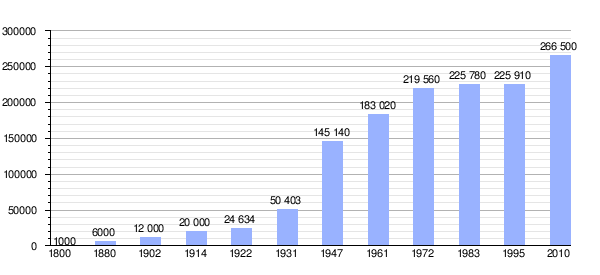 |
Minor division: 12500 inhabitants. |
Haifa is the third largest city in Israel with 103,000 households. The city has an older population compared to Tel Aviv and Jerusalem, due to the migration of young people to the center of the country for study and employment, while young families migrated to suburban commuter towns.
Religious and ethnic communities
Haifa is considered a model of coexistence between Arabs and Jews in Israel. Haifa's population is made up of 80% Jews, 16% Arabs and non-Arab Christians, and 4% Muslim Arabs. As Jewish residents age and youth migrate from the city, the ratio of Christians to Muslims is increasing. As of 2006, 27% of the Arab population was 14 and under, compared to 17% of Jews and other population groups. The trend continues in the 15-29 age group, in which the Arab population makes up 27% and the 30-44 age group is 23%. The percentage of the Jewish population and others in these age groups are 22% and 18% respectively. 19% of the city's population aged 45-59 is made up of Jews and others, compared to 14% of the Arab population. This trend continues with 14% Jews and others aged 60-74 and another 10% over 75, compared to 7% and just 2%, respectively, in the Arab population.
Haifa's Jewish population is relatively secular. As of 2006, 2.9% of Jews in the city were Haredi, compared to 7.5% nationally. 66.6% were secular, compared to the national average of 43.7%.
Territorial organization: districts and neighborhoods
The city of Haifa is divided into nine districts, and these in turn are divided into neighborhoods. According to the Municipality of Haifa, the city is divided as follows:
Kiriat Haim + Kiriat Shmuel
This district makes up 6.5% of the city's territory. In 2008 it had 32,600 inhabitants, representing 12.3% of the city. The sector is divided into two subdistricts: Kiryat Haim, divided into two neighborhoods - Kiryat Haim east and Kiryat Haim west - and Kiryat Shmuel.
Mifratz Haifa and Chek Post
This broad district extends from the north of the city. In this sector of the city is located the main industrial zone of Haifa, with many factories based on chemical products, oil refining and other dangerous products. In turn, it brings together the Chalutzei HaTa'asiá neighborhoods in the northern sector of the district; Lev HaMifratz in the south-eastern sector of the district; and Namal HaKishon in the port area sector.
HaIr HaTachtit

It is the lowest sector of the city, where the port, the main business center and residential areas are located around the Wadi Nisnas, Halisa and German Colony. In this district lives 4.3% of the population of Haifa, where about 70% are Arabs of different religions.
Maarav Haifa
This district is inhabited by about 40,000 people and its area is 9.76 km². Its limits are: the Mediterranean Sea to the north and west; the German Colony to the northwest; the HaCarmel neighborhood to the east; and Titat Carmel to the south. Most of the district's neighborhoods are located on the coastal plain, towards the slopes of Mount Carmel. The neighborhoods Bat Galim, Kiriat Eliezer, Ein HaYam, Kiryat Sprintzak and are brought together in this district. Shaar HaAliya, Neve David and the recreation area in the south. To the west of the district is Israel's largest high-tech park, Matam Park.
HaCarmel
HaCarmel is a district built along the northern sector of the top of Carmel, extending to the west. The area is approximately 7.85 km² and it is the most populous district of Haifa, with 45,000 inhabitants, representing approximately 17% of the total population.
HaCarmel was inhabited even before the start of waves of immigration to Israel. The German quarter Karmelheim, the Carmelite Monastery of Stella Maris and the lighthouse were built in the area. Jewish settlement began in the mid-1920s and intensified in the 1930s, during the Fifth Aliyah. The HaCarmel district is home to the Carmel Mercazí, Carmel Ma'araví, Carmel Tzarfatí and Carmelia-Vardia'' neighborhoods.
Hadar

His name comes from the Hebrew word "nehedar" (Hebrew: נהדר) meaning "wonderful". Hadar is the oldest of the districts in the center of Haifa. Created as a garden city, and planned by Richard Kaufman in 1922, several buildings built in the international style, influenced by the German Bauhaus school, are found in the district. Located on the northern slope of Mount Carmel, between the HaCarmel and HaIr HaTachtit districts. The district brings together the Ma'arav Hadar, Hadar Eliyon, Mercaz Hadar and Hadar Mizrach neighborhoods, which in turn is subdivided into the Yalag, Geula and Ramat Viznitz neighborhoods.
Neve Sha'anan
Located in eastern Haifa, it stretches from the lower slopes of Mount Carmel bordering the Technion campus. It was founded in 1922, and today consists mainly of 3- or 4-story apartment buildings; being the rest of only one floor. Some of the latter are gradually being demolished and replaced by luxury apartment buildings of up to 4 stories. It brings together the Mordot Neve Sha'anan, Neve Sha'anan and Yizre'elia neighborhoods. The Grand Kenion shopping center is located in this district.
Ramot Neve Sha'anan

This district is home to the Ziv neighborhoods, built in the '30s it is the oldest in the district and has an important shopping center (Mercaz Ziv); Ramot Remez, built from the '50; Ramat Alon, Ramat Chen, Ramat Sapir.
Ramot HaCarmel
This district is built along the Carmelo crest, starting from the Carmel Mercazí neighborhood up to the slope of the University. The population of this district is in a high socioeconomic range, with Hod Hacarmel (Denya) ranked among the most exclusive neighborhoods in Israel. There are roads that connect this district to the Matam Park area, the beaches. The neighborhoods of Romemot (Romema HaIeshaná and Romema HaJadashá), Ahuza, Tzir Horev, Tzir Aba Chushi (Hod HaCarmel (Denya), Ramat Golda, Ramat Almogi and Savyonei HaCarmel) come together in this district. In this district is the University of Haifa.
Administrative and political organization

As a port and industrial city, Haifa has traditionally been a stronghold of the Israeli Labor Party ("Ha'Avoda"). Due to the strong presence of dock workers and unions, it earned the nickname 'Red Haifa'. It is now considered 'pink', because in recent years its radicalism has waned in the direction of more moderate socialism, a shift more towards the center, but it is still known as a place where Arab and Jewish workers celebrate a long history of friendship.
Until 1948, the city of Haifa had a very unique social and political activity, having developed a great cooperation between the Arab and Jewish communities of the city, with representatives of the groups involved in the management of the city. Between 1920 and 1927 in the city council there were six Arab representatives and two Jewish representatives, with Arab control of the city. In 1940 Shabtai Levy, the first Jewish mayor, was elected. Two of Levy's directors were Arabs (one Muslim and one Christian), and the rest of the board of directors consisted of four Jews and six Arabs.

Today, the Haifa City Council has 12 members, headed by Mayor Yona Yahav. The results of the municipal elections decided the composition of the board, similar to the Knesset elections. The Municipal Council is the Legislative Council in the city, and has the authority to pass ancillary laws. The XII Municipal Government, which was elected in 2003, has 31 members. Many of the decisions taken by the city council are the result of the recommendations made by the various municipal committees, which are the committees that non-municipal bodies use to meet with representatives of the city. Some committees are spontaneous, and others are mandatory, such as the safety committee, the budget committee, and the finance committee.
Municipal administration

The city's executive branch consists of the mayor, who is elected by vote of city residents to serve for four years. The natural substitute for him is the vice mayor.
The first municipal elections after Israel's independence were held in 1951. Since then, and until 2006, the representative parties of the Israeli left, Mapai and later the Israeli Labor Party, have governed the city.
The city's current mayor is Einat Kalisch-Rotem of the Labor Party.
| Period | Mayor | Political party |
|---|---|---|
| 1940-1951 | Shabtai Levy | |
| 1951-1969 | Abba Hushi | Mapi |
| 1969-1973 | Moshe Flimann | Avodá |
| 1974-1975 | Yosef Almogi | Avodá |
| 1975-1978 | Yeruham Zeisel | Avodá |
| 1978-1993 | Arie Gur'el | Avodá |
| 1993-2003 | Amram Mitzna | Avodá |
| 2003 - interim | Giora Fisher | |
| 2003 - 2006 | Yona Yahav | Avodá |
| 2006 - 2018 | Yona Yahav | Kadima |
| Since 2018 | Einat Kalisch-Rotem | Avodá |

Economy

The phrase "Haifa works, Jerusalem prays and Tel Aviv plays" refers to Haifa's reputation as a city of workers. Haifa's industrial region is located in the eastern part of the city, around the Kishon River. One of Israel's two oil refineries is located in Haifa (the other is located in Ashdod). The Haifa refinery processes 9 million tons (66 million barrels) of oil per year. The 80-meter-tall twin cooling towers, built in the 1930s, were the tallest buildings built in the period of the British Mandate.

Matam Park (short for Merkaz Ta'asiyot Mada - Center for Scientific Industries), the oldest and largest business park in Israel, is at the southern entrance of the city, intended for for the manufacturing and research and development facilities of a large number of Israeli and international high-tech companies, such as Intel, IBM, Microsoft, Motorola, Google, Yahoo!, Elbit, Zoran, Philips and Amdocs. the University of Haifa is also home to the IBM Haifa laboratories.
The port of Haifa leads passenger traffic among Israeli ports, as well as being a major cargo port.
Haifa's shopping malls include Hutsot Hamifratz, Horev Center Mall, Panorama Center, Castra Center, Colony Center (Lev HaMoshava), Hanevi'im Tower Mall, Kenyon Haifa, Lev Hamifratz Mall, and Grand Kanyon.
Tourism
In 2005, there were thirteen hotels in Haifa with a total of 1,462 rooms. The city has 17 km of beaches.
Sights
One of the main tourist attractions in the city is the Baha'i World Center, with the golden dome of the Shrine of the Báb and the surrounding gardens. Between 2005 and 2006, 86,037 tourists visited the sanctuary. In 2008, the Baha'i Gardens were designated a UNESCO World Heritage Site.
At the foot of the world-famous Baha'i Gardens lies the picturesque German Colony of Haifa, founded in the 19th century by German Christians known as the Templars. A large number of stone houses have been preserved, as well as the original German Bible verses on some doors and their colorful tiled floors. Many of those houses today have been converted into restaurants, galleries and gift shops, making the area one of Haifa's top four tourist attractions.
The Monastery of Nuestra Señora del Carmen de las Madres Carmelitas from the 19th century and the Stella Maris Monastery are perched on the western edge of Mount Carmel, high above the city next to Haifa Bay.
Elías' cave also attracts many tourists.
Located in the Haifa district is the Ein Hod artists' colony, where more than ninety artists and craftsmen have studios and exhibits.
Parks and promenades
Haifa has many parks. The best known are:
- Hecht Park;
- The Gan HaEm (Parque de las Madres), located at the Carmel Centre;
- Monte Carmelo National Park, with caves where traces of Neandertal were found, the primitive Homo Sapiens, located in the region known as the "Little Switzerland";
- The walk Bat Galim extends along the beach in the quiet neighborhood of the name of the same name. Along this walk you can find diving clubs, surf clubs and the cable car station;
- Louis Promenade was built in 1992 on an area of 400 metres long. With a dazzling panoramic landscape, you can see the Haifa Bay, the Krayot, Akko, Naharia and Rosh Hanikra. Also Mount Hermon is visible along the promenade;
- The Hai-Bar Natural Reserve, where the animals — who are at risk of extinction in this country, or who have already become extinct in this region — and their offspring are released with nature, where they grow and reproduce.
Transportation
Public transport
Railway
The Israel Railways main line, which runs the Naharia–Tel Aviv route, along the Haifa Bay has six city stations: Haifa Hof HaCarmel, Haifa Bat Galim, Haifa Merkaz HaShmona, Lev HaMifratz, Hutzot HaMifratz, and Kiryat Haim.
There are also special direct services from Haifa to Tel Aviv, Ben Gurion International Airport, Nahariya, Acre, Kiryat Motzkin, Binyamina, Lod, Kiryat Gat, Beersheba and other locations.
Buses

Haifa's intercity bus connections run almost exclusively through the transport company Egged, which has two terminals:
- HaMifratz Central Bus Station. From this bus station leave the journeys to northern Israel;
- Haifa Hof HaCarmel Central Bus Station, heading south of Israel. Among its destinations are Tel Aviv, Jerusalem, Eilat, Ra'anana, Netanya, Hadera, Zikhron Ya'aqov, Atlit, Tirat Carmel, Ben Gurión International Airport and intermediate locations.
All urban lines are run by the company Egged. Since 2006, a network of neighborhood mini-buses called "Shkhunatit" and run by Egged. Haifa is planned to be linked to the Krayots via the bus rapid transit system called Metronit. There are also taxi services that operate along some bus routes, but do not have an official schedule.
Haifa is one of the few cities in Israel where buses operate on Shabbat.
Subway

Haifa is served by six underground train stations of the Carmelit system, unique in Israel. It is an underground funicular on rails, which runs from the Paris Square neighborhood to Gan HaEm Park on Mount Carmel. With a single track, six stations and two trains, it is on the Guinness World Records list as the system of shortest metro in the world.
Cable Car
The Haifa Cable Car is located on the western sector of Mount Carmel, linking the Stella Maris Monastery of the Order of Carmelites with the Louis Promenade in the Bat Galim neighborhood. Through its route you can get an impressive view of the Bay of Haifa, covering 355 meters of distance with a height difference between its two stations of 130 meters. This means of transport is used mainly by tourists.
Air and sea transport
Another gateway to the city is Haifa Airport (also called Uri Michaeli Airport), located to the east of the city, near Kishon Port and Israel Shipyards and mainly serves domestic flights, with 60,000 passengers in 2010. Most flights are domestic operations to Eilat and Tel Aviv and international flights to Jordan, Cyprus and Turkey.
Another important gateway to the city, especially for merchandise, is the Port of Haifa, one of the most important in the Mediterranean, both for the transport of people and merchandise, and thanks to its proximity to the urban center it has become become a large cruise port.
Roads

As far as road transport is concerned, the trip between Haifa and the center of the country is possible via Highway 2, the main highway along the coastal plain, which begins in Tel Aviv and it passes through Herzliya, Netanya, Hedera and ends in Haifa. In turn, Highway 4 runs along the coast north of Haifa from Rosh HaNikra on the Lebanese border, passing through Nahariya and Akko and through Haifa to the south, continues its route parallel to highway 2, passing through Caesarea, Hedera, Petah Tikva, Holon, Ashdod and ending at the Erez pass.
Highway 22 is a suburban highway (under construction) that runs through the Haifa metropolitan area. Currently 4 km long, it connects the center of Haifa, with the northern exit of the city, in the Krayot region. Upon completion of construction to Akko, the highway will be 17km long, running through the Carmel Tunnels and connecting east to Highway 75 towards Nazareth.
Social welfare
Health
Haifa's medical facilities have a total of 4,144 hospital beds. Specialized care offers adequate technical and human means of diagnosis, treatment and rehabilitation that, due to their specialization or characteristics, cannot be resolved at the primary care level. For scheduled and urgent specialized care, there is a hospital network and specialized centers.

- Rambam Medical Center. It is the largest medical center in Northern Israel. It has 1000 beds. About 75 000 people are hospitalized every year, and another 524 000 patients are treated in their outpatient clinics and medical centers. There are 123 000 emergency care, 22 000 surgeries and 2500 catheters a year.
- Bnai Zion Medical Center. It has 450 beds and 65 external offices. About 37 000 people are hospitalized every year and about 130,000 patients are treated in their outpatient clinics, 63 000 emergency cares, 11 000 surgeries and 5000 births.
- Carmelo Medical Center. It has 442 beds. Every year some 600 000 patients are treated in their outpatient clinics; 80,000 emergency cares are performed, 20 000 surgeries and 5000 births.
- Italian Hospital in Haifa. In 2008 he had 86 beds.
- Elisha Hospital (Hebrew: ה ה ה ה ה). This private hospital has 140 beds. A total of 10,000 surgeries are performed annually with internment and another 12 000 outpatient surgeries.
- Horev Medical Center. In 2008 it had 36 beds.
- Ramat Marpe. In 2008 he had 18 beds.
Haifa also has 20 family health centers. In 2004, there were a total of 177,478 hospital admissions.
During the Second Lebanon War in 2006, the Rambam Medical Center was in the line of fire and was forced to take special precautions to protect its patients. All sections of the hospital were moved into the large underground shelters.
Education

Haifa is home to two internationally recognized universities and several institutions of higher learning. The University of Haifa, founded in 1963, is at the top of Mount Carmel. The campus was designed by the Brazilian architect Oscar Niemeyer. The top floor of the 30-story Eshkol Tower offers a panoramic view of northern Israel. The Hecht Museum, with important archeology and art collections, is on the campus of the University of Haifa.

The Technion - Israel Technological Institute, was founded in 1924. It has 18 faculties and 42 research institutes. The original building today is the entrance to the Haifa Science Museum. The first high-tech school in Israel, Basmat, was established in Haifa in 1933.

Other academic institutions in Haifa include the Gordon College of Education and the 'Sha'anan Religious College of Masters', the WIZO Academy of Design and the Tiltan College of Design. The Leminhal College of Management and the Open University of Israel are based in Haifa. The city also has a College of Nursing and the PET College of Engineering.
In the study period 2006-07, in Haifa there were 70 primary schools, 23 secondary schools, 28 high schools (academic secondary schools) and 8 vocational schools. There were 5,133 students in municipal kindergartens, 20,081 in elementary schools, 7,911 in middle schools, 8,072 in high schools, 2,646 in vocational high schools, and 2,068 in district high schools. 82% of students attended Hebrew language schools and 18% attended Arabic schools. In 2004, Haifa had 16 municipal libraries with 367,323 books.
Arts and culture
Despite its image as a port and industrial city, Haifa is the most important center of cultural diffusion in northern Israel. Its cultural manifestations are very abundant and many of them take place outdoors, as it is a Mediterranean city.
During the 1950s, Mayor Abba Hushi went to great lengths to encourage authors and poets to move to the city. He also founded the Haifa Theatre, a repertory theatre, the first municipal theater created in the country. The main Arab theater serving the Arab population of northern Israel is the "al-Midan Theatre" 34;. Other theaters in the city include the Krieger Center for the Performing Arts and the Rappaport Center for Arts and Culture. Its Congress Center hosts exhibitions, concerts, and special events.
The Haifa Symphony Orchestra, created in 1950, has more than 5,000 subscribers. In 2004, 49,000 people attended its concerts. The Haifa Cinematheque, founded in 1975, annually hosts the Haifa International Film Festival during the intervening days of the Sukkot holidays. Haifa has 29 movie theaters. The city publishes a local newspaper, Yediot Haifa, and has its own radio station, Radio Haifa.
Museums
_-_Facade.jpg)
The city has more than a dozen museums. The most popular is the MadaTech - Israel National Museum of Science, Technology and Space, with 400,000 annual visitors. It is located in the historic Technion building in the Hadar area.
The Haifa Museum of Art houses a collection of modern and classical art, as well as an exhibition on the history of Haifa. The Tikotin Museum of Japanese Art is the only museum in the Middle East dedicated exclusively to Japanese art.
Other museums that stand out are: the Museum of Prehistory, the National Maritime Museum, the Museum of the City of Haifa, the Hecht Museum, the Archaeological Museum of Dagon, the Railway Museum, the Museum of Marine and Clandestine Immigration, the Israel Museum of the Petroleum Industry, and the Marc Chagall Artists' House honoring Marc Chagall.
As part of his campaign to bring culture to Haifa, the then mayor of Haifa, Abba Hushi, provided the painter Mané-Katz with a building on Mount Carmel as a place to work and to house his Judaica collection which, after the artist's death, it became the Mané-Katz Museum.
Cinema and theater

For many years in Haifa there were many movie theaters in the neighborhoods, but later they were moved to more central and populated areas. At the end of the XX century, most of the cinemas that operated in the city were closed and the culture of entertainment moved to shopping malls. In Haifa there are three cinemas: "Globus HaCongresim", "Cinema Café Amamí" and "Cinema Café Moriá, to these is added the "Lev HaMifratz" and the former "Haifa Cinematheque" in Carmel.
The Haifa Municipal Theater, Israel's first municipal theater, began operating in the city in 1961. It has an international reputation for producing provocative plays. The company performs eight to ten plays a year for an audience of more than 30,000 people. It takes place in cities, kibbutzim and towns throughout Israel, and regularly presents modern plays in Hebrew and Arabic. The company is based in the Hadar neighborhood.
Festivals
- Haifa International Film Festival - It is an annual film festival that takes place every fall, during the holidays of Sucot. The festival was opened in 1983, and was the first of its kind in Israel. Over the years, it has become the most important film event in the country. The main stage is the Carmelo Cinematheque.
- Festival de Teatro Infantil in Haifa - It is held every year in Pesaj, is sponsored by the Municipal Theatre.
- Fiesta de las fiestas - hajag shel hajagim (in Hebrew: أ أ مع أ م م ن من من من من من من من- The festival's activities are held on Friday and Saturday December. The festival aims to show the nature of Haifa, a city with mixed population, where the coexistence of all religions and the coexistence and tolerance between them is also possible. The activities are carried out in various parts of the city, but most of them are carried out in the neighborhood Wadi Nisnas. During the festival the museums of the city are free of charge for all visitors.
Sports
There are a large number of clubs in Haifa operating in a variety of sports disciplines, including football, basketball, aquatic sports such as swimming, water polo and windsurfing, chess, tennis, table tennis, athletics, weights, fencing among others. The most important of these sports entities are Maccabi Haifa, the largest and oldest of the country's sports associations, and Hapoel Haifa.
In 1996 the city hosted the World Windsurfing Championship. The Haifa Tennis Club, founded in 1982 and with twenty courts, is one of the largest in Israel.
Maccabi Haifa B.C. has a professional basketball team that participates in the Israeli Basketball Super League.
Football

There are a large number of soccer clubs in Haifa, the most popular being Maccabi Haifa and Hapoel Haifa. Both share the Haifa Municipal Stadium, also called Sammy Offer Stadium.
- Maccabi Haifa F.C., founded in 1913, is one of Israel's top players. In its palmarés it has 11 leagues and 5 Israel Cups, 4 Toto Cups and 3 Super Cups of Israel. It was the first Israeli ensemble that reached the group stage of the UEFA Champions League.
- Hapoel Haifa F.C., founded in 1924 and plays at the Premier League of Israel. His palmarés has 1 Premier League of Israel, 3 Cups of Israel, 1 Cup Toto and 1 League Leumit
Other sports associations include Beitar Haifa, Hapoel Haifa Ahva, Hapoel Haifa Spartak and Maccabi Neve Sha'anan Eldad. All of these compete in the minor leagues.
Basketball
Basketball in the city of Haifa has two main representatives:
- Maccabi Haifa B.C. The club was one of the eight teams that founded the Israeli Basketball Cup in 1954, and today is one of the most important basketball clubs in the country. In his palmarés he has a sub-campo in the Israeli Basketball Super League (1999) and two sub-camponatos in the Israel Basketball Cup (1971 and 1985).
- Hapoel Haifa B.C. The club was created after the meeting with Ramat Hasharon in 2005. In his palmarés he has two sub-camponatos at the Israeli Basketball Super League (1965 and 1962).
Both clubs play their matches at the Romema Arena, with a capacity for 2,900 spectators.
Twinned cities
The city of Haifa has actively participated in the twinning initiative with some cities around the world since 1962. These official collaborations have the specific objectives of increasing and benefiting Haifa's presence abroad and enhancing the image and reputation of Haifa. city development. During these years, the necessary actions were taken to achieve twinning with the following cities:
| Shield | City | Country | From | Shield | City | Country | From | |
|---|---|---|---|---|---|---|---|---|
 | Marseille | .svg) France France
| 1962 |  | Düsseldorf | Germany Germany Germany
| 1988 | |
 | Portsmouth | United Kingdom.svg) United Kingdom United Kingdom
| 1962 |  | Rosario |  Argentina Argentina
| 1988 | |
 | Hackney | United KingdomUnited Kingdom
| 1968 |  | Odessa | Ukraine Ukraine Ukraine
| 1992 | |
 | Manila | Philippines Philippines Philippines
| 1971 |  | Shanghai | China China China
| 1993 | |
 | San Francisco |  United States United States
| 1973 |  | Boston | United States
| 1999 | |
 | Aalborg | Denmark Denmark Denmark
| 1973 | Limassol | Cyprus Cyprus Cyprus
| 2000 | ||
 | Cape Town |  South Africa South Africa
| 1975 |  | Fort Lauderdale | United States
| 2002 | |
.svg) | Bremen | GermanyGermany
| 1978 |  | Erfurt | GermanyGermany
| 2005 | |
.svg) | Antwerp | Belgium Belgium Belgium
| 1986 |  | Mannheim | GermanyGermany
| 2009 | |
 | MAJOR | GermanyGermany
| 1987 |  | Newcastle | United KingdomUnited Kingdom
| 1979 | |
| Chengdu | ChinaChina
| 2013 |
Cooperation and Friendship Agreements
| Shield | City | Country | From | Shield | City | Country | From | |
|---|---|---|---|---|---|---|---|---|
.svg) | Turin | Italy Italy Italy
| 2005 | _-_Brasao.png) | Porto Alegre | Brazil Brazil Brazil
| 2010 | |
 | La Spezia | ItalyItaly
| 2006 | | Shenzhen | ChinaChina
| 2011 | |
.svg) | Saint Petersburg | Russia Russia Russia
| 2008 | |||||
 | Dayton | United States
| 2009 |
Notable people
Contenido relacionado
Province of Heredia
Lubumbashi
Arakawa River
General Mosconi (Salta)
Hestur