
Guell Palace
The Güell Palace (in Catalan Palau Güell) is a building designed by Antoni Gaudí and part of the current of Catalan modernism. It is located on Nou de la Rambla street in Barcelona, near the port and the city's seafront. The palace was commissioned to Gaudí by Eusebi Güell, who had great admiration for the architect and financed several of his best-known works. Gaudí put all his effort into this work, since it was his first important commission, and proof of this is who came to devise up to twenty-five different solutions for the design of the façade. For this project he had the collaboration of Francesc Berenguer, one of his most faithful assistants. The construction was carried out between the years 1886 and 1890.
This work belongs to Gaudí's orientalist period (1883-1888), a period in which the architect carried out a series of works with a marked oriental taste, inspired by the art of the Near and Far East (India, Persia, Japan), as well as in Hispanic Islamic art, mainly Mudejar and Nasrid. Gaudí used ceramic tile decoration profusely, as well as mitral arches, exposed brick cartouches and finials in the form of a small temple or dome.
History
.jpg)
Eusebi Güell i Bacigalupi, Count of Güell (1846-1918) was one of the most important industrialists in Catalonia of his time, as well as a politician, scientist and writer. He was the son of Joan Güell i Ferrer (1800-1872), an Indian who amassed an enormous fortune in Cuba and was a promoter of various industries on his return to Barcelona, such as the El Vapor Vell factory, which got the exclusive of the manufacture of corduroy in Spain. After studying Law, Economics and Applied Sciences in Barcelona, France and England, he was the founder with Ferran Alsina of Colonia Güell, a workers' colony dedicated to the textile industry. He intervened in politics and broad cultural sectors: in 1875 he was elected councilor of the Barcelona City Council, in 1878 provincial deputy, and also served as senator of the Kingdom. He was, due to his love for Catalan culture, president of the Jocs Florals (1900) and member of the Royal Catalan Academy of Fine Arts of San Jorge, as well as president of the Center Català.
In 1878 he met Gaudí, after being admired by the display case for the Comella glove shop that the architect was exhibiting at the Universal Exposition in Paris. From then on, a long friendship and a fruitful professional relationship began, since the industrialist was the main patron of the architect Thanks to this, his last name is internationally known, with works such as the Colonia Güell Crypt, the Bodegas Güell, the Güell Pavilions or the Güell Park, as well as the palace.
Güell had a house on the Rambla de los Capuchinos, which he had inherited from his father. In the adjoining street, Conde del Asalto (now Nou de la Rambla), bought two houses with the intention of expanding the one on the Rambla: in 1883 number 3 from Maria Toll i Serra, and in 1886 number 5 from the Boada family More, in total 408 m². These houses then housed a dairy and seventeen rented homes, whose families had to be evicted. In 1887 he also bought number 3 Lancaster street, on the opposite side of the Rambla, and in 1894 number 9 Nou de la Rambla (corner Lancaster) and numbers 5 and 7 Lancaster, with which he practically had He owned the entire block (he only had 7 Nou de la Rambla left, which he could not acquire). Güell's project was to build a new house that was connected by means of an interior patio with the one on La Rambla. Gaudí designed the Güell Palace following the tradition of the great Catalan stately homes, such as those on Montcada street.
The administrative construction process began on July 12, 1886, when Mr. Güell applied to the City Council for a building permit. However, the municipal architect, Antoni Rovira i Trias, submitted a negative report as the project did not comply with article 25 of the Municipal Ordinances, which stipulated that the façade tribunes should be made of iron and glass, as opposed to stonework that Gaudí signed. But this report was dismissed by the Development Commission (on July 24), possibly influenced by Güell himself, who had numerous contacts in the City Council. The permit was finally granted on July 27, and on August 12 Güell and Gaudí signed the document. On October 15, permission was requested for the demolition of number 3-5 of Nou de la Rambla, which was granted on October 23 and ratified by the Development Commission on November 6. Finally, on November 12, the works permit was issued.

Although the work on the interior decoration lasted until 1890, the building was inaugurated in 1888, coinciding with the Universal Exposition held in the Ciudadela Park in Barcelona. On the occasion of this event, personalities such as the Queen Regent María Cristina de Habsburgo, King Umberto I of Italy and the President of the United States Grover Cleveland visited the Güell Palace. Mr. Güell was so proud of his building that he presented some plans of it —made by Joan Alsina i Arús— at the exhibition dedicated to Gaudí at the Grand-Palais in Paris in 1910.
Eusebi Güell lived in the palace until 1906, when she moved to Casa Larrard, in Park Güell, where she lived until her death in 1918. The Güell Palace passed by inheritance to Güell's widow, Isabel López Bru (daughter of the Marquis of Comillas) and later his daughters Maria Lluïsa and Mercè Güell i López. During the Civil War it served as a police station. In 1944 an American millionaire wanted to buy it, to take it to his country stone by stone, but in the end the Barcelona Provincial Council finally acquired it, in exchange for a life pension for Mercè Güell, which also made it a condition that the building would never be modified and intended for a cultural purpose. In 1952 the Association of Friends of Gaudí settled in the Güell Palace, until its transfer in 1968 to the Gaudí House-Museum in Park Güell. Likewise, in 1954 the Theater Museum was established in the palace, until its transfer also in 1996.
Since its acquisition by the Provincial Council, the palace has undergone several restorations: the first after its purchase in 1945, carried out by Manuel Baldrich i Tibau, focused on the carpentry, glasswork, electrical installation and painting of the building; between 1971 and 1979 a new restoration was carried out, by Jordi Querol i Piera, focused on the façade and the terrace; another in 1983, by Carles Buxadé and Joan Margarit, who carried out a complete diagnosis of the structural state of the building, whose deficiencies have since then been corrected in successive phases, by Antoni González Moreno-Navarro and Pau Carbó, especially on the façade, the ground and underground floors, the dome of the lounge and the terrace with its chimneys. In 1992 the Provincial Council acquired part of the original furniture from the descendants of Count Güell, which could be reinstalled in its original location. A coupé type carriage, like the one belonging to the Güell family, from the Museum of Decorative Arts, was also placed in the garage. In 1998 the oratory and the paintings by Aleix Clapés were restored. Finally, between 2004 and 2011 a new complete restoration of the building was carried out by Antoni González, which is currently open to the public and can be visited in its entirety.
In 1969, the Güell Palace was declared a National Historical-Artistic Monument, and since 1984 it has been part of the UNESCO World Heritage Site, within the “Works of Antoni Gaudí” Site.
In 2022, the Provincial Council acquired two neighboring properties on both sides of Palau Güell: the building attached to Casa Fradera, at number 1 bis on Nou de la Rambla street; and the Jordà house, at number 7 on the same street. This extension will allow the opening of new exhibition spaces in the original Gaudinian building, used up to now for offices and complementary services and which can now be opened to the public. Among others, it is expected that spaces such as the library or Eusebi Güell's office can be visited, which until now could not be seen in a normal visit. The new space that can be visited will be 500 m².
Description
.jpg)
The Güell Palace stands on an almost rectangular site, measuring 18 x 22 metres, with an annex building in the southwestern part, measuring 6 x 20 metres. The structure is supported by the walls of the façades, made of natural stone, as well as the dividing walls, made of brick, as well as brick pillars in the basement and stone pillars on the other floors. The party wall on the east side was originally an exposed façade, so it was coated and painted with a fresco by Aleix Clapés depicting Hercules looking for the Hesperides, inspired by the poem L' Atlàntida by Jacinto Verdaguer, now disappeared.
The building is made up of a basement for stables, a ground floor with a hall, concierge, garage and various service areas, a mezzanine for the administrative area, a main floor for the social area, and a second floor for the private area (bedrooms, bathrooms)., third with the service area, kitchen and laundry, and roof terrace. In total, the building has an area of 2850 m².
The general design follows the lines of his creations from that time, marked by the oriental style applied to the design of his works. In this palace, a period of predominance of Arab, Byzantine or Mudejar-inspired forms culminated, with projects such as the Casa Vicens, the Güell Pavilions or El Capricho de Comillas. Gaudí carefully designed both the exterior and interior of the palace, with a sumptuous decoration in the Mudejar style, where the ceilings with coffered ceilings of wood and iron stand out. Likewise, Gaudí efficiently studied all the technical and structural solutions of the building, taking care of aspects such as lighting, ventilation or acoustic insulation from the outside to the maximum detail.
Gaudí led a large team of technicians and craftsmen, such as the architects Francesc Berenguer and Camil Oliveras, the master builder Claudi Alsina, the decorator Francesc Vidal i Jevellí, the builder Agustí Massip, the ironworkers Joan Oñós, Salvador Gabarró and the brothers Lluís and Josep Badia i Miarnau, the cabinet makers Antoni Oliva, Julià Soley and Eudald Puntí, and the marble workers Ventura brothers. Likewise, in the artistic sphere, he had the collaboration of the painters Aleix Clapés, Alexandre de Riquer and Ramon Tusquets, and the sculptors Joan Flotats and Rossend Nobas. As for the suppliers, the ironworks were from Talleres Torras, the glassworks from Taller Pelegrí and the ceramics from Pujol i Bausis.
Facade

The building is built with limestone from Garraf, where Güell had a farm, the Bodegas Güell. Since the street is not so wide, it is difficult to see the entire façade, which, however, is designed with great monumentality. The façade is presented in three levels, broken on the right side so as not to interfere with the adjoining building: the first level corresponds to the ground floor and the mezzanine, and presents the stone cut with a saw and polished; It includes the access doors, in the shape of parabolic arches, while on the right is the service entrance, and a series of windows protected with iron bars complete the set. The second level is formed by the grandstand of the main floor, supported by 21 corbels, with polished stone as in the first level. Finally, the third level corresponds to the second and third floors, with the stone worked with a punch: the second floor has five windows flanked by two balconies, while on the right side (the service area) there is a small tribune resting on three cartouches and with a staggered crowning; the third story contains a row of small windows, and is surmounted by a crenellated balustrade.

Of the entire façade, the entrance doors stand out, which at the top have openwork wrought iron bars, which represent two snakes that with their tails form the letters E and G (by Eusebi Güell), while between At the doors is another iron lattice decorated with the coat of arms of Catalonia and a helmet with a phoenix, the work of Joan Oñós. The entrance has impressive dimensions, designed so that visitors could access it mounted on their horses, or well in their carriages. For the horses there were stables in the basement, which at that time was totally innovative; they were accessed through an ingenious spiral-shaped ramp devised by Gaudí.
The building has a rear façade that overlooks the courtyard of the block, divided into two different orders: the lower one corresponds to the noble floor, where there is a rear patio that is accessed through the dining room; It presents an ingenious gallery with wooden shutters and covered in blue and black ceramic, with two metal windows on the sides, and on the flanks two small access doors to the terrace and another with a walkway that communicates with the annexed lateral body. of the building. Separated from this level by a stone impost that protrudes from the wall is the upper level, where a shadow or brise-soleil made of wood and iron stands out, located on the tribune. The façade is surmounted by a stone cornice with an iron railing. The entire rear façade presents stone worked with a punch. Finally, the façade of the annex, intended for services, is made of exposed brick, with a large metal window with a cast iron column at the height of the main floor, and on the upper floors a set of windows divided by columns. and topped with triangular arches. This attached body is crowned with a stepped brick eaves, with an iron railing.
Inside
.jpg)
The interior of the building is designed to comfortably harmonize public and private life, the family area and the service area. To do this, the lobby on the ground floor connects optimally with the various parts of the building: in the center is the main staircase, in the background the garage and the access to the basement, on the east side the entrance hall and on the west the service staircase and elevator. Following the main staircase, you first reach the mezzanine, where Mr. Güell's office was located on the right, plus the library and the administration and archive rooms; and to the left a vestibule and a rest room.
The main staircase leads from the mezzanine hall, which gives access to the main floor, organized around a large 80 m² central hall, which is three floors high (17.5 m). This hall is the central nucleus of the building, being surrounded by the main rooms of the palace. It stands out for its roof with a double dome with a paraboloid profile on the inside and conical on the outside, a typical solution of Byzantine art. The dome sits on equally parabolic toral arches, and is perforated with small oculi that allow natural light to pass through.; It has a covering of reddish alabaster plates, hexagonal in shape. When entering through the main staircase, a first corridor (north) appears that gives access to four spaces: a first entrance hall, the access room to the living room (or Lost Steps Room), the visiting room and a ladies' toilet. These spaces are delimited by a gallery of arcades that corresponds to the gallery on the exterior façade, where Gaudí used an original system of catenary arches and columns with hyperboloidal capitals, a style not used before or after Gaudí. The visiting room It is decorated with an oak coffered ceiling covered in gold leaf and wrought iron ornaments, and stained glass windows with representations of lotus flowers and medallions with effigies of literary characters created by William Shakespeare.
.jpg)
Next comes the great central hall, which is the one that was most richly decorated, with furniture and works of art of great value, where several busts representing Joan Güell, Antonio López (Marqués de Comillas) and Isabel López stood out. Bru, work of Rossend Nobas. There were also several oil paintings by Aleix Clapés: Saint Elizabeth Queen of Hungary giving her crown to a poor man, Peasant family praying at the foot of a thermal cross, Girls playing and a portrait of Jaume Balmes. Of the furniture, an alabaster and brocatel sofa-seat designed by Gaudí stands out, and a chair called Phebus, by Vidal i Jevellí, in a flamboyant neo-Gothic style, inspired by Bavarian cabinetmaking.

On both sides of the great hall were: a chapel-oratory (on the right), decorated with paintings of the twelve apostles, the work of Aleix Clapés, and an image of the Immaculate Conception on the altar, the work of Joan Flotats, which was destroyed in 1936; and an organ on the left, the work of Aquilino Amezua, which had two 56-note manual keyboards and another 27-note pedal, with complete couplings, tremolos, expression and cancellers. of tongue shop; the console, designed by Gaudí, was located on the main floor, while the ventilation was located two floors above, under the dome. The organ was spoiled during the Civil War, a period in which the metal was melted down. In 2012, the construction process of a new instrument was completed, built in Collbató by the master organ builder Albert Blancafort, made up of 1,386 pipes, with 22 registers, two 56-note manual keyboards and a 30-note pedal keyboard.
From the east side of the room there is a staircase that leads to the elevated gallery on the noble floor —since it is 6.5 meters high—, where the musicians used to be at parties and events organized by the Güell family; from here there is access to a small room that was used as an office by Àngel Guimerà when the Theater Institute was installed in the palace. In the south corridor of the noble floor were the dining room —where a large fireplace designed by Camil Oliveras stands out— and the Trust Room, which was used for meetings and piano concerts; From here you can access the terrace of the block patio. In the part corresponding to the annex building on the noble floor was the billiards and drawing room, while a passageway connected with the house on the Rambla that Güell inherited from his father, where a small museum was located that housed antiques and works of art collected by the Güells.
From the gallery of the main hall, a staircase leads to the second floor, where on the north side there was a study room and several bedrooms, in the center a living room and toilets, and on the south side the bedroom main, several more on the sides and the bathroom. The central room stands out, decorated with a cycle of paintings related to Saint Elizabeth of Hungary —in homage to Güell's wife, Isabel López Bru—, the work of Alexandre de Riquer. It should be noted that the master bedroom has a balcony that corresponds to the brise-soleil of the rear façade. Of the furniture on this floor, a French Second Empire style chaise-longue stands out, located in the main bedroom and used to be used by Güell's wife, and a dressing table belonging to Isabel Güell, both designed by Gaudí. Finally, on the third floor (or attic) were the service rooms, the kitchen and the laundry rooms, while a last section of the service staircase accessed the roof.
It should be noted that various ornamental pieces were used from a previous Güell home, the Fonollar palace, on Carrer de Portaferrissa, from which he had been evicted due to a conflict with the previous tenants. The decoration of this house had been designed by Camil Oliveras. Before Güell left, he took the furniture and all the objects he could transport, such as floor and wall coverings, stained glass windows, ceramics, fireplaces, lamps and other decorative elements, which were reinstalled in the Güell palace. Apparently, the tiles from the bathrooms of the Fonollar palace were even used to cover the chimneys on the roof of the new palace.

Lost step room.

Chapel-oratory.

Chaise-longue.
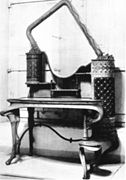
Isabel Güell.
.jpg)

.jpg)

Rooftop

The building is topped by a 481 m² roof, with four levels: the largest corresponds to the central body of the building, with 14 chimneys, four shell-shaped lunettes, skylights and the lantern corresponding to the central dome; going up six steps there is a second level belonging to the annexed body of the building, with six more chimneys; the third level is located in the service stairwell; and the fourth, over the organ box, from which the interior of the lantern was accessed via a walkway.
On the one hand, the chimneys stand out from the roof as a whole, to which Gaudí, far from treating them as annoying elements, gave them a decorative character. With this, he began a way of designing the chimneys that he would develop in his subsequent works, until reaching spectacular solutions such as Casa Batlló and Casa Milà. There are a total of 20 chimneys, built in brick and —except for six left exposed— covered with ceramic (of the trencadís type, common in Gaudí's works), glass, marble or porcelain, with various designs. of bright colors They generally have truncated-conical or truncated-pyramidal shapes, although there are some that are prismatic-pyramidal or cylindrical-conical in shape, with conical or spherical capitals, with rhombuses or triangles, spiral or pyramid. The ceramic used for the fireplaces was from the Pujol i Bausis factory in Esplugas de Llobregat, one of the most prestigious at the time and which had close contacts with most modernist architects. These chimneys were restored between 1990 and 1994, with the collaboration of various artists, such as the ceramicist Joan Gardy Artigas, the sculptor Joan Mora, and the painters Robert Llimós and Gustavo Carbó Berthold. An attempt was made to faithfully follow the original designs, but at some point where they had been lost, the artists' own designs were resorted to, generally following the same style, with only a small reference to contemporary times: the logo of the Olympic Games. from Barcelona in 1992 with his mascot (Cobi) on the south face of chimney number 9.
The tall spire in the shape of a lantern is also noteworthy, which is the outer crown of the dome of the central hall, also made of ceramic and topped with an iron weather vane-lightning rod, which contains the wind rose, a bat and a Greek cross. Conical in shape, it is 16 meters high, and in its central part it has eight windows that give light to the interior of the building, one of which serves as a door and is connected to the terrace by a walkway. A little further up there are twelve small rhomboid-shaped holes, which allow ventilation of the interior, as well as maintaining thermal balance.
Gallery

Yelmo from the entrance door.

Glass of the trust room.

Model of the building, in Catalonia in Miniature.

Helical branch of the basement.

Flashlight of the roof.
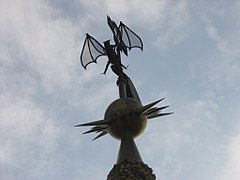
Roof fin.


Contenido relacionado
Millau Viaduct
Yoko ono
Philip Glass