
Guatemala's flag
The Guatemalan flag is the emblem and supreme insignia of the Republic of Guatemala and has undergone transformations since even before the creation of the Republic on September 15, 1821. It was originally created by the conservative government of General Rafael Carrera y Turcios based on the proposal of Bishop Juan José de Aycinena y Piñol and other members of those who wanted to emphasize the conservative influence in Guatemala by keeping Spanish elements on the flag. After Carrera's death between 1860 and 1865 Conservative influence weakened in Guatemala and his government was finally overthrown by the liberal revolution on June 30, 1871 led by Miguel García Granados and Justo Rufino Barrios, who among their first decrees modified the Guatemalan flag to eliminate conservative references.
According to the executive decree of August 17, 1871, it was determined that the flag had only two colors: light blue and white. The white vertical strip between the two light blue ones represents the fact that the country is located between the Pacific Ocean to the west and the Caribbean Sea to the east. In its center appears the National Shield, -which was also modified to remove the conservative elements and the date March 21, 1847, which corresponds to the founding of the Republic of Guatemala and the end of the Central American Federation that the liberals-. The white color also represents purity, integrity, faith, obedience, firmness, vigilance, peace and the nation. The blue color symbolizes justice, loyalty, sweetness, strength, the Guatemalan sky and the two aforementioned seas that bathe the east and west coasts of the country, respectively, as well as those of Central America.
One of the first designs that the Guatemalan Flag had was the Flag of the United Provinces of Central America, which in turn, was inspired by the Flag of the United Provinces of the Río de la Plata, currently Argentina, although in in the latter the stripes are horizontal, and the outer stripes are blue, not light blue. The flags of the other countries that made up the United Provinces of Central America follow this pattern.
Finally, the government agreement of September 12, 1968 regulates in detail the colors, their density and placement on the national flag and shield. This regulation was established during the government of Mr. Julio César Méndez Montenegro. The flag is called a pavilion when it bears the coat of arms and the official colors. In official acts the entrance of the flag is usually accompanied by the march "La Granadera", instrumental version.
Previous flags and shields
1823–1838 Flag and coat of arms used by province of Guatemala
Guatemala, as part of the United Provinces of Central America, adopted the flag and coat of arms approved by the National Constituent Assembly of Central America, according to Decree No. 29 of August 21, 1823. The Flag of the United Provinces of Central America consisted of three horizontal stripes: blue at the top and bottom, and white at the center. This is the aforementioned decree:
 DECRETO CREADOR del ESCUDO AND THE BANDERA DECADE OF THE PROVINCIES OF THE AMERICA CENTREDECEMBER 29 The National Constituent Assembly of the United Provinces of the Centre of America has well decreed and decreed: Article 1 The Arms Shield of the United Provinces of the Centre of America will be an equilateral triangle; on its base there will be a five-volcano mountain range, on a land that is covered by both seas; on the top, a rainbow that covers them and under the arch, the cap of freedom spreading lights. Around the triangle and in circular figure will be written with gold letters: “PROVINCIES OF THE AMERICA CENTRE”. Article 2 This shield will be placed in all posts and public offices replaced by provisions of previous Governments. Article 3 The great seal of the nation, that of the Secretariat of this Assembly, that of government agents, and courts of justice, shall bear all the same shield. Article 4 The national pavilion for the ports and for all kinds of vessels belonging to this new state will consist of three horizontal, blue top and bottom, and white the one of the center in which the shield that designates Article 1 will be drawn. In the gallardetes the fajas will be placed perpendicularly by the order expressed. From the same pavilion will use this government's envoys to foreign nations. In the merchant ships the flags and gallardetes will not bear shield, and in the center's face will be written with silver letters: GOD, UNION, FREEDOM. Article 5 The flags and banners of such living military bodies, as well as of provincial militia while remaining, shall be fixed to the provisions of the preceding article: Their fajas shall always be horizontal, at the top the words: GOD, UNION, FREEDOMand in the lower class and number of each body. In infantry both inscriptions shall be with letters of gold, and in cavalry with letters of silver. Article 6 The bodies of civic force shall have their flags and banners in accordance with the provisions of article 70 of the law of ten and eight of the current. Article 7 By communicating this decree to the government you will be accompanied by designs of the national blazon and pavilion for the easiest intelligence of what is prevented: Contact the Supreme Executive Branch for compliance, and make it print, publish and circulate. Given in Guatemala to 21 August 1823 – José Barrundia: President Member – Mariano Gálvez: Representative Secretary – Mariano de Córdoba: Representative Secretary – to the Supreme Executive Branch. Therefore we command to keep, fulfill and execute all your parts. It will be understood by the secretary of the office, and will be printed, published and circulated. Guatemala National Palace October 3, 1823 – Antonio Rivera: President – Pedro Molina – Juan Vicente Villacorta. To the citizen Manuel Julián Ibarra. And in order of the Supreme Executive Power I insert it to V. for its intelligence and consequent purposes: God, Union, Freedom— Guatemalan National Palace 3 October 1823 M. Julian Ibarra. |
1825-1843 Flag and coat of arms of the State of Guatemala
On January 20, 1825, Guatemala adopted its own state coat of arms by Legislative Decree No. 30. It had three horizontal stripes, the upper and lower ones blue, and the central one white, in the center of which was the coat of arms that had a quiver on top, resting on the ground (where there were several trophies and the national flag), full of blue arrows. and white (which has the Shield of Honduras), on top of a circle. At the top of the shield there are two horns of plenty, one on each side; Inside the circle there is an equilateral triangle, that of the coat of arms of the United Provinces of Central America. This is his text:
.svg) Decree No. 30On 20 January 1825, the Guatemalan State ' s own arms shield was designated The Head of State of Guatemala As the Constituent Assembly of the same State has decreed what follows. The Constituent Assembly of the State of Guatemala, considering that in order to distinguish itself from the same State among the others of the Federal Republic to which it belongs, it is necessary to designate the shield proper of its weapons, placing in it those of the federation in testimony of the sincerity that binds it, has had to decree and decree:
-
Given in the Old City of Guatemala on January 20, eight hundred and twenty-five. Guatemala March 2, 1825. (Tomado del Archivo General de Centroamérica, Guatemala) |
During the Federation each state was free to modify the coat of arms. As of January 20, 1825, the State of Guatemala used it simultaneously with that of the United Provinces of Central America and continued to use the blue and white flag decreed on August 21, 1823. The Federation was broken in 1839 by the State of Guatemala continued to use the same flag and coat of arms decreed in January 1825.
1843-1851 Flag and coat of arms of the State of Guatemala
On December 31, 1842, the Conservative government proposed changing the coat of arms because it lacked aesthetic reasons and contained decorative elements that appeared on the coats of arms of other countries. The proposal was subjected to an exhaustive analysis by a commission appointed by the Ministry of the Interior, which issued a favorable opinion as requested by the Executive Branch. On November 14, 1843, the following legislative decree was issued that created the flag and coat of arms of the country:
.svg) DECEMBER OF THE CONSTITUTIONAL ASSEMBLY OF THE STATE OF GUATEMALA, OF 14 NOVEMBER 1843 MODIFICING THE ARMS SUBMITTED BY THE VERIFIC POLICY CENTRE IN AMERICA State weapons vary The Constituent Assembly of the State of Guatemala, having taken into consideration the Government ' s initiative of 31 December of the past year of 1842 and the statement he led, in 17 August of this year, to represent the need for a change in the State ' s arms shield, through the political change that has occurred, under the dissolution of the federal covenant and independence of the State of Guatemala. He heard the ruling of the government commission. He's got it. Art. Unique. The weapons of the State will be the ones that Central America has used in the reverse of its currency, but arranged so that the sun and volcanoes are placed in the center of a shield whose legend will be: Guatemala in Central America. September 15, 1821; carrying an olive crown in the carcaj. Go to the Government for publication and compliance. Given in the meeting room: Guatemala, October 20 and 6, 1843.—José Mariano Rodríguez, President; Manuel Santa-Cruz, Secretary, Maule Ubico, Secretary. House of the Supreme Government. Guatemala, 14 November 1843. Therefore, execute yourself, Mariano Rivera Paz |
In the modification of the coat of arms, the motto “Guatemala in Central America” appears for the first time. September 15, 1821” and “State of Guatemala in the Federation of the Center” disappears. Until 1851, the blue and white flag of the Central American Federation continued to be used, the year in which it underwent a total modification for the first time.
1851-1858 Flag and coat of arms of the Republic of Guatemala
While Mariano Paredes was President of the Republic, on March 14, 1851, the following executive decree was issued, published in La Gaceta de Guatemala No. 39, Volume V, on Friday the 21st of the same month and year, creating the new patriotic symbols:
.svg) Decree of the Government of the Republic of 14 March 1851, specifying the colors to be formed by the national pavilion with other prevents of the case DECRETO No. 55 The President of the Republic of Guatemala: Since Guatemala had proclaimed itself an independent and sovereign republic, a particular pavilion had to be adopted that distinguished it from the other powers, as well as the other signs used and used everywhere for that purpose; According to the public feeling, the preservation of those colors established before the declaration of independence, as well as those adopted with posterity to that event; Considering everything carefully, and with the presence of the Decree issued by the Constituent Assembly establishing the coat of arms, which must be preserved as it exists today; In accordance with the views of the Advisory Council, RIGHT:
—Mariano Paredes Secretary of Government, Pedro N. Arriaga. |
President Mariano Paredes publicly assured that by conserving the yellow and red colors used during the colony, popular sentiment was interpreted; in reality, it was an order from General Rafael Carrera y Turcios, head of the armed forces and the true ruler of Guatemala, following a suggestion from Bishop Juan José de Aycinena y Piñol, II Marquis of Aycinena and a conservative leader who supported the regime. Lucas Paredes, a liberal leader, contradicted the above, stating that "the agreed flag did not harmonize the true aspirations of the new republic", because it perpetuated the Spanish and aristocratic symbols that conservatives preferred.
1858-1871 Flag and coat of arms of the Republic of Guatemala
When General Rafael Carrera y Turcios was president, the following executive decree was issued on May 31, 1858, creating another national flag and shield:
.svg) DECEMBER OF THE GOVERNMENT, 31 MAY 1858, FIJANDO DEFINITELY DEFINITELY THE NATIONAL ARMS Decree changing the arms of the Republic and placing the colors in the pavilion. His Excellency Mr. President of the Republic has issued the following decree: Don Rafael Carrera, general captain of the Army; Knight Grand Cross of the Pontifical Order of Saint Gregory the Great, in the Military Class; Commander of that of Leopoldo of Belgium; President of the Republic of Guatemala, etc., with the presence of article 2 of the Decree of 6 April 1857, has to decree and decree Article 1. The arms of the republic will henceforth be a shield divided transversally into two barracks; the superior in the field blue raso with vertical bars of silver, and the lower one with three volcanoes on clear celestial field. On the shield will go a sun and on each side two pavilions with the national colors deployed and collected the ends down, nested in the boots. To the right of the shield will go one branch of encino, and to the left one of laurel. In a waving white tape linked to the pavilions, the following legend will be made in gold letters: RESPUBLIC GUATIMALAE SUB DEI OPTIM MÁXIMO PROTECTIONE. Article 2. The red, yellow, blue and white colors will be preserved in the pavilion, distributed in seven horizontal strips, the two of the ends of blue; white the immediate; red the following and yellow the center, on which the weapons will go. Given at the Government Palace in Guatemala, thirty-one May of eight hundred and fifty-eight.—Rafael Carrera Minister of Government Maule Echeverría |
For 13 years these emblems were in force, until the triumph of the Liberal Revolution on June 30, 1871 led by Generals Justo Rufino Barrios and Miguel García Granados. The modifications presented in the national symbols have representations including Spanish and the Catholic Church and are due to the influence of the Marqués de Aycinena who thus introduced the symbols of conservative power in Guatemala and have been considered from the heraldic point of view as the best that the country has had.[citation required]
Decree creating the flag
On August 17, 1871, when General Miguel García Granados was President of the Republic, the following Executive Decree was issued that created the current Guatemalan flag:
THE DECREASE I GIVE US NATIONAL SAMES DECEMBER 12 Miguel García Granados, president of the Republic of Guatemala. Considering that the Revolution that has been verified imposes a duty to adopt a new pavilion that is in better harmony with the fundamental laws that establish the absolute independence of the Republic. RIGHT: Article 1. The national colors will be blue and white, arranged in three vertical strips, leaving the white in the center. Article 2. The National Pavilion will carry the Republic's Arms Shield on the white side. Article 3. The merchant pavilion will be the same, but without Shield. Article 4. The cucarda will bear the same national colors arranged in the same way. Given at the Government Palace in Guatemala, August 10, eight hundred and seventy-one.-Miguel García Granados Minister for Foreign Affairs of the Ministry of the Interior Felipe Gálvez. |
Decree creating the shield
Three months later, on November 18, 1871, the same government approved Decree No. 33 that adopted the current National Shield:
 The Escudo de Armas de la República must be in harmony with the political principles proclaimed by the Nation; in the use of the powers vested in me, DECRETO: Unique article.- The arms of the Republic will be: a shield with two rifles and two swords linked with two branches of laurel, in each light celestial field. The center will be covered with a scroll, which will contain the following legend in gold letters: Freedom September 15, 1821; a quetzal appears at the top as a symbol of the independence and autonomy of the nation. Given in Guatemala, November 18, eight hundred and seventy-one.— Interior Minister Francisco Alburez Miguel García Granados |
Decree regulating the flag and coat of arms
On September 12, 1968, while Julio César Méndez Montenegro was President of the Republic, the following Government Agreement was issued:
 Guatemala 12 September 1968 THE CONSTITUTIONAL CHAIRMAN OF THE REPUBLIC, CONSIDERING:That by Decrees number 12 and 33 of August 10 and November 18, 1871, dictated by the then president of Guatemala General Miguel García Granados, were established respectively, the flag and the shield of arms of the Republic, CONSIDERING:That the lack of adequate regulation in such important matters has led to the fact that such patriotic symbols have been represented in a capricious and arbitrary manner, both in terms of the nuance of their colours and the design of the Republic ' s coat of arms, CONSIDERING:That a commission was appointed by Governmental Agreement dated 30 November 1967 to undertake studies relevant to the correct application of the above-mentioned laws, which after merciful work gave opinions by submitting the respective draft: TANTO:In use of the powers conferred on it under article 189, paragraph 4, of the Constitution of the Republic. In Council of Ministers AGREEMENT:Article 1. The flag of Guatemala is the supreme flag of the nation. It carries at its centre the coat of arms of the Republic, as stipulated in Decrees No. 12 and 33 of 10 August and 18 November 1871. Article 2. The flag does not contain any additional legend or registration except in specific cases provided for by military regulations. Article 3. The colors of the flag will be blue and white, arranged in three vertical stripes of the same width: two blues the ends and one white in the middle. The white strip carries in its center the shield of arms of the Republic, in proportional dimensions to those of the Patria Insignia; the merchant flag will be the same, but without shield. The blue color that expresses justice and loyalty corresponds to the blue of the sky of Guatemala and in the nomenclature of international use is designated as ISCC-NBS 177, or VM 1.6 PB 5.9/9.4. The white colour, which symbolizes purity and integrity, is equivalent to ISCC-NBS 263, or VM 2.5 PB 9.5/0.2. Article 4. The shape of the flag is a rectangle with proportional, vertical and horizontal dimensions, from 5 to 8 respectively. The ratio of 5 to 8 corresponds to the golden rule of the aesthetic proportion. OF THE Article 5. The coat of arms of the Republic, when designed independently of the flag, will go in a clear celestial field under the decree of its creation. This colour, which represents ideality, is equivalent to ISCC-NBS 184, or VM 1.5 PB 8.3/3.3. Article 6. The Remington rifles of the time (1871), are depicted with triangular calada bayonet, with profile, with the guards down, and crossed in a straight angle in the center of the shield. Article 7. The swords, symbol of justice and sovereignty, unravelled and in gold, are interspersed in a right angle to that of the rifles. Article 8. The branches of laurel, a symbol of victory, which link the weapons, represent the natural with fruits, interspersed at the bottom and without any binding. The lower leaves of the branches link with the grips of the swords, the subsequent with the blades of the rifles and the last, at the top, with the bayonets. Article 9. The scroll, whose legend immortalizes the date of the birth of the Patria, is unrolled in the center of the shield, on the cross of the rifles; it has a turn and a half towards the front of the upper and round and a half towards the reverse at the bottom, resting it on the blades of the swords. In the parchment, the following legend appears in letters of gold, capital letters, in four lines: in the first LIBERTAD, in the second 15 DE, in the third SETIEMBRE, and in the fourth of 1821. Article 10. At the top of the scroll the Quetzal poses, the supreme symbol of freedom. It is depicted in its own colours. The longer flowing feathers pass over the branches of the corresponding side and slightly exceed the lower leaves of the laurel. GENERAL PROVISIONSArticle 11. The flag of Guatemala, the most emblem of the country, does not greet or honor. Article 12. With regard to the use of national badges, the “Regulation for the Service of the Army in Time of Peace” (Governmental Agreement of 29 April 1935, as amended by 8 April 1960) and the “Regulation for the Instruction of the Infantry of Order Closed” (Governmental Agreement of 23 January 1957), as well as the other governmental provisions dealing with the provisions of this regulation, should be in force. Article 13. Any individual or legal person, who is engaged in the development of national flags and shields, shall, in each case, apply to the Directorate-General for Culture and Fine Arts, the approval of the respective model, so that such badges are in accordance with the provisions of this Agreement. The unit shall make the appropriate check before the badges are made available to the public. Article 14. The nomenclature used in this regulation corresponds to that of the International Society of the Color Council (ISCC), in conjunction with the National Standards Office of the United States of America (NBS), as well as that of the International Color Designation System of the House “Munsel Color Company” (VM). Article 15. Individuals, public or private entities, companies and establishments of all nature that at the present time hold the symbols of the patrios in a manner different from the colors, dimension and design described in these regulations, shall replace them with those that correspond according to the provisions of the above articles. Article 16. This substitution does not include symbols and documents of historical value or those that form an integral part of monuments or buildings in general. With regard to the use of the shield in currencies and other State values, the provisions of the laws and regulations of the matter are to be found. Article 17. This Agreement shall enter into force on 15 September in progress, Day of the Homeland.- Communicate,
MÉNDEZ MONTENEGRO |
Decree 104-97 of the Congress of the Republic
In 1997, the Congress of the Republic of Guatemala issued Decree 104-97 in which the provisions of 1968 were made official by means of a legislative decree.
LEGISLATIVE ORGANIZATION CONGRESS OF THE REPUBLIC OF GUATEMALA DECRETO NUMBER 104-97 The Congress of the Republic of Guatemala, , CONSIDERING:That the Republic of Guatemala, like any country in the world, must definitively establish the characteristics of its patriotic symbols, as elements of identity and patriotic strengthening among its inhabitants; CONSIDERING:That it is a priority to establish the official colour of the National Flag and the Arms Shield, its dimensions and design characteristics, so that any individual or legal person who is responsible for the design and design of the patrio symbol, performs it exclusively in the established form; CONSIDERING:That for the purpose it is essential to issue the legal provision that establishes the official characteristics of the design of the same, the protocol acts that must be kept in their presence, as well as the respective penalties in case of non-compliance, TANTO:In exercise of the powers conferred upon it by Article 171 (a) of the Political Constitution of the Republic of Guatemala, The following: THE NATIONAL BANDERA LAW AND THE ARMAL SCODE"
Article 2.- Its colors are the blue and the bench arranged in three vertical stripes of the same width: a blue at each end and a white in the middle. The blue tone to be used in its preparation corresponds to the ISCC-NBS177, and to the target the ISCC-NBS263 code according to the International Color Society. At the centre of the white strip, it carries the Republic's Arms Shield, occupying its two thirds to achieve proportional dimensions. Article 3.- The white color represents purity, peace, integrity, firmness and light; the blue expresses strength, justice, truth and loyalty. As for the Shield of Arms, the meaning of the symbols represented in it is the following: the sword symbolizes justice and sovereignty; the branches of laurel, victory; the scroll, immortality of the date of birth of the Patria and the Quetzal is the supreme symbol of freedom. Article 4.- The obligatory design for the Arms Shield is this way: the Remington rifles of the time of their creation (1871), will be represented with triangular bayonets of profile, with the guard down and interspersed in a straight angle, in the center of the shield. The branches of laurel represent the natural with fruits, linking the weapons, interspersed at the bottom and without any binding. The lower leaves of the branches link with the grips of the swords and the subsequent with the blades of the rifles, and the latter at the top, with the bayonets. Article 5.- The scroll that works also within the design, is unrolled in the center of the shield on the cross of the rifles; it has a round and a half towards the front of the top and a round and a half towards the back at the bottom, resting it on the blades of the swords. In the parchment you will find the following legend in gold letters, capital letters, in four lines like this: in the first LIBERTAD, in the second 15 DE; in the third SEPTEMBER and in the fourth of 1821. Article 6.- At the top of the parchment the Quetzal poses, having to be represented on his own colours. The longer flowing feathers pass over the arms on the corresponding side and slightly exceed the lower leaves of the laurel. Article 7.- The Arms Shield is also a National Symbol, although it is not part of our Flag. In such a case, you must keep the same design set in the previous articles, and the bottom of the canvas on which it appears will always be white. Article 8.- Any establishment that shelters State offices, autonomous or decentralized institutions, as well as the establishments of the national educational system, shall keep the Flag of Guatemala on a daily basis, subject to an expectation of administrative sanction, as provided for in Article 10 of this Law. The precepts indicated in the respective articles shall be respected. Individuals or legal persons who do not fit within those listed above and who wish to do so may likewise expose the National Insignia. Article 9.- Individuals or legal entities, public, private or commercial entities, as well as establishments of any nature that at the present time Bandera exhibits with characteristics other than those prescribed in previous articles, shall replace it with that which corresponds, subject to the expectation of being sanctioned in accordance with this Law. This substitution does not include flags of historical value or those that form part of monuments or buildings in general. Such circumstances are also valid for the National Shield. Article 10.- They shall be the respective ministries or governing entities of the obligatory units, who shall ensure compliance with the provisions of articles 8 and 9 of this Act, and shall, where appropriate, have the corresponding penalty in case of non-compliance. Article 11. It is the duty of the consuls to verify that at their headquarters, in the embassies representing Guatemala abroad, as well as in all official acts carried out in any country, the flags that represent us, comply with the requirements of this law. No flag shall be displayed in all previous cases, without the respective Arms Shield. Otherwise, the Ministry of Foreign Affairs shall, at its discretion, sanction the non-compliance with the provisions of the Act. Article 12.- The National Flag will rise slowly and slowly, and all the people present will have to make the respective greetings as long as the act lasts. It is forbidden to izar canvases that have lost their original colors or are in notorious bad condition. Flags leaving circulation must be incinerated with all the corresponding honours, and each institution may have the respective ashes. Article 13.- When carrying the flag in a parade, the following formations should be adopted: 1. When there are two flags, the national will head the parade, located on the right side; and 2. When the flags are several, the national will preside and the remaining ones behind it online. Article 14.- The following order will be followed to raise the flag when there are additional ones: 1. When izen is in different masts, the National Flag will be raised first; and 2. When there are several flags in the same mast, the National Flag will go in the highest part of it. In all cases, the dimensions of the Insignia Patria will be greater than those of the other flags. As for placement, the National Flag will always go to the right if there are two, and in the center if they are more. Any action that contravenes the provisions of this article and the previous one, as well as placing flag, flag or gallant at a height greater than the National Flag, is prohibited. Article 15. The Ministry of Education is obliged to promote the content of this law, and must ensure that public or private educational establishments are made aware of the meanings contained herein. It will also ensure that civic programmes are promoted at all levels, giving greater emphasis to the student population. Article 16. The Ministry of Culture and Sports shall be responsible for authorizing any individual or legal person or commercial entity, who wishes to dedicate himself to the preparation, development, distribution and sale of National Flags. For this purpose, the Ministry shall develop the form of a single model, which it shall give to the entities authorized, together with the respective license. It is strictly prohibited to produce unauthorized flags or of characteristics other than that of the model regulated by this law. In the event of an infringement, the Ministry of Culture and Sports shall have the penalty. Article 17. The day dedicated to the Flag will be August 17 of each year, as the date on which it was created, in 1871. The Ministry of Education will ensure that this day or, if any, the nearest day will be held in all educational establishments of any level, whether public or private, giving honor to the National Flag. Article 18. Any legal and regulatory provision that is contrary to the provisions of this Act is repealed. Article 19. This decree shall enter into force thirty (30) days after its publication in the official journal. POPULATION AND PUBLICATION. DADO en el PALACIO del ORGANISM LEGISLATIVE, en la CIUDAD de GUATEMALA, a los VEINTIOCHOHOHO DAYS OF THE OCTOBER OF MIL NOVENTA AND SIETE. - Communicate,
Alvaro Arzú Irigoyen |
Timeline
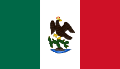
 First National Flag. Used during the First Mexican Empire used between 1822-1823.
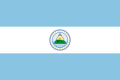 Second National Flag. Used during the United Provinces of the Center of America between 1823-1824.
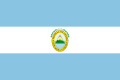 Third National Flag. Used during the Federal Republic of Central America between 1824-1839.
 Fourth National Flag. Used from the establishment of the State of Guatemala during the Federal Republic of Central America between 1825-1838.
 First National Flag of the Republic. Used from the establishment of the Republic of Guatemala used between 1838-1851.
 Second National Flag of the Republic. Used from the establishment of the Republic of Guatemala used between 1851-1858.
 Third National Flag of the Republic. Used from the establishment of the Republic of Guatemala used between 1858-1871.
 Fourth National Flag of the Republic with the Official Shield. Used from the establishment of the Republic of Guatemala adopted on 17 August 1871.
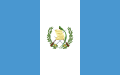 Fifth National Flag of the Republic with the Official Shield. Used from the establishment of the Republic of Guatemala adopted on 12 September 1968.
 Sixth National Flag of the Public with the Official Shield. Used from the establishment of the Republic of Guatemala, adopted on 29 December 1996 following the signing of the Agreements for a Firm and Lasting Peace.
.svg)


.svg)

Government flags
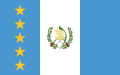
Flag of the President of Guatemala

Flag of the Vice-President of Guatemala
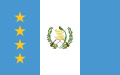
Flag of the President of the Congress of the Republic of Guatemala.

Flag of the President of the Supreme Court of Guatemala


Contenido relacionado
Mondonedo
Alaskan flag
Slovakia flag