
Grande Armée
The Grande Armée (in Spanish "Great Army"), also known as the French Imperial Army, named after Napoleon while preparing the invasion of England, is the military term that was adopted in France to designate its main force in military campaigns. In practice, the name is applied specifically to the Napoleonic army, the multinational army recruited by Emperor Napoleon I of France in his campaigns at the turn of the century XIX: the Napoleonic wars.
The first time that Napoleon used this term was on the occasion of the gathering of troops that took place in Boulogne-sur-Mer in order to invade England, an objective that could not be met when he lost the support of the Spanish-French fleet., defeated at Trafalgar (1805), and it became impossible to transport such a large number of men and equipment to the British Isles. Instead, he had to lead this army towards the Rhine to contain the Austrian and Russian plans to invade France.
Originally, the Grande Armée consisted of six army corps under the command of Napoleon's marshals. As Napoleon conquered more and more of the continent, the army increased in size, reaching a peak of 600,000 soldiers (plus a million in reserve or mobilized) in 1812, just before the invasion of Russia in the War of War. the Sixth Coalition. At that time, the Armée was composed of:
- 300 000 French, Belgian and Dutch
- 95 000 Poles
- 35 000 Austrians
- 30 000 Italians
- 24 000 Bavarians
- 20 000 Saxons
- 20 000 Prussians
- 17 000 westphalian
- 15 000 Swiss
- 9800 Danish and Norwegian
- 4000 Portuguese
- 4000 Spanish
- 3500 Croats
With the exception of the Polish and Austrian corps, each contingent was commanded by a French general.
History
"For the history of the French army in the period 1792 to 1804 during the wars of the First and Second Coalition, see French revolutionary army.".
1804–1806

The Grande Armée was originally formed as L'Armée des côtes de l'Océan (Army of the Oceanic Coasts) intended for the invasion of Gran Brittany, in the port of Boulogne in 1804. Following Napoleon's coronation as Emperor of the French in 1804, the Third Coalition was formed against him and the Grande Armée turned its sights eastward in 1805. The army left Boulogne at the end of August and, by rapid marches, surrounded General Karl von Mack's isolated Austrian army at the fortress of Ulm. The Ulm campaign, as it came to be known, resulted in 60,000 Austrian prisoners at the cost of only 2,000 French soldiers. In November, Vienna was taken, but Austria refused to capitulate and kept an army standing. Furthermore, ally Russia had not yet committed to action. The war would continue for a while longer. The issue was decisively resolved on December 2, 1805 at the Battle of Austerlitz, where the numerically inferior Grande Armée defeated a combined Russian-Austrian army led by the Russian Emperor Alexander I (Alexander I of Russia).). The impressive victory led to the Treaty of Pressburg on December 26, 1805, with the dissolution of the Holy Roman Empire the following year.
.jpg)
The alarming rise of French power in Central Europe worried Prussia, which had remained neutral the previous year. After many diplomatic disputes, Prussia secured promises of Russian military aid and the Fourth Coalition against France was born in 1806. The Grande Armée advanced into Prussian territory with the famous battaillon-carré system. > (battalion square), so the corps marched short support distances and became vanguards, rearguards or flank forces as the situation demanded, and decisively defeated the Prussians at the battles of Jena and Auerstedt, both fought on October 14, 1806. After a legendary chase, the French took 140,000 prisoners and killed and wounded approximately 25,000. The III Corps (Grande Armée) of Marshal Louis-Nicolas Davout, the victor at Auerstedt, received the honors of marching to Berlin first. Once again, the French had defeated an enemy before their allies arrived and, once again, this did not bring peace.

1807–1808

Napoleon now turned his attention to Poland, where the remaining Prussian armies were uniting with their Russian allies. A difficult winter campaign produced nothing but a stalemate, worsened by the Battle of Eylau on 7–8 February 1807, where Russian and French casualties soared with little gain. The campaign resumed in the spring and this time the Russian army of General Levin August von Bennigsen was soundly defeated at the Battle of Friedland on June 14, 1807. This victory brought about the Treaties of Tilsit. ] between France, Russia and Prussia in July, leaving Napoleon without enemies on the continent.
The Grande Armée was dissolved in October 1808 and its constituents were formed into the Army of Spain and the Army of the Rhine, which in 1809 was reorganized into the Army of Germany.
1810–1812
With the exception of Spain, there was a three-year pause. Diplomatic tensions with Russia, however, became so acute that they eventually led to war in 1812. Napoleon assembled the largest field army he had ever commanded to confront this threat. On June 24, 1812, shortly before the invasion, the troops assembled with a total strength of 685,000 men were composed of:
- 410 000 French
- 95 000 Poles
- 35 000 Austrians
- 30 000 Italians
- 24,000 Bavarians
- 20,000 Saxons
- 20 000 Prussians
- 17 000 westphalian
- 15 000 Swiss
- 10 000 Danish and Norwegian
- 4,000 Spanish
- 4,000 Portuguese
- 3500 Croats
- 2000 Irish.

The new Grand Army was somewhat different from the previous one; More than a third of its ranks were now occupied by non-French recruits from satellite countries or allies of France. The gigantic force crossed the Niemen River on June 24, 1812, and Napoleon hoped that a rapid march could place his men between the two main Russian armies, commanded by generals Barclay de Tolly and Pyotr Bagration. However, the campaign was characterized by many frustrations, as the Russians managed to evade Napoleon's pincers no less than three times. A final stand for the defense of Moscow led to the massive Battle of Borodino on September 7, 1812. There the Grande Armée won a bloody but indecisive and debatable Pyrrhic victory. A week later, the Grand Army finally entered Moscow only to find the city largely empty and in flames. His soldiers were then forced to put out the fires while chasing arsonists and protecting the city's historic districts.
Napoleon and his army spent more than a month in Moscow, waiting in vain for the Russian emperor to respond to France's peace offers. Finding these efforts futile, the French departed on October 19, now just a shadow of their former selves. The epic retreat during the famous Russian winter dominates popular conceptions of the war, even though more than half of the "Grande Armée" It had been lost during the summer. The French were repeatedly harassed by the converging Russian armies, Marshal Michel Ney even carried out a famous rearguard separation between his troops and the Russians, and when they reached the Berezina River, Napoleon only had around 49,000 soldiers and 40,000 stragglers of meager military value. The resulting battle and the monumental work of General Jean Baptiste Eblé's engineers saved the remains of the Grande Armée. Napoleon left his men to move to Paris and deal with new military and political affairs. Of the 685,000 men who constituted the initial invasion force, only 93,000 survived.

1813–15

The catastrophe in Russia now fueled anti-French sentiments throughout Europe. The Sixth Coalition was formed and Germany became the centerpiece of the next campaign. With his usual genius, Napoleon raised new armies and opened the campaign with a series of victories at Lützen and Bautzen. But due to the poor quality of French troops and cavalry after the Russian campaign, along with the miscalculations of certain subordinate marshals, these triumphs were not decisive enough to win the war and only secured an armistice. Napoleon hoped to use this respite to increase the quantity and improve the quality of the 'Grande Armée', but when Austria joined the Allies, the strategic situation became bleak. The campaign reopened in August with a major French victory at the two-day Battle of Dresden. However, the Allies' adoption of the Trachenberg Plan, which sought to avoid direct conflict with Napoleon and focus on his subordinates, bore fruit, as the French suffered defeats at Großbeeren, Katzbach, Kulm, and Dennewitz. The growing number of allies finally cornered the French at Leipzig, where the famous three-day Battle of the Nations saw a huge loss for Napoleon when a bridge was prematurely destroyed, abandoning 30,000 French soldiers across the Elster River. The campaign, however, ended on a victorious note when the French destroyed an isolated Bavarian army corps attempting to block their retreat at Hanau.

"The Great Empire no longer exists. "Now we must defend France itself," were Napoleon's words before the Senate at the end of 1813. The emperor managed to raise new armies, but strategically he found himself in a practically hopeless position. Allied armies were invading from the Pyrenees, across the plains of northern Italy and also along the eastern borders of France. The campaign began ominously when Napoleon suffered a defeat at the Battle of La Rothière, but he quickly regained his old spirit. In the Six Days Campaign of February 1814, the 30,000-man Grande Armée inflicted 20,000 casualties on Field Marshal Gebhard Leberecht von Blücher's scattered corps at a cost of only 2,000 to themselves. He then headed south and defeated Field Marshal Karl von Schwarzenberg's army corps at the Battle of Montereau. These victories, however, could not remedy such a bad situation, and French defeats at the Battle of Laon and the Battle of Arcis-sur-Aube dampened spirits. At the end of March, Paris fell to the Allies (Battle of Paris (1814)). Napoleon wanted to continue fighting, but his entourage refused and he was forced to abdicate on April 6, 1814.

After returning from exile on the island of Elba in February 1815, Napoleon set about making a renewed effort to secure his empire. For the first time since 1812, the Army of the North, which would be in command for the next campaign, was professional and competent. Napoleon hoped to trap and defeat the Allied armies under the Duke of Wellington and von Blücher in Belgium before the Russians and Austrians could arrive. The campaign, which began on 15 June 1815, was at first successful, leading to victory over the Prussians at the Battle of Ligny on 16 June; However, poor work by the General Staff and bad commanders created many problems for the "Grande Armée" throughout the campaign. Marshal Emmanuel de Grouchy's delayed advance against the Prussians allowed Blücher to rally his men after Ligny and march to Wellington's aid at the Battle of Waterloo, causing Napoleon's final and decisive defeat.
Forces of the Grande Armée

Cavalry
Despite having had his training and having been a pioneer in artillery maneuvers, Napoleon is well remembered for the performance of his cavalry. This played a very prominent role during the expansion process of the French Empire, being crucial in many battles. Napoleon's final defeat at Waterloo is especially attributable to errors in communication that caused cavalry troops to attack too soon, being decimated by not having the support of infantry or artillery. However, already at this time the inferiority of cavalry in combat against increasingly powerful, precise and maneuverable artillery began to be noticed.
Napoleon's army, like most other armies of the time which were divided into three main branches, was composed of one or more corps: Heavy cavalry (cuirassiers and horse carabiniers), medium or line cavalry (dragons and ulans) and light cavalry (hussars, mounted hunters and later the mamluks). Each cavalry corps was formed in a way that covered specific functions during campaigns, so the members of each one had to have certain characteristics and qualities required in that corps. This does not mean that, at times, a corps of light cavalry could not serve functions that were usually attributed to heavy cavalry.
- Coraceros: Equipped as gentlemen with a hard tie in the chest and iron helmet and brass. They used to be the tallest men and rode big horses but equally fast. They were armed with a straight edge and a gun (for officers). They served as a clash force, so they carried against enemy infantry troops to open gaps and allow the entry of infantry or other cavalry bodies. A farmer must be able, above all, to fight from his mount.
- Carabineros on horseback: Similar in armament and functions to the but more selective and demanding, they functioned as heavy elite cavalry. Despite their name, they were not armed with snails, although they had been carried for a while when the body was formed before the ascent of Napoleon to power.
- Dragons: Average or line horses. They were the main body of the French cavalry since before Napoleon, used both in battle, as well as an advanced body and occasionally in patrolling. They were wearing a metal helmet, but not a tie, and were armed with double-edged sable, also straight, and also with a gun and a snail. That way they could quickly move on horseback and then fight and defend a position fighting as infantry.
- Lanceros and ulanos: The most representative figures of the average cavalry. They constituted a relatively late addition to the Emperor's troops, after their alliance with the Poles and Lithuanians who sought to independence from Russia. They lacked armor and carried a square chaco instead of helmet and were armed with a light spear and a sable in the traditional Polish style, utterly curved and massive. The combination of both weapons allowed them to serve as a clash force against other cavalry bodies and infantry formations in frame, as they could carry the spear, surpassing bayonets, and then fight with the saber. Their uniforms draw attention to the use of short boots and pants instead of the usual boots and socks of the other bodies. The ulanos were one of the most feared forces of the Napoleonic cavalry, being nicknamed in Spain as "Polish Devils" or "Inferno Pigs".
- Húsares: The most representative body of the light cavalry, also derived from the Polish tradition, but adopted since the times of the Bourbons. They constituted one of the most notorious bodies; they were armed with curved and lightweight sabers and gun (official). Its main function was to weaken the enemy with fast loads or brokerages, usually without being engaged in combat, since its main strength was the ability to mobilize quickly and coordinatedly (as a fish cardulum would do). They were particularly useful in scaramuzas and "sorpressive" attacks on flanks or rearguards. Its uniforms were particularly colourful and profusingly decorated, highlighting for including a Pelisse, a thick and rigid leather jacket that used to be worn by buttons on one shoulder and was able to protect its owner from sables and bayonets cuts.
- Hunters on horseback: They were the eyes and ears of the armies of Napoleon, for they were used for reconnaissance operations and messengers, keeping the commanders of the enemy movements informed, while "hugging" the enemy's reconnaissance and intelligence troops. They were armed with snails, pistols and curved and light sables. They were the fastest and most skilled riders in individual manoeuvres, ordinary men of small shape like their horses. They wore uniforms similar to those of infantry granaries, but green to facilitate a primitive camouflage. Among the horse hunters is the figure of Joaquín Murat, one of the most outstanding mariscales of Napoleon, who would later appoint him King of Naples.
- Imperial Guard: The Imperial Guard had been created as a body of bodyguards of Napoleon, his family and most important men. Within the guard, there were also several cavalry regiments divided between the different bodies already mentioned, including ulanos, the so-called "Dragones de la Emperatriz", elite gendarmerie and hunters and horse-riding granaries. They were tall and corpulent men, totally loyal to the emperor and particularly skilled and fierce in combat. Despite being primarily the bodyguards and reserve forces, they were often employed in battle and achieved notable victories for the Empire.
- Mamelucos: They formed a company of about 240 horsemen, who joined the French troops in 1801, after the Egyptian Campaign. At first they constituted rather a personal army of Bonaparte, attached to the horse hunters of the Imperial Guard. After the Battle of Austerlitz (1805), an official mamluk regiment will be formed. They fought equipped in the same traditional way that they had done it under the Ottoman Empire: wearing bombs and turbans and armed with a drawer, one or two pistols, a small deck, a ham and an alphanage (the latter would be adopted as a sable preferred by Napoleon and his high command, and later also by generals and mariscales of other European armies). Their arsenal, the agility and resistance of their Arab horses, as well as their ability to ride them and their loyalty to death to the Emperor, allowed them to stand out in functions of light cavalry and defence forces. They were famous for their work on the Iberian peninsula, being immortalized by Goya in the picture 2 May Uprising.
Infantry
- Regular infantry (granates, rifles and voltigeurs or line harassers): the bulk of the army was composed of the standard infantry. Infantry regiments were known as "demi-brigades" and were made up of three or four battalions.
- Light infantry (carabineros on foot, voltigeurs lightweight and hunters on foot: the companies of voltigeurs they began to join the regiments of the French regular army in 1801. Them voltigeurs They were agile troops, whose task was to advance in the front of the attack and try to break the enemy formations or attack the artillery servers. Separate infantry regiments were subsequently formed.
Artillery
As might be expected from an emperor who had previously been an artillery officer, French cannons were the backbone of the ground troops. The French generally used artillery in massive batteries to weaken enemy formations before launching infantry or cavalry charges. The perfect training of the artillery crews allowed Bonaparte to move these weapons with great speed both to prevent the weakening of defensive positions and to crush and open gaps in the enemy lines. In general, French guns were 4-pounder, 8-pounder or 12-pounder, the smaller calibers being replaced by 6-pounder calibers at the end of the wars. The French cannons had brass barrels on their carriages, wheels and their vantrains were painted olive green.
Imperial Guard
The French Imperial Guard were the elite units of that time and had evolved from the Consuls' Guards and the Consular Guard. It was an army in itself with infantry, artillery and cavalry divisions. Napoleon wanted them as a role model for the army and also as a force that would fight with him in numerous campaigns, and who would be completely loyal to him. Although infantry rarely entered combat en masse, cavalry was often thrown into battle as a killing blow and their artillery often struck enemies before assaults. The Imperial Guard was made up of three sections:
- Old Guard: This was the best thing about Napoleon's army. The Old Guard was composed of veterans with more time of service (from 3 to 5 campaigns).
- Grenadiers à Pied de la Garde Impériale (Greats of the Imperial Guard): The Guard Farmers were the oldest regiment in La Grande Armée. During the 1807 campaign in Poland, the farmers received the nickname of “the grognards” ("the murmurers") by Napoleon himself. They were the most experienced and brave infantry soldiers of the Guard, some veterans had served in more than 20 campaigns. To enlist with the Granaderos, a recruit must have served for at least ten years, received a mention of courage, be literate and have more than 178 cm high. The troops of the Old Guard used to remain in reserve for crucial moments in the battlefield and were used to act as a hammer strike against a shaken enemy. The first farmer regiment on foot played an important role in the Battle of Eylau. By 1815, the Farms of the Old Guard were numbered in four regiments, the 3.° of Granaderos and the 4.° of Granaderos had been added in 1810 and 1815 respectively. These regiments (3o and 4o of granaderos) plus the 2nd oldest granaderos participated fully in Ligny. Two days after Ligny, these regiments were defeated by the British as they advanced in an attempt to crush the weakened British line in Waterloo. The two battalions of the 1st Granaderos formed squadrons and resisted allied attacks to protect the general withdrawal. The Granaderos on foot had a long dark blue uniform (open with long tails) with red counters, puddles and white flaps. The most distinctive feature was the high bear skin cap, decorated with a recorded gold plate, a red pen and white laces.
- Chasseurs à Pied de la Garde Impériale (cazadores on foot of the Imperial Guard): the Guard Hunters constituted the second oldest regiment in La Grande Armée. The 1.o de Cazadores was the sister formation of the 1.o de Granaderos on foot. They had the same admission criteria, but to enter this regiment they had to have more than a 171 cm high. The Hunters on foot came into action in several crucial battles. After the return of Napoleon in 1815, the hunters expanded to four regiments, with the 2nd, 3rd and 4th regiments formed by recruits with a maximum of four years of experience. These regiments also participated in the assault of the Guard during the final phase of the Waterloo battle. The 2nd battalion of the 1st of Hunters joined the main attack of the Middle Guard, but they were rejected, while the 2nd protected the Emperor. The Chasseurs à Pied wore a long dark blue uniform (open with long tails) with red counters, red puddles with green and white flaps. In the campaign, the Chasseurs often wore dark blue pants. As with the Granaderos, the most distinctive feature of the Hunters was the high bear skin cap, decorated with a red feather on green and white laces.
- Middle Guard: It consisted of 3 to 5 campaigns veterans.
- Young Guard: Initially formed by veterans with a campaign at least, as well as brilliant young officers.
Engineers
While the glory of battle went to the cavalry and infantry, the bridge builders of Napoleon's army (the pontooners) were an indispensable part of the military machine. His main contributions were to help the emperor move his forces across water obstacles by building pontoon bridges. His pontoon capabilities allowed Bonaparte to outflank the enemy by crossing rivers when the enemy least expected it, and in the case of the great retreat from Moscow, save the army from complete annihilation at the Battle of the Berezina. They may not have obtained glory, but Napoleon highly valued his pontooners and had up to 14 companies of these within the army.
Large Armée personnel ranking
Rank Equivalence Officers Général de division,
Lieutenant généralGeneral of division Général de brigade,
Maréchal de campBrigade General Adjudant-commandant Major colonel, brigadier Colonel Colonel Colonel en second First class Lieutenant Colonel Major Lieutenant Colonel Major en second First Commander, First Major Chef de bataillon or Chef d'escadron Commander, Major. Capitaine adjutant-major Captain first Captain Captain Lieutenant Lieutenant Sous-lieutenant Lieutenant, Ensign Officers and troops Adjudant sous-officier Officer Adjudant-Chef Brigade Adjudant Sergeant Major Sergent-Major or Maréchal des logis Chef Sergeant first Sergent or Maréchal des Logis Sergeant second Caporal-Fourrier or Brigadier-Fourrier Sergeant Caporal or Brigadier (cavalry, horse artillery and gendarmerie) Corporal Soldat or Cavalier (cavalry) or Canonnier (artillery) Soldier
Gallery

Old Imperial Guard Farmhouse

Fusileros granaderos and rifleeros hunters of the Imperial Media Guard

Hunter on horseback

Lancero
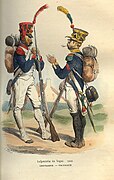
Granadero (left) and voltigeur

Carabinero

Dragon

Húsares

Marine of the imperial guard


Related bibliography of the Napoleonic Wars series
.jpg)
Contenido relacionado
Squad 201
Philippine-American War
HMS Bounty
Operation Bojinka
Battleship