
Golden Gate Bridge
The Golden Gate Bridge is a suspension bridge located in California, United States; It joins the San Francisco Peninsula on the north with Marin County on the south, near Sausalito. Golden Gate is also the name of the strait on which the bridge is built, and gets its name from the strait in Constantinople, also called the Golden Gate, since it connected Europe with Asia.
The Golden Gate is the most famous bridge in San Francisco despite not being the largest in this city, since the Bay Bridge is the main thoroughfare.
In the decade after World War I, road traffic in the San Francisco Bay region increased sevenfold, so the ferry system was unable to absorb that growth. Listed as a suspension bridge, built between 1933 and 1937, with an approximate length of 1,280 meters, it is suspended from two 227-m-high towers. It has a road with six lanes (three in each direction) and has protected accessible lanes for pedestrians and bicycles. The bridge is used to cross power lines and fuel pipelines. Under its structure, it leaves 67 m of height for the passage of ships through the bay. The Golden Gate was the greatest engineering work of its time. It was urgently painted to avoid the rapid oxidation produced in the steel of its structure by the Pacific Ocean.
History
The Golden Gate Bridge and Highway District was authorized by an act of the California Legislature in 1928 as the official entity to design, construct, and finance the Golden Gate Bridge. However, after the Crash of '29, the District was unable to raise the construction funds, so they lobbied for $30 million worth of bonds to be sold. The bonds were approved in November 1930 with the votes of the counties affected by the bridge. The construction budget at the time of approval was USD 27 million. However, the District was unable to sell the bonds until 1932, when Amadeo Giannini, founder of the San Francisco-based Bank of America, agreed, on behalf of his bank, to purchase the entire amount outstanding for the purpose of to help the local economy. The US federal government was not involved in financing the construction costs of the bridge.
Construction began on January 5, 1933. The bridge cost more than $35 million to build. The chief engineer for the project was Joseph Strauss. Strauss remained at the head of the project, supervising the construction on a day-to-day basis, and made some innovative contributions. He pioneered the use of mobile safety nets below the construction site, which saved the lives of many steelworkers who would have died without such protection. Of eleven men killed by falls during construction, ten died (when the bridge was near completion) when the netting gave way under the pressure of a fallen scaffold; nineteen others were saved by this net during construction.
By mid-1935, the two towers (north tower and south tower) with a height of 227 meters were ready to support the two main cables. Each of the cables is just over three feet (about a meter) in diameter and weighs 12,000 tons. They were too heavy to be carried across the Golden Gate Strait on barges and hoisted to the top of the towers.
The cables were made on-site using a process called "cable spinning," invented by John A. Roebling in the 19th century XIX, and founder of the Company that carried out the works.
To string the cables, workers pulled pencil-thick wire from the reinforced concrete anchor on one shore past the two towers to the other anchor; there he made sure and took him back. Many trips back and forth were necessary; the total number of wires making up each rope is 27,572. The individual wires were bundled into heavier strands and compacted to form the finished rope. The spinning of the cables took only six months and nine days, setting speed and efficiency records (the deck of the bridge highway, the track between one tower and the other, is supported by these two cables; hence the definition of bridge pendant).
Traffic

Because it is the only way out of San Francisco on its north side, the bridge is part of both Interstate Route 101 and California State Route 1. On a typical day, about 100,000 vehicles pass over the bridge. It has a total of six lanes and a sidewalk on each side. During the mornings from Monday to Friday, when more traffic enters the city, 4 of the 6 lanes are arranged to circulate in the south direction. In contrast, during workday evenings, most traffic goes to Sausalito, with the largest number of lanes reserved for exiting San Francisco. The separation line between traffic directions is moved when necessary, and until 2015 it was marked by traffic cones that were fixed to the ground.
Since the 1980s, a proposal had been studied for the installation of a mobile barrier to separate the directions of traffic, avoiding the possibility of frontal collisions between vehicles. Finally, it was installed in January 2015.
As for sidewalks, pedestrians can only use the one located on the east side of the bridge. Its opening and closing are regulated by automatic doors. Cyclists (skateboards are not allowed) can use both sidewalks, depending on the weather and the time of year. On the east sidewalk, bicyclists must always yield to pedestrians.
Suicides


The Golden Gate Bridge has been a suicide black spot since its inauguration in 1937 and due to its fame, many curious people come to the area to wait for hours to witness one live, since the number of suicides since the bridge is alarming. Most die from water impact trauma after a four-second fall from about 75 m high (at about 120 km/h). Approximately 5% survive the initial impact, but usually end up dying from drowning or hypothermia in the cold water.
The media have always tried to silence news of suicides, but due to the large number of citizens and tourists who cross the bridge daily, it was unavoidable to observe them. For this reason, on June 28, 2014, the San Francisco authorities decided that it was time to approve a fund with a total of 76 million dollars, to place a steel network of more than 30 kilometers across the Golden Gate. Once placed, it will put an end to 84 years of suicides in which it is estimated that around 1,600 people have ended their lives.
After years of debate, the suicide barriers, consisting of a stainless steel fence extending 6m from the bridge and supported by structural steel 6m below the walkway, began installation in April 2017. it was estimated that it would take approximately four years at a cost of over $200 million. In December 2019, it was reported that construction of the suicide prevention network had been delayed by two years because the main contractor, Shimmick Construction Co., it had been sold in 2017, causing a number of existing projects to slow down. In December 2019, the completion date for the Golden Gate Bridge network was set for 2023.
Structure

The design team

Joseph Strauss's passion for bridges dates back to his years at the University of Cincinnati, and although he specialized in building bridges of fairly limited size, mostly overland, he dreamed of building "the biggest thing of its kind that a man could build.
In 1919, Michael O'Shaughnessy, an engineer for the city of San Francisco approached Strauss to build "his" bridge over the Golden Gate, at the point where the turbulent waters of San Francisco Bay and the Pacific Ocean meet, and where the eddies reach a speed of 95 km/h. Strauss was delighted with the opportunity to realize his dream and worked tirelessly from 1921 on the design of the bridge. However, the first sketches of him were not immediately successful, so he spent more than a decade trying to win support, especially in the rest of California. However, Strauss's persistence allowed him to finally pull off his project. The engineer's initial design already conveyed the grandeur of the future structure: it included two cantilevers, one on each side of the main deck, suspended 67 meters above the water.
To make up for his relative inexperience in suspension bridge construction, Strauss surrounded himself with a team of specialists. He called on several renowned architects and engineers to give credibility to a project that seemed almost impossible to carry out. Strauss initially turned to Charles Alton Ellis, a professor of civil engineering. Although he did not have an engineering degree, Ellis provided scientific backing to the project, since he was in charge of the calculations for the construction of the bridge. Subsequently, Strauss hired Leon Moisseiff, a civil engineer reputed to be the country's leading bridge designer at the time, having completed, among others, the Manhattan Bridge in New York. Together, Moisseiff and Ellis pushed the limits of what was technically possible, including the bridge's two pylons, which rise more than 200 meters above the water. Finally, Strauss contacted Irving Morrow, a San Francisco architect who specialized in building houses. Morrow created the various art deco sculptures on the bridge, and was also responsible for the choice of the "international orange" color for the bridge. that adorns the bridge, and that makes it recognizable among all.
Image Gallery

One side of the bridge.

Night view.
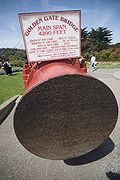
Cross-section of a cable section.

View from Baker Beach.

North view.
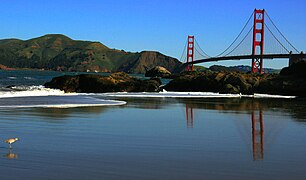
Reflection of the bridge in the water.


