
Gable

A gablet, a word from the French gablet (also incorrectly called a pinion), is an architectural element that serves as a crowning or ornamental finish, similar to a pediment. It has a triangular and sloping shape, formed by two straight lines and an acute vertex, and was arranged in the buildings of the late Gothic period.
Unlike the classic pediment, it does not have to coincide with the slopes of a roof, since it is also placed on railings and cornices or enhancing the entrance doors of some buildings. It can have the lower horizontal line marked or be limited by the archivolts of an arch, generally also pointed.
Some authors suppose that it was an imitation in stone of the wooden constructions that formed armor, constructions that in the Middle Ages were widely used to cover the vaults of monuments that were left unfinished due to lack of resources and that art later simulated with the stone using it as ornamentation and decorating it in many different ways.
In the Gothic period it appears simple and severe, outlined by a cornice and decorated in the center with a trefoil, quatrefoil or multifolio (see rosette), only regularly relieved and often replaced by sculptures. Sometimes it is decorated on the outside with fronds or crochets (Gallicism), leaf-shaped ornamental elements, which also abound on the capitals.
The gable was also widely used in the style called Hispano-Flemish, at the end of the 15th century. It can be seen in cathedrals such as Toledo, in the Álvaro de Luna chapel, or in the cathedral tower.
Image gallery

Gablete ornamental de la cathedral de Lyon

Triple gablete rematizing the Gothic Town Hall of San Quintin (Aisne), France
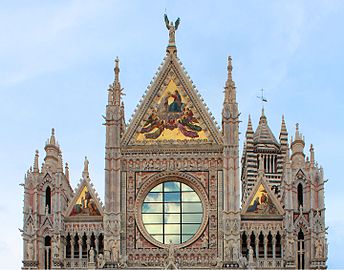
Gables on the facade of the cathedral of Siena
.jpg)


French Romanesque Church of Notre-Dame du Port, with a protogablete
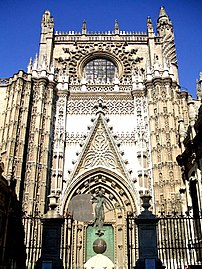
Gablete on the cover of San Cristobal de la Cathedral of Seville

Gablete at a gate of Notre Dame (Paris).

Depurado gablete ahead of the terrace of the rosette of the Colegiata de los Santos Gervasio and Protasio de Gisors


,_coll%C3%A9giale_St-Gervais-et-St-Protais,_croisillon_nord,_rosace_et_g%C3%A2ble_du_portail.jpg)