
Fu Lions


The lions of Fu, also lions of Buddha or Chinese lions (and also erroneously known as dogs of Fu b> —since they are not canids—), and sometimes also called shishi (in Chinese, 石獅; pinyin, shíshī; literally, 'stone lion'), are powerful mythical animals that originate from Buddhist tradition and are consequently quite widespread in the Southeast Asian, China, Japan, Korea and Thailand. To the extent that the Chinese use the term "Fo" To refer to Buddha, one can also speak of "Lions of Buddha". In fact, they are often found on the thresholds of Buddhist temples, palaces, and imperial tombs, on all buildings from the Han Dynasty (206 BC-AD 220) to the end of the empire (1911), as well as as in some representations of the bodhisattva Manjushri.
Actually, these beasts do not appear in early Chinese art, but were introduced late in Buddhism as upholders of law and protectors, much like the Dharmapalas. Another proof of this is that Buddha is sometimes represented riding on the back of these beasts.
The lions of Fu are considered a symbol of protection against evil spirits (demons), bad energies and bad people. For this reason, palaces, buildings and homes used to be decorated with figures of these creatures that always come in pairs made up of a male and a female.
In ancient times, when the figure of this beast reached homes, it used to be said that the male Fu lion was entrusted with the task of protecting the members of the household outside of it while the female protected the home.
Etymology
Guardian lions are called in many different ways depending on the language and context. In Chinese they are traditionally called simply shi (獅, pinyin: shī) meaning lion—the word shi itself is thought to be derived from the Persian word. Lions were first presented to the court Han by emissaries from Central Asia and Persia, and in the VI century AD. C. they were already popularly represented as guardian figures. Today the names of the guardian lions are specified according to the medium or material, for example:
- Stone Lion (pin, pinyin: shíshī): for a stone sculpture; or
- Bronze Lion (,, pinyin: tóngshī): for a bronze sculpture.
and less commonly:
- Auspicious Lion (continued,, pinyin: ruìshī): referring to the Tibetan god lion of snow or good fortune.
- Lion of fortune (RUP,, pinyin: fúshī)[chuckles]required]: referring to good fortune
- Lion of Buddha or Lion of Buddhism (佛, pinyin: fóshī)[chuckles]required]: referring in a religious context to the lion as protector of Buddha.
In other Asian cultures
- In Japan: Lion figures are known as Komainu (perros, lion dogs)
- In Korea: known as Xiezhi or Haetae
- In Burma, Laos and Cambodia: known as Chinthe and also gives its name to the Chindit soldiers of World War II.
- In Okinawa, Japan: known as Shisa
- In Sri Lanka: known as Simha (embodied ම מ)ののののに。
- In Thailand: known as Singha
- In Tibet: known as Snow Lion
- In Vietnam: known as SALES Tá đá
Western Names
In English and various Western languages, guardian lions are often referred to by a multitude of names such as: "Fu dogs", "Foo dogs", "lions Fu", "Fo lions", and "dog lions". The term "Fo" or "Fu" may be due to the transliteration of the words 佛 (pinyin: fó) or 福 (pinyin: fú), which mean "Buddha" or "prosperity" in Chinese, respectively. However, Chinese references to guardian lions are rarely prefixed with 佛 or 福, and more importantly, they are never referred to as 'dogs'.
References to guardian lions as dogs in Western culture may be because the Japanese refer to them as "Korean dogs" (狛犬・高麗犬) due to its transmission to Japan from China via Korea. It may also be due to confusion that the guardian lions represented certain breeds of Chinese dogs such as the Chow Chow (鬆獅犬, Pinyin: sōngshī quǎn, lit. "puffy dog lion") or Shih Tzu (獅子狗; pinyin: Shīzi Gǒu, lit. "lion dog").
Representation

Fu lions are usually shown in pairs with one or both front paws resting on a sphere. They are often found symbolically protecting the entrance to temples and tombs in order to intimidate desecrators, demons and other evil spirits (see gargoyle). Thus, for example, the Forbidden City, in China, is jealously guarded by several pairs of Fu lions.
Their eyes are always open, and with the fierceness of their gaze they intend to transmit protection against evil spirits that want to violate the tranquility of the place. The animal is a symbol of energy and courage.
Sexual dimorphism
Pairs of Fu lions are usually found to be sexual, so in the pair that guards the sacred entrance of an enclosure we differentiate the female from the male because the latter holds an orb under its paw, while the latter holds a cub. Strictly speaking, each one of them which possesses different powers and attributes.
Looking out from the door, the male stands to our left and the female to our right.
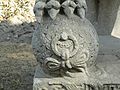
Detail of the male sphere.

Detail of the female child.
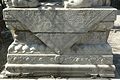
The base of the statue.


History

The first representation of Fu lions dates back to the Han dynasty, in Chinese art, around 208 BC. C. and until 221 d. C. However, for almost 400 years they are not found again and only reappeared in the Tang dynasty. (618-917 AD).
Their introduction into Chinese art coincided with Buddhism. The popularity of this hybrid being was then based on its symbolism. Buddhist art showed lions, hitherto unknown, as beneficent beings and teachers of cats. The Lion of Fu was protector of sacred buildings and upholder of the law. The lions used to be placed flanking the portals of business institutions, temples and, in general, places inhabited by distinguished people. It was not uncommon either to see these sacred lions guarding tombs or in front of government buildings to scare away evil spirits. Over the years, the custom of giving these lions to the Emperor, representing them in sculptures, tapestries or other plastic arts, became established.
Contenido relacionado
Male nude
Moira
Victory (mythology)