
Francis II of France
Francis II of France (19 January 1544 Fontainebleau - 5 December 1560 Orleans) was King of France from 1559 to 1560. He was also King Consort of Scotland, as a result of his marriage with Mary I of Scots, from 1558 until her death in 1560.
He ascended the throne of France at the age of fifteen, after the accidental death of his father, Henry II of France. His brief reign was dominated by the early movements of the French Wars of Religion.
Although the actual age of majority had been set at fourteen, her mother, Catherine de' Medici, entrusted the reins of government to her uncles from the House of Guise, staunch supporters of the Catholic cause. However, they were unable to help the Catholics in Scotland against the creeping Scottish Reformation, and the Auld Alliance dissolved. Francisco II was succeeded by two of his brothers, who were also unable to reduce tensions between Protestants and Catholics.
Early Years


He was the eldest son of Henry II (fourth son of Francis I and Claudia of France), and of Catherine de' Medici (daughter of Lorenzo II de' Medici and Magdalena de la Tour de Auvergne). His paternal grandparents were King Francis I and Claudia of France. On his paternal grandmother's side, his great-grandparents were King Louis XII of France and Anne of Brittany. In 1533, at the age of fourteen, Catherine married Henry.
Born eleven years after his parents' wedding. This long delay in producing an heir may be due to his father's repudiation of his mother, in favor of his mistress, Diana of Poitiers. In 1537, another mistress of his father, Filippa Duci, gave birth to a daughter, Diana of France, who was publicly recognized by the prince himself. This fact tested the fertility of the French heir and added pressure on Catherine so that she would have a descendant.
Around 1538, Diana became her father's lover, when he was the Dauphin of France, already married to her mother. Diana was a lady-in-waiting to Claudia of France, Queen Consort of France and Duchess of Brittany. After the queen's death, she was a lady-in-waiting to the king's mother, Louise of Savoy, Duchess of Angoulême and Anjou, and finally, also to Eleanor of Austria, queen consort of France. It is said that she exercised great influence over him, to the point of being considered the true sovereign. However, this repudiation was denied by Diana's insistence that Enrique spend his nights with Catalina. Francisco had nine legitimate brothers:
- Isabel (1546-1568), married to Felipe II of Spain (1559).
- Claudia (1547-1575), married to Carlos III de Lorena.
- Luis (1549-1550), Duke of Orleans.
- Charles (1550-1574), Duke of Orleans (1550-1560) and King of France from 1560 to 1574.
- Alexander Edward (Enrique) (1551-1589), Duke of Anjou (1551-1576), of Orleans (1560-1576), king of Poland (1573-1574) and king of France (1574-1589).
- Margarita (1553-1615), married to Enrique IV de France in 1572.
- Hercules (Francisco) (1555-1584), Duke of Alençon and Anjou.
- Victoria and Juana (1556).

During the reign of Enrique, the rise of the Guisa brothers took place; Carlos, who became a cardinal, and Francisco, Henry's childhood friend who was made Duke of Guise. His sister, Mary of Guise, had married James V of Scotland in 1538, and was the mother of Mary, Queen of Scots. At five and a half years old, Maria was taken to the French court, where she was betrothed to the dauphin, Francisco. Catherine raised her alongside her own children at the Parisian court, while Mary of Guise ruled Scotland as regent for her daughter.
Francis initially grew up in the castle of Saint-Germain-en-Laye. He was baptized on February 10, 1544 in the Trinitaires Chapel at Fontainebleau. His godparents were Francisco I (who knighted him during the ceremony), Pope Paul III, and his great-aunt Margarita de Navarra. He became Governor of Languedoc in 1546 and Dauphin of France in 1547, when his grandfather Francis de El died. Francisco's mentor and governess were Jean d'Humières and Françoise d'Humières. His tutor was Pierre Danès, a Greek scholar originally from Naples. He learned to dance from Virgilio Bracesco and fencing from Hector of Mantua.
Engagement and marriage

King Henry II, his father, arranged a remarkable betrothal for his son to Mary, Queen of Scots, at the Agreement of Châtillon on January 27, 1548, when Francis was just four years old. Mary had been crowned Queen of Scots at Stirling Castle on September 9, 1543, at the age of nine months, after the death of her father, James V. In addition to being Queen of Scots, Mary was the granddaughter of Claudio, Duke of Guise, a very influential character and an important figure at the court of France.
Once the marriage agreement was formally ratified, six-year-old Maria was sent to France to be raised at court until marriage. Although Maria was tall for her age (she reached an adult height of 5 feet 11 inches or 1.80 m), and eloquent, her fiancé Francisco was unusually short and had a stammer. Her father, Henry II, commented that "from the first day they met, she and my son got on as well as if they had known each other a long time." Vivacious, beautiful, and intelligent (according to contemporary accounts), Maria had a promising childhood. At the French court, she was the favorite of all except Henry II's wife, Catherine de' Medici. Portraits of Maria show that she had a small, oval head, a long graceful neck, glossy brown hair, hazel-brown eyes, thick lowered eyelids, finely arched eyebrows, smooth pale skin, a high, regular forehead with firm features.. She was considered a pretty girl and, later, a very attractive woman.
On April 24, 1558, the fourteen-year-old Dauphin married the Queen of Scots in Notre Dame Cathedral in Paris. It was a union that could have given future kings of France the throne of Scotland and also a claim to the throne of England, through Mary's great-grandfather, King Henry VII of England. As a result of the marriage, Francis became King Consort of Scotland until his death. The marriage produced no children, possibly due to Francisco's illnesses or his undescended testicles.
Later, now a widow, Mary returned to Scotland and arrived in Leith on August 19, 1561. Four years later, she married her first cousin Henry Stuart, with whom, in June 1566, she had her only son, Jacob.
King of France
Just over a year after their marriage, on July 10, 1559, Francis became king at the age of fifteen, following the death of his father, Henry II. Among the festivities for the celebration of the marriage of his sister, Isabel, with Felipe II of Spain, a tournament was included, in which his father, Enrique, was seriously injured, because the lance of the Count of Montgomery, who jousted with him, entered the king's eye. Isabel was present when the accident happened. On September 21, 1559, Francis II was crowned King of France at Reims by his uncle Charles his, Cardinal of Lorraine. The crown was so heavy that the nobles had to hold it in place for him. The court then moved to the Loire Valley, where the Château de Blois and the surrounding woods were the home of the new king. Francis II took the sun for his emblem and his mottos Spectanda fides (This is how faith should be respected) and Lumen rectis (Light for the just).

Under French law, Francis at the age of fifteen was an adult who theoretically did not need a regent. But as he was young, inexperienced and in fragile health both physically and mentally, he delegated power over him to his wife's uncles, from the noble House of Guise: Francis, Duke of Guise and Charles, Cardinal of Lorraine.. His mother, Catalina, agreed with this delegation. On the first day of his reign, Francis II ordered his four ministers to take orders from his mother, but as the latter was still mourning the loss of her husband, he directed them to the House of Guise. The family had all the power: Francisco directed the armies and the Cardinal of Lorraine had the finances and affairs of the Church. The brothers had already had important roles in the reign of Henry II; Francis was one of the most famous military commanders in the royal army, and the Cardinal of Lorraine had participated in the most important negotiations and affairs of the kingdom.
The rise of the House of Guise, worked to the detriment of its old rival, Anne de Montmorency, agent of France. At the suggestion of the new king, she left the court to go to her estate to rest. Diana of Poitiers, the mistress of the previous king, was also asked not to appear at court. Her protégé, Jean Bertrand, had to hand over his title of Keeper of the Seals of France, to Chancellor François Olivier, whom Diana had removed from office a few years earlier. It was a palace revolution and the transition has been described as brutal. But, while it undoubtedly caused considerable ongoing frustration, there was no confrontation or retaliation. Anne de Montmorency remained linked to power. As soon as the day after the king's death, he was present at the council meeting and also at the coronation. He later supported the repression of the Amboise conspiracy of 1560, in particular by going to the Parliament of Paris to communicate to its members the measures taken by the king. In July 1560 he returned to court and council, though in far less extravagant fashion than before. The Guises were now the new masters of the court. The king granted them numerous favors and privileges; one of the most important was the title of Grand Master of France, a title until then held by the constable's son, Francisco de Montmorency.
Reign

The reign of Francis II was immersed in religious unrest. From the beginning of his regency, the Guises faced deep discontent throughout the kingdom. The opposition was led by two princes of the blood, who disputed his power and his decisions as rulers. The Guises were seen by many as lacking in legitimacy. To their adversaries, they were simply ambitious foreigners from Lorraine. His father Claude, Duke of Guise, was the son of Renato II, Duke of Lorraine, who had been granted French citizenship by King Francis I, his military companion. The main criticism against the Guises was that they took advantage of the king's youth to exercise power arbitrarily. An opposition movement led by the prince of the blood, Antonio de Navarra, King of Navarra, challenged his power. Some theorists, such as Francisco Hotman, believed that the law authorized the latter to be the king's main adviser, since he was a descendant of Louis IX of France and, therefore, heir to the throne if the House of Valois disappeared in power.. However, Antonio was unable to prevail against the Guises when he went to court.
The government's policy decisions were also challenged. The Guises faced a disastrous financial situation. After decades of wars against the House of Habsburg, the public debt was 48 million pounds, while the king had only 12 million pounds in annual income. The Guises implemented an austerity policy aimed at improving the country's financial situation, but this contributed powerfully to their unpopularity. They also delayed payment of military personnel, king's officials, and court vendors. They reduced the size of the army and many soldiers became unemployed. Frustrations mounted at court, as cutbacks saved regiments under the control of the Guises and their friends.
In religion, the Guises increased the repression of Protestantism begun by King Henry II. The fall of 1559 saw a wave of raids, arrests, and asset confiscations. On December 23, 1559, the councilor-secretary Anne du Bourg, a magistrate of the Parliament of Paris, who had contested the repression, was publicly executed in Paris on the place de Grève.
Amboise Conspiracy

Determined to stop the persecution and make Protestantism officially recognized, a group of nobles masterminded the Amboise conspiracy to overthrow the government and empower the princes of the blood, who supported the new religion. The conspirators planned to seize the palace with the help of the royal guard, kidnap the king, and then eliminate the Guises if they offered any resistance. A substantial external military deployment was intended to secure the operation. The conspirators probably also had the secret support of Luis de Borbón-Condé, the ambitious younger brother of King Antonio of Navarre.
During February 1560, the court received multiple warnings about the conspiracy. Because of that threat, the royal council decided, under the influence of Queen Catherine de Medici, to make some concessions. On March 8, 1560, the king signed an edict granting general amnesty to Protestants. But it was too late; The conspiracy was already underway. From all parts of the kingdom, the troops went to the castle of Amboise, where the court resided. In the cities of Tours and Orleans, they received money and weapons from the conspirators.
The poorly organized conspiracy ended in a bloodbath. Its outcome was determined on March 15, when Jacques, Duke of Nemours, arrested some of the main conspirators. Over the next few days, the disoriented troops, mostly peasants, were rounded up one by one in and around the Amboise forest. At first the king was inclined to clemency. He released them and ordered them to return to their homes. But on March 17, two hundred men tried to storm one of the city gates at the foot of the castle. Quickly repelled by the Duke of Guise, these rebels were mercilessly hunted down. Over a hundred were executed, some even hung from the castle walls. The reprisals continued for several weeks and nearly 1,200 people were killed.
The Guises were less sure how to handle the Prince of Condé. He had come to court during the uprising and helped defend the castle. The testimony of the prisoners clearly placed him as the beneficiary of the conspiracy, but the word of the commoners did not count against that of a prince of the blood, irrefutable written evidence was needed to accuse him. As he was still free, Condé left court to meet his brother Antonio de él in the southwest.
Conciliation policy

The outbreak of violence caused by the Amboise conspiracy led the court to decide that persecuting Protestants only worsened the religious crisis. Under the influence of Catherine and the members of the royal council, the government tried to ease tensions with a policy of conciliation. Clemency towards Protestants became political. Public assemblies were still prohibited, but the government released all religious prisoners. This was the first easing of religious persecution since the reign of Henry II. An edict signed in Romorantin, in May 1560, was the beginning of the right to freedom of conscience in France.
In April 1560, the Queen Mother had Michel de L'Hospital appointed Chancellor of France. The government was then dominated by "medios", humanists convinced that reconciliation between Christians was possible, based on reciprocal concessions. Carlos, cardinal of Lorraine, was open to the reform of the church. An ecumenical council for the church in France was officially proposed: instead of obtaining the consent of Pope Pius IV, the cardinal and the queen mother convened a general council in which Christians of all opinions and from all over Europe would come together to reform the religion. The pope opposed this. Although they did not want to secede from Rome, the pope's opposition led them to threaten a national council if it did not agree.
To assuage criticism of the king based on his youth, the government tried to win his approval by communicating its decisions themselves. A meeting of the Estates General was suggested, but, fearing that they would be evicted due to their unpopularity, the Guises strongly opposed this. Under pressure from the Queen Mother, the Guises agreed to consult with the notables: this led to a meeting of the Assembly of Notables at Fontainebleau, from 21 to 26 August. The princes of the blood and the bailiff were asked to attend and resume their duties on the king's council. During this assembly, Admiral de Coligny, future head of the Protestants, received a petition from the Norman Protestants before a stunned court calling for freedom of religion. The assembly was closed by summoning the Estates General.
Highly critical of the pope, the Assembly of Notables also decided to bring together the bishops of France to obtain their consent for a national council. Fearful of seeing Gallicanism out of his control, the pope finally agreed to a general council, but refused the attendance of any Protestants, as demanded by the French government. This decision led to the reopening of the Council of Trent.
Rebellion
The government's conciliation policy was intended to ease tensions, but had the opposite effect. Encouraged by the government's leniency, Protestants continued to gather for religious services. Although law enforcement officials intervened to disperse them and imprison the organizers, the growing number of participants, sometimes exceeding a thousand, made it impossible to achieve this due to lack of resources. Some were even won over to the new religion. In some places, Protestants challenged royal authority with riots and armed rebellions. The riots that had begun sporadically during the Amboise conspiracy spread during the summer throughout the kingdom. The main areas of opposition covered a crescent-shaped territory from Anjou to Dauphiné, and included the regions of Poitou, Guyenne, Périgord, Languedoc, and Provence.
Rioters often had the support of local notables. Motivated by the fierce propaganda against the Guises, and seeking revenge for the eradication of the Amboise conspiracy, the most audacious attacked castles, prisons and churches. During the spring of 1560, the kingdom experienced the first major events of iconoclasm in Provence. Over the summer, the civil disobedience movement gained intensity; several cities in the south of France were in revolt.
With the secret support of the two princes of the blood, Condé and Navarra, a political-military organization gradually developed. Protestants elected local leaders, raised money, bought weapons, and formed militias. Armed gangs from Languedoc went to Provence and Dauphiné, which Paul de Mouvans and Carlos de Montbrun were trying to enlist in the insurrection. The climax came during the night of September 4 and 5, when Protestant militias tried to take over the city of Lyon. The king's reaction was fierce and determined: he mobilized his troops, dispatched the army to the troubled areas, and ordered the governors back to his positions. In the autumn, order was slowly restored. Convinced that the Prince de Condé was responsible for the uprising, the king summoned him to court and arrested him on October 31, 1560.
Foreign Policy
In foreign policy, Francis II continued the peace efforts begun by Henry II, with the signing of the Peace of Cateau-Cambrésis in April 1559, which ended 40 years of war between France and the Habsburg empire. At the expense of her influence in Europe, France continued to restore the lands conquered in the last 40 years. In this sense, the reign of Francisco II began the decline of French influence throughout Europe, to the benefit of Spain.
When his father, King Henry II, died, the restitution of these territories was underway. Francisco II, aware of the kingdom's weaknesses, assured Spain of his intention to comply with the treaty he had just signed. Charles, Count of Brissac, who was showing some reluctance to evacuate Piedmont, was asked to change his behavior and hasten the withdrawal. By the fall of 1559, France had completely abandoned Savoy and Piedmont, except for the locations agreed upon in the Peace of Cateau-Cambrésis (Turin, Chieri, Chivasso, Pinerolo, Savigliano, and Villanova d'Asti). Territories returned to the Duke of Savoy, Emanuel Filiberto. He would also return the territories taken in Monferrato to Guillermo Gonzaga, Duke of Mantua. Both were allies of Spain. Finally, Valenza, which the Comte de Brissac complained of liberating, was to be returned to the Spanish Duchy of Milan. On the Spanish side, King Felipe II, showed some reluctance to return Le Catelet, Ham and San Quentin, in the northeast of the kingdom, as required by the treaty. Border disputes renewed tensions between the two nations, but after months of protests, Francis II finally obtained these territories.
Along with the restitution of territories, the government of Francisco II had to negotiate, pay or claim compensation for people whose property was taken or destroyed during the war. He also had to come to an agreement with Spain regarding prisoners of war held by both parties. Many nobles were still prisoners and could not pay their ransom. Common soldiers were consigned to use as oarsmen in the royal galleys. Even after a mutual release pledge was signed, Spain was not eager to lose its prisoners. When Francis II died, France withdrew from Scotland, Brazil, Corsica, Tuscany, Savoy, and most of Piedmont.
Loss of Scotland
With the marriage of Francis II and Mary Stuart, the future of Scotland was linked with that of France. A secret clause signed by the queen provided that Scotland would become part of France if the royal couple had no children. The queen's mother, Mary of Guise, was already regent for Scotland. Due to French control over her country, a congregation of Scottish lords organized an uprising, driving the Regent and her French councils from the capital, Edinburgh, in May 1559. After taking refuge in Dunbar fortress, Marie de Guise pleaded for help. to France. Francis II and Mary Stuart sent troops immediately. By the end of 1559, France had regained control of Scotland.

Nothing seemed to stand in the way of France's control of Scotland, other than English support for the rising of Scottish nobles. Queen Elizabeth I of England, was still offended that Francis II and Mary Stuart had put on the arms of England, thus proclaiming Mary's claims to the throne of England. In January 1560, the English fleet blockaded the port of Leith, which French troops had turned into a military base. They were supported by the arrival in April of 6,000 soldiers and 3,000 horsemen, who began the siege of the city.
The English troops were not particularly successful, but the French troops found themselves in a better strategic position. The bad financial situation of the French government and the internal turmoil in the French kingdom, prevented the sending of military reinforcements. When the Bishop of Valence and Charles de La Rochefoucault, sent by the king to negotiate, arrived in Scotland, they were treated almost like prisoners. With Marie de Guise locked up in an Edinburgh fortress, the two men were forced to negotiate a peace that was to France's disadvantage. On July 6, 1560, they signed the Treaty of Edinburgh, which ended the French occupation of Scotland. Francis II and Mary Stuart had to withdraw the French troops and stop displaying the arms of England.
A few weeks later, the Scottish Parliament established Protestantism as the state religion. When Francis II and Mary Stuart received the Edinburgh treaty, they were outraged and refused to sign it. They also questioned the legitimacy of the Scottish Parliament's decision.
After a few months of reign, Francisco II died on December 5, 1560 due to an otitis that produced an abscess. The trephination was carried out by Ambroise Paré. When he died without issue, his brother, Duke Charles of Orleans, at the age of ten, succeeded him as Charles IX. While his wife, whom he loved until the day she died, Mary Stuart, returned to Scotland.
Death

The king's health deteriorated in November 1560. On November 16, he collapsed, and after only 17 months on the throne, Francis II died on December 5, 1560, at Groslot Palace, Orleans, of a ear condition. Multiple diseases have been suggested, such as mastoiditis, meningitis or otitis exacerbated in an abscess. Ambroise Paré, the royal surgeon, considered performing a trephination. Suspicions that the Protestants had poisoned the king were growing. A view held by Catholics as tensions between them and Protestants increased. However, this has not been tested.

Francisco II died childless, so his younger brother Carlos, then ten years old, succeeded him. On December 21, the council appointed Catherine as regent of France. The Guises left court, while Mary Stuart, the widow of Francis II, returned to Scotland. Louis, Prince of Condé, imprisoned and awaiting execution, was released after some negotiations with Catherine.
Francis II had a brief reign. He became king when he was an inexperienced teenager, at a time when the kingdom was struggling with religious problems. Historians agree that Francis II was frail, both physically and psychologically, and his failing health led to his premature death.The question of whether his marriage to Mary Stuart was consummated or not remains unanswered. On December 23, 1560, the body of Francis II was buried in the Basilica of Saint-Denis by Charles de La Roche-sur-Yon.
Titles and weapons
- King of France (1559-1560)
- King of Scotland (1558-1560)
- Duke of Brittany (1544)
- Dolphin of Viennois (1547)

Royal weapons of Francis, dolphin and consort king of Scotland.
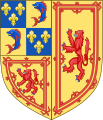
Real weapons of Mary, queen of Scotland, tied with those of her husband Francis.

Real weapons of Francis II.
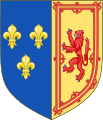
Real weapons of Mary, queen of Scotland, as queen consort of France.
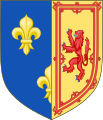
Real weapons of Mary, queen of Scotland, as a widow queen of France.

.svg)

.svg)
.svg)
Ancestry
| Francis II family tree in France | ||||||||||||||||||||||||||||||||||||||||||||||||||||||||||||||||||||||||||||||||||||||||||||||||||||||||||||||||||||||||||||||||||||||||||||||||||||||||||||||||||||||||||||||||||||||||||||||||||||||||||||||||||||||||||||||||||||||||||||||||||||||||||||||||||||||||||||||||||||||||||||||||||||||||||||||||||||||||||||||||||||||||||||||||||||||||||||||||||||||||||||||||||||||||||||||||||||||||||||||||||||||||||||||||||||||||||||||||||||||||||||||||||||||||||||||||||||||||||||||||||||||||||||||||||||||||||||||||||
|---|---|---|---|---|---|---|---|---|---|---|---|---|---|---|---|---|---|---|---|---|---|---|---|---|---|---|---|---|---|---|---|---|---|---|---|---|---|---|---|---|---|---|---|---|---|---|---|---|---|---|---|---|---|---|---|---|---|---|---|---|---|---|---|---|---|---|---|---|---|---|---|---|---|---|---|---|---|---|---|---|---|---|---|---|---|---|---|---|---|---|---|---|---|---|---|---|---|---|---|---|---|---|---|---|---|---|---|---|---|---|---|---|---|---|---|---|---|---|---|---|---|---|---|---|---|---|---|---|---|---|---|---|---|---|---|---|---|---|---|---|---|---|---|---|---|---|---|---|---|---|---|---|---|---|---|---|---|---|---|---|---|---|---|---|---|---|---|---|---|---|---|---|---|---|---|---|---|---|---|---|---|---|---|---|---|---|---|---|---|---|---|---|---|---|---|---|---|---|---|---|---|---|---|---|---|---|---|---|---|---|---|---|---|---|---|---|---|---|---|---|---|---|---|---|---|---|---|---|---|---|---|---|---|---|---|---|---|---|---|---|---|---|---|---|---|---|---|---|---|---|---|---|---|---|---|---|---|---|---|---|---|---|---|---|---|---|---|---|---|---|---|---|---|---|---|---|---|---|---|---|---|---|---|---|---|---|---|---|---|---|---|---|---|---|---|---|---|---|---|---|---|---|---|---|---|---|---|---|---|---|---|---|---|---|---|---|---|---|---|---|---|---|---|---|---|---|---|---|---|---|---|---|---|---|---|---|---|---|---|---|---|---|---|---|---|---|---|---|---|---|---|---|---|---|---|---|---|---|---|---|---|---|---|---|---|---|---|---|---|---|---|---|---|---|---|---|---|---|---|---|---|---|---|---|---|---|---|---|---|---|---|---|---|---|---|---|---|---|---|---|---|---|---|---|---|---|---|---|---|---|---|---|---|---|---|---|---|---|---|---|---|---|---|---|---|---|---|---|---|---|---|---|---|---|---|---|---|---|---|---|---|---|---|---|---|---|---|---|---|---|---|---|---|---|---|---|---|---|---|---|---|---|---|---|---|---|---|---|---|---|---|---|---|---|---|---|---|---|---|---|---|---|---|---|---|---|---|---|---|---|---|---|---|---|---|---|---|---|---|---|---|---|---|---|---|---|---|---|---|---|---|---|---|---|
| ||||||||||||||||||||||||||||||||||||||||||||||||||||||||||||||||||||||||||||||||||||||||||||||||||||||||||||||||||||||||||||||||||||||||||||||||||||||||||||||||||||||||||||||||||||||||||||||||||||||||||||||||||||||||||||||||||||||||||||||||||||||||||||||||||||||||||||||||||||||||||||||||||||||||||||||||||||||||||||||||||||||||||||||||||||||||||||||||||||||||||||||||||||||||||||||||||||||||||||||||||||||||||||||||||||||||||||||||||||||||||||||||||||||||||||||||||||||||||||||||||||||||||||||||||||||||||||||||||
| Predecessor: Henry II |  1559 - 1560 | Successor: Carlos IX |
Contenido relacionado
History of Logic
GM-NAA I/O
Hittite laws
Donation of Pepin
History of optics