
Fragaria
The strawberry or strawberry (Fragaria) is a genus of stoloniferous creeping plants of the Rosaceae family. It groups about 400 described taxa, of which only about 20 are accepted. They are cultivated for their edible fruit (etherium) called in the same way: strawberry or, in some Latin American countries, strawberry. Commercially cultivated varieties are usually hybrids, especially Fragaria × ananassa, which has almost universally replaced local wild species, such as the Eurasian Fragaria vesca, by the superior size of its fruits.
Description
They are herbaceous, evergreen plants, with more or less developed epigeal rhizomes and stolons, which take root at the nodes where tripartite rosette leaves are born. The stems are generally simple, more or less erect, and annual. The leaves are grouped in false rosettes, with oval-rhombic segments, distally toothed. The inflorescences are arranged in cymes with bracts. The flowers, hermaphroditic or functionally unisexual, have a receptacle with a somewhat conical axial zone, accrescent and fleshy when fructifying. The 5 sepals are lanceolate and generally entire, more or less accrescent, erect, patent or reflex during fruiting. The calculi have 5 narrower pieces than the sepals and are usually entire. The petals, generally 5 in number, are usually larger than the sepals; they are obovate, not notched, with a short nail, white, greenish-white or cream-colored. There are about 10-20 stamens and numerous free carpels implanted in the axial zone of the receptacle. The fruit is a polyachene of ovoid achenes embedded in said receptacle (etherium) that becomes fleshy when ripe.
Accepted species
- Fragaria × ananassa (Duchesne ex Weston) Duchesne ex Rozier
- Fragaria chiloensis (L.) Mill.
- Draltonian Fragaria J.Gay
- Fragaria gracilis Losinsk.
- Fragaria iinumae Makino
- Fragaria iturupensis Staudt
- Fragaria moschata Duchesne
- Fragaria moupinensis (Franch.) Cardot
- Fragaria nilgerrensis Schltdl. ex J.Gay
- Fragaria nubicola (Lindl. ex Hook.f.) Lacaita
- Orientalis Losinsk.
- Vesca Fragaria L.
- Fragaria virginiana Mill.
- Fragaria viridis Weston
- Species accepted and synonym according to GRIN

View of various strawberries and their cross-section

Fragaria × ananassa
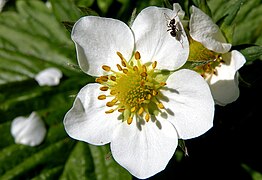
Flower of Fragaria × ananassa

Schematic cut in a flower Fragaria

Draltonian Fragariacommon plant in the Himalayas

.jpg)


Taxonomy

The genus was described by Carlos Linnaeus and published in Species Plantarum 1: 494. 1753. The type species is: Fragaria vesca L.
- Etymology
Fragaria: generic name from the Latin fraga, "strawberry", which is derived from fragum, "fragrant", where it refers to the fragrance of the fruit.
Gastronomy
Strawberries are grown mainly for their use in gastronomy. The strawberry is a suitable forest fruit in dietary regimes, since it has a low concentration of carbohydrates. It has a very pleasant and very sweet taste. They are consumed alone or mixed with sugar, sugar and wine, sugar and cream, orange juice, in ice creams, jams, juices, smoothies, milkshakes and are also highly appreciated in confectionery for sweets, cakes and tarts. The bright red fruits of various species give a special touch as a food garnish. An alcoholic drink composed of brandy called strawberry liqueur is made with the strawberry.[citation required]
The young leaves can be eaten as a vegetable, although such use is rare. The leaves must be collected when the plant is well flowered; the roots, when they are about to dry out; and the fruits, very ripe, of an intense pink color. It should always be kept in the shade and in a place protected from heat and humidity.[citation required]
Properties
Strawberries are high in fiber, vitamin C, antioxidants, potassium, folate, and minerals. It is one of the fruits with fewer calories. The consumption of this fruit helps to keep the skin hydrated; fights constipation due to fiber, prevents eye diseases, also due to vitamin C and pigments such as lutein and zeaxanthin; or reduces cardiovascular problems.
Consumption should be avoided by children under 18 months, as it is an allergenic fruit. Due to a high level of oxalic acid, it may be contraindicated for people predisposed to kidney stones.
Contenido relacionado
Begonia
Viola (genus)
Needle
Camellia
Chasmanthium