
Fly
The term fly (from the Latin musca) is the common name of several species of flying insects belonging to the order Diptera (Diptera).

The species that belong to the family of the well-known common fly (Muscidae) are flies; Some species from close families, such as Calliphoridae or Sarcophagidae, are rather called blowflies, given their large size, their hairy body, and the low-pitched buzz of their wings. Other diptera are called by other names, such as horseflies and mosquitoes.

Etymology
The term fly is very vague, and it is difficult to specify which species are included under this name. The definition given by the Diccionario de la lengua española does not clarify the matter; it says that it has the "black body", therefore, surprisingly, it does not include the common fly (Musca domestica), whose abdomen is yellowish.
In other etymology pages, the Latin term musca is associated with the Indo-European root mu-, present in the Greek myia, "fly", hence also "myiasis", with which parasitic diseases generated by parasitization with fly larvae are named.
Other Insects Called Flies
There are several groups of insects that also receive the common name of "flies" without being dipterous. Saw-bearing "flies" are Hymenoptera (of the same order as bees, wasps, and ants); May "flies" are mayflies; the "flies" of the stones are stoneflies; scorpion "flies" are Mecoptera; white "flies" are Hemiptera; the Spanish fly is a beetle; damp "flies" are mosquitoes, etc.
Features

I: head; II: thorax III: abdomen. - 1: prescutum; 2: front spiral; 3: scutum; 4: basicosta; 5: calypters; 6: scutellum; 7: vein; 8: wing; 9: abdominal segment; 10: 11: later spiral; 12: femur; 13: warm; 14: spurn; 15: tarso; 16: propleura; 17: prostern; 18: mesopleura; 19: Mesosternón; 20: metapleura; 21: metatern; 22: composite eye; 23: arist; 24: antenna; 25: maxilar palp; 26: labium; 27: labellum; 28: pseudotrachea.

The typical flies (Muscidae and related families), like all diptera, have a body divided into three regions or tagmas: head, thorax and abdomen. They have eyes made up of thousands of individually light-sensitive facets that they constantly clean by rubbing their paws, and mouthparts adapted for sucking, licking, or piercing; no fly is capable of biting or chewing, but many species bite and suck blood (hematophagy). They have two functional wings and two posterior ones that are reduced to structures called halteres or rockers, which act as stabilizing organs for displacement.
They have numerous sensory silks covering their bodies with which they can taste, smell and feel. The silks of the mouthparts and legs are used for relishing; flies taste what they step on since they have taste receptors at the end of their legs; if they step on something with a pleasant flavor, they lower their mouths and taste it again.[citation needed]
The feet have sticky pads that allow them to walk on smooth surfaces such as glass, even upside down.[citation needed]
Flies, like many types of insects, are cold-blooded animals and can only receive heat from external sources, so they are attracted to the body temperature of people and other animals, and are often seen basking in the sun.
Another peculiarity is that each female lays an average of 2,000 eggs throughout her life.
Some species of flies (see calliphorids) display metallic colors, due to "thin nanometer structures that make up the carapace and wings".
Biology and ecology
Its life cycle is holometabolous; that is to say, four morphological phases follow one another: the egg, the larva or maggot, the pupa, and the adult or imago. Some species complete this cycle in a few days; others, in one or two months. But in general the average life of a fly is 15-25 days. However, not all flies lay eggs. Some species are ovoviviparous; the eggs hatch inside the mother, so that the young come out as larvae.
They live near decaying organic matter (garbage) and in places where there is fecal matter from animals. Animals attract flies within hours of death. Most flies are diurnal.
Impact on ecosystems
Flies are part of almost every ecosystem, in every terrestrial habitat. The consequences of their presence in the environment and in human society are of exceptional importance.
- Positive. Flies and other insects, such as excavatory beetles, are very important in the consumption and disposal of the bodies of the animals. Flies are also essential to convert fecal matter and decomposition of vegetation. Tachynid flies are used as biological control because they parasitize different species of chinches bugs. Flies also serve as a prey for other animals including birds and small rodents; they are thus an important part of the food chain. Some are active pollinators (for example, flies are raised to serve as pollinators in greenhouses; they are also good pollinators of cabbage, other raw plants and onions).
- Negative. Since fecal matter and decomposition meat attract flies, flies are involved in the transmission of infectious diseases such as dysentery, cholera and typhoid fever by polluting the foods they pose, diarrhoeal diseases that are caused by enterobacteria of the genus. Shigella, related to flies, have the highest mortality rate. They are also vectors in the transmission of epizootypes, such as the tse-tsé fly, which spreads, by bite, sleep disease between the Bovites and the human being. The larvae of some flies produce miasis (gusaneras or bicheras) in the cattle (Cochliomyia hominivoraxThe Worm Worm Worm Worms and the Human Being (Dermatobia hominis).
Larval therapy
Lorval therapy, also known as maggot therapy or maggot therapy, is the intentional introduction by a medical professional of live, sterilized fly larvae into non-healing wounds of animals and humans, for the purpose of selectively cleaning necrotic tissues from it and promote healing.
Ability to escape
In 2008, a team of researchers at Caltech in the United States, led by Professor of Bioengineering Michael Dickinson, published in Current Biology that these insects owe their ability to escape to the fact that they have with a sophisticated defense system that makes them anticipate their attacker's movements and respond with "very fast, about 200 milliseconds" movements. Through high-speed, high-resolution video, these scientists have discovered that a fly is capable of moving its hind legs and placing them in just the right position to take flight in order to escape. They also say that they are capable of doing this and not necessarily fulfill it; that is, if the attacker finally does not attack the fly, they return to their normal position. They are also capable of using this system while performing other actions.

Free will in flies
In December 2010, the article «Towards a scientific concept of free will as a biological trait: spontaneous actions and decision-making in invertebrates» was published in the Proceedings of the Royal Society journal. in which it is affirmed that even invertebrates somehow manifest behavior with free will. Its author, Björn Brembs, affirms that the behavior of flies, although it is not completely free, is not completely constrained. The work provides evidence obtained from the brains of flies, brains that seem to be endowed with flexibility in decision-making. The scientist points out that the ability to choose between different behavior options, even in the absence of differences in the environment, would be a capacity common to most brains, if not all, so that the simplest animals would not be totally predictable automata. Likewise, he points out that said capacity has its adaptive explanation as a response to competitors, prey and predators.
Image gallery
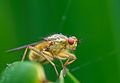
Strawberry
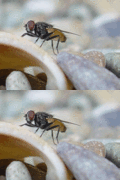
Animation of a fly
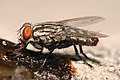
Sarcophaga (Sarcophagidae)
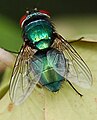
Lucilia sp. (Calliphoridae)
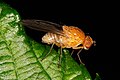
Drosophila melanogaster (Drosophilidae)
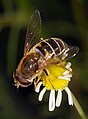
Eristalis (Syrphidae), a fly that imitates a bee
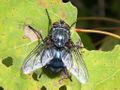
Domestic Muscaa

Calliphora vomit (Calliphoridae)

Small fly back.
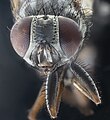
Mosque head and eyes, details.

It flies the whole body. Domestic moss.

Bigmouth, buzzer, head.
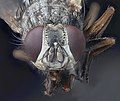
Mosca, detail.
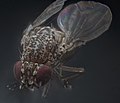
Mosca, whole.


Flies and culture
Flies have often been used in mythology and literature to represent agents of death and decay, such as the fourth of the ten plagues of Egypt. They have been portrayed as the evil ones (for example, in Greek mythology, Myiagros was a god who chased away flies during sacrifices to Zeus and Athena, and Zeus sent a fly to bite the horse Pegasus causing Bellerophon to fall to Earth when rode it to get to Olympus).

However, in some cultures the connotation is not so negative (for example, in the traditional religion of the Navajo, the Big Fly is an important spirit).
The fly, as a symbol of indomitable courage, persistence and tenacity in the face of conflict, was the highest military award in Egyptian culture, the highest distinction granted by the pharaoh to his brave men. Pharaoh Amosis decorated his mother, Ahhotep, in a beautiful ceremony with a necklace with three large gold flies, 9 cm high. No other queen of Egypt received this military decoration. Ahmosis thus recognized that the inspirer of the liberation war had been Ahhotep; It was her way of recognizing the great efforts and sacrifices to which this queen had submitted, dedicated to the cause of freeing Egypt from the yoke of the Hyksos.
The inhabitants of Cyrene offered sacrifices to the god Achorus to rid them of these insects. The Acarnanians venerated flies and the natives of Acaron offered incense to the divinity that hunted them. The Greeks also had their god Flycatcher (Myiagros). Aeliano says that the flies withdrew by themselves in the Olympic games and passed to the other part of the Alfeo river. In the temple of Apollo in Actium, when the festival drew near, a bull was immolated to the flies, which, once satiated, retired.
The demon Beelzebub is called "lord of the flies," after a pun that turned the Canaanite god Ba'al Zebûl (literally & #34;the lord prince") in Baal Zabut ("the lord of the flies").
In ancient Rome there was a temple, that of the victorious Hercules, in which flies never entered, even though that hero could never have driven them away, since, according to Theophilus and Paracelsus, not even Jupiter himself has this power. Flies flocked to Moloch's sacrifices in myriads, and the Jews considered it a happy omen that no fly should ever be seen in Solomon's temple.
Emily Dickinson's poem says "I heard the buzz of a fly when it died"; referencing flies in the context of death. In the same way, in art and fiction, flies are also used mainly to introduce elements of horror or a feeling of dirt; an example of this is the 1958 science fiction film The Fly as well as the 1986 remake of The Fly, in which a scientist was observed exchanging parts of his body (DNA) accidentally with those of a fly. The flies' ability to cling to almost any surface has also inspired the nickname "fly man" For people with climbing and skydiving skills on the buildings.
Flies are one of the personal symbols of the poet Antonio Machado; in his poem The flies he portrays them as unruly and endearing little animals that evoke the poet's childhood and have no respect even for the "eyelids of the dead."
Contenido relacionado
Sclerochloa
Capsella bursa-pastoris
Amphicarpum