
Eurofighter Typhoon
The Eurofighter Typhoon is a multipurpose, bimotor, maneuvering hunt, designed and built by the consortium of European companies Eurofighter GmbH, created in 1983 and composed by the companies Airbus Group, BAE Systems and Aeronautics Alenia. He made his first flight on 27 March 1994, coming into service on 8 April 2003 with Germany. Its design with a wing configuration in delta-cantilever looks like other modern combat planes, such as the Dassault Rafale of France, and the Saab 39 Gripen of Sweden. It was designed to enhance agility, furtive capabilities and the inclusion of advanced aviation systems, making it the launch date in one of the best hunts in service. Although it remains an excellent hunt, it has been overcome by subsequent developments, mainly by the Sukhoi Su-34 and the F-35. However, an update, called Long Term Evolution, is under development in order to extend its capabilities and useful life.
Serial production of the Eurofighter Typhoon has been divided into three phases (tranches), with a gradual increase in the aircraft's capabilities in each of them. It initially entered service with the British Royal Air Force (RAF), the German Luftwaffe, the Italian Air Force, the Spanish Air Force. Saudi Arabia signed a contract worth 4.43 billion pounds (approximately 6.4 billion euros of 2007) for 72 aircraft.
Development

_JP6628660.jpg)
The project was initiated by a technical requirement from several countries to replace the SEPECAT Jaguar (RAF), Panavia Tornado (RAF), McDonnell Douglas F-4 Phantom II (RAF and Luftwaffe), Lockheed F-104 Starfighter (Italy) and Dassault Mirage F1 (Spain) from various European air forces. The trigger for the appearance of this new fighter was, among others, the information that was being received about the new Soviet prototypes RAM-K and RAM-L, which were later They would be renamed Su-27 Flanker and MiG-29 Fulcrum. The aircraft was designed taking into account the technical requirements of the air forces of some NATO members such as Germany, France and the United Kingdom; originally the expression "Eurofighter" It was not due to a particular ship, but to the need to have this fighter in common use. However, with the French air force abandoning the project and focusing on building its own version of a "Eurofighter" with an aircraft tailored to its needs, where Dassault would lead the design and the other partners would limit themselves to jointly financing the project. Furthermore, the Armée del Air was not satisfied with designs such as the TFK-90 or the < i>P110.B, on which the Eurofighter Typhoon is based, preferring a somewhat smaller and shippable aircraft, so he abandoned the European aircraft project to create his own fighter, the Avion de Combatérimental (ACX), which would later become known as Rafale A.
In this way, in 1982 the Agile Combat Aircraft (ACA) program was presented, in which Italy, Germany and the United Kingdom appeared as partners. An attempt was made to create a program for a technological demonstrator called Experimental Aircraft Programme (EAP), but the British Government did not finance it and in the end it had to be British Aerospace (BAe) itself that financed the project. taking advantage of parts such as the tail section of the Tornado and its RB199 engines. The EAP made its first flight in 1986 and was immediately successful. There were some voices that wanted that same aircraft to enter service in the RAF, but the development of the more conservative Tornado F.Mk3 stopped the financing of the project. However, at that time Germany was also developing the a first moment. The Eurofighter is largely based on technologies tested in the EAP.
Spain joined the project on September 2, 1985, although it had already followed the evolution of events with interest. From then on, the project was known as European Fighter Aircraft (EFA) and several consortia were formed to produce the various parts of the Eurofighter aircraft: for the airframe and systems integration, for the Eurojet engines, for the EuroDASS security system, etc. From then on, the project suffered a halt due to the end of the Cold War and the high costs of German reunification, which meant that the project was delayed for about five years. Meanwhile, the partners were discussing how to reduce the price of the aircraft, as well as the overall cost of the program, by eliminating aircraft systems (for example, the very expensive protection against pulses of electromagnetic radiation), or reducing the number of prototypes. Finally, on March 27, 1994, the first DA01 prototype flew from the MBB factory in Manching, piloted by test pilot Peter Weger. For 8 years, the seven prototypes of the program flew numerous hours to reach the manufacturing phase at the beginning of 2001.
When the final production contract was signed, the revised sales were: United Kingdom, 232 devices, Germany, 180, Italy, 121 and Spain, 87 (for a total amount of €10,795 million). Production was redistributed according to the following percentages: British Aerospace (37%), DASA (29%), Aeritalia (19.5%) and CASA (14%).
Development is the responsibility of Munich-based Eurofighter Jagdflugzeug GmbH, a company wholly owned by BAE Systems (part of British Aerospace) in the United Kingdom, Alenia Aerospazio in Italy, EADS Deutschland Aerospace Group (part of DaimlerChrysler in conjunction with DASA) and EADS Spain (formerly CASA).
On July 2, 2002, the Austrian government announced the decision to purchase the Typhoon as its new air defense aircraft. The purchase of 18 Typhoons was completed on July 1, 2003. The cost was €1,959 million and included 18 aircraft, training for pilots and ground crew, logistics, maintenance and a simulator. The cost of a Typhoon aircraft ready to fly is 62.9 million euros. This order was later reduced to 15 devices.
The project has been named and renamed several times since its birth, being known as EFA (European Fighter Aircarft), Eurofighter, EF2000 (Eurofighter 2000) and Typhoon (“typhoon”).
Production


The Eurofighter Typhoon is the only modern fighter aircraft that has different assembly lines (the F-16 is only produced internationally under limited licenses). Each partner assembles its own aircraft, although it builds the same parts for all aircraft produced.
- Italy (Alenia)
- On the left.
- Borders of external attack.
- Rear fuselage sections.
- United Kingdom (BAE Systems)
- Front fuselage (including canards).
- Pavilion.
- Spina dorsal.
- Line fins.
- Borders of internal attack.
- Rear fuselage sections.
- Germany (EADS Deutschland)
- Central fuselage.
- Spain (EADS CASA)
- Right wing.
- Border surfaces.
Production is divided into three models or phases (or tranche in the official name), with a gradual increase in capacity in each of them (see table below).
| Country | Phase 1 2003-2007 | Phase 2 2008-2012 | Phase 3 2013-2020 | Phase 4 2021-? | Total |
|---|---|---|---|---|---|
.svg) United Kingdom United Kingdom | 53 | 67 | 40 | 0 | 160 |
 Germany Germany | 33 | 79 | 31 | 38 | 181 |
 Italy Italy | 28 | 47 | 21 | 0 | 96 |
 Spain Spain | 19 | 34 | 20 | 45 | 118 |
 Saudi Arabia Saudi Arabia | 0 | 48 | 24 | 0 | 72 |
 Austria Austria | 15 | 0 | 0 | 0 | 15 |
 Oman Oman | 0 | 0 | 12 | 0 | 12 |
| TOTAL | 148 | 275 | 148 | 83 | 654 |
The United Kingdom transferred 16 appliances from which it had contracted to Saudi Arabia's order and in June 2011 announced the withdrawal in 2018 of 55 Eurofighter from the first phases, due to the lack of its upgrade to Phase 3, thus its current inventory is 144 aircraft, which could be reduced to 89 in the future. In November 2011, EADS proposed to programme partner countries to cancel the 3B Tranche orders in exchange for new contracts in export campaigns and to invest that money in reactivating the Talarion program. In the face of tension with Russia, the RAF is replanted to activate two squadrons of the retired planes, devoting itself exclusively to air defense, corresponding to the oldest version. RAF and BaE Systems are investigating how to improve airplane capabilities in attack missions.
According to the consortium's proposal, if Cassidian's German subsidiary wins the contract for the MRCA Competition that it is leading in India, the country would have no obligation to acquire the 37 Tranche 3B aircraft that it has agreed upon. In exchange, EADS asks that this money be invested in the purchase of the European UAV. The same would happen with the campaign for which Spain is responsible and which it champions in Korea or the United Kingdom with that of Japan.
Costs
The Eurofighter program had a cost of 60,000 million euros, of which almost 12,300 correspond to its development, having an estimated takeoff cost in 2008 of 63 million euros, with a cost purchase of 88.4 million euros.
The acquisition cost varies depending on the configuration that each country has chosen for its aircraft, since each one is different, the total cost of obtaining the British Typhoon in 2011 was 126 million pounds.
As a reference, the cost per flight hour is €43,000 in 2010, and the annual maintenance cost in the period 2009-2019 would be €15 million, with the following figures projected:
- Defects rectified in 45 min: 50% of them.
- Engine change for 4 people: 45 min.
- Defects rectified in 3 h: 90% of them.
- Inspection pre-flight: less than 15 min by two people.
- Post-flight inspection: less than 45 min by two people.
- Change or installation of air-to-air configuration: less than 23 min by 6 people.
- Air-to-ground configuration or installation: less than 30 min per 6 people.
Exports

Austria

On July 2, 2002, the Austrian Government announced the decision to acquire the Typhoon as its new air defense aircraft. The order for 18 Typhoon was completed on July 1, 2003, including, in addition to the aircraft, training of pilots and ground personnel, logistics, maintenance and a simulator. The future of this request was questioned by the Austrian Parliament.
On June 26, 2007, Austrian Defense Minister Norbert Darabos announced a reduction of the initial order, which went from 18 to 15 units. The first of the Eurofighter ordered by Austria was delivered on July 12, 2007, becoming part of the Austrian Air Force.
Only 10 years later, on July 7, 2017, the Austrian Ministry of Defense announced the withdrawal of the Typhoon for not being "militarily effective and economically efficient." According to Minister Hans Peter Doskozil, its abandonment would allow savings of 2 billion euros.
However, in 2022, the same Ministry announced that the entire Eurofighter fleet would be modernized. The current 15 examples would receive night vision, self-defense and medium-range missiles.
In addition, the purchase of more jet fighters began to be examined.
Saudi Arabia

On August 18, 2006 it was announced that Saudi Arabia would acquire 72 Typhoon to equip the Royal Saudi Air Force. In November and December it was reported that Saudi Arabia had threatened to buy French Rafale over the investigation into the Al Yamamah case, which began in the 1980s. However, on September 17, 2007, Saudi Arabia Saudi confirmed the order for 72 Eurofighter Typhoon for £4.43 billion.
On August 11, 2008, Saudi Arabia began negotiations with BAE Systems for the acquisition of a second batch of 72 or more devices.
Oman
On December 21, 2012, it was announced that Oman had signed a purchase agreement that included 12 Typhoon fighters and 8 Hawk trainers to equip the Royal Oman Air Force, valued at 2.5 billion pounds.
Kuwait
In 2016, the purchase agreement was signed between the State of Kuwait and the Government of Italy, relating to the acquisition of 22 single-seat aircraft and six two-seat Eurofighter Typhoon aircraft. The aircraft will be standard Tranche 3, equipped with E-Scan radar.
Qatar
In December 2017, BAE Systems officially announced the signing of a contract to supply 24 Eurofighter Typhoon to the Qatar Air Force.
Possible exports
Colombia
In July 2019, the Colombian Air Force made public in a statement the so-called short list of the fighters preselected to replace its twenty IAI Kfir. The three devices included in that list were the F-16, the Eurofighter Typhoon and the Saab 39 Gripen. At later dates, companies and different air forces made offers for new and second-hand appliances. Regarding the Typhoon, the proposal was a dozen devices belonging to Tranche 1 plus maintenance and spare parts, all of them coming from the Spanish Air Force.
Serbia
In 2022, Serbia indicated its interest in acquiring new or used Eurofighter.
Frustrated sales
Greece
In 1999, the Greek government agreed to purchase 60 Typhoon to replace its second-generation fighter aircraft. Although in June 2006 the government announced a multi-year procurement plan for 2.2 billion euros, with the intention of achieving the acquisition of a next-generation fighter (the Typhoon, the Dassault Rafale and the Lockheed Martin F-35 Lightning II being candidates, the purchase has been postponed indefinitely due to the acute economic problems presented in the third half of the 21st century.
India
The Typhoon participated in India in the program to choose a new combat aircraft called Indian MRCA Competition (in Spanish: Competition for the acquisition of a new combat aircraft Indian multipurpose aircraft), through which 126 aircraft could be sold. There were reports indicating that the Typhoon could be the winner of the contest, however it was finally awarded to the Dassault Rafale.
Japan
The Eurofighter Typhoon was a candidate in Japan in the competition to provide its air force with a new generation fighter, competing with the American F/A-18E/F Super Hornet and F-15E Strike Eagle, but the Japanese government finally decided on the Lockheed Martin F-35 Lightning II.
Switzerland
The Alpine country evaluated the purchase of the Eurofighter Typhoon to replace its Northrop F-5E Tiger II, in a competition in which it competed against the Dassault Rafale and the Saab Gripen NG, but ultimately did not No order was placed for any aircraft. A new competition in 2021 once again presented the Typhoon as an option, in addition to the Rafale, the Boeing F/A-18 Super Hornet and the Lockheed Martin F-35 Lighting II, the latter being the winner in practically all criteria.
Finland
The Eurofighter also participated in 2021 in the HX competition to replace the F/A-18 Hornet in service in the Finnish Air Force, facing the Dassault Rafale, the Boeing F/A -18 Super Hornet, the Saab JAS 39 Gripen E/F and the Lockheed Martin F-35 Lighting II. Once again, the F-35 far surpassed the Typhoon and the rest of the competitors.
Inventory
.jpg)
Despite delays and controversies over its cost, the Typhoon has been in production since 2003.
Royal Air Force
In British service, this aircraft would replace the Tornado F3 interceptor and the Jaguar GR.3A ground attack aircraft. The Tornado would be gradually replaced in the period 2006-2010, and the Jaguar in 2010-2014. Initial Typhoon deliveries to the RAF began in 2003. The first unit was an Operational Evaluation Unit, 17 Squadron RAF, in 2003, followed by the Operational Conversion Unit, 29 RAF squadron, in 2004. The initial designation of RAF aircraft is T1, for two-seat trainers, and F1, for operational fighters. single seat.
The RAF has used its Typhoon in real combat in operations in Libya and Iraq.
The remaining 30 Tranche 1 are being progressively retired until 2025. The structure of these aircraft will still have almost 60% useful life on average. Updates with certain Tranche< equipment /i> 2 and Tranche 3 would be possible.
Air and Space Army
In Spain, the Eurofighter Typhoon is called C.16 Typhoon and entered service in October 2004. It is assigned to the 11th Wing unit of the Air Force, located at the Morón Air Base (Seville). After these deliveries to the 11th Wing, the 14th Wing received Eurofighter in the following decade, replacing the Mirage F1 at the Los Llanos Air Base (Albacete).
Finally, the Eurofigther will replace the twenty ex-US Navy F/A-18 that the 46th Wing operates at the Gando Air Base (Telde). It was estimated that 24 Tranche 3B aircraft could be purchased, which would be based on the peninsula to assign two modernized F-18 squadrons to the Canary Islands. In June 2022, the definitive purchase of 20 new units was made official. The first units will be received in 2026.
Austrian Air Force
A marketing and commercialization effort obtained an order from Austria for 15 units and from Saudi Arabia for a number of 48 units, plus 24 optional units (with the probability of new acquisitions).[citation required]
Greece
The Greek government also selected the Eurofighter, but the order was postponed due to the expense incurred by the 2004 Athens Olympics, and the subsequent purchase of 30 F-16, which has seemed to indicate a disinterest of the Greek government, or its air force, in the plane.
Norway
Norway has also expressed its interest, and participates in the program on a testimonial basis, although it also does so in the US Joint Strike Fighter Program, ultimately purchasing 52 F-35 aircraft.
Türkiye
Among the countries that have shown interest in the Eurofighter, Turkey stands out, which it is said could even become the fifth partner in the program. However, the Air Force imposed its preference for the F-35.[citation needed]
Italy
Italy is one of the partners of the program. It is doubtful that it will acquire more aircraft given the current Italian commitment to the F-35.[citation needed]
Saudi Arabia
The Air Force ordered 72 planes. Along with the RAF, he is the only operator to have used the plane in combat.[chuckles]required]
Problems
In 2001, it was announced that the RAF would not be using the aircraft's internal cannon. This was not because the cannon was perceived as inadequate, but rather because it was considered unnecessary, as missile armament was considered more suitable for the Typhoon's fighter role. In any case, the removal of the cannon would affect the flight characteristics of the aircraft, requiring modifications to the flight software that would have to be paid for by the RAF. Precisely due to this circumstance, the RAF announced that all its Typhoons would carry the cannon, although it would not be used. RAF technicians claimed that this would save money by reducing the cost of ground equipment requirements and by avoiding the effects of fatigue when firing the gun. The RAF maintains the option of activating the guns in a minimum time if operational requirements vary.
Design

The characteristics of Typhoon they are a good sample of their development. The cell of the Typhoon was designed so that it was unstable in flight (with canards and wing in truncated delta), which provides a great maneuverability. A redundant quadruple flight control system is used to solve the problem of instability. fly-by-wire.
In turns it maintains energy perfectly by having a thrust-to-weight ratio of 1.15, in addition to the EJ200 engines allowing it to fly in supercruise regime (ability to fly at supersonic speeds without using afterburners). The Spanish company ITP (Industria de Turbopropulsores, S.A.) is developing an adjustable nozzle system that would allow the Typhoon to have thrust vectoring. The tests of these nozzles, carried out with the EJ200 engines, have been successful and only depend on the will of the governments to equip the devices with them, since the flight control system (FCS for its acronym in English) of the Eurofighter is now prepared to receive them.
The aircraft is largely made of compounds such as fiberglass or carbon fiber, which provide greater structural rigidity to the airframe, allowing it to perform maneuvers with very high G force values. The ejection seat is of the Cero-Cero type, built by manufacturer Martin Baker, and is capable of ejections at more than 600 knots of speed (approximately 1,100 km/h). The adoption of conformal fuel tanks (CFT) in phase 3 of production is not ruled out either, which would provide greater flight autonomy, although this would force the Eurofighter to carry less weapons. In the early design phases, the possibility of using a double drift was considered, although it was later discarded due to the greater structural strength presented by the single drift. Despite not looking for low detectability characteristics as a requirement, as the F-22 Raptor has done, the Typhoon has its shape well cared for to try to be the least detectable possible to radar illumination.

Eurofighter Typhoon German (right view).

German Eurofighter Typhoon preparing for landing.
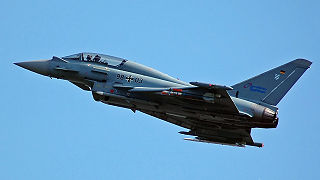
Eurofighter Typhoon German (left view).


Structure and aircraft

In the construction of the Typhoon intensive use is made of composite materials, which are resistant and light and ensure that the aircraft has a reduced weight. Its structural surface is made of 82% of these materials, which consist of 70% carbon fiber composites and 12% glass fiber composites. In other words, metal only represents 15% of the materials used in the construction of the aircraft, in this case being light alloys and titanium. These materials offer an estimated useful life of 6000 flight hours.
This fighter is characterized by its great agility, both in supersonic flight and at low speeds, thanks to its delta/canard design. This design is unstable in flight by nature and has been designed this way to ensure high maneuverability. For this reason, it has a completely digital quadruple redundancy fly-by-wire flight control system, responsible for providing artificial stability; This system automatically corrects the pilot's maneuvers so that he cannot take the aircraft outside the safe limits, since manual control alone could not compensate for the inherent instability. Likewise, in cases of disorientation, the system automatically recovers the aircraft to a stable position.
In the Eurofighter, pitch control is provided by the symmetrical operation of the forward planes and the wing flaperons. Roll control is achieved mainly through the differential use of the wings' ailerons-fins. And yaw control is provided by the vertical stabilizer rudder. The control surfaces are moved by two independent hydraulic systems, which also operate other components of the aircraft, such as the cockpit canopy, brakes and gear. landing.
Navigation is carried out simultaneously by global positioning system (GPS) and an inertial navigation system (INS), and can use an instrument landing system (ILS) to land in bad weather.
Cabin
The Eurofighter Typhoon has a glass cockpit without any conventional instruments, that is, all information is displayed on flat screens. It includes three color multi-function displays (MHDD; Multi-function Head Down Display) that can be manipulated using the keys surrounding each screen, with an XY cursor, or by voice commands (DVI, Direct Voice Input). It has a head-up display (HUD) with forward scanning infrared (FLIR), "voice + hands on throttle and control lever" control mode. (Voice+HOTAS), Helmet Mounted Symbology System (HMSS) (known to test pilots as 'the electric hat'), Multifunctional Information Distribution System (MIDS), a manual information Manual Data Entry Facility (MDEF) located on the left side of the panel and a fully integrated aircraft warning system with a dedicated Dedicated Warnings Panel (DWP). The backup flight instruments, illuminated by LEDs, are located on the right side of the panel.
The crew member pilots the plane by means of a central control stick and an engine throttle lever on the left side. To escape from the cockpit in an emergency, he uses the Martin-Baker Mk.16A ejection seat, powered by two rocket engines.
Sensor fusion

Like all modern weapons, the Eurofigther has a multitude of systems, of which the FCS of the type carefree handling[citation required] developed by BAES and GEC Marconi, which controls the maneuvers of the aircraft, as well as other minor subsystems, such as the air intake through the varicrowl system.
The ECR 90 CAPTOR-M Radar is based on the Ferranti Blue Vixen Radar of the Harrier FSR.Mk 2, since the pulse frequency of the FoxHunter radar of the Tornado F.Mk 3 did not meet the requirements of the plane. The radar is of the fourth generation multimode type, with X-band pulse Doppler, which allows the identification of targets at more than 150 km (BVR) and with up and down search and lock capability. As an improvement to the radar, the replacement of the mechanically scanned antenna with an AESA (Active Electronically Scanned Array) antenna with approximately 1,400 TR modules is planned. In this way, the radar will be called CAESAR (acronym for Captor AESA Radar). According to the Euroradar consortium (manufacturer of the Euroradar CAPTOR) the capabilities of the Captor radar are significantly increased with the adoption of the electronic scanning antenna. Furthermore, according to this information, a Captor radar can be easily converted into a CAESAR simply by changing the antenna and updating the software associated with the radar.
The PIRATE System allows the detection and fixation of targets using infrared, with a range of 30 km and has been developed by the Eurofirst consortium. It presents several modes of operation such as: Air-Air and Air-Ground, and also allows data exchange with the ECR 90 radar, although it is likely that it will be used only in Air-Air detection modes, since the RAF, for example, has purchased Litening II nacelles to carry out attack tasks.
DASS is a threat detection and response system. The system warns of the presence of hostile activity and automatically activates the most appropriate countermeasures for each type of threat. The helmet has a visor integrated into the visor, which provides information regarding targets, speeds and distances.
The helmet's HST subsystem allows you to aim at a target you are looking at, even if it is outside the HUD's view range. Even being able to launch missiles at targets located "over the shoulder."
DVI (Direct Voice Input) is a system that allows interaction with the aircraft through voice. The pilot can perform actions such as target assignments, changes to navigation routes, changes to information on data display screens, etc.
The ESM system measures electromagnetic emissions and allows them to be identified, as well as their directions. In the cockpit there is a Head-up display (HUD) with a wide field of vision in which information on flight characteristics and combat modes is received, and it can also present images from the PIRATE's FLIR system.
The Typhoon has three MHDD multifunction displays with all kinds of information. The commanders follow the HOTAS doctrine containing more than 50 functions. To finish with the systems, it is worth highlighting the tests with the flight suit called Libelle, designed for the pilot to withstand maneuvers with high G values. This includes a system that is formed by a network of liquid tubes that causes pressure on certain areas of the body. body, depending on the circumstances. With this new suit, pilots have been comfortable maneuvering at 12G, with the ability to move their arms and talk on the radio.
DASS

.png)
1. Laser alert receivers.
2. Bngalas dispensers.
3. Dispensers chaff.
4. Missile alert receivers.
5. ESM/ECM containers.
6. Towed decoy.
The fighter employs a sophisticated and highly integrated defensive aids subsystem or DASS (Defensive Aids Sub-System) called Praetorian, formerly EuroDASS. The DASS includes threat detectors a radar warning receiver (RWR), a missile approach warning (MAW) and a laser warning receiver (LWR, only for the British Typhoon). It also includes electronic countermeasures (ECM), chaff, flares, and a towed radar decoy (TRD). The Praetorian can monitor and respond automatically the outside world providing the pilot with a complete assessment of priorities for air-to-air and air-to-surface threats. It can respond to single or multiple threats.
The aircraft also has an advanced ground proximity warning system (GPWS) based on the TERPROM terrain navigation system used by the Panavia Tornado but further improved and fully integrated with the screens and cockpit controls.
MIDS
The digital data transmission system MIDS (Multifunctional Information Distribution System) provides the data link to the NATO Link 16 standardized information network, which is used to exchange tactical information (such as for example flight paths, objectives, position, status and orders) between different units or military platforms in joint or combined missions.
IRST PIRATE
.jpg)
The PIRATE system (Passive Infra-Red Airborne Track Equipment) is an infrared search and tracking (IRST) system that is mounted on the left side of the Typhoon fuselage. i>, in front of the windshield. The Italian-British company SELEX Galileo is the main contractor that, together with the French company Thales Optronics and Tecnobit from Spain, make up the EUROFIRST consortium responsible for the design and development of the system.
The PIRATE works in two bands of infrared radiation, 3-5 and 8-11 micrometers. When used in conjunction with radar in an air-to-air mission, it functions as an infrared search and track (IRST) system, providing passive target detection and tracking. In an air-to-surface mission, it performs target identification and location. It also provides navigation and landing assistance. It is linked to the pilot's helmet-mounted visor.
The Eurofighters began to incorporate the PIRATE in Block 5 of Tranche 1, the first being a copy delivered to the Italian Aeronautica Militare in August 2007. Search capabilities can be achieved more advanced targets with the addition of a target search container like LITENING.
Weapon systems

.jpg)
The internal armament of the Typhoon consists of a Mauser BK-27 automatic cannon, caliber 27 mm, which has a rate of fire of 1,700 rounds per minute. It is located in the right wing socket of the plane and has an ammunition of 150 projectiles.
On the outside it has up to thirteen anchor points, of which five are in the fuselage and eight under the wings. In these supports you can load a wide variety of air-to-air and air-to-surface launchable weapons, in addition to a maximum of three external fuel tanks (1000 or 2000 liters) and containers (pods) such as the LITENING target designator.
| Air | Short-range missiles | AIM-9L Sidewinder AIM-132 ASRAAM IRIS-T |
|---|---|---|
| Mid-range missiles | AIM-120 AMRAAM MBDA Meteor | |
| Air-surface | Anti-ship missiles | AGM-84 Harpoon Rb 12 Penguin |
| Anti-radiation missiles | AGM-88 HARM MBDA ALARM The future AGM Armiger | |
| Missiles for Near Air Support | AGM-65 Maverick Brimstone | |
| Cruise missiles | Storm Shadow Taurus KEPD 350 | |
| Guided pumps | Paveway II: GBU-10, GBU-16 and GBU-48 Paveway III: GBU-24 and BPG-2000 JDAM Future HOPE/HOSBO | |
| Free/retardated fall pumps | Classes 500, 1000 and 2000 lb. |
This wide range of weapons can be combined in the fighter in numerous ways. Below are some examples of configurations depending on the type of mission (all include the internal cannon).
| Air superiority | Polivalente | Interdiction / Attack |
|---|---|---|
|
|
|
| Near air support | Deletion and destruction of air defences | Maritime attack |
|
|
|
Germany - Saudi Arabia - Austria - Spain - Italy - Oman - United Kingdom
| Air-air missiles | |||||||||||
|---|---|---|---|---|---|---|---|---|---|---|---|
| Navy | 1 | 2 | 3 | 4 | 5 " 6 " | 7 " 8 " | 9 | 10 | 11 | 12 | Users |
| AIM-132 ASRAAM | 1 | 1 | 1 | 1 | - | - | 1 | 1 | 1 | 1 | |
| IRIS-T | 1 | 1 | 1 | 1 | - | - | 1 | 1 | 1 | 1 |     |
| AIM-9 Sidewinder | 1 | 1 | 1 | 1 | - | - | 1 | 1 | 1 | 1 | |
| AIM-120 AMRAAM | - | 1 | 1 | 1 | 2 | 2 | 1 | 1 | 1 | - | |
| MBDA Meteor | - | 1 | 1 | 1 | 2 | 2 | 1 | 1 | 1 | - | |
| Air-surface missiles | |||||||||||
| Taurus KEPD 350 (planned) | - | - | 1 | 1 | - | - | 1 | 1 | - | - | |
| Storm Shadow | - | - | 1 | 1 | - | - | 1 | 1 | - | - | |
| Brimstone II | - | 3 | 3 | 3 | - | - | 3 | 3 | 3 | - | |
| Air-surface guided pumps | |||||||||||
| GBU-10 | - | 1 | 1 | 1 | - | - | 1 | 1 | 1 | - | |
| GBU-16 | - | 1 | 1 | 1 | - | - | 1 | 1 | 1 | - | |
| GBU-48 | - | 1 | 1 | 1 | - | - | 1 | 1 | 1 | - | |
| Paveway IV | - | 1 | 1 | 1 | - | - | 1 | 1 | 1 | - | |
| GBU-54 | - | 1 | 1 | 1 | - | - | 1 | 1 | 1 | - | |
| Status: 09/2020 | |||||||||||
Performance in combat
The combat performance of the Typhoon, comparing it in particular to the American F-22 Raptor and F-35 Lightning II and the Dassault French Rafale has been the subject of much discussion. Although making completely truthful and unbiased comparisons is impossible with the publicly available information, there is a study by the United Kingdom's Defense Evaluation and Research Agency comparing the Typhoon with other contemporary fighters; In this study, the Typhoon was second only to the F-22.
On July 20, 2004, General John P. Jumper, Chief of Staff of the United States Air Force, tested a Eurofigther from the first operational squadron of the Luftwaffe, thus becoming the first person to have flown in the Typhoon and the Raptor. That same day he declared:
I have piloted all the [American] air force reactors. None are as good as the Eurofighter.
In March 2005, Jumper made comments about those two aircraft for the United States Air Force news section. The general said:
The Eurofighter is both agile and sophisticated, but it remains difficult to compare with the F/A-22 Raptor. They are different types of planes to start; it is as if they ask us to compare a NASCAR car with one Formula 1. Both are exciting differently, but are designed for different performance levels.
In addition, he commented:
The Eurofighter is undoubtedly, in terms of ease of control and traction capacity (and of maintaining high G forces), very impressive. It was designed for that, especially the version that I piloted, with its avionic, the screens with a mobile color map, etc. (all was first class), and the maneuverability of the plane in closed combat was also very impressive.

In June 2005, the Scottish weekly Scotland On Sunday reported that the previous year, a Eurofighter T1 trainer had had a chance encounter with two F-15E of the US Air Force over the Lake District, in the north of England. The encounter became a simulated combat in which the Eurofighter managed to avoid its pursuers and maneuver into a firing position. The success of this aircraft was a surprise to both the Americans and the British.
In July 2007, the Indian Air Force deployed its Sukhoi Su-30MKIs in the Indra-Dhanush exercise, with the RAF's Eurofighter Typhoon. This was the first time that the two aircraft had taken part in this exercise, and the Indian Air Force did not allow its pilots to use the MKI's N011M Bars radar during the exercise, in order to keep it secret. During the exercise, RAF pilots frankly admitted that the Su-30MKI had shown superior maneuverability to that of the Typhoon, but that the others had studied, prepared and anticipated this. The Indian pilots, for their part, were also visibly impressed by the Typhoon's agility in the air.

During the "Typhoon Meet" Held in Seville in March 2008, British, German, Italian and Spanish Eurofighters faced F/A-18 Hornet and Mirage F1 fighter jets of the Spanish Air Force, F-16 of the Portuguese Air Force and AV-8B Harrier II of the Spanish Navy in an aerial combat simulation. It is stated that the Eurofighters won all combats (even outnumbered 8 against 27) without suffering losses.
At the end of 2008, the German aerospace magazine Flug Revue reported that German Typhoon fighters clashed with French Rafale and that the results They are said to have been "very rewarding", the main difference being the "much greater thrust of the EJ200 engine".
At the beginning of 2010, the official Eurofighter website made public that during dissimilar air combat training (DACT) exercises carried out by NATO in the Canary Islands in 2009, two Spanish Eurofighters had managed to "shoot down" in an aerial combat against seven of the eight American F-15s that were acting as aggressors in the exercise. The first of the Spanish fighters managed to shoot down four F-15s, while the second shot down three more. Spanish Air Force officials indicated that, during those maneuvers, the Spanish pilots took the Eurofighters to the limit of their capacity.
The thrust of the EJ200 allows the Typhoon to have supercruise capability, that is, it is capable of flying at supersonic speed without using afterburners. According to the official pages of the German and Austrian air forces, its maximum possible speed without afterburner is between Mach 1.2 and Mach 1.5, depending on the configuration. Although the Eurofighter only achieves the maximum supercruise speed in one configuration without missiles or external fuel tanks.
The Eurofighter consortium claims that its fighter has a higher turn rate at both subsonic and supersonic speeds, and a greater acceleration to Mach 0.9 at 20,000 feet (6,096.0 m), than the F-14 Tomcat fighters., F-15 Eagle, F-16 Fighting Falcon, F/A-18 Hornet, Dassault Mirage 2000, Dassault Rafale, Sujói Su-27 and Mikoyan MiG-29.
What people don't know about Typhoon It's the good thing that's at high altitude. Between 40 000 and 55,000 feet, nothing can touch it except an F-22. That's what makes him so strong in air defense.Air Chief Marshal Sir Glenn Torpy, Chief of Staff of the Royal Air Force, February 12, 2009 at Aero India, Bangalore.
The long-range air-to-air missile carried by the Eurofighter at the beginning of its operational life was the AIM-120 AMRAAM, but this would be replaced by the MBDA Meteor, thus achieving greater and better range and maneuverability than any other. projectile available. This should give it a greater advantage over fighters with less advanced missiles, particularly those without the benefits of stealth technologies, and therefore more easily detectable by radars.
Components
First-level suppliers are more than 400, corresponding to more than 100,000 jobs.
Country law: Germany -  Canada - Spain -
  United States -
 .svg) France - Italy - United Kingdom -
France - Italy - United Kingdom -  Sweden
Standardized
Electronics

| System | Country | China | Notes |
|---|---|---|---|
| Model-based development environment | | MathWorks | MATLAB |
| Programming languages | Simulink, SPARK, Ada (the largest European project in this language) | ||
| Real-time operating system | | Green Hills Software | INTEGRITY-178B |
| Flight control system | Digital FBW quadruple. Fully closed loop. | ||
| CPU flight control computer | | Motorola | Motorola 68020 (Tranche 1), PowerPC (Tranche 2) |
| Auto-GCAS |  No. No. | ||
| TAWS |  Yes. Yes. | ||
| ACAS | No. | ||
| Radar CPU | | Motorola | Motorola 68881 (Tranche 1), PowerPC (Tranche 2) |
| IRST PIRATE System CPU | | Motorola | PowerPC (Tranche 1 Block 5, 2007) |
| FPGAs | | Actel | ProASIC Plus APA150 (Tranche 2) |
| Flight Simulator (ASTA FMS) |  | Eurofighter GmbH Euro Simulafighter Systems | ESS: Rheinmetall Defense Electronics, CAE Elektronik GmbH, Indra Sistemas, Selex Galileo and Thales UK |
| Flight Simulator (ASTA CT/IPS-E) | | Eurofighter GmbH Euro Simulafighter Systems | |
| SO of Simulator Image Generator | | Microsoft | Windows Embedded |
| GPU Simulator Image Generator |  | NVIDIA TSMC |
Weapons
| System | Country | China | Notes |
|---|---|---|---|
| Mk 83 TIP for Enhanced Paveway II Guide Kit | | Diehl Defence | |
| JDAM Guide Kit for Free Fall Pumps | | Boeing | |
| GPS/CCD/IIR Spice Guide Kit for Free Fall Pumps |  | Rafael Advanced Defense Systems | |
| Paveway II Laser Guide Kit for Free Fall Pumps | | Lockheed Martin Raytheon Texas Instruments | |
| Paveway III Laser Guide Kit for Free Fall Pumps | | Raytheon Texas Instruments | |
| GPS/laser Enhanced Paveway II Guide Kit for Free Fall Pumps | | Raytheon Lockheed Martin | |
| GPS/INS/láser Paveway IV | | Raytheon UK | |
| Anti-radiation missile AGM-88 HARM | | Raytheon | |
| ALARM anti-radiation missile | | MBDA UK | |
| Brimstone anti-tank missile | | MBDA UK | |
| Air-surface missile AGM-65 Maverick | | Raytheon | |
| KEPD 350 (planned) cruise missile |  | TAURUS Systems GmbH | |
| Storm Shadow Air-surface Cruise Missile | | MBDA | ITAR-free |
| Missile antibuque Mars | | MBDA Italy | |
| Anti-buke missile Rb 12 Penguin |   | Kongsberg Defence " Aerospace NAMMO | |
| AGM-84 Harpoon | | Boeing Defense, Space & Security | |
| Short-range AIM-9L Sidewinder | | Raytheon NAMMO | |
| IRIS-T short-range air-to-air missile |  | Diehl Defence Expal SA Composite International SENER Aerospace NAMMO Hellenic Defense Systems INTRACOM Defense Electronics Avio S.p.A. Litton Italy Magnaghi Simmel Difesa Flygtekniska försöksanstalten Saab Bofors Dynamics | |
| AIM-132 ASRAAM short-range air-to-air missile | | MBDA UK | Block 6 ITAR-free |
| Integration of short-range air-air missile AIM-132 ASRAAM | | MBDA UK | |
| Air-to-air missile BVR AIM-120 AMRAAM | | Raytheon NAMMO | |
| Integration of air-to-air missile BVR MBDA Meteor | | MBDA | ITAR-free |
| Mark 82 Pump | | General Dynamics | |
| Bomb Mark 83 | | General Dynamics | |
| Mark 84 Pump | | General Dynamics |
Propulsion
| System | Country | China | Notes |
|---|---|---|---|
| Turbine | | MTU Avio S.p.A. Rolls-Royce Holdings | |
| Tubine housing | | ITP Aero | Former subsidiary of Rolls Royce Holdings sold to Bain Capital. Participant in engine development for FCAS |
| Tobera | | ITP Aero | Former subsidiary of Rolls Royce Holdings sold to Bain Capital. Participant in engine development for FCAS |
Spanish version
References.
Structure
| System | Country | China | Notes |
|---|---|---|---|
| Radomo | | CONSUR S.A. | |
| Timons, tail, Canards, left wing and central fuselage | | EADS Deutschland Alenia BAE Systems | |
| Right wing and fuel tanks | | Aircraft constructions S.A. | |
| High Pressure Pure Air Generator | | Ultra PCS | |
| Hydraulic system | | CESA | Spanish company sold to Héroux-Devtek |
| Ejection system | | CESA | Spanish company sold to Héroux-Devtek |
| Emergency braking system | | CESA | Spanish company sold to Héroux-Devtek |
| Braking parachutes | | CESA | Spanish company sold to Héroux-Devtek |
| Landing train | | CESA | Spanish company sold to Héroux-Devtek |
| Braking system | | Meggitt | British company sold to Parker Hannifin |
| Carboceramic brakes | | Meggitt | British company sold to Parker Hannifin |
| Wheels | | Meggitt | British company sold to Parker Hannifin |
| Tyres | | Michelin |
Electronics
| System | Country | China | Notes |
|---|---|---|---|
| Flight control system hardware | | ENOSA, currently part of Indra Sistemas | developed jointly with GFSA, Bodenseewerk Gerätetechnik (BGT) and BAE Systems |
| Flight Control System Software | | Airbus Defence & Space | |
| Flight computer hardware | | Indra Sistemas | |
| Flight computer software | | Indra Sistemas | |
| Positioning system | | Indra Sistemas | |
| Automatic pilot system | | Indra Sistemas | |
| Altitude | | Thales | |
| ADTs | | Meggitt | British company sold to Parker Hannifin |
| Data storage and transmission system | | Tecnobit | BSD |
| Communications system | | Airbus Defence and Space S.A.U. | |
| Arms Control System | | Indra Sistemas | |
| Radar | | Indra Sistemas | Developed jointly with Selex Galileo, EADS Defence Electronics and BAE Systems |
| IRST PIRATE System | | Tecnobit | Developed jointly with Leonardo S.p.A. and Thales Land & Joint Systems |
| Thermal chamber | | Tecnobit | |
| FLIR | | Tecnobit | |
| Optronic | | Tecnobit | |
| Cabin | | BAE Systems | |
| Casco | | BAE Systems | |
| Costume and pilot | | Parafly | |
| Oxygen system and life support | | Dräger Spain | |
| Escape system | | Martin-Baker | Mk.16 eye seat |
| Missile alert system | | Indra Sistemas | |
| ECM-ESM Team | | Indra Sistemas | |
| Chaff and bengalas system | | Fibertecnic | |
| Containers of chaff and bengalas | | SAAB | |
| Combined control unit | | Hamilton Sundstrand | |
| Servopropulsors | | Page | |
| Key management system | | Tecnobit | BULKANO |
| Flight Simulator (PSTS) | | Airbus Defence and Space CAE Elektronik GmbH Indra Sistemas |
Weapons
| System | Country | China | Notes |
|---|---|---|---|
| Cannon and ammunition deposit | | Mauser Santa Bárbara Sistemas | BK 27 of 27 mm manufactured by Santa Barbara Systems licensed by Mauser Spanish company sold to General Dynamics |
See MBDA Meteor.
Variants


Development aircraft
- DA (Development aircraft - Development Aeronave)
- Seven planes with different equipment and missions.
- DA1 (Germany)
- Flying Structure, Engines and Flight Control Software (FCS - Flight Control Software).
- DA2 (United Kingdom)
- FCS development and structural improvements.
- DA3 (Italy)
- Development of arms systems.
- DA4 (United Kingdom)
- Radar and aircraft development, updated to Phase 2.
- DA5 (Germany)
- Radar and aircraft development, updated to Phase 2.
- DA6 (Spain)
- Development of flight structure and piloting.
- DA7 (Italy)
- Navigation, aircraft and missile loading.
Instrumented production aircraft
- IPA (Instrumented Production Aircraft - Aeronave instrumented of production)
- Seven standard production aircraft for future systems development.
- IPA1 (United Kingdom)
- Defensive Aid Subsystem (DASS - Defensive Aids Sub System).
- IPA2 (Italy)
- Integration of air-to-ground weaponry.
- IPA3 (Germany)
- Air-to-air weapon integration.
- IPA4 (Spain)
- Integration of air-to-ground weapons and environmental development.
- IPA5 (United Kingdom)
- Integration of air-to-ground and air-to-air weapons.
- IPA6 (United Kingdom)
- Conversion of Series Aircraft (BS031). Phase 2.
- IPA7 (Germany)
- Conversion of Serie aircraft (GS029). Standard Phase 2.
Serial production aircraft
Serial production aircraft, also known by the acronym SPA (Series Production Aircraft), are operational and training aircraft.
Tranche 1
The Tranche 1 aircraft were produced from 2003 onwards and had the initial capabilities of the Typhoon.
- Block 1
- Initial operating capacity (IOC) and air defence capacity.
- Block 2
- Initial air-to-air capabilities.
- Block 2B
- Full air-to-air capabilities.
- Block 5
- Full operating capacity (FOC) standard combining existing air-to-air capabilities with air-to-ground capabilities. All planes of the Tranche 1 are being updated with the capabilities of Block 5 through the R2 conversion programme.
Tranche 2
- Block 8
- New mission computers (hardware) necessary for the integration of future weaponry such as the MBDA Meteor, Storm Shadow and Taurus missiles. Differences in construction with Tranche 1 related to obsolescence or changes in production technology.
- Block 10
- Increased operational capacity (EOC) 1
- Air-to-air: AIM-120C-5 AMRAAM, IRIS-T digital.
- Air-to-ground: GBU-24, GPS-guided weapons, ALARM, Paveway III and IV, Rafael LITENING III.
- Block 15
- EOC 2
- Air-air: Meteor.
- Air-to-ground: Taurus, Storm Shadow, Brimstone.
Tranche 3A
The Tranche 3 (Block 25) aircraft are currently in production.
- Block 20
- EOC 3.
- Block 25
- Due to budgetary problems arising from the current economic crisis, the Tranche 3 was divided into two: the Tranche 3A and Tranche 3B. Aircraft Tranche 3A will have interfaces for possible future improvements, but will be delivered with the level of capabilities reached in the Tranche 2, leaving Tranche 3B waiting to be approved.
Tranche 3B
It will include the following improvements, if approved:
- Radar AESA CAPTOR-E.
- Vector push control software to manage the movement of future 3D nozzles.
- 3D covers.
- BAE Helmet “Striker” HMD.
- Conformable fuel tanks.
Long Term Evolution (LTE)
It will serve as a bridge project until the entry into service of the Future Combat Air System around the year 2040. It will include the following improvements:
- Mission system architecture.
- Praetorian Defensive Help Subsystem (in English Praetorian Defensive Aids Sub System, DASS).
- Man-machine interface.
- Operational flexibility.
- EJ2000 engine performance improvements.
Naval Eurofighter
Originally proposed in the 1990s as a possible solution to the Royal Navy's needs for an embarked aircraft for its new Queen Elizabeth class aircraft carrier (Future Carrier - Borne (FCBA)). In January 2001, the The UK Ministry of Defense formally scrapped the option of a naval Eurofighter for its new national aircraft carriers, in favor of the STOVL variant, i.e. the F-35B, which at the time promised to be a capable, light, single-engine, low cost and lower radar mark, more invisible due to its stealthy design. This aircraft was supposed to enter service in 2012, a date that would coincide with the date when the new national aircraft carriers of the United Kingdom would enter service. It was rejected for "cost-effectiveness reasons".
The October 2010 Strategic Defense and Security Review Plan ("SDSR") announced that, due to time, cost and development issues with the STOVL variant of the F-35 (F-35B), the United Kingdom will proceed to procure the CATOBAR F-35C variant instead, which are larger and heavier, which will also They will be used by the US Navy on the new aircraft carrier USS Gerald R. Ford (CVN-78). This will require the UK's Queen Elizabeth class aircraft carriers (already under construction) to be modified with steam catapults or the new electromagnetic catapults to launch aircraft in the future.
This, combined with the increasing costs and delivery times of the F-35 programme, has led to renewed calls for the UK to cancel or postpone its participation in the F programme. -35 and "navalize" the final stretch of production of the European Eurofighter fighter (which it is already committed to purchasing for land bases) to operate from the new Queen Elizabeth class aircraft carriers. A Despite this, to date, the naval Eurofighter remains only a proposal; but there has been some interest from other nations, such as India, in adapting the Eurofighter to operate from aircraft carriers.
The proposed design variant would allow the Eurofighter to operate from aircraft carriers in short take-off but recovery by arrest (STOBAR), using a sky jump ramp to launch aircraft and arresting gear or arresting line for conventional landing, or with steam catapults in a similar way to France's Rafale fighter.
In February 2011, BAE debuted a naval Typhoon in response to India's request. The model offered is STOBAR (Short Take-Off But Arrest Recovery) capable of operating on India's future INS Vikrant (R11) class of light aircraft carriers.
The changes necessary for the Typhoon to be launched by the sky jump and can be recovered on landings, add about 500 kg to the airframe. If the Indian Navy pursues a catapult-launched aircraft carrier from a light carrier, the Typhoon is currently uncompetitive against offerings from other rivals (e.g. the Rafale from France, the Super Hornet from the United States, the new Mikoyan MiG-29K medium-weight fighter and the Su-33 heavy fighter from Russia, and the new project of India's HAL Tejas national light naval fighter and Sweden's Saab Gripen NG light fighter.
Since the purchase confirmation meeting, the requirements to operate a catapult, new landing gear, forward and more extended wings, add too much weight to this aircraft, decrease performance and substantially increase modification costs.
Operators

.jpg)


- Germany
- Luftwaffe: received the first 143 aircraft orders. 38 Tranche 4 were commissioned.
- Jagdgeschwader 73 Steinhoff.
- Jagdgeschwader 74.
- Jagdbombergeschwader 31 Boelcke.
 Saudi Arabia
- Royal Saudi Air Force: The 72 aircraft ordered, with option of 72 more, have all been delivered since June 2017.
- Austria
- Austrian Air Force: 15 aircraft received.
- Überwachungsgeschwader.
 Qatar
Qatar

- Qatar Air Force: responsible for 24 aircraft.[chuckles]required]
- Spain
- Spanish Air Army: received the 73 aircraft orders. By the end of 2021, the government approved the Halcon I program that ended up buying 20 new Eurofighter fighters to replace the F-18 de Canarias. In June 2022 he reported the final purchase of 20 new units. In September 2023 the Halcon II program was launched to acquire another 25 units.
- Wing 11, Morón Air Base.
- Squad. 111.
- Box 112.
- Squadron 113, training and evaluation.
- Wing 14, Los Llanos Air Base.
- Box 142.
- Wing 11, Morón Air Base.
- Italy
- Military aeronautics. Received the 96 planes ordered.[chuckles]required]
- 9th Caccia Group.
- 20th Caccia Group.
- 12th Caccia Group.
 Kuwait

- Kuwait Air Force: responsible for 28 aircraft.
 Oman
Oman
- Royal Oman Air Force: responsible 12 aircraft Tranche 3, to be received from 2017.
 United Kingdom
- Royal Air Force: received the first 160 copies, an additional request of 72 has not yet been confirmed.
- No. 1 Squadron RAF
- No. 2 Squadron RAF, April 1, 2015.
- No. 3 Squadron RAF.
- No. 6 Squadron RAF.
- No. 11 Squadron RAF.
- No. 17 Squadron RAF.
- No. 29 Squadron RAF.
- RAF Air Base in Monte Agradable (Mount Pleasant), Soledad Island, Falkland Islands
- No. 1435 Flight RAF (Malvinas Islands).
Operational history

- On 21 November 2002, a Eurofighter Typhoon prototype version crashed in the Sierra de Altamira in Toledo. Fortunately, the two crew members were able to eject from the plane before it crashed.
- On 8 February 2007, three Eurofighter Typhoon Spain participated in its first reconnaissance mission during the NATO summit in Seville.
- On 17 August 2007, two Eurofighters Typhoonbelonging to the XI Squadron of the RAF, intercepted a Tupolev Your-95 approaching British airspace.
- Around 25 April 2008, a RAF Eurofighter suffered damage by landing at the China Lake Aeronaval Base (United States). The pilot was not forced to activate his eye seat and was not injured.
- In September 2009, the RAF deployed four Eurofighters at the Monte Agradable Air Base (Malvinas Islands) Typhoon for the defense of the archipelago, replacing the four Panavia Tornado ADV that were there so far.
- On 24 August 2010, a Eurofighter Typhoon training was completed at the Morón de la Frontera Air Base in the province of Seville, Spain. The accident occurred during a training session of a Saudi Arabian pilot, resulting in his death, while the Spanish national instructor was able to save his life by being ejected from the plane.
- On 9 June 2014, a Eurofighter Typhoon the Spanish Air Army crashed at the Morón de la Frontera Air Base in the province of Seville (Spain). The pilot died in the accident.
- On 13 September 2017, in the Alwade'a district in Yemen, a Eurofighter Typhoon of the Royal Saudi Air Force (RSAF), which participates in a mission against Houthi combatants, crashed into a mountain, causing the pilot's death.
- On September 24, 2017, during an air show in Terracina, Latina, a Eurofighter Typhoon the Italian Air Force crashed into the sea; 33-year-old Captain Gabriele Orlandi died in the accident.
- On October 12, 2017, a Eurofighter Typhoon belonging to Ala 14 of the Spanish Air Army, he crashed into the perimeter of the Los Llanos Air Base, when he returned from Madrid after having participated in the air parade celebrated by the Day of Hispanity. Captain Borja Aybar, 34, died in the accident. A video of the maneuver that caused the accident was recorded (although the accident itself was not filmed). It is believed that the pilot could suffer a fading.
Specifications
Data reference: Eurofighter.com, BAESystems.com, and Royal Air Force.

General characteristics
- Triple: One (pilot, 2 in the training version)
- Length: 16 m (52.4 ft)
- Scope: 11 m (35.9 ft)
- Height: 5.3 m (17.3 ft)
- Elong surface: 50 m2 (538.2 ft2)
- Empty weight: 11 000 kg (24 244 lb)
- Weight loaded: 15 550 kg (34 272,2 lb)
- Maximum weight at takeoff: 23 500 kg (51 794 lb)
- Track length required: 500 m
- Motriz plant: 2× turbophan Eurojet EJ200.
- Normal push: 60.1 kN (6123 kgf; 13 500 lbf) every push.
- Push with postburner: 89.9 kN (9163 kgf; 20 200 lbf) every push.

Eurofighter EJ200 engines. 
A Eurofighter EJ200 engine fan.


Performance
- Maximum operating speed (Vno): 2470 km/h (1535 MPH; 1333 kt) (1320 mph) to 11 000 m (Mach 2)
- Supercrucero: Mach 1,3 without postburner
- Action radio: (using the 3 deposits):
- Ground attack, lo-lo-lo: 601 km
- Ground attack, hi-lo-hi: 1389 km
- Air defence with 3 h combat air patrol: 185 km
- Air defense with 10 min merodeo: 1389 km
- Range by ferry: 3706 km using 3 external fuel tanks
- Flight board: 19 812 m (65 000 ft)
- Promotional regime: 315 m/s (62 007 ft/min)
- Long load: 311 kg/m2 (63.7 lb/ft2)
- Push/weight:
- Normal: 0.77
- With post burner: 1,15
- G-force limits: +9/-3
Weapons
- Cannons:
- 1x Mauser BK-27 of 27 mm


- Anchor points: 13 in total (8 pylons under the wings and 5 more fuselage supports) with a capacity of 7500 kg, to load a combination of:
- Pumps:
- Guided pumps:
- Paveway II Series: GBU-10, GBU-16, GBU-48 TIP and Enhanced Paveway
- Paveway III Series: GBU-24 and BPG-2000
- JDAM
- Future HOPE/HOSBO
- Free/retardated fall pumps: of classes 500, 1000 and 2000 lb
- Guided pumps:
- Missiles:
- Air-to-air missiles:
- Short range: AIM-9L Sidewinder, AIM-132 ASRAAM and IRIS-T
- Medium/long range: AIM-120 AMRAAM and future MBDA Meteor
- Air-surface missiles:
- Antibuke: AGM-84 Harpoon or Rb 12 Penguin
- Antiradiation: AGM-88 HARM, MBDA ALARM and future AGM Armiger
- Near air support: AGM-65 Maverick, Brimstone and SPEAR 3 (in development)
- From cruise: Storm Shadow and Taurus KEPD 350
- Air-to-air missiles:
- Others:
- Can bengalas dispenser/infrared lures and radar decoy pod
- Electronic countermeasures
- LITENING III target search
- Up to 3 refueling tanks, 1 of 1000 central, 2 of 1000 liters
- Pumps:
Avionics
- Radar Euroradar CAPTOR
- Infrared search and tracking system (IRST) PIRATE
Development milestones
- 1972
- The RAF submitted its requirements (AST-396) for an STOVL aircraft to replace the Harrier and Jaguar fleet.
- The AST-403 specification was revised for an air superiority hunt. The STOVL requirement disappeared and the AST-409 led to the development of the Harrier GR5.
- Mitad of the 1970s
- France, Germany and the United Kingdom jointly launched the European Fighter Plant (EU) programme (ECA, European Combat Aircraft.
- 1979
- Following the different requirements (in particular, the French requirements for aircraft carrier compatibility), BAe and MBB proposed the European Fighting Hunt (the European Fighting Hunt).ECF - European Combat Fighter.
- 1981
- The development of different national prototypes and the continuing differences on specifications led to the cancellation of the ECF program.
- The partners of Panavia (Germany, Italy and the United Kingdom) launched the Agile Fighting Plane (Agile Fighting Plane)ACA - Agile Combat Aircraft. Due to the lack of development payments by Germany and Italy, the United Kingdom paid the prototype of £80 million, the European Aeronave Programme (EAP).
- 1983
- May: the production contract for the prototype of the EAP was signed.
- United Kingdom, France, Germany, Italy and Spain launched the European Hunt for the Future program (F/EFA - Future European Fighter Aircraft. The aircraft should have features of Short Deployment and Landing (STOL) and attack capabilities beyond the visual range (BVR).
- 1984
- France reiterated its requirement for a version with capacity to be used in carriers and requires 50% of the workload. The United Kingdom, Germany and Italy chose to establish a new EFA program.
- 1985
- France officially leaves the program, starting its ACX project that would end up giving birth to the Dassault Rafale.
- October 27: the EAP demonstrator is in BAe Warton.
- 1986
- June: Eurofighter GmbH is established.
- August 8: The EAP makes its first flight. Its configuration is almost the final design of the Eurofighter.
- Rolls-Royce, MTU Aero Engines, FiatAvio (today Avio) and ITP form the EuroJet Turbo GmbH for the development of the Eurojet EJ200.
- 1988
- November 23: contracts for the production of demonstration engines are signed.
- 1990
- EuroRADAR is constituted for the development of the ECR-90 radar (later known as Euroradar CAPTOR).
- 1991
- 1 May: last flight of the EAP demonstrator.
- 1992
- EuroDASS is constituted for the development of the Sub-Systems of Defensive Help (DASS). Initially, only the UK and Italy participated. With the Eurofighter in service only the RAF aircraft operate all the possibilities of the DASS.
- July: Germany announced its intention to abandon the project. Negotiations began to reduce costs. As a single engine aircraft, Germany was decanted by cheaper systems such as F/A-18 of APG-65 instead of the ECR-90s, and delayed their entry into service two years. Germany participated in all systems.
- December: Renames to Eurofighter 2000.
- 1994
- 27 March: first flight of the first development aircraft, DA1 DASA in Manching, with RB199 engines.
- 6 April: first flight of the second development plane, DA2 from BAe Warton. The DA2 also flew with RB199 engines.
- 1995
- 4 June: first flight DA3 Italian, the first with EJ200 engines.
- 1996
- 31 August: DA6 Spanish was the first double seat to fly.
- 1997
- 27 January: first flight DA7 from Turin.
- 24 February: first flight DA5 German, first equipped with ECR-90.
- 14 March: first flight DA4 British, the second two seats and the last of the seven development planes.
- 1998
- January: first flight refueling attempts involve the DA2 and a Vickers VC-10 of the RAF.
- January 30: NETMA and Eurofighter GmbH sign contracts for the production and support of 620 aircraft.
- September: the name is adopted Typhoonannounced as a definitive name for its export. There was controversy that the last aircraft would bear the name of the Hawker Typhoon, a plane from the Second World War.
- December 18: Phase contracts are signed.
- 1999
- Eurofighter International is the sole company for managing all exports.
- 2000
- 8 March: first sale abroad: 60 planes purchased by Greece, with option to another 30.
- May 16: UK commissioned the MBDA Meteor BVRAAM, bringing important benefits to export projects.
- 7 July: the DA2 it reappeared after 10 months, with the last of a plane, painted in black to reduce the visual effect of 490 pressure transducers installed on the surface.
- 2002
- 5 April: the IPA2 make your first flight from Turin.
- 11 April: the IPA3 made his first flight from Manching, Germany.
- 15 April: the IPA1 made his first flight from BAE Warton.
- 2 July: Austria announces the acquisition of 24 Typhoonlater reduced to 18.
- July 23: The name "Typhoon" was officially adopted as a service name by the four partner countries.
- 21 November: DA6 Spain crashed 110 km (70 mi) south-west of Madrid. The problem was attributed to an initial development model of the EJ200 engine, a problem that the manufacturer insisted cannot occur with the engines in production.
- 11 December: flight tests are undertaken.
- 2003
- 13 February: the first serial plane, GT001He flew from Manching. It was the first of the 180 German planes.
- 14 February: in the space of one hour the IT001 Italian and BT001 British made their inaugural flight.
- 17 February: the Spanish plane ST001 it flew from EADS Military Aircraft, Getafe, Spain.
- 8 March: the first Eurofighter enters active service at the German Luftwaffe Typhoon.
- 30 June: the reception agreement was signed, formally handing over the aircraft to the partner nations.
- October: the integration of the Meteor begins.
- 2004
- May 27th: the first three Spanish Eurofighter aircrafts arrive at the Morón Air Base, attached to the 111 Wing Squadron 11 of Morón.
- 27 June: two Typhoon T1 from the UK to Singapore for marketing and training.
- 15 December: United Kingdom confirms the request for a second lot of 89 aircraft, the last nation to reach the production phase 2 of 236 aircraft
- 2005
- 16 December: the Military Aeronautics declared the Eurofigther 'operative' and established it in the rapid alert force Grosseto Air Base.
- 21 December: Saudi Arabia agrees with the British Ministry of Defence to purchase an undetermined number of aircraft.
- 2006
- January: first operational squadron of the Military Aeronautics.
- February: first operational mission carried out by an Italian Air Force Eurofighter to protect the airspace over Turin at the 2006 Winter Olympics.
- April: first operational squadron of the RAF.
- 18 August: the signing of the contract for the acquisition of 72 aircraft by Saudi Arabia was announced.
- 3 October: the production plane number 100 is delivered.
- 2007
- September: Minister of Defense, José Antonio Alonso, presides over the delivery of the 19 fighter for Spain.
- 2008
- January: Eurofighter GmbH announces the official designation of the first Eurofighter squad in Spain, belonging to the 11th wing with a total of 14 aircraft. In Spain the plane has been designated CE.16, and the serial number of the first apparatus delivered to the Spanish armed forces was the CE.16-01.
- March: 14 Eurofighter Typhoon of the Spanish Air Force, of the 11th Wing of Morón, four of the Italian Aeronautics, three of the German Luftwaffe and four of the RAF fly for the first time together in an exercise of air space defense. The Air Base of Morón (Seville) and the skies of Albacete are the scene of the manoeuvres called "Typhoon Meet", in which air combat drills are carried out with F-18 and Harrier Spanish and Spanish F-16 Portuguese.
- August 11: Saudi Arabia initiates the first contacts with the intention of acquiring a second lot of Eurofighter of 72 or more units.
- 21 October: United Kingdom receives its first two aircraft Tranche 2.
Related aircraft
Related developments
- British Aerospace EAP
Similar aircraft
 Chengdu J-10B
- /
 JF-17 Thunder
  Boeing F/A-18E/F Super Hornet
- Boeing F-15E Strike Eagle
- Boeing F-15SE Silent Eagle
 Dassault Rafale
- Saab Gripen NG
- Saab 39 Gripen
 Mikoyan MiG-35
- Sujoi Su-35


Designation sequences
- Sequence C. _ (Spanish Air Army Hunts, 1978-present): ← C.11 - C.12 - C.14 - C.15 - C.16
Contenido relacionado
Design pattern
Gigabytes
Driver