
Euler's φ function


The Euler function φ (also called the Euler indicator function or totient function ) is an important function in number theory. If n is a positive integer, then φ(n) is defined as the number of positive integers less than n and we coprime with n, that is, it can be formally defined as:

where |·| means the cardinality of the described set.
Another way of defining the tociente of a natural number n is to indicate that it is the number of positive integers less than n such that the greatest common factor with respect to n is equal to 1.
The φ function is important mainly because it provides the size of the multipliative group of integers module n. More precisely, is the order of the ring unit group . In fact, along with the Lagrange theorem of the possible subgroup sizes of a group, it provides a demonstration of the Euler theorem that says that for everything a copress with n. The φ function also plays a key role in defining the RSA encryption system.



History, terminology and notation
Leonhard Euler introduced the function in 1763. However, at the time he did not choose any specific symbol to denote it. In a 1784 publication, Euler studied the function again further, choosing the Greek letter π to denote it: he wrote πD for "the multitude of numbers less than D< /span>, and that they do not have a common divisor with it". This definition varies from the current definition of the totient function at D = 1 but is otherwise the same. The now standard notation φ(A) comes from Carl Friedrich Gauss's 1801 treatise Disquisitiones arithmeticae , although Gauss did not use parentheses around the argument and wrote φA. Therefore, it is often called the Euler phi function or simply the phi function.
In 1879, J. J. Sylvester coined the term totient for this function, which is why it is also known as the Euler totient function, totient of Euler, or Euler's totient. Jordan's totient is a generalization of Euler's idea.
The cototient of defined as . Counts the number of positive integers less or equal to that have at least one prime factor in common with .


First properties and calculation of the function
Follows the definition that therefore the element It can only be copressed with itself. For other numbers it is fulfilled that:


- Yeah. He's a cousin.
- Yeah. He's a cousin. It's a natural number.
- is a multipliative function: yes and They're coprimos, then .
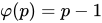





La first property is shown easily, because a prime number is co-pressed with all its previous numbers. And therefore they exist coprimos elements . In other words, like he is a cousin only to have of divisors himself and the unity, which is present in the previous numbers .

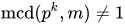
For the Second propertyWe must observe that if He's a cousin only his multiples. minors or equals present a common divider with different from one. This is, are the only numbers such that . As in total numbers that satisfy this property, the rest of numbers between and They only have as a common divider with . This is, . (Note that this second property is fulfilled because He's a cousin. Indeed, if there was a , such as , then would be splitter ( sometimes); i.e., would be a power (and therefore multiple) contradicting the initial assumption ).









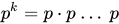
To demonstrate third property, be it , , the sets of positive integers that are coprimos and less than , , respectively (then , and ). Then, for the Chinese Theorem of Resto there is a bijection between and , which implies that .


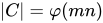

With this, the value of can be calculated using the Fundamental Theorem of Arithmetic: if
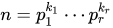
where the pj are distinct prime numbers, then

This formula can be rewritten as follows (known as the Euler Product Formula):
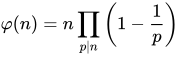
where the are the different cousins who divide to .
Calculation example

Also,

You can manually check that the numbers coprime with 36 (that is, they are not divisible by 2 or 3) are twelve: 1, 5, 7, 11, 13, 17, 19, 23, 25, 29, 31, and 35.
Fourier transform
The totient is the discrete Fourier transform of the gcd, evaluated at 1. Let
![{displaystyle {mathcal {F}}{mathbf {x} }[m]=sum limits _{k=1}^{n}x_{k}cdot e^{{-2pi i}{frac {mk}{n}}}}](https://wikimedia.org/api/rest_v1/media/math/render/svg/44406da8bf27ff396599d35e91d4328c3f961a81)
where xk = gcd(k,n)< /span> for k ∈ {1,..., n}. So
![{displaystyle varphi (n)={mathcal {F}}{mathbf {x} }[1]=sum limits _{k=1}^{n}operatorname {mcd} (k,n)e^{-2pi i{frac {k}{n}}}.}](https://wikimedia.org/api/rest_v1/media/math/render/svg/45bba2a152ca93a92a23eeb59cca9e13077fe049)
The real part of this formula is
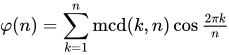
Unlike the Euler product and divisor sum formula, this one doesn't require knowing the factors of n. However, it involves computing the greatest common factor of n and any positive integer less than n, which is enough to provide the factorization anyway.
Sum of its divisors
The property established by Gauss, that
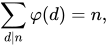
where the sum is over all positive divisors d of n, can be demonstrated in several ways (see arithmetic function for notation conventions).
One proof is to note that φ(d) is also equal to the number of possible generators of the cyclic group < span class="texhtml">Cd; specifically, if Cd = ⟨g⟩ with gd= 1, so gk is a generator for each coprime of k a d. Since each element of Cn generates a cyclic subgroup, and all subgroups < span class="texhtml">Cd ⊆ Cn are generated precisely by φ(d) elements of Cn, the formula is as follows. Equivalently, the formula can be derived using the same argument applied to the multiplicative group of the roots of unity nth roots of unity and d-th primitives.
The formula can also be derived from elementary arithmetic. For example, let n = 20 and consider positive fractions up to 1 with denominator twenty:

Reducing them to smallest terms:

These twenty fractions are all k d ≤ positive 1 whose denominators are the divisors d = 1, 2, 4, 5, 10, 20. Fractions with 20 as denominator are those with numerators relatively prime to 20, namely 1, 320, 720, 920, 1120, 1320, 1720 and 1920. By definition, this is the φ(20) fractions with denominator 20. Similarly, there are φ(10) fractions with denominator 10 and φ(5) fractions with denominator 5, etc. Therefore, the set of twenty fractions is divided into subsets of size φ(d) for each d that divides 20. A similar argument applies for any n.
The Möbius inversion formula applied to the divisor sum formula gives
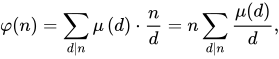
where μ is the function of Möbius, the multipliative function defined by and for every cousin p and k ≥ 2. This formula can also be derived from the product formula multiplying to get


An example:
![{displaystyle {begin{aligned}varphi (20)&=mu (1)cdot 20+mu (2)cdot 10+mu (4)cdot 5+mu (5)cdot 4+mu (10)cdot 2+mu (20)cdot 1\[.5em]&=1cdot 20-1cdot 10+0cdot 5-1cdot 4+1cdot 2+0cdot 1=8.end{aligned}}}](https://wikimedia.org/api/rest_v1/media/math/render/svg/5a4ce2d54734e410d4eea1d1a6b0d62ad7fbfed9)
Some values

The first 99 values of the function are written in the following table, as well as graphically.
| +0 | +1 | +2 | +3 | +4 | +5 | +6 | +7 | +8 | +9 | |
|---|---|---|---|---|---|---|---|---|---|---|
| 0+ | 1 | 1 | 2 | 2 | 4 | 2 | 6 | 4 | 6 | |
| 10+ | 4 | 10 | 4 | 12 | 6 | 8 | 8 | 16 | 6 | 18 |
| 20+ | 8 | 12 | 10 | 22 | 8 | 20 | 12 | 18 | 12 | 28 |
| 30+ | 8 | 30 | 16 | 20 | 16 | 24 | 12 | 36 | 18 | 24 |
| 40+ | 16 | 40 | 12 | 42 | 20 | 24 | 22 | 46 | 16 | 42 |
| 50+ | 20 | 32 | 24 | 52 | 18 | 40 | 24 | 36 | 28 | 58 |
| 60+ | 16 | 60 | 30 | 36 | 32 | 48 | 20 | 66 | 32 | 44 |
| 70+ | 24 | 70 | 24 | 72 | 36 | 40 | 36 | 60 | 24 | 78 |
| 80+ | 32 | 54 | 40 | 82 | 24 | 64 | 42 | 56 | 40 | 88 |
| 90+ | 24 | 72 | 44 | 60 | 46 | 72 | 32 | 96 | 42 | 60 |
Euler's Theorem
Euler's theorem states that if a and n are coprime numbers, so

The special case where n is prime is known as Fermat's little theorem.
This follows from Lagrange's theorem and from the fact that φ(n) is the order of the group multiplicative of integers modulo n.
The RSA encryption system is based on this theorem: it implies that the inverse of the function a ↦ ae mod n, where e is the encryption exponent (public), is the function b ↦ bd mod n, where d, the decryption (private) exponent, is the multiplicative inverse of e module φ(n). The difficulty of calculating φ(n) without knowing the factorization of n is therefore the difficulty of computing d: this is known as the RSA problem, which can be solved by factoring n. The owner of the private key knows the factorization, since an RSA private key is constructed by choosing n as the product of two prime numbers large (chosen at random) p and q. Only n is publicly disclosed, and given the difficulty of factoring very large numbers, you are guaranteed that no one else will know about the factorization.
Other formulas
- ( ): Sea . Then we have to:

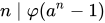


. Then, by the Theorem of Lagrange, divide a .



But Yeah. and also .



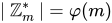
So,

- where
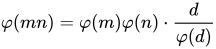

Note the special cases:



Share this with the formula (see minimum common multiple (mcm) and maximum common divider (mcd)).


- φ(n) It's a pair. n ≥ 3. Besides, if n It has r different odd prime factors, 2r 日本語 φ(n)
- For any a ▪ 1 and n ▪ 6 such as 4 n There is a l ≥ 2n such as l 日本語 φ(an (1).
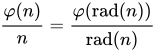
where rad(n) is the radical of n (the product of all different cousins that divide n).
- (quoted in)
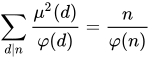
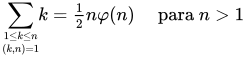




where γ is the constant of Euler-Mascheroni.
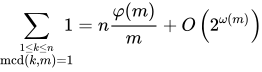
where m ▪ 1 is a positive integer and ω(m) is the number of prime factors other than m.
Menon's identity
In 1965, P. Kesava Menon showed that
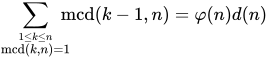
where d(n) = σ0(n) is the number of divisors of n.
Formulas involving the golden ratio
Schneider found a pair of identities connecting the totient function, the golden ratio and the Möbius function μ(n) . In this section, φ(n) is the totient function and ϕ = 1 + √52 = 1.618... is the golden ratio.
You have to:
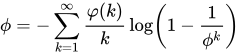
and
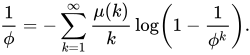
If they are subtracted, you get

Applying the exponential function to both sides of the above identity produces an infinite product formula linked to e:
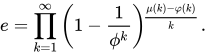
The proof is based on the following two formulas
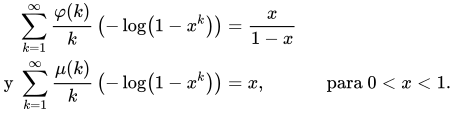
Generating functions
The Dirichlet series for φ(n) can be written in terms of the Riemann zeta function as:
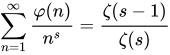
where the left side converges .

The generating function of the Lambert series is
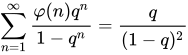
which converges for | q | < 1.
Both formulas are proved by manipulations of elementary series and the formulas for φ(n).
Growth rate
In the words of Hardy & Wright, the order of φ(n) is "almost always n»".
First
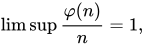
but since n tends to infinity, for all δ > 0

These two formulas can be proved using little more than the formulas for φ(n) and the function sum σ(n) divisors.
In fact, during the proof of the second formula, the inequality
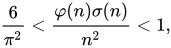
true for n > 1, is proven.
You also have to
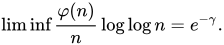
Here γ is Euler's constant, γ = 0.577215665..., so eγ = 1.7810724... and e−γ = 0.56145948....
Proving this does not require the Prime Number Theorem at all. Since log log n tends to infinity, this formula shows that
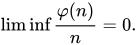
And indeed, more properties are checked, such as

and

The second inequality was proved by Jean-Louis Nicolas. Ribenboim noted that: "The proof method is interesting, since the inequality is shown first under the assumption that the Riemann hypothesis is true, and then under the opposite assumption".
For the average order, one has to

This result, due to Arnold Walfisz, was proved by exploiting the estimates on exponential sums due to I. M. Vinogradov and N. M. Korobov.
Using a combination of the methods of van der Corput and Vinogradov, H.-Q. Liu (On the Euler function. Proc. Roy. Soc. Edinburgh Sect. A 146 (2016), no. 4, 769–775) improved the error term to
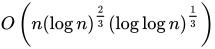
(this is currently the best known estimate of this type). The "Big O" represents a quantity that is bounded by a constant multiplied by the function of n inside the parentheses (which is small compared to < span class="texhtml">n2).
This result can be used to show that the probability that two randomly chosen numbers are relatively prime is 6π2.
Relation between consecutive values
In 1950, Somayajulu proved that
![{displaystyle {begin{aligned}lim inf {frac {varphi (n+1)}{varphi (n)}}&=0quad {text{y}}\[5px]lim sup {frac {varphi (n+1)}{varphi (n)}}&=infty.end{aligned}}}](https://wikimedia.org/api/rest_v1/media/math/render/svg/4b425b7a350d278f9b4f5d096ca210ce1285caac)
In 1954 Schinzel and Sierpiński strengthened this proposition, proving that the set
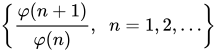
is dense in the positive real numbers. They also proved that the set
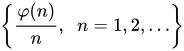
is dense on the interval (0,1).
Totient numbers
A totient number is a value of the Euler totient function: that is, an m for which there is at least one n for which φ(n) = m. The valence or multiplicity of a totient number m is the number of solutions of this equation. A non-bearing number is a natural number that is not a bearing number. Every odd integer that exceeds 1 is trivially a non-counting number. There is also an infinite number of even non-totents, and, in fact, every positive integer has a multiple that is an even non-totent.
The number of numbers up to a given limit x is
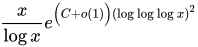
for a constant C = 0.8178146....
If counted according to their multiplicity, the number of counting numbers up to a given limit x is

where the error term R is of order at most < span class="sfrac nowrap" style="display:inline-block; vertical-align:-0.5em; font-size:85%; text-align:center">x(log x)k for any positive k.
It is known that the multiplicity of m exceeds mδ infinitely often for any δ < 0.55655.
Ford's Theorem
Ford (1999) proved that for every integer k ≥ 2 there exists a totient number m of multiplicity k: that is, for which the equation φ(n) = m has exactly k solutions; this result had been previously conjectured by Wacław Sierpiński, and had been obtained as a consequence of Schinzel's hypothesis H. In fact, every multiplicity that occurs does so infinitely often.
However, there is no known number m with multiplicity k = 1. The Carmichael totient function conjecture is the statement that there is no such thing as m.
Perfect Tontient Numbers
The perfect totients are those that are equal to the sum of their successive totients. There is a family of these numbers related to the powers of three, as well as the products of these powers by some prime numbers.
Applications
Cyclotomy
In the last section of the Disquisitions, Gauss proved that a n-regular agon can be constructed with rule and time signature if φ(n) is a power of 2. If n is a power of an odd prime number, the formula for totient says that its totient can be a power of two only if n is a prime power and n − 1 is a power of 2. Prime numbers that are one more than a power of 2 are called Fermat prime numbers and only five are known: 3, 5, 17, 257 and 65537. Fermat and Gauss knew this data, and subsequently no one has been able to verify if there are more than these numbers.
Therefore, a regular n-gon has a straightedge and compass construction if n is a product of distinct Fermat primes and any power of 2. The first few n are
- 2, 3, 4, 5, 6, 8, 10, 12, 15, 16, 17, 20, 24, 30, 32, 34, 40,... (A003401 Succession in OEIS).
Prime number theorem for arithmetic progressions
The RSA Cryptosystem
Setting up an RSA system involves choosing two large primes p and q, calculate n = pq and k = φ(n) and find two numbers e and d such that ed ≡ 1 (mod k). The numbers n and e (the "encryption key") are disclosed to the public and d (the "encryption key of decryption") is kept private.
A message, represented by an integer m, where 0 < m < n, is encrypted by calculating S = me (mod n).
And it is deciphered by calculating t = Sd (mod < i>n). Euler's theorem can be used to show that if 0 < t < n, so t = m.
The security of an RSA system would be compromised if the number n could be factored efficiently or if φ(n) could be computed efficiently without factoring n< /span>.
Unresolved issues
Lehmer's conjecture
If p is prime, then φ(< i>p) = p − 1. In 1932 Derrick Henry Lehmer raised the question of whether there is any composite number n such that φ(n) divides n − 1. None known.
In 1933 he proved that if there exists such a n, it must be odd, without squares, and divisible by at least seven prime numbers (that is, ω(n) ≥ 7). In 1980 Cohen and Hagis proved that n > 1020 and that ω(n) ≥ 14. In addition, Hagis proved that if 3 divides n, then n > 101937042 and ω(n) ≥ 298848.
Carmichael's Conjecture
This statement states that there is no number n with the property that for all other numbers m, m ≠ n, φ(m) ≠ φ(n). See Ford's theorem above.
As stated in the main article, if there is a single counterexample to this conjecture, there must be an infinite number of counterexamples, with the smallest having at least ten billion base-10 digits.
Riemann Hypothesis
The Riemann hypothesis is true if and only if the inequality

is true for all n ≥ p120569#, where γ is the Euler-Mascheroni constant and p120569< /sub># is the product of the first 120569 prime numbers.
Contenido relacionado
Twenty six
Interval
Numerical derivation