
Enrique Florez
Enrique (or Henrique) Fernando Flórez de Setién Huidobro y Velasco, O. S. A. (Villadiego, Burgos, July 21, 1702-Madrid, May 5, 1773), was a Spanish Augustinian religious, famous as a historian, although he can also be considered a translator, geographer, chronologist, epigrapher, numismatist, paleographer, bibliographer and archaeologist of the Enlightenment.
Biography
Born into a family of ten siblings, he was the son of Pedro José Flórez de Setién Calderón de la Barca (d. 1747) and Josefa de Huidobro y Velasco Puelles (d. 1743); during his childhood he lived in Zahara de Los Algodonales (Cádiz) and in El Barco de Ávila, where his father served as corregidor on behalf of the Duke of Alba Francisco Álvarez de Toledo.
As a young man he studied Logic in the convent of Santo Domingo de Piedrahíta, and at the age of sixteen he entered the convent of Salamanca of the Order of San Agustín, where he professed the following year. He studied Philosophy at the Augustinian College of Valladolid and Theology at the University of Salamanca until finishing his ecclesiastical career in 1725. After winning a public examination for Arts and being ordained a priest in 1725, he graduated with a bachelor's degree from the College of Santo Tomás de Ávila and as a doctor at the University of Alcalá, where he was a professor.
He was also an academic of the Royal Order of Knights of Valladolid, a member of the Academy of Good Taste of Zaragoza and an Academician of the Royal Inscriptions and Fine Letters of Paris. During his stay in Madrid he met some of the most educated Spaniards of his time, such as Gregorio Mayáns y Siscar, Father Martín Sarmiento, Blas Nasarre and the Iriartes, Juan and Tomás. He was a member of the council of the Inquisition with the position of bookstore inspector and visitor (1743), as well as assistant general of the Spanish province of his order (1765). He by then he wrote the six volumes of a Scholastic Theology (1732-1738). He then turned to scholarly studies and research, particularly to the ecclesiastical history of Spain, applying the methodology of the Enlightenment, criticism, to the original sources. He therefore abandoned his chair in Alcalá and undertook his research at the age of forty, in 1742. He made several trips throughout Spain in search of documents and references and to visit archives. He exhumed numerous important documents, some of them lost today. The following year he published the Historical key that opens the door to ecclesiastical and political history , a book that was reprinted twelve times in little more than half a century.

In 1747 the first volume of his most famous work was printed, the monumental España sagrada, which reached fifty-six volumes, of which Father Flórez composed the first 29, among which years 1747 and 1750 the first five; the rest were dating until 1775, while the last two appeared posthumous. Flórez was clearly inspired by Denis de Sainte-Marthe's Gallia christiana (Paris, 1715-1785, 13 vols.) and by Italia sacra (Venice, 1717-1722)., 10 vols.) by Ferdinando Ughelli, two of the most ambitious historiographic endeavors of their time. The Augustinians, their companions of the Order, did not want to leave the work interrupted and continued it, in whose work Fathers Manuel Risco stood out, who was in charge of the edition of volumes 30 to 42; and Antolín Merino and José de la Canal, who dealt with volumes 43 to 46. The Confiscation of Mendizábal in 1836 interrupted the work, and volumes 47 and 48 appeared thanks to Pedro Sainz de Baranda; promoted by the Royal Academy of History, Vicente de la Fuente prepared volumes 49 (1865) and 50 (1866). Carlos Ramón Fort elaborated volume 51 published in 1879 and volume 52, elaborated by Eduardo Jusué, appeared in 1917; Ángel Custodio Vega composed the last two published, which appeared in 1957.
To proceed with his enormous task, Enrique Flórez divided Spain into dioceses, studying their foundation, coins, monuments, inscriptions, manuscripts, bishops, churches, convents, abbeys, and saints. He reproduces a large number of ancient manuscripts, including texts from ancient chronicles such as the Anales Toledanos , the Crónica Compostelana and many others. These editions were not made with the modern paleographic rigor that prevails today, but it is still necessary to go to Sacred Spain today, and that demonstrates the solidity of the work carried out by the industrious Augustinians. Much of this solidity derives from the humility of the wise Father Flórez, when consulting and communicating with all sorts of experts in matters in which he himself was, since he maintained an enormous literary and scientific correspondence with all those who were dedicated to the study of antiquities, epigraphy and numismatics, or those who also dealt with the ancient and late-antique history of the Iberian Peninsula, whether they agreed with him or not: the antique dealers Miguel de Espinosa, Count of Águila; Andrés Burriel; Patricio Gutierrez Bravo; Luis José Velázquez de Velasco, Marquis of Valdeflores; Gregorio Mayáns and Siscar; Francisco Pérez Bayer, the bibliographer Father Francisco Méndez, who would be his biographer, friend and companion in fatigues, or the Mohedano brothers.
He promoted various editions under his watchful direction: Ambrosio de Morales' trip, by order of King Don Felipe II to the kingdoms of León and Galicia and the Principality of Asturias (1765); that of the De Formando Theologiae Studio Libri IV collecti ac restituti per R. P. M. Fr. Laurentium a Villavicentio; that of the De Sacris Concionibus and the famous Sancti Beati, Presbyteri Hispani Libanensis, In Apocalypsim (1770) or Exposition of the Apocalypse by San Beato de Liébana, which was exhumed by Father Flórez. He also wrote as a numismatist Medals of the colonies, municipalities and ancient towns of Spain (three vols., 1757, 1758 and 1773) and as a genealogist Memory of the Catholic queens, genealogical history of the House Real de Castilla y León (1761, two vols.), among several others. The book La Cantabria, from 1768 was originally going to be an appendix to volume XXIV of España sagrada, but it was published independently because it studied various points, «worthy of particular consideration, with more examination and extension than the regular subjects». This work is considered a reference for the discovery in modern times of the limits of ancient Cantabria, being the starting point for numerous subsequent studies of the Cantabrian people in antiquity. Among the many contributions that his work offers us, special mention should be made of the equivalence made by himself between the ruins of Retortillo and the Roman city of Julióbriga, as well as the location of the mythical Fuentes Tamaricas in Velilla de Guardo (Palencia)..
Died of pneumonia in 1773 at the age of 70 after several days of illness, his body was buried in the Convent of San Felipe el Real in Madrid; His tomb was destroyed during the demolition of the convent in 1838 and his remains, along with those of other religious buried there, were transferred to the southern cemetery, and after its dismantling in 1942, to the Almudena cemetery.
Works
Religion
- Theologia Scholastica Iuxta Principia Scholae Augustiniano-Thomisticae. Computer 5 vols., and left several drafts in order to write a sixth (1732–1738).
- Practical mode of mental prayer (1754); accompanied by The sighs of Saint Augustine by a religious of the same Order, but he had so many mistakes that he had to withdraw from the sale. It was reprinted in 1760.
- Totius Doctrinae de Generatione et Corruptione, de Caelo et Mundo et Anima Compendiosa Tractatio iuxta mindm Doctoris Angelici Divi Thomae Aquinatis (1727), this is volume IV of the Summa Philosophica of Father Fray Andrés Sierra, who had left incomplete.
Social and natural sciences
- Geographica Clave to learn Geographia those who do not have a master1789.
- Key record opening the door to ecclesiastical and political history1742. Sixteen reprints were made before 1817.
- Sacred Spain. Theatro geographic-historic of the church of Spain. Origin, divisions and terms of all their provinces. Antiquity, translations and old and present state of your chairs, in all domains of Spain and Portugal. With several critical presentations to illustrate the ecclesiastical history of Spain (Madrid: 1747-1775, twenty-nine volumes, then continued by other authors). The new edition of the Sacred Spain (2000–2012), which facilitates the reading and understanding of the text and includes the modernization of the spelling, score and accentuation, is due to the enormous work done by the literary editor Rafael Lazcano, and the sponsorship carried out by the Agustinian Province of Castilla, to which Editorial Agustiniana belongs.
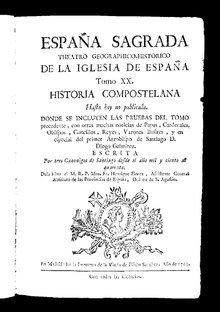
THEATRO GEOGRAPHICO-HISTORICO
OF SPAIN
TOMO XX.
HISTORIA COMPOSTELANA
Give birth to M.R.P. Mro. Fr. Henrique Florez.
- I (1747): Geographical key and ecclesiastical geography of all patriarchs
- II (1747): Chronology of the ancient history of these kingdoms
- III (1748): Prediction of the Apostles in Spain
- IV (1749): Last of the Church in common
- V (1750): From the Carthaginian province in particular
- VI (1751): From the Holy Church of Toledo as Metropolitan
- VII (1751): From the ancient suffrage churches of Toledo
- VIII (1752): From the ancient Suffrage Churches of Toledo
- IX (1752): From the Old Province of Bética in common and the Holy Church of Seville in particular
- X (1753): From the ancient suffrage churches of Seville
- XI (1753): Contains the Lifes and Writings, never published until today, of some Cordobesian Illustrious Men who flourished in the CenturyIX
- XII (1754): From the ancient suffrage churches of Seville
- XIII (1756): Of the ancient Lusitania in common and of its Metropoli Merida in particular
- XIV (1758): From the Churches of Avila, Caliabria, Coria, Coimbra, Ebora, Egitania, Lamego, Lisbon, Osonoba, Pacense, Salamanca, Viseo and Zamora.
- XV (1759): From the ancient province of Galicia in common and its Metropoli, the Church of Braga in particular
- XVI (1762): From the Holy Church of Astorga in its ancient and present state
- XVII (1763): From the Holy Church of Orense
- XVIII (1764): From the British and Dumiense Churches, included in the present Mondon
- XIX (1765): Contains the ancient state of the Iriense and Compostelaan Church until its first Archbishop
- XX (1765): Compostelana History, until today not published
- XXI (1766): Contains the Church of Porto, of ancient Galicia, from its origin to today
- XXII (1767): From the Church of Tuy, from its origin to the centuryXVI
- XXIII (1767): Continuation of the memories of the Holy Church of Tuy
- XXIV (1768): Part One. The Cantabria
- XXIV (1769): Part Two. Tarraconian Antiquities
- XXV (1770): It contains the ancient ecclesiastical memories of the Holy Church of Tarragona
- XXVI (1771): Contains the ancient state of the Churches of Auca, Valpuesta and Burgos
- XXVII (1772): Contains the Colegial Churches, Monasteries and Saints of the Diocese of Burgos
- XXVIII (1774): Contains the ancient state of the Holy Church Ausonense, today Vique
- XXIX (1775): It contains the old state of the Holy Church of Barcelona.
- Elogios del Santo Rey Don Fernando III (1754). After the Elogioson p. 26, follow the Tables of Arab Hegiras or Years.
- Medals of the Colonies, Municipalities and Ancient Peoples of Spain. (2 vols.: 1.o in 1757 and 2.o in 1758). Later, the author published a third volume entitled Medals of the Colonies, Municipalities and Old Towns of Spain, until today not published, with those of the Kings Godos1773. It is the first numismatic treaty published in Spain.
- Memories of the Catholic Queens. Genealogical history of the Royal House of Castile and Leon. (two vols., 1761). There is modern edition: Valladolid: Consejería de Educación y Cultura, 2002, 2 vols. Volume 1 and volume 2.
- Utility of Natural History. A speech dedicated to the later Monarch Carlos IV.
- Map of all the battle sites that the Romans had in Spain. (3 editions: the first in 1745, and the second and third in 1774).
Translations
- Vindicias de la Virtud y Escarmiento de Virtuosos, written by the Portuguese Fray Francisco de la Anunciación de la Orden de los Ermitaños de San Agustín and doctor of the University of Coimbra. Translated by Don Fernando de Setién Calderón de la Barca. Two vols in fourth, 1742.
- Various and admirable works of Mother Mary where Ceo. Franciscan and Abbotian Religious of the Lisbon Hope Convent, translated from the Portuguese edition and illustrated with brief notes by Dr. Don Fernando de Setién Calderón de la Barca. Two tomos in eighth, 1744.
- Work of Jesus, written in Portuguese by the Augustinian Fray Tomé of Jesus being captive and imprisoned in Berbería and translated by Fray Enrique Flórez. Two vols in fourth, 1763.
- Delation of the doctrine of the Jesuit intitulates on dogma and morals, made to the Archbishops and Bishops of France, translated into Spanish by Dr. Fernando Huidobro and Velasco. Fourth, 1768.
Manuscripts
(Almost all disappeared during the War of Independence)
- The Book of the Books and Science of the Saints, in doctrines of eternal truths to revive the faith.
- Treaty of the Holy Church of Lugo. By order, it would correspond to the XXI Volume of the Holy Spain, but for some reason it could not end it. From this manuscript I would later remove Fr.Risco the XL volume.
- Treaty of the Holy Church. Also found a small outline of Treaty of the Holy Church of Zaragoza.
- Century I of the Church.
- Genealogy of Caesars.
- Response or challenge to the Chronological Fanal.
- Intents and preventions on the reduction of the alphabet of the unknown letters that was used among the ancient Spaniards before the rule of the Romans.
- Delation made to the Holy Court of Inquisition on the angelic days of N. P. San Agustín, against Fathers Luis de Molina, Cornelio a Lapide and Fr. Arriaga.
- Dictamen ordered and given to the Ilmo. and Rvdmo. Mr. Fr. Francisco de Rávago, on whether the Gothic Conciliar Codexes in the Royal Monastery of the Escorial should be printed.
- Opinion asked and given to the Royal and Supreme Council of Castile on the method of censoring books.
- Geographi Veteres Graeci et Latini qui res Hispaniae Memoriae tradidere. Pick up the old geography of Spain.
Poetry
- Distichorum, Lyricorum, Epigrammatum, Heroicorum. Opera Fr. Henrici Flórez, Agustiniani. Includes the Qualis sit Princeps hexameters; a composition in senarios yámbicos and quaternarios and a plant in elegiac distics dedicated to St. Thomas of Villanueva; an hymn in loor of St.John of the Cross in the asclepiádeas thermoplastic estrophas of three asclepiádeos and a glynical and a bilingual poem in Latin Spanish University.
- In Ioannem to Cruce Labyrinthus. Written on the occasion of the feasts of the canonization of San Juan de la Cruz (in 1727, when the friars celebrated it, or in 1728 when the Carmelite nuns did it).