
Electronic component

An electronic component is a device that is part of an electronic circuit. They are usually encapsulated, generally in a ceramic, metal or plastic material, and terminate in two or more terminals or metal pins. They are designed to be connected together, normally by welding, to a printed circuit, to form the aforementioned circuit.
Components are physical devices, while elements are idealized models or abstractions that constitute the basis for the theoretical study of the aforementioned components. Thus, the components appear in a list of devices that form a circuit, while the elements appear in the mathematical developments of circuit theory.
Classification
Components can be classified as passive/active or electromechanical. The strict definition of physics treats passive components as those that cannot supply energy on their own, while a battery would be seen as an active component since it actually acts as a source of energy.
However, electronic engineers who perform circuit analysis use a more restrictive definition of passivity. When dealing only with signal power, it is convenient to ignore the so-called DC circuit and pretend that power supply components such as transistors or integrated circuits are absent (as if each component has its own built-in battery), although in reality it may be powered by DC circuit. So the analysis only refers to the AC circuit, an abstraction that ignores the DC voltages and currents (and the power associated with them) present in the real-life circuit. This fiction, for example, allows us to see an oscillator as "energy producer" although in reality the oscillator draws even more power from a DC power supply, which we choose to ignore.
According to the criteria chosen, we can obtain different classifications. The most commonly accepted ones are detailed below.
- 1. According to its physical structure
- Discreet: are those who are encapsulated one by one, as is the case of resistors, capacitors, diodes, transistors, etc.
- Integrated: They form more complex sets, for example, an operational amplifier or a logical door, which can contain from a few discrete components to millions of them. These are the so-called integrated circuits.
- 2. According to the manufacturing base material.
- Semiconductors (see list).
- No semiconductors.
- 3. According to its operation.
- Assets: provide electrical excitation, gain or control (see list), and can usually inject energy into a circuit, although this is not part of the definition.
- Liabilities: they are responsible for the connection between the different active components, ensuring the transmission of the electrical signals or modifying their level (see list).
- 4. According to the type of energy.
- Electromagnetic: those who take advantage of the electromagnetic properties of materials (mainly transformers and inducers).
- Electroacoustics: transform acoustic energy into electrical and vice versa (microphones, speakers, horns, headphones, etc.).
- Optoelectronics: transform light energy into electrical and vice versa (LED, photoelectric cells, etc.).
Most passive components with more than two terminals can be described in terms of two-port parameters that satisfy the reciprocity principle, although there are rare exceptions. In contrast, active components (with more than two terminals) generally lack that property.
Components
Semiconductor components
A semiconductor is a substance that behaves as a conductor or as an insulator depending on the conditions in which it is found: electric field, magnetic field, pressure, radiation or ambient temperature. A semiconductor electronic component is one that uses the electrical properties of semiconductor materials, mainly silicon, germanium and gallium arsenide, as well as organic semiconductors. The most common semiconductor component is the MOSFET transistor, however, there are many other semiconductor devices such as diodes, BJTs, IGBTs, thyristors, etc.
Active components
Active components are those that are capable of controlling the current flow of the circuits or making gains. They are mainly electric generators and certain semiconductor components. The latter, in general, have a non-linear behavior, that is, the relationship between the applied voltage and the demanded current is not linear.
The active semiconductor components are derived from the Fleming diode and the Lee de Forest triode. In the first generation, valves appeared that allowed the development of electronic devices such as radio or television. Later, in a second generation, semiconductors would appear that would later give way to integrated circuits (third generation) whose maximum expression is found in programmable circuits (microprocessor and microcontroller) that can be considered as components, although in reality they are circuits. that have millions of components integrated.
There is a large number of active components, and it is common for an electronic system to be designed from one or several active components whose characteristics will condition it. This is not the case with passive components. The following table shows the main active components along with their most common function within a circuit.
| Component | Most common function |
|---|---|
| Operational amplifier | Amplification, regulation, signal conversion, switching. |
| Biestable | Sequential systems control. |
| PLD | Control of digital systems. |
| Diac | Power control. |
| Diodo | Signal rectification, regulation, voltage multiplier. |
| Diodo Zener | Tension regulation. |
| FPGA | Control of digital systems. |
| Memory | Digital data storage. |
| Microprocessor | Control of digital systems. |
| Microcontroller | Control of digital systems. |
| Pila | Generation of electrical energy. |
| Tiristor | Power control. |
| Logical door | Combination system control. |
| Transistor | Amplification, switching. |
| Triac | Power control. |
Passive components
| Component | Most common function |
|---|---|
| Condensador | Energy storage, filtering, impedance adaptation. |
| Inducer or coil | Store or attenuate the change of energy due to its power of self-induction. |
| Resistant or resistance | Division of intensity or tension, limitation of intensity. |
| Memristor | Connect the electric charge with the magnetic flow. |
Electromechanical components
Switches, fuses and connectors belong to this group.
Optoelectronic components
Optoelectronic components are those that transform light energy into electrical energy, called photosensitive, or electrical energy into light, often called electroluminescent.
Main manufacturers
The components industry is fundamental for the electronics industry, which in turn is fundamental for the rest of the industries. The significant volume of business of this type of industry in the most developed countries makes them play an important role in their respective economies. The following table shows a list of the main electronic component manufacturing companies. The majority are multinationals in which the manufacturing of electronic components represents only part of the field of action.
| Company | Symbol | Country | Types of components that manufacture | Web |
|---|---|---|---|---|
| Advanced Micro Devices | AMD | United States | Semiconductors, microprocessors and microcontrollers | AMD |
| Analog Devices | AD | United States | Semiconductors | Analog Devices |
| Cypress Semiconductor | CY | United States | Semiconductors | Cypress S. |
| Fairchild Semiconductor | F | United States | Semiconductors | Fairchild |
| Freescale Semiconductor | United States | Semiconductors | Freescale | |
| Fujitsu Microelectronics | FUJ | Japan | Semiconductors, capacitors, relays... | Fujitsu |
| IBM Microelectronics | IBM | United States | Memories, microprocessors, microcontrollers... | IBM |
| Intel | i | United States | Memories, microprocessors and microcontrollers | Intel |
| Microchip Technology Inc. | MCHP | United States | Semiconductors | Microchip Technology |
| Mitsubishi Semiconductor | Japan | Semiconductors | Mitsubishi | |
| NEC Components | NEC | Japan | Semiconductors, capacitors, relays... | NEC |
| OKI | OKI | Japan | Semiconductors | OKI |
| Panasonic | Japan | Semiconductors, batteries, resistors... | Panasonic | |
| NXP | Netherlands | Semiconductors | NXP Semiconductors | |
| Rambus | RMBS | United States | Memories | Rambus |
| Samsung | Republic of Korea | Memories, microcontrollers... | Samsung | |
| SGS-Thomson | ST | Switzerland | Semiconductors | ST |
| Sharp | Japan | Memories, microcontrollers, power control... | Sharp | |
| Siemens AG | Germany | Semiconductors, regulators... | Siemens | |
| Texas Instruments | ♪ | United States | Semiconductors | IT |
| Xilinx | United States | FPGA, CPLD | Xilinx | |
| Zilog | United States | Microcontrollers, microprocessors, peripherals... | Zilog |
Conventions used when studying electronic components
Definitions of voltage and current in the context of a dipole
Considering a dipole where and limbs:


- tension can be defined as the potential difference or as the difference of potentials ;
- the intensity of the current that passes through it can be seen as that of the circulating current of towards of the current that passes through it can be seen as that of the circulating current of towards .

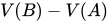
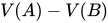

Therefore, it is necessary to rigorously define these two quantities.
To do this, arrows are used:
- Low voltage, is calculated by subtracting the potential at the base of the arrow (signed parallel to the dipole) of the potential at its top;
- in the context of intensity, the arrow (designed in the cable considered) indicates the direction of the flow of the current when It's positive.
Attention: such notice of intensity gives no information about the direction of the flow of the current itself: this information results from the sign of .
Generator and receiver conventions for a dipole
They are defined for the study of a dipole:
- the convention of the generator, in which the arrows that define the current and tension are in the same direction;
- the convention of the receiver, in which the arrows that define the current and tension They're in opposite directions.

When plotting the characteristic of a dipole:
- for an active dipolo, the generator convention is adopted;
- for a passive dipole, the receptor convention is adopted.
It should be taken into account in particular that since these conventions influence the relative signs of and different formulas depend on it.
For example, considering an optical resistance conductor , the law of Ohm is usually written in the receiving convention:


But in the generator convention, it becomes:

Standard symbols
In a circuit diagram, electronic devices are represented by conventional symbols. Reference designators are applied to symbols to identify components.