
Eduardo Frei Montalva
Eduardo Nicanor Frei Montalva (Santiago, January 16, 1911-Ib., January 22, 1982) was a Chilean lawyer, journalist and Christian Democrat politician. He was President of the Republic during the period between 1964 and 1970 —being the first president born in the 20th century— and President of the Senate between May and September 1973. He Son of a Swiss father and prominent member of the Frei family.
Trained in the ranks of the Conservative Party and graduated from the Pontificia Universidad Católica de Chile (PUC), he was one of the founders of the Falange Nacional (FN), a split from conservatism that proposed the postulates of the Social Doctrine of the Church and Christian humanism. After participating in the ministerial cabinet as Minister of Public Works of the radical president Juan Antonio Ríos, he was elected Senator of the Republic between 1949 and 1957 for the provinces of Atacama and Coquimbo, being re-elected for the period between 1957 and 1965 for the province of Santiago.
In 1957, Frei participated in the reform of the National Falange (FN) that gave life to the Christian Democratic Party (PDC), which proclaimed him as its candidate for the 1958 presidential elections. Although he was defeated by Jorge Alessandri and Salvador Allende obtained an auspicious 20.75% that raised his chances for the 1964 presidential elections, when he was again presented as a candidate. In these elections he was supported by sectors of the center and right, obtaining 56.08% of the votes.
After the end of his term, he became one of the main opponents of the Popular Unity (UP) government led by Allende, taking over as president of the Senate after the 1973 parliamentary elections, when he won a seat again for Santiago, a position he held until the dissolution of Congress after the coup of September 11, 1973. During the military dictatorship, and after initial support for the coup, he became one of the main opposition figures against the regime headed by Augusto Pinochet, being the only one allowed to hold a demonstration against the approval of the Political Constitution of 1980.
In 1982, Frei Montalva died after digestive surgery for a hiatal hernia. Although at first his death was officially explained as the result of septic shock after the operation, derived from complications in it, during the return to democracy a judicial investigation was initiated, after which in December 2009 he was classified as homicide, prosecuting six people as alleged perpetrators and participants in said crime, being classified as assassination. In 2019, Judge Alejandro Madrid confirmed that the death of the ex-president was a simple homicide and sentenced six defendants for the crime of homicide. The doctor Patricio Silva Garin, as the author, was sentenced to 10 years in prison On January 25, 2021, the Santiago Court of Appeals decided to revoke the first instance ruling issued by Alejandro Madrid and acquit all the defendants, since the surgery that was performed on him was necessary and correctly executed, there would be no intentional offenses or guilty to the medical lex artis.
Early Years
He was the son of Eduardo Frei Schlinz, an Austrian of Swiss origin, who arrived in South America at the age of 24, passing from Argentina to Chile, where he married Victoria Montalva Martínez, with whom he had three children: Eduardo, Arturo and Irene. He was the uncle of Arturo Frei Bolívar, who was a representative and senator.
At the age of three, in 1914 he left with his family for Lontué, in one of whose vineyards his father was hired as an accountant. His other two brothers were born: Arturo and Irene. In this place, he attended the Lontué Public School.
In 1919 the family returned to Santiago, where he continued his primary and secondary studies at the Seminario Conciliar de Santiago. The Council was closed after three years and he entered the Catholic Church's Luis Campino Humanities Institute, where he began to acquire a taste for reading and his Catholic faith grew.
Rise in politics
.JPG)
First, in 1928, he began to study law at the Catholic University thanks to a scholarship obtained by his mother with the rector Carlos Casanueva. There he began to take a political position, joining the National Association of Catholic Students (Anec) in 1929, which also included Bernardo Leighton, Radomiro Tomić, Julio Philippi, Jaime Eyzaguirre, Mario Góngora and Rafael Agustín Gumucio. This association would join Catholic Action, creating a magazine, the "Catholic Student Magazine", where Catholicism was raised in light of the encyclicals "Rerum Novarum", by Leo XIII and those of Pope Pius XI.
At the end of 1933 Frei would travel to Rome to the Pax Romana Congress representing the Catholic university youth and in which he would take the highest position of the Ibero-American Confederation of University Students created on the occasion. There he would meet other young Latin American leaders, including Rafael Caldera, who would eventually be elected president of Venezuela.
He graduated as a lawyer on October 27, 1933 with his thesis «The salaried regime and its possible abolition», receiving the Grand Prize of Honor, awarded to students with brilliant studies and exemplary university performance. The text includes themes such as "co-ownership of companies" and "worker shareholding", which only years later would be current issues.
On April 27, 1935, he married María Ruiz-Tagle, with whom he would have seven children (Irene, Carmen, Isabel, Mónica, Eduardo, Jorge and Francisco Javier), establishing his residence in Iquique until 1937, the year in who returned to Santiago. In Iquique, he dedicated himself to journalism and became director of the newspaper El Tarapacá . During this stay in the north of Chile, he would also write his book Chile desconocido .

In 1935 he joined the Conservative Party and in it he was part of the group that founded the National Falange in 1936, the seed of the Christian Democratic Party, a movement that was mainly inspired by the social doctrine of the Catholic Church and the teachings of the French philosopher Jacques Maritain, whom Frei would know personally.
In Santiago, he worked as a lawyer and as a professor of Labor Law at the Catholic University, as well as being an editor for the conservative Diario Ilustrado.
In 1938 the National Falange separated definitively from the Conservative Party, Frei becoming president of that in 1941, 1943 and 1945.
During the presidency of the radical Juan Antonio Ríos he was Minister of Public Works and Communications, the first important post held by the National Falange, but he resigned in protest of the events that culminated in the Plaza Massacre Bulnes, on January 28, 1946. On that date, the vice president of the resigned President Ríos, Alfredo Duhalde, was at the La Moneda Palace.

On April 23, 1947, during a meeting in Montevideo, Uruguay, attended by the main political figures from Argentina, Brazil, Chile and Uruguay who agreed on the need to create an international organization of Christian democrats, the Christian Democratic Organization of America. Representatives from Bolivia and Peru also adhered -through written notes- to the new organization. At the meeting, a board of directors was created with the mission of organizing the "international section" of the movement, made up of Manuel Vicente Ordóñez, from Argentina; Trisao de Ataide, from Brazil; Eduardo Frei Montalva, from Chile; and Dardo Regules, from Uruguay. The Declaration of Montevideo, April 23, 1947, set the objective:
... “to base a supranational movement of common bases and denominations that aims to promote, through study and action, a true political, economic and cultural democracy, on the basis of the principles of Christian humanism, within the methods of freedom, respect for the human person and the development of the spirit of community and against totalitarian dangers...”. (MONTEVIDEO DECLARATION, 23 APRIL 1947)
On July 28, 1957, he participated in the founding of the Christian Democratic Party, which was the product of the union of the National Falange with the Social Christian Conservative Party, splinter groups of the Conservative Party. Subsequently, smaller groups such as the National Christian Party and the so-called agrarian-laborists joined the PDC. Eduardo Frei became the natural leader of the party, although he did not hold its presidency.
He was elected senator on several occasions: 2nd Provincial Grouping (Atacama and Coquimbo, where he had gained great popularity for his works as a minister) 1949-1957, and 4th Provincial Grouping (Santiago) 1957-1965 and 1973-1981. During his legislative period, he was a member of the Permanent Commission on Finance and Budgets; and that of Public Works and Communication Routes and the Mixed Budget Commission. He was a substitute in the Permanent Commission of Hygiene, Health and Public Assistance.
This last period could not be completed when the National Congress was dissolved by the military dictatorship.
He stood as a candidate in the 1958 presidential elections, obtaining 254,233 votes (20.7% of the validly cast votes) and third place in the election won by Jorge Alessandri and in which Salvador Allende came second.
Presidency (1964-1970)

Introduced again in the 1964 election by the Christian Democrats, he widely surpassed party schemes and attracted a large part of the country's youth with his humanist ideals, to which was added the unconditional support given to him by the right, which he abandoned his candidate Julio Durán and decided to support him to prevent a possible victory for Salvador Allende.
This allowed him to obtain an absolute majority of the votes (which had not been given since Juan Antonio Ríos) in the election with 56.09%, and the possibility of governing with the DC alone for the entire six-year term, since the drive of his campaign and the slogan "a parliament for Frei" allowed him to obtain 42.3% of the votes in the parliamentary elections six months later.
Frei's election was viewed with interest in all parts of the world, as it was a very promising political experiment, which could be the option to capitalism and socialism, in the middle of the Cold War. In this global context, the influence of the United States over Latin America was also present to prevent the eventual election of the Socialist candidate Salvador Allende. Thus, the United States, through the CIA, financed more than half of Eduardo Frei Montalva's campaign in 1964, without his knowledge.
Ministers of State
 of the Government of Eduardo Frei Montalva | ||
|---|---|---|
| Ministry | Owner | Period |
| Ministry of the Interior | Bernardo Leighton Guzmán Edmundo Pérez Zujovic Patricio Rojas Saavedra | 3 November 1964 - 15 February 1968 15 February 1968 - 10 July 1969 10 July 1969 - 3 November 1970 |
| Ministry of Foreign Affairs | Gabriel Valdés Subercaseaux | 3 November 1964 - 3 November 1970 |
| Ministry of National Defence | Juan de Dios Carmona Peralta Tulio Marambio Marchant Sergio Ossa Pretot | 3 November 1964 - 2 May 1968 2 May 1968 - 22 October 1969 22 October 1969 - 3 November 1970 |
| Ministry of Finance | Sergio Molina Silva Raúl Sáez Sáez Andrés Zaldívar Larraín | 3 November 1964 - 15 February 1968 15 February 1968 - 15 March 1968 15 March 1968 - 3 November 1970 |
| Ministry of Economy, Development and Reconstruction | Domingo Santa Maria Santa Cruz Andrés Zaldívar Larraín Juan de Dios Carmona Peralta Enrique Krauss Rusque Carlos Figueroa Serrano | 3 November 1964 - 15 February 1968 15 February 1968 - 2 May 1968 2 May 1968 - 30 September 1968 30 September 1968 - 5 September 1969 5 September 1969 - 3 November 1970 |
| Ministry of Public Education | Juan Gómez Millas William Thayer Arteaga Maximum Pacheco Gómez | 3 November 1964 - 17 February 1968 17 February 1968 - 4 March 1968 4 March 1968 - 3 November 1970 |
| Ministry of Justice | Pedro Jesús Rodríguez González William Thayer Arteaga Jaime Castillo Velasco Gustavo Lagos Matus | 3 November 1964 - 15 February 1968 15 February 1968 - 14 August 1968 14 August 1968 - 27 June 1969 27 June 1969 - 3 November 1970 |
| Ministry of Labour and Social Security | William Thayer Arteaga Eduardo León Villarreal | 3 November 1964 - 15 February 1968 15 February 1968 - 3 November 1970 |
| Ministry of Public Works and Transport | Modesto Collados Núñez (as Minister of Public Works) Edmundo Pérez Zujovic (as Minister of Public Works) Sergio Ossa Pretot (as Minister of Public Works) Sergio Ossa Pretot Eugenio Celedón Silva | 3 November 1964 - 16 December 1965 16 December 1965 - 7 September 1967 7 September 1967 - 13 December 1967 13 December 1967 - 12 November 1969 12 November 1969 - 3 November 1970 |
| Ministry of Health | Ramon Valdivieso Delaunay | 3 November 1964 - 3 November 1970 |
| Ministry of Housing and Urbanism | Modesto Collados Núñez Juan Patricio José Hamilton Depassier Andrés Donoso Larraín | 16 December 1965 - 10 August 1966 10 August 1966 - 9 October 1968 9 October 1968 - 3 November 1970 |
| Ministry of Lands and Colonization | Hugo Trivelli Franzolini Jaime Castillo Velasco Hugo Trivelli Franzolini Víctor Emerson González Maertens | 3 November 1964 - 16 December 1965 16 December 1965 - 16 May 1967 23 May 1967 - 21 May 1968 21 May 1968 - 3 November 1970 |
| Ministry of Agriculture | Hugo Trivelli Franzolini | 3 November 1964 - 3 November 1970 |
| Ministry of Mining | Eduardo Simián Gallet Alejandro Hales Jamarne | 3 November 1964 - 21 October 1966 21 October 1966 - 3 November 1970 |
Social program

His program «Revolución en Libertad» proposed a structural reform of the country through the creation of cooperatives and new social organizations such as neighborhood associations, youth centers, mothers' centers among others. It was the "Popular Promotion" (Law 16,880): creating grassroots organizations capable of facing problems with which it was intended to improve the living conditions of marginal sectors. The changes would not be made from the State but from the community itself. For this reason, the government of Frei Montalva gave special impetus to trade unionism and education.
The National Council for Popular Promotion was created, which, against the wishes of Frei Montalva, could not become a ministry, although it was as important as if it had been.
He created the Ministry of Housing and about 130,000 affordable houses were built. This sought to alleviate the housing deficit created by the increase in population. In social security, it issued Law 16,744, which created the Insurance for Work Accidents and Occupational Diseases.
In health, 56 new hospital establishments were built, which meant doubling the number of beds.
In education, he promulgated the Educational Reform, whose fundamental objective was to create the possibility that everyone could access education and remain in it regardless of their socioeconomic level.
To achieve these goals, 3,000 new schools were built throughout the country, the same school uniform was created for all, basic education was extended to eight years, enrollment in basic education doubled and tripled in the humanist scientist. One of his achievements was the sharp reduction in illiteracy.
The Law on Child Care Centers was also promulgated to care for a population of one and a half million children between one and six years of age.
In supplementary feeding, the delivery of milk in the maternal program was increased by more than 80%; general mortality dropped from 11 per thousand per year to 8 per thousand, and infant mortality from 103 per thousand to 79 per thousand.
In the labor field, unionization had an extraordinary growth: from 270,000 to 550,000 people.
Infrastructure and industry
In public works and industry, the Pan-American Highway between Arica and Puerto Montt was paved, works began on the Santiago Metro, the Lo Prado tunnel and the first stage of the Pudahuel Airport, works that provided the country with important infrastructure in the transportation area.
During the period, installed electrical power increased by more than 50%, the Chilean Electricity Company was nationalized, oil refining increased by 1%, the Chilean Nuclear Energy Commission (Cchen) was created, managed to install most of the telecommunications trunk network between Arica and Punta Arenas, 51% of the Chilean Telephone Company (CTC) was acquired through the Production Development Corporation (Corfo), the Televisión Nacional de Chile and extended its network to the entire country.
In terms of industrial development, in the steel sector, investments were made to expand the productive capacity of Huachipato from 620,000 tons of steel per year to one million tons; Special importance was given to the petrochemical industry with the installation of six plants for different products in Concepción.
In the institutional field, the National Planning Office (ODEPLAN), currently the Ministry of Social Development, was created.
Economic reforms

An essential aspect of the government of Frei Montalva was the implementation of the Agrarian Reform, already begun under the administration of Jorge Alessandri Rodríguez, but considered incomplete.
Its purpose was "to give access to land ownership to those who work it, increase agricultural production and soil productivity." Two laws were promulgated in 1967, the Peasant Unionization Law and the Agrarian Reform Law. The latter allowed the expropriation of land when an agricultural property was excessively large, there was abandonment, poor exploitation or excessive fragmentation of the land.
Through the text, 1,300 farms with an area of 3.5 million hectares could be expropriated, which allowed the construction of more than a thousand settlements, which meant benefiting more than 30,000 people.
Finally, the “Chileanization of copper” came into effect. Because this mineral constituted the main wealth of the country and the first source of foreign currency, it was considered essential that the State acquire its property. Frei himself considered it the main beam of the Chilean economy.
Through two successive negotiations, the «Chileanization» (1965) and the «agreed nationalization» (1969), the State acquired important shares in the large mines of US capital. Along with this, the State obtained from US companies the concession of a broad investment plan to increase copper production. In turn, the capacity to refine copper in Chile increased (from 390,000 tons in 1965 to 750,000 in 1970) and the control of commercialization through the National Copper Corporation of Chile (Codelco).
Specifically, the State bought 51% of El Teniente, 30% of Andina, 25% of La Exótica and 51% of Chuquicamata, Salvador and Potrerillos (these last three from Anaconda Copper) owned by the families Rockefellers and Rothschilds.
During his government, the Unidad de Fomento was created, which at that time was calculated quarterly and which started at a cost of 100 escudos.
Foreign Policy

During 1965, the Laguna del Desierto dispute incident occurred, where President Eduardo Frei Montalva had a very weak role in the Argentine dispute, which ended with the advance of the Argentine Gendarmerie on said territory, with the subsequent loss after arbitration in 1991 under the government of Patricio Aylwin.
In 1966, the limit was defined in the area of Palena (commune) where there were divergences between Chile and Argentina. The arbitration of S.M. British issued a ruling that was accepted by both countries, where the British ruling favored Argentina.
In addition, he made trips to Europe and America and received visits from the President of France, Charles de Gaulle, and in November 1968, Queen Elizabeth II and Prince Philip for a week.
He also maintained relations with all countries, including the Soviet Union and its satellites. He was unable to travel to the United States because the National Congress denied him the permission that the Constitution made necessary.
After the Warsaw Pact troops invaded Czechoslovakia, Eduardo Frei Montalva sent a special flight to bring refugees from various European camps to Chile (most of the refugees continued to the United States because his successor Salvador Allende slyly promised to return them to Czechoslovakia).
Subsequently, he visited Argentina, Brazil, Colombia, Ecuador, Peru and Venezuela, which contributed to strengthening the Andean Pact.
Tension with the military

Before the end of his term, Frei had to face a significant armed incident that stressed his last months: the so-called "tacnazo", which finally did not go any further. This was a failed coup d'état that occurred on October 21, 1969, where a group of officers led by General Roberto Viaux, garrisoned the Tacna Regiment in the capital to demand salary and professional improvements for the Chilean Army.
Public Image
The sociologist Eduardo Hamuy conducted ten public opinion polls during the government of Eduardo Frei Montalva in Greater Santiago —May, June, and October 1966; November 1967; January, February, April and July 1969; and March and July 1970. Frei's approval peaked in June 1966 (76.4%) and its lowest point in July 1969 (46.2%), while his disapproval never exceeded 15%.
Opposition to Allende
.jpg)
The presidential election of 1970 gave victory to the candidate of the Socialist Party (PS) Salvador Allende. Meanwhile, the Christian Democratic candidate, Radomiro Tomić, only obtained 27% of the vote, which was a complete defeat for the party.
Allende was victorious by a simple majority and, therefore, needed to be ratified by the full congress. Frei was convinced that a government led by the doctor Allende would hurt the country. This position was taken advantage of by sectors of the right who wanted to prevent Allende from reaching power, who proposed to Frei that if the Christian Democrats supported the election of Alessandri in Congress, he would resign and new elections would be held, where Frei would be the candidate of the Christian Democrats and of the right.
Frei did not share Radomiro Tomic's willingness to support Allende's inauguration as president. On September 8, he summoned the commanders in chief of the three branches of the Armed Forces, the general director of the Carabineros and Carlos Prats. At this meeting he assured them that with the inauguration of Allende a Marxist regime would be established.
In addition, in those days of September 1970, he requested US help to prevent Allende from being sworn in. For this, he met with John Richardson, Assistant Secretary of State for Education and Culture, and with the then United States Ambassador to Chile, Edward Korry.
In an interview given in 1996, Edward Korry referred to that meeting with Frei in the following terms:
I took notes from the whole meeting. Then it was when President Frei asked Mr. Richardson to return to Washington: "Can you convey a personal message to President Nixon?" Richardson said yes, he could. And the message came: "The odds are fifty to one that Allende's presidency will mean in Chile a government like the one in Cuba." I was translating, believe me or not, to Mr. Richardson, and I intervened instantly: "Are you, through this message, asking the U.S. for some action?" Because it was like making signs with a red flag. And I wrote on my cable to Washington that President Frei, sending this message, wanted us to make that decision, and that I was a hundred percent against it. That's why I asked President Frei, and so I put him on the cable: "Do you want the U.S. to do something specific?" He said, "No, nothing, except propaganda." I sent the cable to Washington summarizing the whole conversation, directing it to Nixon, Kissinger and everyone else. That's how it was. Then the White House and Kissinger decided to use the CIA and continue with a Caribbean intrigue.
After the handover of command, Frei moved away from the political front line, to return from Europe in June 1971, after the assassination of his former interior minister, Edmundo Pérez Zujovic, by the left-wing group Vanguardia Organizada del Pueblo (VOP), justifying himself in the ex-minister's responsibility in the Puerto Montt Massacre, which buried any possibility of understanding between the Popular Unity and the DC.
Thus, the party positioned itself alongside the National Party in the Confederation of Democracy (CODE), to oppose the government, transforming Frei into one of the symbols of the opposition.
Despite his fierce opposition to Allende, he and his wife, Hortensia Bussi, sent Eduardo Frei a wreath on the occasion of the death of his mother, Victoria Montalva, in October 1972. On October 19, Frei responded Allende with a letter in which he addressed him as "esteemed President and friend" and expressed his "deepest gratitude."
In the 1973 parliamentary elections, where two-thirds of the votes were sought to remove the President, Frei was elected senator for Santiago by first majority. However, the prevailing political crisis did not have a peaceful solution and a coup d'état was unleashed, which was propitiated. Indeed, on July 6, 1973, the then President of the Senate, Eduardo Frei met with the board of the Sociedad de Fomento Fabril (SOFOFA). At that meeting, the directors of the Chilean business organization told the leader of the opposition to the Allende government that "the country was disintegrating and that if urgent rectifying measures were not adopted, it would inevitably fall into a bloody Marxist dictatorship, the Cuban". Eduardo Frei's response was clear and revealing: "I, neither Congress nor any civilian can do anything. Unfortunately, this problem can only be solved with rifles... I advise you to bluntly state your apprehensions, which I fully share, to the Commanders-in-Chief of the Armed Forces, hopefully today".
Initial support for the coup and subsequent rejection of the military dictatorship

In his memoirs, the Christian Democrat Gabriel Valdés, former Minister of Foreign Relations in the Frei government, recorded the following conversation he had with him at the end of July 1973:
He asked me to speak on the street, in front of his house, because he feared to be recorded. Congoja explained to me that he had three colonels who would warn him of the coup d'etat and had already received notice of two of them. He told me it was a tragedy for Chile, but Allende's collapse was inevitable.
On the morning of September 11, 1973, Frei telephoned Pinochet three times, making himself available to him in whatever he needed, but Pinochet referred the call to a subordinate, without answering him. Frei did not immediately make public statements after the coup, although he accompanied the four members of the Military Junta in the Te Deum held at the Temple of National Gratitude on September 18, 1973. The situation had impacted him, especially the death of President Salvador Allende, but after a few months, he justified military action abroad, since he had avoided the country —in his opinion— a very probable civil war, as was believed at that time by broad sectors of society, since the majority of the parties that supported Allende, promoted the class struggle through speech and revolutionary action, coming to postulate the need to use the armed force as a method of revolutionary action, [citation required] for which they would ultimately prove ill-prepared.
Frei hoped that this military intervention would quickly bring about a return to democracy, which did not happen, transforming each day more into a personal dictatorship.
Given this situation, he opposed the continuity of the regime. During the 1980 national plebiscite for a new Political Constitution, he participated in the Caupolicanazo, the only massive opposition act authorized by the government, at the Caupolicán Theater, in which he called for a return to democracy.
Both Aylwin and Eduardo Frei in separate documents —such as the famous letter to Mariano Rumor, Italian Prime Minister and world president of the DC; and in an interview with the Spanish newspaper ABC, titled "The military have saved Chile"—they defended the military coup that "would bring the country out of chaos and prevent it from falling under a communist tyranny".
According to the White Paper on the change of government in Chile, Frei Montalva, after the military coup in 1973, demanded that he be given the post of President of the Republic, a request that it would not have been welcomed by the military. Later it was proven that it was an insult against him.[citation required]
Although the 1980 Constitution was finally approved, Eduardo Frei returned to active politics and became one of the main leaders of the opposition to the figure of Augusto Pinochet.
Death and homicide investigation

In December 1981, Frei underwent simple surgery to remove a hiatus hernia at the Clínica Santa María in Santiago. However, days after his intervention, his condition drastically worsened and he died unexpectedly at 5:00 p.m. on Friday, January 22, 1982, at the age of 71.
Officially, death would have been caused by a bacterial infection that would have caused acute peritonitis and subsequent septic shock, but his death led to suspicions of murder from the start. According to his family, he would have become a major concern for the military dictatorship of Augusto Pinochet, establishing himself as one of the main leaders of the opposition, until then mainly clandestine. [ citation needed ]
The suspicion of third-party intervention remained latent in some members of the Frei family and in many others. But there was no evidence until the body was exhumed in 2006 and alleged traces of sulfuric mustard and thallium were found in the remains examined.
These tests were later discredited by the newspaper La Segunda, which contacted the University of Ghent (which supposedly had found traces of mustard gas). When speaking with the head of Communications of the house of studies, he asserted that no laboratory of his had issued any report on the subject.
In 2013, the Chilean justice system found traces of sarin in the body of the former president.
In August 2017, the civil justice system in charge of Judge Alejandro Madrid accused the 6 defendants and confirmed that the former president was assassinated. On September 11 of that year and at the commemorative act of the military coup, then-president Michelle Bachelet mentioned him as the first assassinated Chilean president.
On January 30, 2019, in an 811-page ruling, Judge Alejandro Madrid confirmed that his death was a simple homicide. Six defendants were sentenced for the crime of homicide: Patricio Silva Garín (doctor), Luis Becerra Arancibia (Frei's personal driver), Raúl Lillo Gutiérrez (former CNI civil agent), Pedro Valdivia Soto (doctor), Helmar Rosenberg Gómez (thanatologist) and Sergio González Bombardiere (thanatologist). The doctor Patricio Silva Garín, as its author, was sentenced to 10 years in prison.
On January 25, 2021, in a 97-page ruling, the Court of Appeals revoked Judge Alejandro Madrid's ruling and acquitted all those involved and convicted by Judge Madrid, indicating that there was no homicide in the surgical intervention to which he was subjected at the time.
Distinctions and decorations
National Awards
 Grand Master of the Order of Bernard O'Higgins (1964-1970).
 Grand Master of the Order to Merit of Chile (1964-1970).
- Municipal Literature Prize of Santiago (along with Jaime Castillo Velasco, 1956).
- Declared “illustre son” and distinguished with the Antofagasta Golden Anchor (1965).


Foreign Awards
 Knight Grand Honorary Cross of the Order of Bathroom (United Kingdom
 United Kingdom).
 Knight with Necklace of the Order of Pius IX (
 Holy See).
 Knight Great Cross of the Legion of Honor (
 France).
 Great Cord of the Order of Leopoldo (Belgium
 Belgium).
 Special class of the Grand Cross of the Order of Merit of the Federal Republic of Germany (
 West Germany).
 Knight Grand Cross of the Order of San Olaf (Norway
 Norway).
 Knight of the Great Cross adorned with the Grand Cord of the Order to the Merit of the Italian Republic (Italy
 Italy, 1965).
 Necklace of the Order of San Martín (
 Argentina).
 Big Order of the South Cross Necklace (Brazil
 Brazil).
 Gran Cruz de la Orden El Sol del Perú (Peru
 Peru.
Peru. Necklace of the National Order to Merit (Ecuador
 Ecuador).
 Gran Collar de la Orden de Libertador (Venezuela
 Venezuela).

.svg)


.svg)


_-_ribbon_bar.gif)

Honoris Causa Doctorates
- Doctor Honoris Causa by the Pontifical Catholic University of Chile, 1970.
- Doctor Honoris Causa by the University of Bologna.
Public works
After his death, the "Eduardo Frei Montalva Foundation" was created in honor of his political career and as a Christian humanist thinker.
After the return to democracy and the reopening of the National Congress, Law No. 19,014, published on December 17, 1990, ordered the erection of a monument in his memory in Valparaíso and another in Santiago. On his part, Law No. 19,685, published on August 22, 2000, authorized the erection of a monument to honor his memory in the city of Concepción.
- Statue of the sculptor Arturo Hevia in the Plaza de la Constitución, in Santiago de Chile.
- Carretera Eduardo Frei Montalva, also known as Carretera del Cobre, between Rancagua and the mine El Lieutenant.
- Monument at the Copper Road roundabout in Rancagua (1991).
- Parque Eduardo Frei Montalva in the municipality of La Florida.
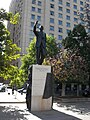
Frei Montalva by Arturo Hevia in front of La Moneda.

The Copper Road.

Monument to Eduardo Frei Montalva in Rancagua.

Monument to Eduardo Frei Montalva in La Florida.


Written work
He was the author of the following books:
- Chile unknown (1937)
- Politics and the spirit (1940)
- History of Chilean political parties (in collaboration with Alberto Edwards, 1949)
- Sentence and form of politics (1951)
- The truth has its time (1955)
- Thought and action (1956)
- A new world (1973)
- The mandate of history and the demands of the future (1975)
- Latin America: choice and hope (1977)
- Institutional Future of Peace in Chile (1977)
- The humanist message (1981)
Electoral history
1958 Presidential Election
| Portrait | Candidate | Covenant | Party | Votes | % | Outcome |
|---|---|---|---|---|---|---|
 | Jorge Alessandri Rodríguez | Liberal-conservative | Indep. | 386 197 | 31,52 | Chairman |
 | Salvador Allende Gossens | Popular Action Front | PS | 354 300 | 28.91 | |
 | Eduardo Frei Montalva | Christian Democratic Party | DC | 254 233 | 20,75 | |
 | Luis Bossay Leiva | Radical Party | PR | 189 152 | 15,43 | |
 | Antonio Zamorano Herrera | Indep. | Indep. | 41 244 | 3,36 |
1964 Presidential Election
| Candidate | Covenant | Party | Votes | % | ||
|---|---|---|---|---|---|---|
| Eduardo Frei Montalva |  Christian Democratic Party Christian Democratic Party | PDC | 1 409 012 |
| ||
| Salvador Allende Gossens | Popular Action Front | PS | 977 902 |
| ||
| July Duran Neumann | Radical Party | PR | 125 233 |
| ||
| Total votes | 2 512 147 | |||||
1973 parliamentary elections
- Candidate to Senator for the 4th Provincial Group, Santiagoperiod 1973-1981
| Candidate | Party | Votes | % | Outcome |
|---|---|---|---|---|
| A. Confederation of Democracy | ||||
| Eduardo Frei Montalva | PDC | 398 238 | 28.18 % | Senator |
| José Musalem Saffie | PDC | 109 314 | 7.73 % | Senator |
| Alberto Baltra Cortés | PIR | 26 790 | 1.89 % | |
| Alberto Labbé Troncoso | PN | 87 165 | 6.17 % | |
| Sergio Onofre Jarpa Reyes | PN | 195 472 | 13.83 % | Senator |
| Roster votes | CODE | 9661 | 0.68 % | |
| B. Popular Unity | ||||
| Carlos Altamirano Orrego | PS | 234 232 | 16.57 % | Senator |
| Aníbal Palma Fourcade | PR | 76 037 | 5.38 % | |
| Carmen Gloria Aguayo Irribarra | MAPU | 21 320 | 1.51 % | |
| Volodia Teitelboim Volosky | PCCh | 243 891 | 17.26 % | Senator |
| Roster votes | UP | 11 081 | 0.78 % | |
| Vows validly issued | 1 413 201 | 98.6 % | ||
| Null vote | 15 300 | 1.07 % | ||
| White votes | 4721 | 0.33 % | ||
| Total votes cast | 1 433 222 | 100% | ||
| Source: Directorate of the Electoral Register. | ||||
Contenido relacionado
Gothic art
Methodism
Barceo