
Domingo Faustino Sarmiento
Domingo Faustino Sarmiento (San Juan, Argentina, February 15, 1811 – Asunción, Paraguay, September 11, 1888) was an Argentine politician, writer, teacher, journalist, soldier, and statesman.; Governor of the province of San Juan between 1862 and 1864, President of the Argentine Nation between 1868 and 1874, National Senator for his province between 1874 and 1879 and Minister of the Interior in 1879.
He is considered a great Castilian prose writer. He collaborated both in public education and in the scientific progress of his country.
Biography
Birth, family and education
Domingo Faustino Sarmiento was born on February 15, 1811 in a house in the Carrascal neighborhood, one of the humblest in the city of San Juan, capital of the current province of the same name, the son of José Clemente Cecilio Quiroga Sarmiento and Paula Zoila Albarracín Irrazábal.
His baptismal name was Faustino Valentín Quiroga Sarmiento. According to some sources, the name Domingo was given to him later, it did not appear on his birth certificate.There are also testimonies that neither his family nor friends called him "Valentín", a name that was given to him given by that saint. The name "Faustino" was given to him by the saint of the day of his birth.
Domingo's first teachers were his father and uncle José Manuel Quiroga Sarmiento, who began teaching him reading at the age of four. In 1816 he entered one of the so-called "Escuelas de la Patria", founded by the governments of the Revolution, where he had the brothers Ignacio and José Rodríguez, professional teachers, as educators. After completing these studies in 1821, his mother suggested that he attend the seminary in Córdoba, but Sarmiento refused, processing a scholarship to enter the College of Moral Sciences in Buenos Aires that was not granted. The scholarships were given by lottery or by contacts. Sarmiento was not drawn by lot and since he did not have enough money or influential relatives or friends, he could not continue his studies and had to stay in San Juan. From then on he was an autodidact. An engineer friend helped him with mathematics, his uncle José de Oro helped him with Latin and Theology, in his spare time.In 1823 he worked as an assistant to Víctor Barreau in the Office of Topography in San Juan.
In 1825 his uncle Fray José de Oro was exiled to San Francisco del Monte, province of San Luis, and Domingo accompanied him; Currently the town is called San Francisco del Monte de Oro, in homage to the rebellious friar and teacher. There they founded a school, Sarmiento's first contact with education.
Exiles
In 1827, Domingo Faustino Sarmiento was recruited into the federal army. According to his own stories, Sarmiento, as a militia lieutenant, had to carry out tasks that made him uncomfortable. He filed a claim and was summoned by Governor Manuel Quiroga. During the meeting, Sarmiento asked to be treated fairly, but this was held in contempt and he was sent to prison. Because of this, and other personal confrontations with members of the Federal Party, he decided to support the unitary cause and joined the army commanded by José María Paz.
Due to the federal victory in his province, in 1831 he was forced to emigrate to Chile, where he carried out different activities to survive. During this time, he worked as a teacher in a school in the province of Los Andes, where he had with his student María Jesús del Canto, whom he never married, his only daughter Ana Faustina Sarmiento, who would later be the mother of Augusto Belin and Eugenia Belin. In 1836, while working as a miner, he contracted typhoid fever and, at the request of his family, the then governor of San Juan, Nazario Benavídez, allowed him to return to Argentina.
Back in his hometown, he was a member of the Philharmonic Dramatic Society, and later founded the Literary Society (1838), a branch of the Mayo Association; he began to participate in artistic activities, having contact with the Generation of 1837 and resumed political activity. In fact, the headquarters of the artistic group of which he was a part was used as a meeting place for those who opposed Juan Manuel de Rosas, then governor of Buenos Aires and in charge of Argentina's Foreign Affairs.
In 1839 he founded the Colegio de Pensionistas de Santa Rosa, a secondary school for young ladies, and created the newspaper El Zonda, from which he directed harsh criticism of the government. Due to his constant attacks on the federal government, on November 18, 1840 he was arrested and once again forced into exile in Chile.
.jpg)
Back in Chile, he dedicated himself fully to cultural activity. He wrote for the newspapers El Mercurio , El Heraldo Nacional and El Nacional ; and he founded El Progreso. In 1842 he was appointed by the then Minister of Public Instruction, Manuel Montt Torres, to direct the Normal School of Preceptors, the first Latin American institution specialized in preparing teachers. He also promoted romanticism, coming to argue with Andrés Bello. His work as an educator was recognized by the University of Chile, which named him a founding member of the Faculty of Philosophy and Humanities; and in 1845 President Manuel Montt Torres entrusted him with the task of studying the educational systems of Europe and the United States.
During his time in France, he took the opportunity to meet José de San Martín who lived in exile of his own free will in his residence in Grand Bourg.
Once his world trip was over, in 1848 he married Benita Agustina Martínez Pastoriza, widow of his friend Domingo Castro y Calvo, in Santiago de Chile, and adopted their son, Domingo Fidel (Dominguito), and became settled in the Yungay neighborhood of the city of Santiago. For a year he devoted himself fully to writing, and the result of this is Travels through Europe, Africa and America, in which he wrote about what he observed on his travels, and Popular Education, where he transcribed a large part of his educational thought, and his project of public, free and secular education.
The following year he separated from his wife; in 1851 he returned to Argentina, where he joined the Ejército Grande of General Justo José de Urquiza.
"Sunday"
In the midst of the long life of Domingo Faustino Sarmiento, the young Domingo Fidel Sarmiento, popularly known as "Dominguito", stood out. The son of Domingo Castro y Calvo and Benita Martínez Pastoriza, he was born in Chile in 1845 and his original name was Domingo Fidel Castro. When he was very young, his father died and, some time later, his mother married Domingo Faustino Sarmiento —also a widower—, who adopted him in 1848.
At the age of four, he learned to read; In his native country he attended primary school and finished high school in Argentina. When the War of the Triple Alliance broke out, Dominguito decided to enlist in the Argentine army despite the opposition of his mother. He participated with the rank of captain of the Argentine Army.
In September 1866, during the battle of Curupayty, Dominguito was mortally wounded; he was twenty-one years old. Sarmiento was then serving as Argentina's plenipotentiary minister in the United States, where he received the news of the death of his adoptive son through the special envoys of Bartolomé Mitre. The news plunged him into a deep depression.
Shortly thereafter, Sarmiento resigned from his diplomatic post and returned to Buenos Aires. Already in the Argentine capital, he went to the cemetery, where Dominguito's grave was located, and spent a long time there, very devastated. Years later he wrote the biography of his son: & # 34; Vida de Dominguito & # 34;.
Political career

In 1851 Domingo Faustino Sarmiento joined Justo José de Urquiza's army as a newspaper reporter until the battle of Caseros. After the fall of Juan Manuel de Rosas, he settled in Buenos Aires, but came into conflict with Urquiza and was forced to return to Chile. During this period he entered into discussions with Juan Bautista Alberdi about the country's politics. The ideological controversy was limited to liberalism, a thought to which both ascribed. The two thinkers were supporters of constitutionalism, contractualism, democracy, the republic, immigration, education and progress. Their clashes were political rather than ideological. The man from San Juan expressed his opinions in the One Hundred and One while the man from Tucumán expressed them in the Cartas quillotana . Despite their differences, the two politicians were the fathers of the Argentine Constitution of 1853/60, which shaped the original constituent power of the Argentine state and allowed the beginning of the constitutional era of Argentine history.
During his stay in Chile he was a member of the Masonic lodge Unión Fraternal de la Ciudad de Valparaíso, founded on July 27, 1853.
In 1855 he returned to Argentina and was editor of the newspaper El Nacional and acted as a consultative member of the province of Buenos Aires. The following year he was elected municipal councilor for the city of Buenos Aires.
In 1857 and 1860 he was elected senator and in the meantime served as head of the Department of Schools. In 1860 he was a member of the Constituent Convention and when Bartolomé Miter assumed the governorship of Buenos Aires he appointed him Minister of Government .
After the battle of Pavón, he accompanied General Wenceslao Paunero in the campaign to Cuyo. There he was appointed governor of San Juan (1862) and supported the persecution of the local federals, in two campaigns that ended with the assassination of the La Rioja caudillo Chacho Peñaloza. In April of that year, he resigned as governor and the government sent him on a diplomatic mission to Chile, Peru, and the United States, where he wrote several books on politics and education. From abroad, he rejected the positions of national senator for San Juan and Minister of the Interior of President Mitre.
Governor of the province of San Juan
.jpg)
Domingo Faustino Sarmiento arrived in San Juan as a national envoy by President Bartolomé Miter and assumed power in 1862. He found the province impoverished and divided. For this reason, he tried to order finances and promote the model based on civilization and progress, for which he managed, in just two years, to completely change the face of his province with numerous public works of all kinds.
In terms of education and culture, he created Legislation that established free and compulsory public education, inaugurated new primary schools, a Preparatory School, the Quinta Normal (currently the School of Oenology) and the School of Mines (currently the Industrial School), both located in the city of San Juan, and publishes again El Zonda. As for public works, he incorporated public lighting and paving, opening and widening of streets, forestation, and preparation of the topographic map of the province of San Juan. From the economic point of view, he promoted mining exploitation (Mines Council, Mining Company), tax laws (patents and justice seals) and, in the social sphere, a colonization and agricultural development project with immigrants.
However, the struggle, and the death of the caudillo Chacho Peñaloza and the internal opposition that he had to face prevented the full achievement of his projects and, due to the lack of support from his fellow citizens, he resigned from the government in 1864.
Presidency of the Argentine Nation
.jpg)
Domingo Faustino Sarmiento was proposed as a candidate for the presidency of the Nation by a group of politicians from the country, at the initiative of Colonel Lucio V. Mansilla. While he was in the United States, he was elected to the position in the elections nationals from April 1868, and took office on October 12, 1868.
The Sarmiento presidency was the second of Argentina's historic presidencies. These historical or founding presidencies of the modern Argentine state had three clear objectives or goals: “nation, constitution and freedom”. The nation understood as the definitive union of the Argentine provinces as an entity superior to the parts that compose it. The Constitution as the bases of the rights of the people and of power. Freedom conceived as a principle of liberalism that gave way to "civilization" and relegated to "barbarism."
Two days after the presidential inauguration, Congress met for a brief extraordinary session, during which the budget for the following year was approved, a credit of four million pesos and an increase in customs duties, to solve the continuity of the Paraguayan War.
Education and culture
It is generally accepted that Domingo Faustino Sarmiento focused most of his governmental effort on promoting education, although some historians claim that he gave at least equal importance to the spread of communications in the country.
In any case, the boost given to education under the ministry of Nicolás Avellaneda was notable. Through the Grants Act of 1871—which assigned inheritances without direct succession and one-eighth of sales of public land to public education—he guaranteed funds for the creation of new schools and the purchase of materials and books. During his tenure, and with national support, the provinces founded some 800 primary schools, reaching a total of 1,816 schools, of which 27% were private; the school population rose from 30,000 to 110,000 students..

In order to guarantee primary education, during the presidencies of Sarmiento, Avellaneda and Roca, more than 75 teachers (71 women and 4 men) were brought from the United States for primary school teachers (Normal Schools); it created the first normal schools, taking as an example the Normal School of Paraná, founded in 1870. He subsidized the first school for deaf-mutes, which was private.
Continuing the policy of his predecessor, he founded the National Colleges of the city of La Rioja, Santa Fe, San Luis, San Salvador de Jujuy, the city of Santiago del Estero, Corrientes, San Nicolás de los Arroyos, and Rosario.
He founded schools of arboriculture and agronomy in San Juan, in the city of Mendoza, and later in San Miguel de Tucumán and in the city of Salta.
In that same year, he fostered the creation and development of the National Commission of Popular Libraries (CONABIP), which to this day promotes the strengthening of popular libraries as civil society organizations and promotes their public appreciation as physical spaces and social issues relevant to community development and the construction of citizenship. In the capital, he founded the National Library of Teachers.
One of his first decisions was to hold an Exhibition of National Arts and Products, which was finally held in 1871 in the city of Córdoba. People took this project as crazy, but it ended up being a huge success. In it, textiles, tanneries, foundries, dry cleaners, and agricultural products were promoted; all from different regions of the country. During his visit to the exhibition, Sarmiento showed off a vicuña suit made with national fabrics and also received a medal for having introduced wicker into the country.Abundant agricultural and industrial machinery available for import was also promoted. This exhibition began the concern for basic sciences, and from that impulse arose the Academy of Sciences of Córdoba –directed by the German botanist Germán Burmeister– and the National Observatory of Córdoba, directed by the American astronomer Benjamin Gould.
At the National University of Córdoba, the Faculty of Exact, Physical and Natural Sciences was created, which dictated the engineering degree. On his initiative, mineralogy chairs were created in the Cuyo region in the National Colleges of Catamarca and San Juan, which would become the San Juan School of Engineers in 1876.
End of the Paraguayan War
The War of the Triple Alliance against Paraguay had broken out during the Argentine presidency of Bartolomé Mitre, who had commanded the allied forces against that country until shortly before stepping down from the presidency. As soon as Sarmiento had assumed the presidency, the final advance of Brazilian troops towards Asunción del Paraguay took place, which was sacked by the Brazilians. Paraguayan President Francisco Solano López, despite the occupation of the capital, organized a new army some distance away. In response, a provisional government was formed under Argentine and Brazilian protection in Asunción.
An army formed and directed mainly by Brazilians –in which the Argentines initially had some participation– launched in pursuit of Solano López, in the so-called Campaña de las Cordilleras; After two bloody victories over the Paraguayans, Solano López managed to sneak towards the northern limit of the country, where two Brazilian divisions went looking for him, which managed to defeat him and kill him in the Combat of Cerro Corá, on March 1, 1870. The war it was over.
Paraguay was devastated: depending on the sources, it is estimated that between 50 and 90% of the total population died during the war, and it lost all the territories in dispute with its neighbors, with the exception of the Chaco Boreal.
The war also meant an enormous cost for Argentina: first of all, in human lives, since more than 18,000 men died in the conflict, to which could be added the victims of cholera, which were many thousands; 15,000 only in the province of Buenos Aires. Also, it had an enormous economic cost, since, as a result of the conflict, Argentina had to borrow up to 9,000,000 pounds sterling.
During the last year of the war, the Military College of the Nation was founded, whose first director was the Hungarian Juan F. Czetz. The possibility of conflicts with Brazil from the discussions after the war prompted Sarmiento to modernize the war squadron: he created the Naval School and incorporated several ships, with which he managed to form the first Argentine squadron capable of operating at a level comparable to the war fleets of Brazil and Chile.
The last federal warlords on the coast

After the defeat of Felipe Varela, three Argentine provinces still remained in federal hands: in Córdoba, military pressure forced Governor Luque to resign, and in Corrientes a liberal revolution overthrew the federal governor in May 1868. A belated reaction federal was crushed by troops of the national army, transferred from the Paraguayan front in defense of a government that emerged from a coup.
Only Entre Ríos remained, where Urquiza lived peacefully with the national government against the wishes of many feds: at the beginning of 1870 he had received the president at his mansion in the San José Palace, whom he ordered to give the corresponding honors. Shortly after the end of the Paraguayan War, on April 11, 1870, General Ricardo López Jordán started a revolution, which resulted in the death of Urquiza at the hands of Simón Luengo from Córdoba. López Jordán was elected governor by the Legislature.
President Sarmiento sent an army made up of veteran divisions of the Paraguayan War to Entre Ríos. The governor prohibited the entry of those troops to his province, but the president ridiculed the possibility of prohibiting the entry of national troops in a province. When the landing took place, López Jordán ordered the general mobilization of the province. Sarmiento declared war on Entre Ríos, although the National Congress did not authorize federal intervention in that province until August.
Four armies advanced simultaneously on the province; the national troops —superior in weapons and discipline— occupied the cities, so López Jordán had to withdraw to the interior of the province, where the Entre Ríos —with better horses— held advantageously. Seeking to open a new front, López Jordán invaded the province of Corrientes, but on January 26, 1871 he was completely defeated in the battle of Ñaembé; shortly after he fled to Brazil.
The Federal Party of Entre Ríos was destroyed, and the federalists were displaced from all public positions, including priests and teachers.
In May 1873, López Jordán insurrected his province again, reaching 16,000 men, well supplied with artillery and infantry. Sarmiento responded by putting a price on López Jordán's head —a possibility that was ruled out by Congress — and decreeing the federal intervention of Entre Ríos. Three armies occupied the province under the superior command of the Minister of War, Martín de Gainza. Fighting broke out again throughout the province, and several Jordanian officers were shot; After a bloody defeat, in December López Jordán left for Uruguay.
On August 22, 1873, Sarmiento had suffered an attack while he was going to the house of Vélez Sarsfield, in the city of Buenos Aires; when he was passing through the current corner of Corrientes and Maipú, an explosion rocked the car in which he was traveling. The man from San Juan did not listen to him because he already suffered from profound deafness. The perpetrators were two Italian anarchists, the brothers Francisco and Pedro Guerri, who declared that they had been hired by López Jordán's men. The attack failed because Francisco Guerri's blunderbuss burst in his hand. Sarmiento emerged unharmed from the attack.
Population and health
One of Domingo Faustino Sarmiento's first actions as president of Argentina was to organize the first national census, which was carried out in 1869; it gave the result of 1,836,490 inhabitants for the country. 8% of the total were European immigrants, 70% were rural population, and 71% of the total was illiterate.
During his tenure, immigration experienced a significant increase with the arrival of 280,000 immigrants, who settled mainly in the city of Buenos Aires and —to a lesser extent— in agricultural colonies in the Litoral provinces.
The rapid increase in population in the capital generated large-scale housing and hygiene problems: in 1871, an epidemic of yellow fever—probably a consequence of the war—caused the death of around 14,000 people in Buenos Aires The full national government fled the city, so the fight against the plague had to be carried out by a commission. This commission ordered the creation of the Chacarita Cemetery and in the following years the first networks of running and sewer waters of the city.
Transport and communications
As president, one of his main objectives in terms of transportation was the construction of a trans-Andean railway that linked the Atlantic Ocean with the Pacific. For this, he favored the construction of the branch from Villa María to Río Cuarto; Also, the branch was built from Córdoba to Tucumán, and two short branches between Concordia (Entre Ríos) and Mercedes (Corrientes), and between Buenos Aires and Campana. The railway network grew from 573 kilometers in 1868 to 1,331 in 1874. As the Córdoba railway was planned to be extended to the north, he hired the German engineer José Enrique Rauch to design the route from Salta to the Pacific coast, which decades later it would become the so-called Train to the Clouds.
During his tenure, some 5,000 km of telegraph lines were laid, promoted by the president and his minister Dalmacio Vélez Sarsfield; In his message to Congress in 1873, he was able to affirm that "the telegraph line has been completed and runs throughout the Republic. " On August 5, 1874, at the end of his presidential term, he inaugurated the first telegraphic communication with Europe.. He decreed that the day of the inauguration of the telegraph cable, which in his words turned all the towns into "a single family and a neighborhood," should be a national holiday. The ceremony was attended by, among others, former Minister Vélez Sarfield, to whom Sarmiento attributed in the act "the exclusive honor of the daring idea and the rapid execution of the telegraph network, which contributes to giving peace to the Republic and well-being to his children".
Some ports were built, such as those of Zárate and San Pedro (Buenos Aires). A modern port was projected in Buenos Aires, borrowing the country 30 million pesos to carry out the work, but that money was wasted on minor works.
In 1873 the National Bank was created, which lent money at low interest or to insolvent debtors. The public debt —prompted by that generated as a result of the Paraguayan War— reached unsustainable levels, although the resulting economic crisis would erupt during the management of his successor.
Foreign relations
During the first part of his administration, Foreign Minister Mariano Varela tried to carry out an almost idealistic policy regarding the future of Paraguay: his well-known phrase "Victory does not give rights" was part of an attempt to limit the expansionist ambitions of the Brazil. Brazil's response was to take advantage of that same policy to make the Paraguayan government protest the Argentine occupation of Villa Occidental, opposite Asunción. When the Brazilian ambassador to Paraguay forced changes in the Paraguayan government, the president replaced Varela with Carlos Tejedor.
In 1872, Brazil signed a boundary treaty with Paraguay, which awarded it all the territory in conflict, and then supported Paraguay in its defense against Argentine claims. Tejedor then began an aggressive campaign to resolve disputes as soon as possible, which led to a growing confrontation with Brazil.
Relations with Chile centered on the discussion about the rights of both countries over Patagonia. In 1874 it was decided that an arbitration by the King of England would settle the disputes between the two countries.
Cabinet of Ministers
 Faustino Sarmiento | ||
|---|---|---|
| Portfolio | Owner | Period |
| Ministry of the Interior | Dalmacio Vélez Sársfield Uladislao Frías | 12 October 1868-May 1872 May 1872-12 October 1874 |
| Ministry of Foreign Affairs and Worship | Mariano Varela Carlos Tejedor | 12 October 1868-17 August 1870 17 August 1870-12 October 1874 |
| Ministry of War and Marina | Martin de Gainza | 12 October 1868-12 October 1874 |
| Ministry of Finance | José Benjamín Gorostiaga Luis L. Domínguez Santiago Cortínez | 12 October 1868-13 October 1870 13 October 1870-13 February 1874 13 February 1874-12 October 1874 |
| Ministry of Justice and Public Instruction | Nicolás Avellaneda Juan Crisóstomo Albarracín | 12 October 1868-23 November 1873 24 November 1873-12 October 1874 |
Subsequent Charges
At the end of his presidential term, Domingo Faustino Sarmiento transferred the presidency of the Argentine Republic to Nicolás Avellaneda, in 1874. In 1875, he took office as national senator for his province, a post he abandoned in 1879 to briefly assume as Minister of the Interior of Nicholas Avellaneda. He later held the position of Superintendent of Schools during the government of Julio Argentino Roca, but resigned due to radical differences with Avellaneda and Roca himself. In 1885, he founded the newspaper El Censor in Buenos Aires.
Death
.jpg)
In 1887, Domingo Faustino Sarmiento traveled to Asunción, Paraguay. He returned to Buenos Aires, but already old and with deteriorated health due to deafness and cardiovascular and bronchial failure. The doctors advised him to move away from Buenos Aires to avoid the city's cold winter. At the beginning of 1888 he embarked with his daughter Faustina and his grandchildren for Asunción.
On September 11, 1888, Sarmiento died in the Paraguayan capital at the age of 77 and his remains were buried in the Recoleta Cemetery in Buenos Aires ten days later. Before his tomb, Carlos Pellegrini summarized the general judgment: "He was the most powerful brain that America has ever produced."
Works
Literature
Domingo Faustino Sarmiento was a great writer and is considered one of the great Argentine prose writers.
Ezequiel Martínez Estrada had one of his most defined sources of inspiration in Sarmiento, and he praised him when he called him
the greatest prosist of speech.
Miguel de Unamuno considered it, in reference to the 19th century, as
the writer in Castilian language more deeply castizo than we have had in the last century.
Pedro Henríquez Ureña described Sarmiento's gifts as a writer:
[...] he had the full romantic impetus, the energy of the imagination and the passionate torrent of words, together with vivid perception of the facts and fast flow of thought. But with all these gifts he did not resign himself to remain a mere writer; he only thought of serving his Argentine homeland, Chile, all over Spain.
Jorge Luis Borges, still pointing out the existence of incorrectness in Sarmiento's prose, recognized the "extremely effective" nature of his writing:
There is not one of his phrases, examined, that is not correct; any man of letters can point to his errors; the observations are logical, the original text is not; however, that incriminated text is very effective, although we do not know why. [...] The virtue of Sarmiento's literature is demonstrated by its effectiveness.
María Emma Carsuzán described as a "prejudiced assumption" the incorrectness in Sarmiento's prose that some critics tend to invoke, with emphasis on the abundance of Gallicisms and the ignorance about traditional uses:
Now, if the mistakes invoked attack the chastism, to dispel this prejudiced assumption, the opinions of the Habanero Mantilla spokesman are very valuable, which almost did not make grammatical corrections in the edition of Facundo subject to his review, and he was surprised to find out the old and well-born locuciones; of Rojas, who attributes some grammatical care at the random of improvisation, not ignorance, because in other parts are avoided, and that compares it with the great Spanish prosists: “Venial is the Gallicism in Sarmiento [...]”
In the words of Carlos Altamirano and Beatriz Sarlo:
There's a romantic theory of impromptu to which the methods of Sarmiento's writing are not alien: the movement, even disordered, of writing reproduces on the surface of the text the waves of inspiration, the violent and instant perception of the literary truth that is, at the same time, historical truth.
In Sarmiento's literary work, the following stand out:

- My defense1843.
- Facundo or Civilization and Barbarie1845; It deals with the riojano leader Facundo Quiroga and the differences between the federal and unitary. It is a description of the social and political life of the country that has sociological and historical scopes, since it offers a sociological explanation of the country based on the conflict between "civilization" and "barbarie", personified respectively in urban and rural media. It is his main work and one of the covers of Latin American literature. The first English translation, Mary Mann, appeared in 1868.
- Life of Aldao1845.
- Gradual method of teaching to read Spanish1845.
- Travel through Europe, Africa and America1849; Autobiographic.
- Of popular education1849.
- Argirópolis1850.
- Memories of province1850; Autobiography.
- Grand Army Campaign1852.
- One hundred and one1853; series of epistles addressed to John the Baptist Alberdi.
- Commentary to the Constitution of the Argentine Confederation1853.
- Report on common education1856.
- The Chacho, 1865; on the riojano leader Angel Vicente Peñaloza.
- Schools, bases of prosperity1866.
- The Childhood and Education of Abraham Lincoln1873.
- Conflict and Harmonies of Races in America1883. In this work it develops a conception similar to that of Facundobut in an ethnic way. His first volume is 1883 and the second, posthumous, which according to his author is "Facundo arrive a la old age".
- Life of Dominguito1886; about his adoptive son, killed in the War of the Triple Alliance.
Complete works
The complete works of Sarmiento were published between 1884 and 1903. The edition was in charge of his grandson Augusto Belín Sarmiento and consisted of fifty-three volumes. A second edition was published between 1948 and 1956 by the publishing house Luz de Día, in fifty-two volumes.
- I. Critical and literary articles (1841-1842)
- II. Critical and literary articles (1842-1853)
- III. My defense. Province memories. Necrology and biography
- IV. Orthography - Public instruction (1841-1854)
- V. Travel through Europe, Africa and America (1845-1847)
- VI. Argentine policy (1841-1851)
- VII. Facundo. Aldao. El Chacho (1845-1863)
- VIII. Comments of the Constitution
- IX. South American institutions
- X. Legislation and progress in Chile
- XI. Popular education
- XII. Common education
- XIII. Argirópolis
- XIV. Campaign in the Big Army
- XV. One hundred and one. Preconstitutional period
- XVI. Provinciano en Buenos Aires. Porteño in the provinces
- XVII. National union
- XVIII. Parliamentary speeches. First volume
- XIX. Parliamentary speeches. Second volume
- XX. Parliamentary speeches. Third volume
- XXI. Popular speeches. First volume
- XXII. Popular speeches. Second volume
- XXIII. Immigration and colonization
- XXIV. Organization of the State of Buenos Aires
- XXV. Buenos Aires State Policy (1855-1860)
- XXVI. The Way of Lazio
- XXVII. Abraham Lincoln. Dalmacio Vélez Sarsfield
- XXVIII. Educational ideas
- XXIX. Both Americas
- XXX. Schools. Prosperity and republic base in the United States
- XXXI. Constitutional practice. First volume
- XXXII. Constitutional practice. Second volume
- XXXIII. Constitutional practice. Third volume
- XXXIV. American questions
- XXXV. American questions. Limits with Chile
- XXXVI. Status of aliens in America
- XXXVII. Conflict and Harmonies of Races in America
- XXXVIII. Conflict and harmony of races in America. Part two
- XXXIX. Revolutionary Doctrines (1874-1880)
- XL. Failures and deviations. Politics of 1880
- XLI. General progress. Economic views
- XLII. Costumes - Progress (continued)
- XLIII. Francisco J. Muñiz o Horacio Mann
- XLIV. Education reports
- XLV. Antonino Aberastain. Dominguito's life. Necronologies
- XLVI. Literary pages
- XLVII. Educate the sovereign
- XLVIII. The ultrapampeana school
- XLIX. Memories
- L. Roles of the President (1868-1874). First volume
- LI. Roles of the President (1868-1874). Second volume
- LII. Miscellaneous writings
- LIII. General index. Onomastic index
Science
Domingo Faustino Sarmiento made an important contribution to knowledge thanks to his contribution as a promoter of scientific progress and his constant action and preaching in favor of teaching and the creation of scientific and cultural institutions.
Sarmiento's action in the dissemination of Western sciences, in a peripheral country in the world of sciences such as Argentina, was to consolidate an independent scientific system, enriching it with the contributions of the most modern European science.
When he held the position of Minister of Public Instruction of the province of Buenos Aires, the scientist Germán Burmeister arrived in the country. When he was director of the Museum of Buenos Aires, and in compliance with a law of 1869, Sarmiento entrusted him with the efforts to incorporate twenty European professors to teach exact and natural sciences at the University of Córdoba.
In Argentina, the two positions that faced each other worldwide in the field of natural sciences were represented by Florentino Ameghino, on the side of evolutionism, and by Burmeister, on the field of creationism. Sarmiento, despite the fact that Burmeister was a renowned scientist in Europe, did not hesitate to support the ideas of Ameghino, of whom he said in 1881:
A countryman of Mercedes, Florentino Ameghino, who no one knows and is the only Argentine sage (...) that recognizes Europe. His support made him the first Argentine scientist of international relevance.
During his tenure as Argentine representative in the United States, he managed to get astronomer Benjamin Apthorp Gould to agree to travel to Argentina to create an astronomical observatory. When Gould arrived in Argentina, Sarmiento was already president and had created, in 1871, the Córdoba Astronomical Observatory, which at that time acquired international relevance. Sarmiento and Gould are also responsible for the initiation of meteorological studies in Argentina when the National Meteorological Office was created in 1872 (the first in South America and the third in the world, behind Hungary and the United States) which functioned until 1884, in Córdoba and then moved to Buenos Aires.
He always praised the figure of the doctor and amateur paleontologist Francisco Javier Muñiz.
According to an anecdote, it seems that soccer also owes its momentum to him. In effect, Alexander Hutton, founding father of Argentine soccer, and at the time, Rector of High School English, when asking Sarmiento for permission to teach the sport of ball among his students (base of the remembered Alumni), received this response:
Let them learn, my friend, at kicks but learn.
From his position, Sarmiento defended the education of women on a par with that of men and maintained a strong friendship with Juana Manso, whom he considered the only person in Latin America who had interpreted his education plan. In a letter addressed to her, he congratulated her on the reestablishment of the Annals of Education, and congratulated the Argentine government on this decision, as well as asserting that women, due to their maternal instinct are the ideal beings. to take care of children's education.
Innovation on learning to read

During his exile in Chile, Sarmiento actively participated in cultural and educational activities. One of his occupations consisted of creating a modern reading learning system, which did not require studying isolated syllables by heart as was customary at that time, but rather a method with a pedagogical foundation and a progressive methodology. He then published his Gradual Reading Method (1849), in Santiago de Chile. He claimed that previous syllabaries had squandered the potential benefits of the Lancastrian method, and included advice to "make learning more natural and intuitive", such as simplifying the names of consonants. Thus, for example, according to Sarmiento's system, the "m" was called "me" instead of "eme". The use of what he called "useless or conventional letters" was left among the final contents, such as the "h" or the "u" placed after the "q", and the replacement of the "y" by the "i"..
Freemasonry
Domingo Faustino Sarmiento was initiated into Freemasonry on July 31, 1854, in the Unión Fraternal Lodge in Valparaíso, Chile, when a group of Chilean intellectuals founded a lodge called Unión Fraternal . Sarmiento began in that lodge together with his compatriots Manuel Moreno and Domingo Rodríguez Peña.
Upon returning to Argentina, convinced that Freemasonry is an ideal school for human perfectibility, he continued his Masonic works, founding together with fourteen other Freemasons, on December 29, 1855, the Logia Unión del Plata Nº 1, standing out among its members: Miguel Valencia, lawyer and legislator; Ricardo Lavalle, president of the Legislature and of the Stock Exchange; Santiago Rufino Albarracín, Minister of War and Navy; Federico Álvarez de Toledo Bedoya, rancher and founder of the Rural Society and Carlos Casares, governor of Buenos Aires.
The formation of the lodges Argentine Confraternity Nº 2; Consolation for Misfortune No. 3; Tolerance No. 4; Regeneration No. 5; Loyalty No. 6 and Constancia No. 7, gave rise to the foundation in 1857 of the Gran Masónico Oriente para la República Argentina, presided over by the Dr. José Roque Pérez. Framework in which, on July 21, 1860, a historical gathering was held, presided over by Grand Master Dr. José Roque Pérez, with the participation of the President of the Argentine Republic, Santiago Derqui; General Bartolomé Mitre; the governor of Entre Ríos, Justo José de Urquiza and Domingo F. Sarmiento.
Sarmiento's Masonic activity continued to be of great importance. Sarmiento received the 33rd degree, the highest rank of the ancient Scottish rite. He was accepted on July 18, 1860, and the highest position was handed over to him by the Supreme Council Grade 33 for the Argentine Republic. In this sense, when in 1864 he was appointed Argentine ambassador to the United States, he was also granted the representation of Argentine Freemasonry before the Grand Lodges and Supreme Councils abroad, with the power to celebrate treaties. of friendship. This allowed Sarmiento to be linked to great Masonic public personalities, among which Abraham Lincoln's vice president stood out, and after the assassination of the US president, Andrew Johnson.
Sarmiento left the ranks of Freemasonry on two occasions. The first time he resigned was when he became president of the Argentine Republic, in 1868.
This was confirmed by Sarmiento himself in one of the speeches he gave, after assuming the presidency of the Argentine people by prioritizing the general government, stating:
A public man does not bring his own private convictions to the government to make them law and rule of the State.
Also at a Masonic banquet in 1868, he declared:
In expressing my deep gratitude for the feeling that brings us together here today, to give me public a sign of sympathy, I believe in the duty to express frankly my respect, my adherence to the bonds that bring us all together in our society of brothers.Called by the people's vote to play the first judiciary in a Republic, which is by a majority of Catholic worship, I need to reassure the timorates who see in our institution a threat to religious beliefs. If the masonry has been instituted to destroy Catholic worship, from now on I declare that I am not a Mason.
I further declare that having been elevated to the highest degrees in conjunction with my brothers Generals Mitre and Urquiza, by the unanimous vote of the Council of Venerable Brothers, if such designs are hidden, even to the highest degrees of masonry, this is the occasion to manifest that, or we have been miserably deceived, or there are no such designs, or such purposes. And I solemnly affirm that they do not exist, because they have not been able to exist, because they detract from the very composition of this great and universal confraternity. (...)
Having these manifestations, so that it is not believed that I conceal my beliefs, I have the duty to proclaim to my brothers, that from now on, I consider myself detached from any practice or subjection to these societies.
Called to perform high public functions, no personal motive is to deviate from the fulfillment of the duties that are imposed on me; simple citizen, I will return one day to help you in your philanthropic tasks, waiting from now that for the benefits you have done, you will have continued to conquer the public estimate; and for your abstention from taking as a corporation part of the political or religious issues that converge, you can dispel the concerns of those that are more firm
He returned to Masonic activity in 1874 as evidenced by the plates found in the Archivo del Histórico Recinto de la Masonería del Gran Oriente Masónico Argentino, in the Federal Capital, where his name appears.
On April 18, 1882, he applied to the Obedience of Law No. 13 Lodge. That same year he became Grand Master of the Argentine Grand Lodge of Free and Accepted Masons for the period 1882-1885. On May 12, he accepted his appointment to the position, being accompanied by Leandro N. Alem, later founder of the Unión Cívica de la Juventud , who held the position of Pro Grand Master.
Sarmiento resigned from the important position the following year, on September 15, 1883, being replaced by Alem. This second resignation would have occurred due to health problems, or, in another context, because there were ideological clashes within the lodge. The conflict is quite difficult to unravel, because everything was kept secret. It would have had to do with Sarmiento's support for the universal, secular and free education law:
When Sarmiento assumed the position of Grand Master of Argentine Freemasonry in 1882, he had held the Superintendency of the School Council since 1881, engaging in strong controversies with other members who responded to the conservative Catholic line of the then Minister of Public Instruction, Worship and Justice, Manuel D. Pizarro. Being arbitrarily removed from said position by President Julio Argentino Roca, he found himself in charge of the El Nacional newsroom, from where he waged a double and hard fight against rockism, on the one hand, denouncing his maneuver of concentration of power in their hands and on the other, in favor of the implementation of common secular education, in constant reply against the militant ultramontane sector that had its combative press organ in La Unión.
His term as Grand Master should have lasted until 1885, however, in September 1883 he resigned. His resignation began with the public response that Sarmiento gave to the President of the Club Liberal, who through the press had summoned him as Grand Master of Freemasonry to participate in the demonstration that was being prepared for September 16, 1883 in favor of secular education, asking him to act as an intermediary so that the lodges of his obedience could attend it.
In the winter of 1888, he moved to the warm climate of Paraguay with Aurelia Vélez, the daughter of Dalmacio Vélez Sarsfield, the author of the Civil Code, who was his companion during the last years of his life. There he died, on September 11, 1888, refusing to receive religious assistance, and ordering the non-attendance of a Catholic priest at his last bed. The Freemasonry of that country honored him. When his remains were transferred to Argentina, it also happened on behalf of the Argentine Freemasonry.
A controversial man
.jpg)
Although Domingo Faustino Sarmiento is considered by historiography as one of the main Argentine figures of the 19th century, his person is not without controversy. The numerous writings and articles that he wrote over more than fifty years, the last compilation of which took fifty-three volumes and more than fifteen thousand pages, contain some contradictory passages and others of notable verbal violence, a resource used by his contemporaries..
Along with his promotion of the development of the country, the cruelty of the national troops under his orders in the repression of the rebellions of the last caudillos (such as the assassination of General Ángel Vicente Peñaloza) and the forced conscriptions of gauchos to fight against the natives.
Likewise, his position regarding Patagonia was criticized, casting doubt on Argentina's sovereignty over that region., a month after the Chilean troops entered Lima, advised Don José Manuel Balmaceda:
'I must have waited to answer you, that the rumor of the battles cease; that the actors count all the scenes of the great drama, to give you. my opinion on the policy to be followed by Chile after its great victory in the Pacific: To refuse the entry into the Atlantic and to have the courage to have no reason in Magellan or Patagonia, so sad to constitute a state from Tarapacá to Santa Cruz, with a thousand five hundred leagues long, without a significant width, three republics and two seas to store. »
His position regarding the aborigines, the gauchos, and the Jews is also controversial. In the same vein as his famous Unitarian comrade Esteban Echeverría, who despises the people of Buenos Aires and treats them as rabble, in addition to repudiating blacks and gauchos in El matadero (1840), Sarmiento tells Bartolomé Miter in a letter: "do not save the blood of gauchos, it is the only thing that is human about them". Trying to excuse these comments about the gauchos, José Ignacio García Hamilton points out that:
"The word "gaucho" in the centuryXIX It had a meaning different from the present. When Sarmiento tells Mitre "do not save blood from gauchos, it is the only thing they have of human," he is talking about Urquiza, that is, a very rich businessman and rancher. Gaucho wanted to say marginal, criminal or politically intolerant. That is why Rosas and Urquiza were told gauchos in this last sense, that is, barbaric leaders, who did not allow the dissent.
In relation to the aborigines, the multiple facets of Sarmiento's position towards the American Indians have been highlighted and the opinion widely spread among Americanists that he felt hatred towards the Indian and wanted his total extermination. Thus it is argued that Sarmiento had "two positions vis-à-vis the Indians", including those who were in the savage state and the others, who had been assimilated to the cities, that is, to civilization. While the former, who were the ones who carried out the raids, he called them "savages"; u "wild hordes"; he felt sympathy for those who had assimilated into civilization.
Sarmiento, at the same time, had an ethnographic and archaeological interest in the Indian.
The enemy of Sarmiento was not the American Indian, but the heavy ballast left by the Spanish colonization, some of whose involuntary elements were the surviving Indian and the mestizo, with the stigmas left in them colonization.
The problem of the relationship with the Indians came from the Hispanic era and had continued during the homeland era and during the National Organization. Raids devastated not only the border but periodically attacked both rural areas and towns and during the Sarmiento presidency it was one of the main issues of national public opinion. In June 1870, the Mapuche cacique Calfucurá gathered between 3,500 and 6,000 warriors and produced a new great raid that attacked and devastated Tres Arroyos continuing towards Bahía Blanca, where he killed fifty Creoles, took numerous captives and stole 80,000 heads. of cattle.
In 1872 Calfucurá once again commanded 8,000 lances and launched another raid that sacked the towns of Veinticinco de Mayo, Alvear, and Nueve de Julio, leaving 300 civilians dead, 500 captives, and 150,000 to 200,000 heads of stolen cattle. Sarmiento organized a punitive expedition under the command of the experienced General Ignacio Rivas who was joined by a significant number of allied Indians such as the borogas, pampas and ranqueles of cacique Catriel. This combined force —Argentine and indigenous Army— defeated Calfucurá in the Battle of San Carlos de Bolívar, on March 11, 1872.
In 1873, after chief Calfucurá died, the government took advantage of the situation and again defeated his warriors, capturing Atreucó, one of the main camps of the deceased chief. Only during the presidency of his successor, Nicolás Avellaneda, did the question of the Indian culminate in the Conquest of the Desert, carried out by General Julio Argentino Roca.
Tributes
Teacher's Day

In 1943, during the first Inter-American Conference on Education, meeting in Panama, it established September 11 as Pan-American Day of the Teacher in the Americas in homage to the death of Domingo Faustino Sarmiento:
“Considering that it is a fundamental activity of the School to educate the feelings, for which reason it should not be forgotten that among them is the gratitude and devotion due to the teacher of the primary school, that his abnegation and sacrifice guides the first steps of our generations and guides the spiritual and cultural future of our peoples; that no date has to be more timely to celebrate the day of the teacher than on 11 September, the day that passed to the Argentinean immortality,”
Museums
There are currently different museums dedicated to the figure of Sarmiento, some of which served as his residence.
- His Natal House in the City of San Juan, raised by his mother's work. It was used by Sarmiento as a residence and government house during his administration as governor.
- The School of San Francisco del Monte de Oro, founded by Sarmiento in 1826 at the age of 15. It consists of a typical ranch of adobe walls, roofed with straw cake and mud on wood. It was declared a National Historical Monument in 1941. It is protected by a concrete temple, built in 1957. It is preceded by a large courtyard of acts, with mast, statue of the procer and numerous commemorative plaques.
- The Casa Museo Sarmiento, located in the islands section of Tigre, in the province of Buenos Aires, located on the Río Sarmiento and which functions as a museum and library. Used as a recreational house, Sarmiento was one of the first to acquire a land in the island sector in 1855, as well as one of the main drivers of his colonization, writing numerous articles where he defended the advantages and possibilities of exploiting that area, which were collected posthumously in his book The Carapachayas he called the region of islands, the name of Guaraní that today bears one of its rivers.
- The Historical Museum Sarmiento, located in the Belgrano district, in the building that operated temporarily as the headquarters of the national government, before it is declared a Federal Capital. It saves the most important collection of objects dedicated to the procer, including the famous portrait that his granddaughter Eugenia Belín made.
- The last house Sarmiento had in Buenos Aires, where he lived between 1875 and 1888, is currently home to the House of the Province of San Juan, so despite not being a dedicated space to the procer, it remains open to the general public.
Funeral monument

At the beginning of the XX century, it was built on the tomb of Domingo Faustino Sarmiento, located in the Recoleta Cemetery, a funerary monument in his honor.
The newspaper La Nación, in its edition of June 19, 1900, headlined: Monument to Sarmiento. Appointment of the executive committee:
At the meeting held yesterday by the initiators of the erection of the monument to Sarmiento, in the tomb that keeps its remains in the North Cemetery, the executive commission of the work to be carried out to give effect to the initiative was definitely constituted. Today the provincial commissions will be organized and tomorrow they will be publicized. The executive commission has been composed as follows: Honorary Presidents: General Lieutenant Bartolomé Mitre, Dr. Carlos Tejedor, Mr. José Posse, Dr. Mariano Varela, president: Rafael A. Cobo, vice president: Eustaquio Díaz Velez, vice president 2nd general Manuel Campos (...).
Monuments
Many monuments have been erected in honor of Domingo Faustino Sarmiento, both in Argentina and abroad. Among them, the Monument to Sarmiento located in Parque Tres de Febrero, in Buenos Aires, stands out, a bronze statue made by the famous French sculptor Auguste Rodin and the well-known high-relief Floral Offering to Sarmiento, the work of the French Émile Peynot, in El Rosedal in Buenos Aires. Aires.

Monument in Parque Tres de Febrero, Buenos Aires, of Auguste Rodin, inaugurated for the Argentine Centenary

Offer Floral to Sarmiento, by Émile Edmond Peynot, in El Rosedal, Buenos Aires.

Monument in his hometown, San Juan
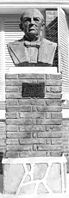
Bust in the village of Lucio Vicente López, Argentina.
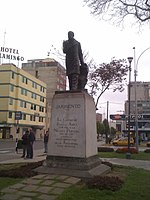
Monument in Lima, Peru; was donated by the city of Buenos Aires
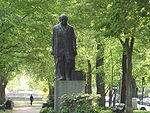
Monument in Boston, United States.

Ladrillos de la primera escuela que fundó, en la provincia de Buenos Aires

Bust in the town of Villa San Agustín, in Valle Fértil, San Juan, Argentina.

Portrait sculpted in the Sierra de Marquesado, in San Juan
Monument to Sarmiento in Caucete, San Juan
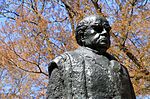
Monument in Boston, Massachusetts


.jpg)


Paper money
Another recognition of Sarmiento by the Argentine State is the placement of his image on the 100 australes bills (1985-1992) and the 50 pesos legal tender. In 2014, a bill was created with the figure of the gaucho Rivero and the Malvinas Islands of the same value, and in 2018 another was created with the figure of the Andean condor from the series "Native Animals of Argentina" with which it coexists.
Hymns
Two hymns are known in honor of Domingo Faustino Sarmiento. The first was created by Segundino Navarro, with music by Francisco Colecchia, while the second was created by Leopoldo Corretjer. The one created by Navarro is sung in the province of San Juan, while the one by Corretjer is heard in the rest of the country.
However, there is evidence that in a ceremony held in Barracas in the mid-1900s by 1,200 students from the 11 schools of the 8th District of the City of Buenos Aires, presided over by Benito Carrasco, the first child tribute to Sarmiento, performed a hymn in his honor composed by a music teacher named Rolón and with lyrics by B. V. Charras.
Contenido relacionado
Ostrogothic people
Fernando de la Rua
Luis Solari Tudela