
Death


The death (sometimes referred to by the euphemisms death, death, expiration, death or death, among others) is the end of life. It is an irreversible process that results from the cessation of homeostasis in a living being, that is, from its inability to use energy to keep the organism alive, with which vital functions come to an end. The cause of death can be natural (aging, disease, predation, natural disaster) or induced (suicide, homicide, euthanasia, accident, death penalty, environmental disaster, etc).
After death, the corpse can have different destinations, but in its natural state it goes through several processes known as cadaveric phenomena such as decomposition and fossilization. People can also carry out burial, mummification, cremation or cryogenics on the lifeless body.
The process of death, although it is fully defined in some of its phases from a physiological, biochemical and medical point of view, is still not fully understood as a whole from a thermodynamic and neurological point of view, so there are scientific discrepancies in this regard.
Death not only marks the end of the life of the human person but also the end of his existence as a subject of law.
Death in biology and medicine
Medical science defines death as the "irreversible cessation of cardiorespiratory functions or all functions of the brain", For biology, it is an event resulting from the organic inability to maintain homeostasis. Due to the degradation of the deoxyribonucleic acid (DNA) contained in the cell nuclei, the replication of the cells becomes more and more expensive until the fatal outcome occurs.
Evolution of estimates of the state of death
In the 20th century, death was defined as the cessation of cardiac activity (absence of a pulse), absence of reflexes and visible breathing. However, based on this insufficient evidence, many people were buried while in a state of latent life or affected by periods of catalepsy.
Later, thanks to technological advances and better knowledge of brain activity, death came to be defined as the absence of bioelectrical activity in the brain, verifiable with an electroencephalogram. Later, even this evidence turned out to be insufficient, when it was demonstrated that the phenomenon of absence of bioelectric activity in some very exceptional cases could be reversible, as in the case of drowning and presumed dead in waters on the verge of freezing point.
Forensic Medicine
Historically, attempts to define the precise moment of death have been problematic. In the past, death was defined as the moment when the heartbeat and breathing cease, but the development of science has allowed us to establish that death is really a process, which at a certain moment becomes irreversible. Today, when a definition of the moment of death is required, it is considered that this corresponds to the moment in which the irreversibility of this process occurs. There are clinical protocols in medicine that make it possible to establish with certainty the moment of death, that is, that a sufficient and necessary condition has been met for the irreversibility of the death process.
Types of death
Although death can be caused naturally or induced, the following types of death can be distinguished without considering the nature of its cause but rather other classification criteria that consider various aspects:
Sudden death
Sudden death or instantaneous death occurs abruptly with the instantaneous invalidation of one or more essential organs for sustaining life, a sudden stroke, an acute cardiac syncope or through an abrupt violent event (wave expansive force of an explosion) or an accident with a lot of energy developed.
Sudden cardiac death
Sudden cardiac death is a form of natural death due to heart causes, often due to an unexpected coronary artery disease in time and in its form of presentation, which is preceded by abrupt loss of consciousness within, at most, the time that follows the beginning of symptoms, in an individual with a known or unknown heart disease. Other time limits of 2, 6 and 24 hours have been proposed for specific circumstances such as witnessless death. Note that sudden cardiac death can be recovered by
proper cardiopulmonary resuscitation manoeuvres and therefore can be recurrent.Sudden Infant Death

Sudden infant death syndrome (SMSL) is defined as the sudden and unexpected death of a child under a seemingly healthy year. It is also known as a "childish sudden death syndrome", "death in crib" or "white death". Usually the baby is dead after he put him to sleep, not showing signs of suffering.
SMSL is considered if, after a post mortem investigation, death remains unexplained.
This investigation includes an autopsy, scene examination and circumstances of death and examination of the medical history of the baby and the family.Brain Death
Brain Death
Brain death is an irreversible form of loss of consciousness characterized by a complete disappearance of brain function, with maintenance of cardiac contraction. Thanks to technological advances in medicine, today it is possible to maintain artificial heart and ventilator activity in intensive care in a person whose heart has stopped beating and who is not able to breathe on their own, thus demonstrating that they have not died.. The protocol used for the diagnosis of death in this case is different and must be applied by specialists in neurological sciences, and we then speak of "brain death" or "brain death". In the past, some considered that the cessation of electrical activity in the cerebral cortex (which implies the end of consciousness) was enough to determine brain death, that is, the definitive cessation of consciousness would be equivalent to being dead, but Today, almost everywhere in the world, a person is considered dead (even if they remain with cardiac and ventilator activity thanks to artificial support in an intensive care unit), after the irreversible cessation of the vital activity of the entire brain, including the brain. brain stem (the lowest structure of the brain, responsible for the vast majority of vital functions), verified through well-defined neurological clinical protocols and supported by specialized tests.
In these cases, determining death can be difficult. An electroencephalogram, which is the most widely used test to determine brain electrical activity, may not detect some very weak brain electrical signals or signals produced outside the brain may appear on it and be mistakenly interpreted as cerebral. Because of this, other more reliable and specific tests have been developed to assess brain vitality, such as single photon emission tomography (cerebral SPECT), cerebral panangiography, and transcranial ultrasound.
Cell death
Cellular death
is the cessation of the vital functions of a cell produced by irreversible morphological, functional and chemical changes. The death of cells can be triggered by multiple natural causes: loss of function, mechanical damage, infection by microorganisms or viruses, action of toxic chemicals or lack of nutrients. This according to classic criteria, can be divided into a death that happens by regulated mechanisms called “programmed” which is the one that occurs in embryological development and the unregulated or accidental caused by toxic agents, ischemia, etc. Cell death rates include apoptosis, autophagia, necrosis and erebosis.Clinical death

Perinatal death
Pernatal mortality or perinatal death refers to the death of the fetus or newborn within the perinatal period, that is, from 28 weeks of pregnancy to the first week of life -7 days-.
The World Health Organization defines perinatal mortality as the "number of dead births and deaths in the first week of life for every 1,000 live births, the perinatal period begins at 22 full weeks (154 days after pregnancy) and ends at seven days after birth."Civilian death

Civil death (in Latin, civiliter mortuus) consists, in general, of the loss of the civil rights of an individual, even if the biological death of an individual has not occurred. It presupposes the loss for a person of his or her legal personality, which entails the general deprivation of his or her rights. The person ceases to be considered alive for legal purposes, even long before his actual death. It is considered a legal fiction.
Civil death may be applied as an accessory penalty to persons sentenced to life imprisonment or who are to be sentenced to death. It has also been applied to persons entering the clergy, consecration to religious life.
Civil death results in the loss of the rights of the civil state, rights of power, property rights, political and public subjective rights, i.e., practically the status of the person. From the point of view of his powers, he shall be suppressed by law. However, the one who suffered civil death did not lose his quality as a person,[chuckles]required] as soon as he maintained a certain capacity. In imposing himself as a penalty, the one to whom he applied was subject to duties from the point of view of criminal law. For example, he could suffer further sanctions if he committed other crimes. He should also observe certain conduct in prison as mandatory, in the event of sanctions if he did not observe it.Presumed death
Fake death
A fined death, also called pseudocide, is a case in which an individual leaves evidence suggesting that he is dead to deceive others. This can be done for a variety of reasons, such as fraudulently charging insurance money or avoiding being apprehended by police authorities for any other crime.
People who pretend their own death often do so by simulating drowning, because it provides a plausible reason for the absence of a body. According to a theory, sometimes accredited to an anonymous study, up to a quarter of the suicides carried out from the Golden Gate Bridge of San Francisco, in which no body has been found, may have been faked.[chuckles]required]
There are a lot of books that deal with how to fake one's own death, including How to Disappear Completely and Never Be Found (How to completely disappear and never be found).Main causes of death

Currently, the leading cause of death worldwide is by far aging and all associated chronic and degenerative diseases, characterized by the progressive deterioration of various organs and systems of the body. Some characteristic conditions of this stage of life are Alzheimer's, Parkinson's, dementia and the different organic dysfunctions that appear as the physical wear and tear on the body progresses, making the body's inability to maintain its functions increasingly evident. normal.
In developed countries, the causes that cause the most deaths are cardiovascular diseases such as hypertension and heart attacks as a result of obesity and a sedentary lifestyle, cerebrovascular accidents that are also a product of the above, various types of cancer such as breast that can develop due to exposure to carcinogens, skin cancer mainly due to exposure to UV rays from the sun and lung disease, respiratory diseases such as pneumonia or chronic obstructive pulmonary disease, these three mainly caused by smoking, diabetes mellitus, which is largely due to physical inactivity and poor eating habits, HIV/AIDS, a consequence mainly of the lack of protection during sexual intercourse, nephropathies such as kidney failure, liver diseases such as cirrhosis of the liver and traffic accidents, the latter caused mostly by alcoholism. Many of these conditions have an important genetic predisposing factor, although the environment also plays a crucial role in the development of these conditions, ultimately determining their appearance.
In underdeveloped countries, in addition to the above, the main causes of deaths also include infectious diseases such as tuberculosis, dysentery and diarrhea such as those caused by intestinal parasites and cholera, neonatal mortality, malnutrition caused by the famine and finally the homicides. In turn, most of these causes have their origin in the lack of hygiene and poverty that also trigger the lack of access to basic health services, a situation that worsens the situation of people living in these circumstances.
Similarly, there are also catastrophic events that can cause the massive death of a population or a large part of it in a short period of time such as genocide, wars, pandemics, terrorist attacks, mass murders, collective suicides, natural or environmental disasters, among others.
Other causes of death somewhat less common but equally with a relatively high incidence may include accidents, poisoning, poisoning, overdose, contamination, predation, animal bites, stray bullets, etc.
Death as contrast
Opposed to birth, death is the culmination of the life of a living organism. Synonyms of the noun death are death, death, expiration, death, death, finishing, death or perishment); The word occiso, used both as a noun and as an adjective, is applied when the person dies violently.
It is often said that one of the key characteristics of death is that it is final, and indeed, until now scientists have not been able to witness the recomposition of the homeostatic process from a thermodynamically recoverable point.[citation required]
The transitory period between life and death that appears in the final phase of many diseases is known as agony.
Psychological consequences, human death

Emotive definitions and meanings
The most important type of death for human beings is undoubtedly human death, especially the death of loved ones. Knowing with certainty the moment of death serves, among other things, to ensure that the will of the deceased will only be applied after his death and, in general, to know when to act under the conditions established before a deceased person.
There is psychological death, where the person is aware that they are going to die. In this sense, the person is capable of perceiving it. This psychological death often causes anxiety and depression in people. Accepted psychological death allows the person to adapt, with the resources they have left, to their environment.
The desire and ability to die
Some people, at certain moments in their lives, experience the self-destructive feeling of ending their existence. The act to achieve it is what we call suicide.
The opposite is the desire to live, which would not count against the survival instinct, since it drives us to avoid death. For example, if a suicide jumper unconsciously tries to hold on to something so as not to die, it is due to the survival instinct.[citation needed]
The fear of death
The fear of death or thanatophobia is due to two events that occur within our unconscious:
- First, death is never possible with respect to ourselves; that is, the cause of death is external, in this sense, it is attributed to him an evil character; death is bad and found in the environment, not ourselves. Following this, for our unconscious it is inconceivable to die for some natural cause or old age.
- Secondly, the person is not able to distinguish between a desire and the realization of this (a fact); this justifies death on the basis of guilt, where desire and reality generate a conflict. Thus, the person is held responsible for the death of the other in the sense that the desire to kill him and the fact of death generates guilt.
Also, the grieving process always carries a certain amount of anger with it. In this sense, two differentiated feelings are deposited in the dead person: the love that one has and has had for them throughout their lives, and the hatred generated by the feeling of abandonment generated by the loss of this loved one. The fear of death arises as a denial of its existence. Another aspect that could feed the fear of death is the ignorance, among the living, and the uncertainty about whether the spirit will have life after physical death or not, and what such a life would be like.
The point of view of the atheist is different. Thus, in the words of the philosopher and physicist Mario Bunge:
Death is not a mystery for those who know some biology. Death does not scare an atheist, because he knows nothing will happen to him after he died. The only thing that can scare you is a slow and painful death, but assisted death frees us from this fear.Mario Bunge
Death in human society

The conception of death as an end or as transit, his belief in a life after death, in the Last Judgment, act as conditioning factors for the actions of individuals in one direction or another. The idea of immortality and the belief in the Hereafter appear in one form or another in practically all societies and historical moments. Usually, the decision to believe or not believe and exactly what to believe is left to the discretion of individuals, within the framework of the concepts given by their society. Life expectancy in the social environment determines the presence of death in the lives of individuals, and their relationship with it. Its presence in art is constant, being one of the most frequently used dramatic elements both in the theater, in the cinema or in novels and stories.
But the characteristic of the human experience of death is that in all cases it leads not only to the understanding of the fact that there are deaths, but to the fact that death is something indissoluble linked to existence. The experience of death, in its various forms, leads to the conviction of “have to die”.José Ferrater Mora, Dictionary of philosophy.
Life after death
Life after death is the belief that the essential part of a living being's identity or stream of consciousness continues after the death of the physical body.
According to various ideas about this life, the essence of the one who lives after death can be that of some partial element or the survival of the soul, spirit or consciousness that it carries with it and can confer a personal identity on it. However, the majority scientific position is that there is no proof of the existence of life after death. Also, the belief in an afterlife contrasts with the belief in oblivion after death or non-existence.
Many anthropologists, such as William Rendu of the Center for International Research in the Humanities and Social Sciences (CIRHUS) in New York, believe that the delicate burials of Neanderthals are evidence of their belief in the afterlife.

Christian religious traditions
The second question that arises about human death and perhaps the most interesting is: What happens to human beings after death? Really, what they ask is what happens to the mental faculties of the person who has died. Some believe that they are preserved thanks to the spirit that impelled their mind, raising their state of consciousness to even greater realities, others believe in the migration of the soul of a human being after his death to a physically unattainable plane.
The Christian religion considers death as the end of the physical permanence of the human being in his carnal state, the spirit leaves the physical body that deteriorates and is unable to sustain itself under the laws of this finite universe, and immediately returns to God (Ecclesiastes 12:7). The soul, depending on whether it knew and recognized Jesus Christ as its God and savior (Romans 10:9), goes to a place of rest awaiting the second coming of Jesus Christ (1 Thessalonians 4:16). In that place of rest, their relationship with the Supreme Being would be direct (Paradise), and the other, that of the imprisoned spirits, who did not recognize Jesus as their Lord and Savior, must appear at the Final Judgment. This place is called Hell. Paradise is a dynamic world where interaction with God's handiwork and with people on earth takes place through the ministry of angels.
Latter-day Saints
According to the Church of Jesus Christ of Latter-day Saints (Mormon), the spirit that leaves the body is similar in appearance to the one that leaves in the carnal state, but in its younger form. The knowledge acquired, the physical appearance are preserved but in a state of intangible perfection for this world and more pure. Then it will continue with the universal resurrection by the grace of Jesus Christ, who was the firstfruits of the resurrection. Then will come a judgment according to the individual works of this earthly life of the responsible persons. According to Latter-day Saint religion, God's work is summed up in the following verse showing the words of the God of Israel: "This is my Work and my Glory, to bring to pass immortality and the eternal life of man.” Moses 1:39, The Pearl of Great Price.
Jehovah's Witnesses
For Jehovah's Witnesses, the dead are in a state of absolute unconsciousness comparable to a deep sleep, so when someone dies they simply cease to exist. From their point of view, the dead cannot think, act or feel, so they do not believe in the existence of a soul or spirit that survives after death in the afterlife, the body simply stops working and eventually dies. turns to dust (Ecclesiastes 9:5,6,10; Psalm 146:4). They believe that the soul can die, since from their perspective, the soul corresponds to the same living being or individual in question, and therefore if the person dies, the soul is the one that dies and nothing immortal survives, something applicable both for humans and animals alike. Likewise, they believe that the origin or reason for death is a consequence of the original sin of Adam and Eve, and therefore this is a hereditary defect. Since they compare death to a state similar to that of a deep sleep, Jehovah's Witnesses assert that just as it is possible to awaken from a deep sleep, at the end of time, the dead will also "awaken" or they will come back to life, through resurrection, and therefore death is not the end after all.
They postulate that there are two types of resurrections, one heavenly and one terrestrial. The first is applicable only to a minority group of Christians that originates with the apostles and first disciples in the first century and continues to this day. These cherish the hope of reigning together with Christ in heaven. They are called "Anointed" by the Holy Spirit or the 144,000, mentioned in the book of Revelation and who according to them, when they died, were in a state of unconsciousness and from 1914 onwards have begun to resurrect in a spiritual body in heaven, similar to that of angels, with the purpose of being kings and priests and ruling with Jesus Christ "on earth" in the future Millennial reign after Armageddon. This would be the so-called "first resurrection" that is mentioned in the Bible.
The second case would correspond to the terrestrial resurrection of the rest of the human beings who have died throughout history, which includes the just and the unjust, that is, those who served God in life and the people who never they had the opportunity to know and obey God's rules. This would be after Armageddon, during the thousand-year Reign of Jesus Christ, a period in which they propose that the earth will become a paradise or garden similar to Eden, but at global level. In said paradise, death would cease to exist and therefore, it would be defeated as the last enemy and would be reduced to nothing. According to his doctrine, the dead will come back to life in bodies of flesh and blood. However, they will not necessarily be physically an exact copy of your previous body, since it has disappeared as a result of decomposition, but they will be similar enough to be recognized by your family and friends, which means that they would maintain your personal identity and the memories they had up to the moment of their death. Finally, from their perspective, resurrection is not the same as reincarnation (which they do not believe in) and should not be confused. They are also not compatible, since the latter would not allow resurrection, since no one would be really dead, but rather in a continuous state of transition between life and death, while resurrection implies living again to never die.
Death in terminal patients
There are five phases that the terminally ill could go through (that is, those afflicted with an incurable disease, whose fatal outcome will occur within a few years or even months):
- Negation: the sick does not assume the reality that appears before his eyes.
- Ira: the irreversible condition has already been internalized, but it is answered with a state of anger, envy and resentment.
- Negotiation: the person seeks to reach a covenant with death, seeking to prolong the time of life in exchange for something.
- Depression: the individual begins to lose interest in his environment.
- Acceptance: the sick person assumes his condition and is predisposed to die.
Death in art
Most Christian sculptors depict death in the figure of a skeleton wielding a scythe, and sometimes also an hourglass or weapons.
The Etruscans painted it with a horrible face or under a Gorgon's head bristling with snakes or in the figure of a rabid wolf. The most common of the allegories of this divinity among the Romans was a sad and immobile genius with an extinguished torch turned upside down.
The Hellenes gave it a much less gloomy appearance, according to the emblem found on some carnelians: it is a winged foot near a caduceus and above it a butterfly that takes flight. The winged foot is an indication of the one that no longer exists and is going to follow Mercury and his caduceus through space; The butterfly is the image of the soul that ascends to heaven.
In classical Greece, one of the main themes of Plato's Phaedrus is death. Major research by Italian historian Giordano Berti on the skull in Western art was published in Terzo Occhio magazine.

The Day of Deathby William-Adolphe Bouguereau (1825-1905).

Azraelthe angel of death, Evelyn De Morgan (1855-1919).
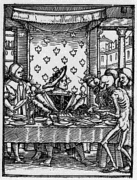
Dance of Death, text that points to what is believed to be represented and danced in the 14th century.

Representation of a Gorgona, with snakes in the head (Bernini).

Death without endMexican artist Mauricio García Vega.

The triumph of Death (1562), of Pieter Brueghel the Old.
_-_The_Day_of_the_Dead_(1859).jpg)


Contenido relacionado
Towel
Feb. 10
Outline