
Cyclotron

_-_01.jpg)
A cyclotron is a type of particle accelerator. The direct method of accelerating ions using the potential difference presented great experimental difficulties associated with strong electric fields. The cyclotron avoids these difficulties by multiple acceleration of ions to high speeds without the use of high voltages.
Most of today's high-energy particle accelerators descend from the first 1 MeV proton cyclotron built by Ernest Lawrence and M. Stanley Livingston in Berkeley, California, USA. The original article published in the Physical Review, Volume 40, April 1, 1932, titled "High-speed production of light ions without the use of high voltages", describes this original invention. The first cyclotron in South America was built by the Argentine engineer Mario Báncora, who was a disciple of Lawrence at Berkeley.
Description

The cyclotron consists of two hollow semicircular plates, which are mounted with their adjacent diametrical edges within a uniform magnetic field that is normal to the plane of the plates and is evacuated. High frequency oscillations are applied to these plates that produce an oscillating electric field in the diametral region between them. As a consequence, during one half cycle the electric field accelerates the ions, formed in the diametral region, towards the interior of one of the electrodes, called Ds, where they are forced to travel a circular path by means of a field magnetic and will eventually appear again in the intermediate region.
The magnetic field is adjusted so that the time it takes to travel the semicircular path inside the electrode is equal to the half-period of the oscillations. Consequently, when the ions return to the intermediate region, the electric field will have reversed its direction and the ions will then receive a second increase in speed as they pass into the other 'D'.
Since the radii of the paths are proportional to the speeds of the ions, the time it takes to travel a semicircular path is independent of their speeds. Consequently, if the ions spend exactly half a cycle in a first semicircle, they will behave in a similar way in all the successive ones and, therefore, they will move in a spiral and in resonance with the oscillating field until they reach the periphery of the apparatus.
Its final kinetic energy will be many times greater than that corresponding to the voltage applied to the electrodes multiplied by the number of times the ion has passed through the intermediate region between the 'Ds'.
Uniform circular motion
An electrically charged particle performs a uniform circular motion describing a trajectory of half a circle. The force on the particle is given by the following expression, which makes up the magnetic force part of the Lorentz force:

where It's the load, It's the speed vector, and the magnetic field vector. The force module is therefore applying the properties of the vector product:



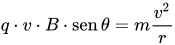
Moreover, as it is a uniform circular motion, the magnetic force will act as a centripetal force; and applying Newton's second law, we therefore obtain equality from which we can find out the radius of the middle circumference, clearing of the equation:

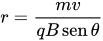
The time it takes to make said route is independent of the mentioned radius.
Acceleration of the ion
The ion is accelerated by the electric field between the D's. It increases its kinetic energy by an amount equal to the product of its charge times the potential difference between the D's.
When the ion completes a semicircle in the constant time P1/2, the polarity is reversed, so the ion is again accelerated by the existing field in the intermediate region. The ion again increases its kinetic energy by an amount equal to the product of its charge by the potential difference between the D's.
The final energy of the ion is nqV, where n is the number of times the ion passes through the region between the D's.
Cyclotron Resonance Frequency
We can calculate the semiperiod, taking into account that the time it takes for an ion to describe a semicircle is the same and independent of its radius.
From the data of the intensity of the magnetic field (B), the amount of charge (q) and the speed (V), we can obtain the value of ω:
The Larmor radius is defined by:

Furthermore, in a circular motion it is known that:

Therefore:

There is a system that bears a certain analogy with the forced oscillations of a particle attached to an elastic spring. The particle (ion) in the magnetic field has a natural period (or frequency) that we have calculated above. The oscillating force is represented by the alternating potential. When the frequency (or period) of the alternating potential coincides with the frequency (or period) of the particle that describes the semicircular orbits, the phenomenon of resonance occurs. The particle is continually gaining energy that supplies the alternating potential. When they do not coincide, the ion gains energy at first but there comes a time when it loses it and ends up stopping in the intermediate region between the D's.
Contenido relacionado
Positron
Michelia
Applied botany