
Cuenca Province
Cuenca is a Spanish province in the autonomous community of Castilla-La Mancha, with the capital being the city of Cuenca. It has a population of 195,516 inhabitants (INE 2021), of which around 27.84% live in the capital. The northeastern area of the province is dominated by the Iberian system, while the Manchegan plain extends to the southwest. It has 238 municipalities and a total extension of 17,141 km², being the fifth largest province in the country.
Symbols

The heraldic shield that represents the province of Cuenca, although centenary, was officially rehabilitated on October 31, 1975 by decree. The coat of arms is as follows:
«Hearing barracks. First, in turn, barracks; first and fourth of gules, the golden castle; second and third of gold the rampant lion of gules. Second, of gules; chalice of gold, added of silver star. Third, of silver; the pin of siple. Fourth, of azur; a book—the rod of Cuenca—of gold. To the bell, royal crown closed. »Official State Gazette No. 269 of 10 November 1975.
The first quarter alludes to Cuenca belonging to the Kingdom of Castile. The chalice and the star allude to the conquest of the city of Cuenca, capital of the province. Specifically, the golden chalice on the final date of the conquest of the city on September 21, 1177, the day of Saint Matthew, as this symbolizes the saint's day; while the silver star alludes to January 6, 1177, the feast of the Three Kings, which was the date the siege began.
Geography
It limits to the north with the province of Guadalajara, to the east with Aragón, specifically with the province of Teruel, and the Valencian Community, specifically the province of Valencia, to the south with the province of Albacete, to the west with that of Toledo and part of that of Madrid and to the southwest with the province of Ciudad Real.
| Northwest: Guadalajara | North: Guadalajara | Northeast: Teruel |
| West: Madrid and Toledo |  | This: Valencia |
| Southwest: Ciudad Real | South: Albacete | Sureste: Albacete |
Provincial boundary

Hydrography

- Cuenca del Tajo
Although the Tagus does not have its origin in the province of Cuenca, since it rises in Fuente García, in the province of Teruel, it serves as a limit to that of Cuenca, separating it from the province of Guadalajara. It receives the rivers of Cabrilla, Gallo and Hoceseca in that part, and continues through the provinces of Cuenca and Guadalajara, touching areas of the second such as Poveda de la Sierra, Peñalver, Zaorejas, Huertapelayo, Armallones, Valtablado, Carrascosa de Tajo, Chillarón del Rey, Pareja and Sacedón, leaving Cuenca near Buendía, in the jurisdiction of Almonacid de Zorita. A tributary of the Tagus is the Calvache.

The Guadiela is born in the sources of the Muela de Pinilla, above the Cueva del Cobre, jurisdiction of the Cueva del Hierro; It thickens with the Valsalobre stream and the spillage of the Tobar lagoons or Masegar river, passes through the terms and towns of Beteta, Cañizares, Carrascosa, El Pozuelo, Alcantud, Priego, Arandilla del Arroyo, Albendea, San Pedro Palmiches, Villar del Infantado, Alcocer, Alcohujate, Cañaveruelas, La Isabela and Santa María de Poyos (disappeared under the waters of the Buendía reservoir), and Buendía, and when leaving the province it joins the Tagus, perhaps with a greater flow, in the reservoir of Bolarque. Among the tributaries of the Guadiela are the Cuervo and the Escabas, the latter in turn fed by the Trabaque river.
The Mayor or Huete river has three main sources: one in Valdecabrillas, another in Villarejo de la Peñuela and another in Villar del Saz de Navalón, which meet between Castillejo del Romeral and Valdecolmenas de Abajo; it leaves Castillejo del Romeral and Bonilla on the right, and Caracenilla and Verdelpino de Huete on the left, passes near Huete, where it meets the Borbotón spring, continues through Moncalvillo, joins the Guadamejud river, and both increase the Guadiela near Buendía, in the homonymous reservoir.
- Cuenca del Júcar
The Júcar is one of the main rivers in the province. It rises in the Sierra de Tragacete, in the place called Ojuelos de Valdeminguete, above the Los Chorros forge, enters the district of Cañete through Huélamo, returns to Cuenca passing through Uña and Villalba de la Sierra, reaches Cuenca with a fairly large flow. and slides through terms and towns such as Albaladejito, Colliguilla, Belmontejo, Villaverde and Pasaconsol, Olivares, Valverde, Buenache de Alarcón, Gascas de Alarcón (disappeared under the Alarcón reservoir), Alarcón and El Picazo, entering the province of Albacete through Villalgordo del Jucar. They are tributaries of the Júcar watercourses such as the Moscas, the Valdemembra, the Tórtola and the Huécar. The latter is born in the Ojo de Megía, term of Palomera, passes through the one of his name, crosses from the Cristo del Amparo the city of Cuenca and its suburbs, and joins the Júcar when leaving them; its flow is low.

The Cabriel has its origin in the Sierra de Tragacete, crosses the district of Cañete, runs through the municipality of Villora, fertilizes the municipalities of Mira, La Pesquera and, already in the province of Valencia, Villargordo del Cabriel, in whose In the immediate vicinity it is crossed by the East highway; joins the Júcar in the valley of Cofrentes. Among its tributaries are the Mira (or Ojos de Moya) and the Guadazaón. Another watercourse in the Júcar basin is the Ranera, which is born at the peak of this name and joins the Magro river near Requena.
- Guadiana Basin
The Záncara has its origin in the municipality of Abia de la Obispalía and is made up of two main sources: one in the municipality of Abia and the other in Villarejo Seco, which meet below Huerta de la Obispalía, and pass through Zafra de Záncara, El Congosto, Villar de Cañas, Casas de Haro, Carrascosa de Haro, Villar de la Encina, La Alberca de Záncara, Las Pedroñeras and the uninhabited area of Santiago de la Torre, in the municipality of El Provencio out of the province to join the Guadiana. It is fed by watercourses such as the Saona and the Rus.
El Cigüela rises a little above the Venta de Cabrejas, Cuenca district, on the road from Tarancón to said city; it passes through the unpopulated area of Cabrejas, Villar del Horno, Naharros, Horcajada de la Torre, Torrejoncillo del Rey, Almonacid del Marquesado, and running through the municipalities of Pozorrubio de Santiago, Horcajo de Santiago and Villamayor de Santiago, Tarancón district, it enters the province of Toledo through Villanueva de Alcardete, until it meets the Guadiana. The Riánsares is the main tributary of the Gigüela.
- Lagunas
.jpg)
There are many lagoons in the territory of this province, but the most notable are the Uña, the Hito lagoon and the Manjavacas lagoon.
Uña's origins come from a spring that gushes out at the foot of some high immediate cliffs, whose flow, after forming it, pours into the Júcar. In Tobar there are two lagoons, one large and the other small: the largest would be two to three kilometers in circumference.
The other lagoons are the following: Montalbo, which is very long and shallow, and usually dries up in summer; the Manjavacas lagoon in Mota del Cuervo; those of Fuentes, Ballesteros and Alcantud; those of Las Zomas, La Laguna, Cañete, Cañada del Hoyo, Reillo and the El Taray lagoon, between Las Pedroñeras and Las Mesas.
History
The current conformation is mostly the result of the reform of Javier de Burgos in 1833.
It is worth noting the fact that a large part of the north of the current province of Albacete incorporates territories that once formed part of the province of Cuenca in the Old Regime; as well as the southeastern part of the province of Guadalajara and more specifically the area of the lordship of Molina.
In 1851 the province lost the territory of Requena and Utiel in favor of the province of Valencia.

Cora Santaver

War of Independence

First Carlist War

Third Carlist War


Demographics
With 3.4% of the national surface, Cuenca has a population that represents only 0.46% of the national territory and 10.3% of the autonomous community of Castilla-La Mancha.

The province of Cuenca has a high rate of depopulation. Cuenca is the least populated province of Castilla-La Mancha, according to the 2018 census of the National Institute of Statistics, which makes it one of the most depopulated territories in Spain (11.51 inhabitants/km² 2018). This index is very far from the average values of Spain and the European Union (92.47 inhab./km² and 117 inhab./km², respectively also in 2018).
It also has one of the highest aging and depopulation rates in Spain; It has a vegetative growth of -203 in 2007, but it has been dragging continuous vegetative growth for decades (years 2004, -608; 2005, -683; 2006, -553) In addition, its municipalities are experiencing a critical situation since 74 of its 238 municipalities have less than 100 inhabitants, 179 have less than 500 inhabitants and only seven have more than 5,000 inhabitants. Which puts the demographic situation of the province in a rather difficult situation.
In addition, the population of the province of Cuenca is concentrated in: the capital and some adjacent municipalities; the municipalities in the southwest of the province, that is, the municipalities belonging to the regions of Manchuela and La Mancha de Cuenca bordering the provinces of Toledo and Albacete; and in the old county heads (Tarancón, Landete or Huete) that are also in a regressive dynamic. On the contrary, the regions of Serranía Alta, Media and Baja have very low population densities and quite high levels of depopulation.
| Graphic of demographic evolution of the province of Cuenca between 1842 and 2018 |
 |
Source: Spanish National Statistical Institute - Graphical development by Wikipedia. |

Population by municipality in 2018

Population density by municipality in 2018

Population growth by municipality between 1998 and 2008
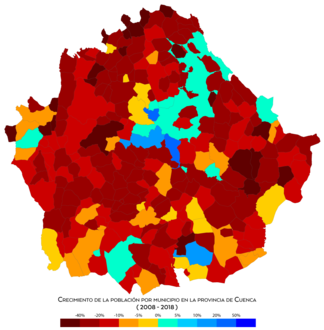
Population growth by municipality between 2008 and 2018


Territorial organization
Municipalities
There are 238 municipalities in the province.
The province of Cuenca is the 34th in Spain in which there is a higher percentage of inhabitants concentrated in its capital (27.84%, compared to 31.85% for the whole of Spain).
Country
- Historical
Pedro Pruneda divided the province in 1869, in his Crónica de la provincia de Cuenca, into three regions: Sierra, Alcarria and La Mancha, whose exact limits were not easy to determine.

The area of the Sierra was included within the mountain range that, entering the province through the term of Alcantud, follows the direction of the magnetic meridian to the east of Priego, Villaconejos, Albalate de las Nogueras, Torralba, Villar de Domingo Garcia, Tondos, Arcos de la Cantera, Cuenca, La Melgosa, Mohorte and Las Zomas. There it makes a semi-elliptical inflection heading west through the town of Fuentes, north of Villar del Saz de Arcas, Tórtola and Valdeganga, to end on the left bank of the Júcar between south of Villar de Olalla and the Castellar mill. From this point it once again takes a north-south course east of Albaladejo del Cuende, Valera de Abajo, southwest of Piqueras, east of Hontecillas, Buenache de Alarcón, Olmedillo de Gaseas and Barchín del Hoyo, changing its direction here to take it from the southeast through Gabaldón, Campillo de Altobuey, Puebla del Salvador and Minglanilla, to find the Cabriel river that forms the border of the province with that of Valencia in this part. The line that forms the perimeter of the Sierra continues along the same limit and that of the provinces of Teruel and Guadalajara, following the Aliaguilla, Pico Ranera and Collado de las Cruces de Talayuelas mountain ranges, from whose site it turns north, seeking the Sierra de Santerón, Zafrilla, Tejadillos, Valdemeca and Tragacete, to return along the slopes of the Tagus to finish towards Alcantud.

The second zone, known by the name of Alcarria, was the territory that in its most flat part includes the hydrographic region of the Tagus in this province and that must be considered circumscribed to the east by the piece of mountain range described from Alcantud to Bascuñana. The southern side is marked by the division of the Tagus and Júcar, which beginning in the Bascuñana area goes through Sacedoncillo, Fuentesclaras, Navalón, Jábaga, Cólliga and Villanueva de los Escuderos, ending at the Cabrejas heights, where the river originates. Cigüela River, a tributary of the Guadiana. The western limit is made up of the dividing line between Guadiana and Tagus, running east from Caboyas, Villar del Horno, Pineda, Valparaíso de Arriba, La Olmedilla, Loranca del Campo, southwest of Huete, ending to the west of Vellisca. The north side is closed by the Altomira mountain range from Vellisca through Mazanellegua, Garcinarro, Javalera and Buendía until it meets the Alcantud mountain range.
.jpg)
The area called Mancha covered the land from the divide between the Tagus and Guadiana in Vellisca, to the source of the Cigüela in Cabrejas, and the continuation from here through the Castellar mill and a piece of mountain range that ends in Minglanilla. At this point it takes the limits with the provinces of Valencia, Albacete, Ciudad Real, Toledo and Madrid, to come to an end through the towns of Belinchón, Leganiel and Saceda-Trasierra, in the municipality of Vellisca where it begins.
- Contemporary
The Provincial Council of Cuenca divides the province into five large regions: La Alcarria of Cuenca, La Mancha de Cuenca, La Manchuela of Cuenca, the Serranía Alta and the Serranía Media-Campichuelo and Serranía Baja. The five regions of Cuenca are very disparate in landscape and demographics, instead they have a fairly common culture and gastronomy. They can be differentiated by their landscape into two groups; those of the mountain range (Serranía Alta and Serranía Media-Campichuelo and Serranía Baja), the plateaus (La Mancha de Cuenca and La Manchuela Cuenca) and La Alcarria, which has a transitional landscape between the two.[citation required ]
Demographically they can also be grouped in the same way, since the municipalities of the mountains and those of Alcarreño are small municipalities that suffer a great demographic crisis with a strong depopulation, while the municipalities of La Mancha are medium and large municipalities with a dynamism older demographic.
Means of transportation
The province of Cuenca is an important transit point, since it is located in the center-east of the peninsula, thus connecting the south and west with the Spanish east, so it has a large number of roads and highways, and since December 2011 it is also a transit point to connect Madrid with the entire Mediterranean coast through the Spanish High Speed lines.
Roads
| Identifier | Name | From/ | Important cities of Cuenca where it passes |
|---|---|---|---|
 | East motorway | Madrid-Valencia | Tarancón, La Almarcha, Honrubia, Tébar, Motilla del Palancar, Minglanilla |
 | Autovía de Alicante | Atalaya del Cañavate-Alicante | Honrubia, Cañavate Watch, Sisante |
 | Autovía de la Meseta Sur | Avila-Teruel | Tarancón, Carrascosa del Campo, Cuenca |
 | Autopista Ocaña-La Roda | Ocaña-La Roda | Mota del Cuervo, Las Pedroñeras, San Clemente |
 | Guadiana motorway | Torrefresneda-Atalaya del Cañavate | San Clemente, Vara de Rey, Watchtower of the Cañavate |
| Identifier | From/ | Important cities of Cuenca where it passes |
|---|---|---|
 | Honrubia-Requena | Tarancón, Honrubia, Alarcón, Motilla del Palancar, Minglanilla |
 | Ocaña-Cartagena | Mota del Cuervo, Santa María de los Llanos, El Pedernoso, Las Pedroñeras, El Provencio |
 | Manzanares-Villanueva de la Jara | San Clemente, Vara de Rey, Sisante, El Picazo, Villanueva de la Jara |
 | The Gineta-Venturada | Quintanar del Rey, Villanueva de la Jara, Motilla del Palancar, Almodóvar del Pinar, Cuenca, Chillarón de Cuenca, Villar de Domingo García, Cañaveras |
 | Toledo-Cuenca | Tarancón, Carrascosa del Campo, A-40, Cuenca |
 | Córdoba-Tarragona | Mota del Cuervo, Belmonte, La Almarcha, San Lorenzo de la Parrilla, Villar de Olalla, Cuenca, Fuentes, Carboneras de Guadazaón, Cañete |
| Identifier | Name | From/ | Important cities of Cuenca where it passes |
|---|---|---|---|
 | Alcarria motorway | Tarancón-Guadalajara | Tarancón, Barajas de Melo |
| South Plateau motorway (continued to Teruel) | Avila-Teruel | Cuenca, Fuentes, Carboneras de Guadazaón, Cañete |
| Autovía Cuenca-Albacete | Cuenca-Albacete | Cuenca, Motilla del Palancar, Villanueva de la Jara, Quintanar del Rey | |
| Autovía Transmanchega | Daimiel-Tarancón | Villamayor de Santiago, Horcajo de Santiago, Tarancón | |
| Autovía Cuenca-Ciudad Real | Cuenca-Daimiel | Cuenca, Villar de Olalla, La Almarcha, Belmonte, Mota del Cuervo | |
| Pozoamargo-Villamalea | Pozoamargo, Casasimarro, Quintanar del Rey, Ledaña |
Railway

Until 2010, the only railway line that passed through the province of Cuenca was the conventional train line Madrid-Cuenca-Valencia. The most important towns through which it passes are: Tarancón, Huete, Cuenca, Cañada del Hoyo and Carboneras de Guadazaón. This line is a single track, and due to its difficult layout and the limitation imposed in 2011 (60 km/h), it considerably lengthens the travel time, compared to the line through Albacete and the AVE. The conventional line that ran through the province from East to West saw its last train circulate between Cuenca and Aranjuez on July 19, 2022; however, the section of the Serranía de Cuenca was already out of service since January 8, 2021, after the incursion of the Filomena storm.
On December 18, 2010, the Madrid-Cuenca-Valencia and Toledo-Madrid-Cuenca-Albacete high-speed lines were inaugurated (whose AVE connection was abolished months later due to the low influx of passengers), which allow connecting Madrid with Cuenca in just 50 minutes with AVE S-112 and Alvia S-130 trains, with Valencia in 45 minutes and with Albacete in 35. In addition, the arrival of high speed has led to the Madrid-Cuenca lines stopping. Castellón (with stops at Valencia-Joaquín Sorolla and Sagunto), Madrid-Alicante (with stops at Albacete and Villena-AV) and Alicante-Gijón (with stops at Villena-AV, Albacete-Los Llanos, Madrid-Puerta de Atocha, Madrid -Chamartín, Segovia-Guiomar, Valladolid-Campo Grande, Palencia, León, Pola de Lena, Mieres-Puente and Oviedo).
Economy

Cuenca, with a somewhat depressed economy mainly due to continued emigration, seems to be reborn now with tourism and the progressive knowledge of its excellent landscapes and resources. The economy has traditionally been focused on agricultural and forestry activities: cereals, vines, olives, saffron, garlic, chickpeas, lentils, mushroom cultivation (Villanueva de la Jara, Altarejos, Las Pedroñeras, Los Hinojosos, Mota del Cuervo, Puebla de Beacon). In relation to livestock activities in the province, sheep cattle stand out, in addition to the beekeeping of hives. In the past, obtaining salt was of economic importance in the area, with various salt mines existing in the province.

The industry is mainly focused on the sector derived from Cuenca's forest wealth: sawmills (Cuenca, Almodóvar del Pinar) and resins (Cuenca, Arcos de la Sierra). Its high-quality mineral water springs, mainly in the north of the province, give rise to a bottling industry of increasing importance (for example, the waters of Beteta and Huerta del Marquesado). It has in its territory the reservoirs of Buendía, La Toba, Alarcón and Contreras that today are in a very deficient situation.
Its most characteristic products are meat derivatives, such as mortaruelo or pastor gazpacho. Desserts such as alajú, drinks such as resolí, wine and brandy from Ribatajada, cheese, purple garlic from Las Pedroñeras, mushrooms and mushrooms from La Manchuela and honey from La Alcarria.
Culture
Folklore
_en_el_Museo_de_Artes_y_Tradiciones_Populares_(15_de_julio_de_2016,_Madrid).jpg)
The geographical variety of Cuenca (Sierra, Alcarria, Mancha and La Manchuela), the diversity of confluent cultures in the region throughout its history, the isolation caused by its geographical and climatic characteristics and its predominantly agricultural and social configuration. livestock (of transfer of farmers and shepherds), they make suppose by themselves the consequent folkloric variety of Cuenca, which is confirmed in reality. Musical examples corresponding to the cycles Annual (of Nature or the Seasons), Religious or Liturgical (closely related to the previous one by incorporating pre-Christian customs with a new meaning) and Vital and Social (relative to the different stages of human life and institutions), which are commonly used to classify folklore, are found in the province of Cuenca attesting to the aforementioned variety.
In some cases, such examples are infrequent or isolated, such as those related to the celebration of Carnival and the summer solstice (San Juan), a consequence, perhaps, of more or less recent inquisitions and censorship.
Others appear, almost singularized to some localities close to each other, such as the albadas at the source of the Sierra Oriental de Cuenca (Víllora and Cardenete) or more extended by the Sierra or the Alcarria, such as Las Músicas, in which it is possible to affirm their derivation from more frequent and developed forms in neighboring regions (Valencian les Albaes in the first case and the Old Fandangos of Castellón and Alto Palancia in the second). On other occasions, the examples take the form of defined and widely generalized musical forms, sung, danced, or mixed, as is the case with jotas, rondas, mayos, seguidillas, dances of sticks, carols, romances, and work songs.
The abundance and variety of them allows, then, their comparison and, consequently, the possible detection of musical characteristics common to each of these genres or specific to certain areas; characteristics that allow us to risk some punctuation of jotas and seguidillas, which are both of greater melodic extension and rhythmic definition in the Sierra and La Alcarria than in La Mancha. The Manchego seems to cut or reduce the melody and frees himself, in singing, from the rhythm imposed by the instrumental accompaniment, (as occurs in the Torrás and in some Seguidillas by Mota of the Raven).
Pottery
Gastronomy
- Rural and Pastoral Gastronomy

The cuisine of the province of Cuenca brings to mind the typical Castilian gastronomy; dishes prepared by shepherds, muleteers, hunters, men who, through the energy provided by food, cope with a harsh climate, where one goes from hot to cold almost non-stop and in a region that provides many products so that be used.

The quality of raw materials and respect for traditions are two essential characteristics of this province. Game meat, headed by the partridge, is present in many dishes, such as the mortaruelo, although chicken meat can be used instead. Other meats, such as lamb, also find their place in Cuenca lands. Recipes such as zarajos, or suckling pig chops in the embers of the mountains, are very interesting, tasty, and ideal for savoring all the flavor of this meat. Traditional dishes such as ajoarriero, made with cod and garlic (the ones from Las Pedroñeras are excellent). The original Galian gazpachos that use unleavened bread, mortaruelos, various game meats, migas (hard crumbs), stews, complement this meat-based cuisine and add different flavors, but just as popular.
- Quarantine cuisine

The prominence of meat disappears from the kitchens of Cuenca with the arrival of the Holy Week festivities. The stews, chickpeas with cod and spinach, white beans or potatoes with Ajovirón, assume stardom, giving a twist to traditional gastronomy. The vegetables, cooked in water and salt, give a touch of simplicity in which, however, the natural flavors surprise. Trout, from Cuenca rivers and streams, fresh and tasty, also take center stage on the tables with the arrival of this season.
- Hong
Mushrooms have always been used in Cuenca cuisine, due to the large forest area that this province has. In towns like Almodóvar del Pinar or Monteagudo de las Salinas, the níscalo is widely used in the autumn season. Starting in the 1970s, the mushroom (Agaricus bisporus) and the oyster mushroom (Pleurotus ostreatus) began to be cultivated in Villanueva de la Jara. Homemade scrambled eggs with mushrooms, garlic mushrooms, chicken with mushrooms, battered mushrooms, and much more are made with these products.
- Sweets
The sweet offer in the province of Cuenca is wide and very varied. The alajú stands out, a sweet made with honey, almonds and bread crumbs, although there are also versions that substitute almonds for walnuts or figs. Also worth mentioning are the French toast soaked in milk (especially in the aforementioned Easter holidays), the anise donuts, the French toast (in Easter as well), the cinnamon biscuits, the wafers, the raisin bread or the fried donuts, without forgetting the tortas de las candelas (fine crunchy cakes dipped in honey and typical of Ribatajada and its surroundings). Also in the town of Zarza de Tajo is the so-called Torta de La Virgen, this sweet based on honey and noodles, is prepared from the month of January so that in the festivities of the patron saint the Virgin of Las Candelas it is offered to the virgin, this large cake can weigh more than 800 kg, in order to cut it, a large saw is necessary.
Other typical desserts from Cuenca are papartas (also called Japaipas in the town of Uclés and Hojuelas in Tinajas), some cakes made with water, oil and flour, a dough similar to that of churros, to which sugar once fried. They are typical of Holy Week. In the Alcarria (Valdemoro del Rey and Garcinarro), torcíos are also typical, propeller- or screw-shaped sweets made from a dough similar to that of donuts.
- Wines

This province produces wines from the Denominations of Origin La Mancha, La Manchuela and Ribera del Júcar, wines from Tierra de Castilla and the recent Uclés Denomination of Origin, whites and reds are very interesting and recently awarded, light and fruity when they are young. You can also find a typical liquor to ease heavy digestions: resolí, which is a liquor made by mixing brandy, coffee, cinnamon, orange peel and sugar.
Notable people
Contenido relacionado
Annex: Municipalities of the province of Cádiz
Asaka (Saitama)
Gulf of mexico