
Cossack

Them Cossacks (in Russian: как, tr.: kazak (plural, japanese) kazakiUkrainian: kok (plural, japanese) kozakiin Polish: kok (plural, kozacy) were groups of social and military formations, initially of Slavic origin, which were established permanently in the steppes of what is currently southern Russia and Ukraine, which provided military services to the neighboring rulers of Rostov del Don, Kubán, the Caucasus and Ukraine, approximately in the centuryX. The Cossacks were known for their military skill and confidence in themselves. The name derives from Slavic languages Kasak “nomadic”, “free man”. This term is first mentioned in a Ruthenian document dating from 1395.
In sociopolitical terms, since the XV century and until the present day, the Cossack community is organized in an administrative structure that It could be considered a primitive federal democracy, something novel but unacceptable in the entirety of Eastern Europe and Asia in medieval times.
Cossack is the common name shared independently by various population groups and military units over the course of the history of Eastern Europe and adjacent territories. The main and most numerous group is that of the Russian Cossacks (казаки) of the Don, Kuban, Terek and Ural rivers and that of the Ukrainian Cossacks (козаки), respectively. Somewhat less known are the Polish Cossacks (Kozacy) and the Tatar Cossacks (Nağaybäklär). The name "Cossack" should not be confused with the Kazakhs (natives of Kazakhstan, a country in Central Asia). In the native language of Kazakhstan, its natives are called Kazáj: Kazakh.
In Russia, the native Cossacks took care, for centuries and until now, to jealously preserve the pronunciation and writing itself of the name of their origin. According to ancient Cossack tradition, the word “Kazak” must be written and read equally, both from left to right in Slavic Cyrillic transcription, and from right to left in transcription of Turkic languages. The Russian Cossacks played an important role in the colonization of Siberia. In the middle of the 17th century, the Russian Cossacks reached the coast of the Pacific Ocean. The Ukrainian Cossacks formed the Zaporozhye Cossack State in 1649. They are considered the progenitors of the modern Ukrainian nation and Ukrainian nationalist discourse largely appeals to the Cossacks.
In 1670, the Don Cossack Stenka Razin proclaimed the Cossack Republic in the city of Astrakhan, on the banks of the Volga River, near its mouth into the Caspian Sea. To the previous decree abolishing slavery he added the principle of equality and the end of privileges in the territories of this Cossack Republic. The Don Cossacks formed the Don Cossack State in Russia. During the time of the Russian Empire, numerous Russian serfs who were fleeing from their masters joined the Don Cossacks. Additionally, the Don and Kuban Cossacks were two of the main resistance forces against the Bolsheviks during the Russian Civil War. At the same time and after the collapse of the Russian Empire (in May 1918), Don Cossacks led by their hetman, Pyotr Krasnov, again attempted to form an independent Cossack republic in union with the Kuban Cossacks. The republic included ten provinces, with the capital in the city of Novocherkassk, with the administrative-political scheme of an independent federal State.
The Cossack traditions, culture and community itself were mostly exposed to extermination during the Soviet Union, especially between 1922 and 1945, and are currently in a process of resurgence. The vast majority of the Cossack community is concentrated in the Volgograd and Rostov-on-Don regions, 108,140 of the total. Another 21,444 Cossacks are residents of Krasnodar Krai and the Stavropol region. 3,223 Cossacks are divided between the Republic of Karachay-Cherkessia and the Republic of North Ossetia. The rest of the Cossack community is spread throughout the Russian Federation from the Baltic Sea to the coasts of the Pacific Ocean. Regardless of the above and according to different statistics, about 10 million people in Russia, Ukraine and abroad consider themselves to be Cossacks of origin or direct descendants of them.
Geographic distribution

The Cossacks were formerly nomads or semi-nomadic; They are ethnically Slavs and currently reside mainly in the territories of Russia and Ukraine. Some communities are located on the territory of Kazakhstan (Ural and Semiréchinskie Cossacks). Before, they lived mainly in the steppes, between the Black Sea and the Caspian Sea, and also in the Caucasus Mountains. With the sponsorship of the Russian Empire, the Cossacks actively participated in the colonization of Siberia, conquering extensive territories from the Ural Mountains to the Pacific Ocean, the Altai Mountains, the steppes of Central Asia and also settling on the coasts of the Ussuri River.
The main centers of the Cossack population are found in the regions of the Don, Kuban and Dnieper rivers, and are called the Don and Kuban Cossacks, respectively. Currently there are eleven traditional Cossack communities in the territories of the former Russian Empire and former Soviet Union. Most of these are concentrated in the territories of the current Russian Federation. The Cossacks originating from these regions receive the respective name: Don Cossacks, Kuban Cossacks. Each of these regions has a local Cossack administrative authority. In addition, there are Cossack organizations in and Saint Petersburg with representations of their specific region:
- 1. Don Region
- 2. Kuban Region
- 3. Térek Region
- 4. Astracán Region
- 5. Ural Region
- 6. Region of Orembourg
- 7. Semirechie Region
- 8. Siberia Region
- 9. Transbaikal Region
- 10. Amur Region
- 11. Ussuri Region
The last census carried out before 1917 indicated that the Cossack population in Russia numbered more than 4 million people of both sexes, distributed mainly in the border regions of southern Russia. Starting in 1920, systematic persecution, reprisals and mass executions of the Cossack people began, unleashed by the Communist Party of the Soviet Union—more than two-thirds of the Cossack population were exterminated in the first ten years of Soviet government alone—.
A large number of the Cossacks were forced to emigrate and are now residents of other countries, such as France, Germany, Belgium, the United States, Canada, Australia, Argentina, Chile and many others. Many of these emigrants maintain close relationships with the Cossack communities in Russia. Some, as in the case of the Cossacks residing in New Jersey, United States, maintain national Cossack museums and libraries, intended to preserve the cultural, traditional and historical heritage of their people.
According to the official census of the Russian Federation in 2002, for the first time after the census of 1897, more than 140,000 people of both sexes (0.1% of the total population) in Russia in They openly indicated and officially declared their nationality as "Cossack", residents and citizens of Russia.
History
15th-16th centuries


The last to abandon the Khans of the Golden Horde were the Cossacks of the Nogai and Astrakhan Horde who joined the Don Cossacks only in the second half of the century XVI. From then on the life of the Cossacks would border with the principalities of the area who often fought among themselves. Given these conditions and the presence of Turks and Tatar-Mongols in the area, the need arose to serve under the orders of the two powers in the area: The Principality of Moscow and the Duchy of Lithuania. As a protest against these threats, the birth and formation of two Cossack republics on the Don River and the Lower Dnieper River took place later, after which the strengthening of Cossack independence and identity began, with these states being the main centers. of unification of the Cossack people.
However, not all Cossacks chose to return to the environment of their homeland. Many of them, accustomed in the hundred years of life in the territories of Muscovy, Lithuania and Poland, stayed. Traditionally loyal to their allies and authority, they became faithful defenders of the interests of the kniaz (princes), tsars and kings of the time, and in exchange for this they accepted abundant royalties and privileges, land grants, titles of nobility from the monarchs., forming mixed families with Russians, Lithuanians, Poles, and gradually they became diluted in their environment, forming their natural part. Children and grandchildren of Cossack emigrants also stay in the Far North. Once accustomed to the harsh local climate, they moved in small groups to the East, crossing mountain ranges and rivers, crossing extensive areas of forest. They managed to dominate and conquer the local tribes, expanding the power of the Russian monarchs throughout the territory of Siberia. For a time they still remembered their ties with the Don Cossacks, they called themselves "sons of the gentle Don" (Deti Tíjogo Dona) and they began the formation of the new Host's or Voisko (large and well-organized and administered communities, military, in times of war; civil and absolutely autonomous, in times of peace), with new names: Terek Cossacks (North Caucasus), Siberian Cossacks or Transbaikal Cossacks. United by their origins, they now found themselves divided by great distances and very extensive territories, as each formation continued its life along its own particular path. In the next stage of history, in the 16th-17th centuries, the majority of the Cossacks belong to the Zaporozhie and Don groups, the same ones who decided to return to their homeland - Kasak Land, on the plains of the sea coasts. of Azov, and they called themselves in the XVIII century as Chernomorskie Kazakí (the Black Sea Cossacks), ancestors of the Cossacks from Kuban.
The ancient history of the Cossack people is for now reconstructed schematically, for the same reason sometimes intentionally, for nationalist reasons, political or ideological situation, some historians present it in the wrong way.
It is known that in ancient times there was a very well-organized Cossack community from Zaporozhye, on the Dnieper River in the south of what is currently Ukraine, which in turn in times of the splendor of the Russian Empire was called Malorossia ("little Russia").). At the end of the Middle Ages, Cossack populations came under the crossfire of Poland, Lithuania and Russia, the three great powers in the area. The Russians of Muscovy and the Cossacks always lived in a tense relationship, in which the latter undertook assaults against the villages and fields of the former, after which the latter sent out punitive expeditions. In 1539, Grand Duke Basil III of Russia asked the Sultan of the Ottoman Empire to control the Cossacks, to which the Sultan replied: "The Cossacks do not swear allegiance to me and live as they please themselves." Similarly 10 years later, in 1549, the Russian Tsar Ivan the Terrible responded to a request from the Turkish Sultan to curb the aggressive actions of the Don Cossacks with the following: "The Don Cossacks are none of my concern." and they go to war or live in peace without my knowledge. Similar messages circulated between Russia, the Ottoman Empire, and the Polish-Lithuanian Commonwealth, each of which sought to exploit Cossack bellicosity for their own interests. Finally, under the aegis of Ivan IV (Ivan the Terrible), an agreement was reached that allowed the establishment of a special status for the Cossack community of the Don River (around 1570). These statutes guaranteed the autonomous administration of Cossack communities, their tax-free commercial activities, land grants, titles of nobility for Cossack leaders - all this and more in exchange for permanent military service, ensuring internal and external defense and security., protecting Russia's borders from enemy invasions.
Traditionally, each Cossack was equipped with weapons, ammunition, uniform, and means of transportation (horse), acquired completely by each combatant individually or paid for by the community and his family. That was one of the deals with the Russian government regarding the Cossack obligation to the State in exchange for the privileges granted to its community. Over time, the Cossack people would play a very important role in the Russian conquest of Siberia, establishing new voiskos and stanitsas (Cossack villages) throughout the Asian continent.
16th-19th centuries


In 1613, despite the opposition of some Russian leaders and princes, the Don Cossacks openly and energetically demonstrated in support of the representative of the Romanov family to govern Russia – the young Mikhail Fyodorovich Romanov. In 1634, during the reign of this first Tsar of Russia, the claims of the Polish king Władysław IV Vasa to the throne of Russia were put to an end. Since then, explicit and unconditional Cossack support serves as the basis for the power of the Romanov Dynasty at the head of the Russian Empire.
At the same time, Poland encouraged the Dnieper Cossacks to ally with the Ukrainians to establish a markedly anti-Russian principality. For this purpose, at the beginning of 1646 a secret meeting was held between the hetman of the Dnieper Cossack community, Bohdan Khmelnytsky, and the Polish king Władysław IV Vasa.
The negotiations did not lead to the result expected by the Cossacks and by 1648 they took up arms together with the Ukrainians against the growing ambition of the Polish-Lithuanian Commonwealth to expand its rule over the region. The result of this was the Liberation War that lasted six years, between 1648 and 1654, where the local Slavic, Ukrainian and Russian peoples, led by the Cossacks, revolted against the Poles. In February 1649 the Polish authorities again attempted to negotiate peace, offering a degree of autonomy to the Cossack communities in exchange for maintaining Polish authority over the region, but without considering the interests of other local peoples, especially the Ukrainians. The negotiations were frustrated and a few months later, in the same year, Bohdan Khmelnytsky formalized diplomatic relations with Russia, thereby getting the Don Cossacks loyal to the Russian monarchy to unite in support of the Dnieper Cossack community, led by Khmelnytsky. Between 1649 and 1651 fighting continued between the Poles and the unified Ukrainian and Cossack forces, with intermittent successes on both sides.
In the autumn of 1653, the Polish army under John II Casimir Vasa began a desperate offensive to regain and consolidate its authority over the region. On October 1, 1653, as a result of agreements and meetings with Bohdan Khmelnytsky, the Russian authorities authorized his support and made Russia's participation in the Liberation War official. At the beginning of 1654, the Tsar of Russia Alexius I of Russia officially declared war on Poland, which ended in 1667. In the end, the fate of the first "Polonized" Ukrainian State would end up being divided between the Russian Empire and Poland in 1667 according to to the Treaty of Andrusovo. Along with this, the original historical ties between the Dnieper and Don Cossacks were recovered and strengthened.
In 1670 another charismatic character in Cossack history, Stenka Razin, proclaimed the Cossack Republic in the city of Astrakhan, southern Russia, which lasted until 1671. Throughout history there were other attempts by the Cossack community to create an independent Cossack State. All of them were brutally repressed by the Russian, Ukrainian and Polish authorities of different times by military force or by creating political, religious and ideological divisions within the same Cossack community. As time went by, and in particular during the great Russian campaigns of the 19th century (for example, the campaign against Napoleon Bonaparte, in which Matvéi Platov, one of the greatest atamans, stood out), the Cossacks would end up being a powerful arm of the army of the House of Romanov (in a way, special forces of the time, where all its members belonged to a same ethnic community, similar to the situation of Nepalese Gurkhas in the UK army).
19th-20th centuries
By 1914 there were 11 Cossack administrative communities, most of them (with the exception of the Don and Kuban Cossacks) located in different border areas of the Russian Empire (with Turkey or China, for example). This association between the Cossacks and the Romanov dynasty meant the former's fall from grace after the Russian Revolution and during the Russian Civil War, since the Bolsheviks did not accept the special status that the Cossacks had had in the Russian Empire. All Cossacks swore to the flag of the Russian Empire and absolute loyalty to the tsar. Since after the revolts of 1917, Tsar Nicholas himself refused the crown and throne of the monarchy and the Empire itself began to crumble, the Cossacks no longer felt obligated to follow the internal interests of the Russians. The numerous political parties of the time strove to come to power and dominate what was left of the Empire.


After the February Revolution, the first National Cossack Congress was held in the city of Petrograd on April 4, 1917, in which representatives of the eleven Cossack communities of Russia met and one of the first decrees issued by this It was the expulsion from their regiments of all soldiers who were not of Cossack origin.
Considering all of the above and under the leadership of Pyotr Krasnov, Don Cossack ataman, the Cossack community again attempted to create an independent Cossack republic, the union of Don and Kuban Cossacks. On May 17, 1918, the Cossack Republic was proclaimed, with statutes, constitution, parliament and federal state administrative political system. Hetman Piotr N. Krasnov was elected the first president of the Cossack Republic (1918-1919). The republic included 10 provinces with the capital in the city of Novocherkassk. The official flag was composed of three colors, symbolically representing the three main nations of this Cossack Republic: Cossacks – blue; Tatars and Kalmyks - yellow; Russians - red.
Finally the republic was abolished (1921), since the Russian commanders of the White Army, composed mainly of Mensheviks and Russian monarchists, opposed the Cossack independence movement. During the Russian Civil War, relations between the Russian "volunteers" (of the monarchist White Volunteer Army) and the Cossacks were difficult. Dissensions between the Russian monarchist "Mensheviks" and the nationalist Cossacks (the latter being supporters of the monarchy of the Romanov) damaged relations. On the other hand, the Cossacks were also fought by the "Bolsheviks" and the Red Army, since they had traditionally been allies of the repressive forces of the Empire.
In addition, the Cossacks themselves were not united among themselves, and had different visions regarding their national identity, traditions and culture. During the civil war there were Cossack factions fighting on opposing sides, even periodically changing from one side to the other.
The Soviet era: 1922-1990
When the Soviet State was established, the tradition and culture of the Cossack people were promoted. However, later there were Cossacks fighting on both sides of the German-Soviet conflict, as members of German and Soviet troops.[citation needed] Some Cossack emigrants decided to rebel against Stalin trying to obtain definitive Cossack independence. For their part, the Germans and Italians even promised to create a Cossack State in Carnia, in northern Italy, safe from Stalinist persecution. The Cossacks who fought within the Red Army, above all, prioritized the integrity of the Soviet Union, as the natural "heir" of the Russian Empire.
Once the war was over, and complying with the terms previously agreed upon at the Yalta Conference, Great Britain and the United States decided to wash their hands of it, letting Stalin treat the Cossacks in the way he saw fit, deporting any Cossacks they found. in Europe, back to the Soviet Union.[citation needed] Among the tens of thousands of refugees from occupied Eastern Europe, there were mixed Nazi collaborators, anti-communists, military and ordinary civilians without any kind of ideological or political context, both exiles from the Soviet Union and emigrants from the time of the Russian Civil War. In the group, there were also approximately 50,000 Cossacks, including women, elderly people and children from the defunct Russian Empire who were never citizens of the Soviet Union. In fact, many were born in the 1920s-1930s, after the Civil War, having already emigrated to Serbia or Western Europe. They were all rounded up in Austria and forcibly repatriated in Operation Keelhaul. Most were directed to the Soviet zone in Germany. Many of the Cossack refugees, both military and civilian, were summarily executed (as revenge for being old enemies of the Russian Civil War, and for their subsequent collaboration with the Nazis during World War II), sometimes shot in full view of the British. Others were sent to Siberia or Central Asia and sentenced to hard labor in Soviet concentration camps.[citation needed]
The fate of the Cossacks who fought against the Nazis in the ranks of the Red Army was also predetermined. Freed from the need to use them as troops, Stalin decided to integrate them into the Red Army.[citation needed] Many Cossacks, military and civilian, men, women and children who survived the Russian Civil War and World War II, they ended their days in the gulag, as prisoners in forced labor camps in regions of Siberia, Central Asia and the Russian Far East.[ citation required]
News
The end of the 80s marked the history of Russia with significant changes in the social and political system, the emergence of new organizations and the rebirth of old socio-political institutions and traditional communities, lost or repressed in Soviet times. Among these were the Cossacks. According to statistics from 1992, about 10 million men and women citizens of Russia, Ukraine and other countries in the world self-identify and consider themselves as original Cossacks or descendants of Cossacks. Many of them are grouped in popular, cultural or folkloric organizations, some of which even enjoy official recognition by the authorities, supported by decrees and laws that authorize, with certain limitations and statutes, the traditional Cossack organization and structure.
72 years after the Russian Revolution, on November 14, 1989, the Supreme Soviet of the former USSR made public the declaration “On the recognition of illegality and criminality of repressive acts against peoples, victims of forced displacement and the need to guarantee their rights.” The aforementioned decree affirmed the right of the Cossack community to rehabilitation. In this way, bodies of the legislative and executive power of the Russian Federation recognized the Cossack community as a people that has suffered massive, systematic and organized terror by the Soviet authorities of the time.
Regardless of the statutes granted, the Cossacks dispersed throughout all regions of Russia are part of a large sociocultural community, mostly multi-denominational, the members of which self-determine and self-identify as Cossacks of origin. On June 30, 1990, the first Bolshoi Krug (Great Circle, traditional Cossack parliamentary conference) was held in Moscow. The result of this was the formation of the Cossack Union, which initially grouped 29 Cossack organizations. In October 1991, Cossack leaders formed the South Russian Cossack Union.
On July 17-18, 1993, the Supreme Unified Krug (Congress) of the Cossack communities of Russia and abroad was held in Moscow. In this, the city of Novocherkassk was unanimously proclaimed the capital of all Cossack communities in Russia and the rest of the world.
On June 15, 1992, the President of the Russian Federation publishes the Decree “On measures for the implementation of the Law of the Russian Federation in relation to the rehabilitation of the Cossack ethnic community”, literally ordering “to impose the judgment of the State policy of the Communist Party of the time to carry out repressions, arbitrariness and illegalities against the Cossack community and its representatives, with the aim of rehabilitating this historical ethnic community. On July 16, 1992, the Supreme Soviet of the Russian Federation publishes Decree No. 3321-1, legally putting an end to all repressive, criminal and illegal actions that the Cossack community has suffered since 1918.
In January 1995, the General Directorate of Cossack Communities was created, as part of the presidential Cabinet. On August 9, 1995, Decree No. 835 of the President of the Russian Federation declares “Temporary Rules on State Registration of Cossack Communities in the Russian Federation.” In 1998, the General Directorate of the Cossack Communities was transformed into the Directorate of the President of the Russian Federation on Cossack Community Affairs.
By 1999 the initial support shown by the Russian State to the Cossack organizations decreased significantly. The above, mainly due to the markedly separatist and nationalist ideas expressed by some of the Cossack representatives and leaders, with the primary objective of gaining autonomy, sovereignty and formal political recognition of the "Kazaki Republic" in territories populated in a compact majority. by Cossacks of origin, the North Caucasus, the region of the lower and middle Volga River, the Ural River (including the city of Chelyabinsk) and the northwestern regions of the Aral Sea. Without a doubt, if it became a reality it would cause instant conflict with other peoples residing in these territories, even outside of Russia as is the case of Kazakhstan. Logically, these ideas are considered by the government to be separatist and unconstitutional in today's Russian Federation.
On February 25, 2003, Decree No. 249 of the President of Russia orders the appointment of General-Colonel Gennadiy Troshev to the position of advisor to the President on affairs of the Cossack communities.
The movement for the recovery of Cossack culture and traditions went through a complex path from the few and small informal groups of the 80s composed of enthusiasts of Cossack origin, to centralized para-military systems ("reiestr" in Russian, a type of registration or registration) of the Cossack organizations registered by the State in the 90s. Under this last concept, currently in Russia there are 10 officially para-military organizations ("reiéstrovie kazaki": registered Cossacks) in the Volga, Don, Yenisei, Transbaikal, Irkutsk, Kuban, Orenburg, Central Siberia, Terek and Ussuri regions. In addition, there are 16 other Cossack organizations with special status of the same type. In total, these organizations bring together 660,000 Cossacks “registered” (officially registered) by the State.
However, most Cossack organizations have a rather sociocultural character. According to statistics from 2000, there are currently more than 680 traditional Cossack socio-cultural communities in the Russian Federation.
In 2002, there was an attempt to politicize the Cossack nationalist movement with the formation of the political party Partia Kazaki Rosii, PKR (PCR, “Russian Cossacks Party”), which was ultimately unsuccessful.
On October 11, 2008, in the city of Novocherkassk (Russia), the Third World Cossack Congress was held. For the first time this event was sponsored by the Government of the Russian Federation. More than 500 representatives of Cossack communities from Russia and other countries around the world met to discuss different aspects of current economic, political, cultural and informational issues, as well as norms and rights in relation to the activities of Cossack communities in Russia and abroad. At the Congress, a resolution was taken on the creation and development of the Cossack community's own media: Internet resources, written press and television channel.
In 2008 the production studio “Massalskiy Multi Merdia” began to develop the realization of the social educational project “Kazak-TV” (www.cossack.tv). The goal of this project is the creation of a unified information-cultural space of the Cossack community of Russia, preservation and dissemination of Cossack culture and traditions, as well as education and training of young generations of the Cossack community.
In an interview with the head (S) of the President's Administration, director of the Council of the President of the Russian Federation on the affairs of the Cossack Communities, Mr. Alexander Beglov told “RIA Novosti” (“РИА Новости”) that by the beginning of 2010 and “according to expert assessments, about 7 million people in Russia are officially considered to belong to the Cossack community.”
Cossack settlements
The Russian Cossacks founded numerous settlements (called stanitsa) and fortresses along the "problematic borders" such as the forts of Vernyi (Almaty, Kazakhstan) in southern Central Asia, Grozny in the North Caucasus, Fort Aleksándrovsk (Fort Shevchenko, Kazakhstan), Krasnovodsk (Turkmenistan), Novonikoláevskaya stanitsa (Bautino, Kazakhstan), Blagovéschensk and cities and settlements on major rivers, such as the Ural, Ishim, Irtysh, Ob, Yenisei rivers, Lena, Amur, Anadyr (Chukotka) and Ussury.
The Cossacks are sometimes considered xenophobic, especially by contemporary Jewish historians, who accuse the Ukrainian Zaporozhye Cossacks of the massacre of Jews during the Khmelnytsky Rebellion and of participating in anti-Jewish pogroms in the 16th centuries. XVII.
As time passed, the Cossacks easily adapted to the cultures and customs of nearby peoples (particularly the Terek Cossacks, who were greatly influenced by the culture of the North Caucasus tribes). They frequently married local residents (other settlers and non-Cossack natives) regardless of their race or origin and sometimes disregarding religious restrictions. Wives brought from distant lands after a war were also not uncommon in Cossack families.
Each Cossack settlement, alone or in conjunction with neighboring settlements, formed military units and light cavalry (or mounted infantry) regiments prepared to respond to a threat in a short period.
Administrative organization of the Cossack community
The myth about the composition and original organization of the Cossack community, which points to the massive admission into its ranks of fugitives from the law, slaves and indebted peasants, has no meaning or any serious basis.[< i>citation required] The version about the subversive and bandit character of Cossack society was fed mainly by contemporary Russian historians of the Soviet period, [citation required ] with clearly specific objectives – detrimentally compromising the origin and existence of an entire ethnic community as such.[citation needed]
The traditional cooperation and alliance of the Cossacks with great lieutenants and different foreign authorities could not have taken place if Cossack society was composed entirely of criminals and escaped slaves from their owners, landowners and foreign leaders. [citation required] The hypothesis about escaped slaves, who first took refuge in the steppes and later, by creating a powerful armed organization, once again obeyed the orders of their previous oppressors, sounds at least absurd.[citation needed] However, throughout their history the Cossacks willingly cooperated with the aristocracies, the owners of large lands and the landowners of the time.

Only this factor eliminates the version about the escaped peasants who called themselves “Cossacks”. The original Cossacks of the time did not know social antagonisms.[citation required] Therefore, the Cossack leaders interacted and established agreements of all kinds very easily and independently. with their peers from other nations and peoples, with neighboring foreign respectable authorities: Tatar, Polish, Russian, Ukrainian, etc. These relationships also had other clearly strategic purposes for the benefit of the Cossack community. The participation and alliance of the magnates and the different authorities allowed the Cossack military excursions and expeditions to be seen as objectives with characteristics of the needs of a state and/or sponsorship of officially recognized authorities. Therefore, it allowed responsibility for participation in many of the warlike actions to be separated: in safeguarding the interests of its partners in alliances, it offered them certain necessary, legal and official protection.
The Cossack community was more or less autonomous; It could consist of a village (stanitsa in the singular, stanitsi in the plural) or a fortified camp (gorodki). Initially, the Cossacks had a huge degree of autonomy, but over time their association with the Russian Empire led to their authorities (the Ataman) being directly elected by the tsar, although with certain restrictions.
The Cossack people are governed by rules that harshly punish crimes of theft, homicide, treason and many others, especially when these were committed against a representative or interests of their community. The penalty applied to a person who becomes drunk in public, or mistreats a woman, is an undetermined number of lashes in the maidan (square), with the nagaika, traditional Cossack whip that is also considered a weapon (the Cossacks learned to use it from a very early age as part of their martial arts education). The sanctions spare no one, and a Cossack regardless of his status and economic level can be sentenced to the death penalty for stealing community funds or for treason. The common punishment is to be whipped in a public place in front of the entire local community. It is characteristic that after receiving the sanction the offender bows and thanks the elders out loud for the "lesson."
_Cathedral_in_Starocherkasskaya.jpg)
Those in charge of dictating the rules and ordering the sanctions are the local judges, the most respected men, elected (or re-elected) along with the rest of the administration (including the hetman: the highest authority of the local Cossack community) throughout the community in a democratic way once a year, an internal Cossack tradition that has been in force since approximately the X century and until now. The judge had the power to apply the punishment to all members of the community, women and men, without exceptions, including the hetman. The ataman or hetman (head of a region or community, democratically elected by all once a year, over 18 years of age, respected and recognized by the entire community) enjoys great prestige throughout his area and is the supreme military commander in times of war, while in times of peace he is the administrator and head of the local authority. Starting in 1891, Cossack communities made it official to raise the age limit to be elected to the position of ataman, to a minimum of 33 years. To be chosen as a judge (“sudiá” in Russian) of the community, the suitor must be at least 45 years of age, in addition to having other respective attributes and characteristics. Absolutely all Cossack civic and military administrative positions went through a process of internal election by the community. Among other positions, general accountant ("kaznachéy"), in charge of budget and common fund administration; secretary (“písar”), in charge of keeping control of internal and external documentation of the community, etc. In Krugs (popular assemblies), important decisions are usually made annually, including elections (or re-elections) of authorities. In its structure there are no major social differences and everyone fights and works for the group, for their people. Residents or neighbors of Cossack towns, not belonging to the Cossack community ("inogorodnie", read foreigners) could also participate in Cossack popular assemblies ("krug"), as long as they dealt with issues that involve their interests, however only with the right to speak, not to vote. The right to vote in Cossack communities was reserved exclusively for Cossacks of origin.
The three ideals that govern Cossack society are: freedom, tradition and discipline. Children sign up for military academies from a young age, and the military feeling within their customs is very strong. Although it is true that military preparation was primary, at the same time each member of the community has absolute freedom to choose a civil profession or trade according to their personal interest and ability, study and train in areas that are not necessarily warlike.
Internal solidarity is also very present. As an example: in ancient times, in the Zaporizhia Cossack community (ancestors of the Kuban Cossacks, displaced by the Russian authorities to the coasts of the Kuban River and the Black Sea), the young people who were the only ones who supported His family, and they are the only descendants-men of the family, had an earring placed in their ear which for a commander meant that they were exempt from dangerous missions. In any case, this did not prevent the participation of these young people in combat or high-risk missions; in these cases, the decision to participate in these was voluntary.
Women have a passive role in society, but in the past they fought alongside men. They generally had to raise children, tend to the fields and businesses, and take care of property, while their husbands remained away participating in military campaigns. But sometimes entire Cossack families and communities, including children, women and the elderly, followed behind their troops with all their belongings (during the civil war and later, when the Cossack troops were part of the German Army in its fight against the Red Army).. The historian John Ure explains this fascination that the Cossacks could exert: "the women in a Cossack stanitsa were very different from their counterparts in northern Russia, explains Ure, and radically opposed to the women who could be found in a Turkish harem, further north. south. Cossack women were famous for their independence and spirit; "They participated in the same jobs as men and also shared camaraderie in the camp." In any case, Cossack women, particularly older ones, always enjoy great respect in the Cossack community. Although it is true that important decisions in the community are always made by men, Cossack women enjoy freedoms and equal treatment and a lot of respect, even since the century XV, unimaginable in the society of that time in other nations.
When founding a stanitsa (Cossack village), first a church and a school (mixed - for men and women) were built and only later were the rest of the buildings - hospitals, private houses, granaries, agrarian and administrative structures - built.... The level of education in Cossack stanitsas was very high for that time, even in our times. In 1850, the illiteracy rate in Russia was as high as 85%. At the same time in Cossack communities this rate did not reach 5%. All this cultural development was sponsored and financed solely by its own means. The cost of education was always borne by the local Cossack community concerned about its future and the creation of its own Cossack intellectual class, allocating large sums of money from common funds.
All these stanitsa sent their youth for long regimental service and each of them was equipped by their parents with their own horse, saddle, uniform (traditional Cossack style), weapons and ammunition. Therefore, each family gave in to military service, not only its strongest, healthiest and most valuable representatives, but also sponsored it by contributing significant sums of money for the equipment of its children, young Cossack fighters. Despite everything, they were hardworking and hard-working people, with heart and intelligence who tried to get the most out of their lands rich in natural resources; Its stanitsas shined with their economic and cultural achievements.
During the civil war and later, in Soviet times, the Cossack administrative, educational and military system was condemned to disappear. For a long time, membership in the Cossack community or the word "Cossack" itself would mean repression, harassment, forced displacement, punishment or simply the capital punishment: death. One of the main reasons for the policies and practices of open genocide against the Cossack community, applied by the Bolshevik authorities and the Communist and Socialist Party of the time, can be seen in the comments of Leon Trotsky: “The Cossack community is the only community of all the peoples of Russia with the capacity for self-organization and self-determination. For this reason they (the Cossacks) must be exterminated head by head (sic – “completely”).”
Such comments by the Bolshevik leaders on the "application of terror" (textual) were made official on January 24, 1919 by the Directive of the VTsIK (ВЦИК - in Russian) with a decree and Law (!) "On Extermination of Cossacks» (!) – a case that was unprecedented until then in the history of Russia, where an entire entire ethnic group was declared and condemned to extermination legally and by decree. There are written decrees, signed by communist leaders of the Soviet era, literally ordering "to impose terror and physical (textual) extermination on the Cossack communities, without age and sex discrimination... and the total expropriation of their property for the benefit of the Soviet people» (textual)... (Archive Source: Izvestia, Central Committee of the Communist Party of the Soviet Union (K.P.S.S.), year 1989 No. 6, pages 177-178 - Directive of the Central Committee of the R.K.P. (Communist Party of Russia), Signed: Chairman of the Organizational Bureau - Yakov Sverdlov, January 24, 1919.)
January 24 is declared by the Cossack community in Russia as Cossack Remembrance Day, in memory and honor of the Cossack people, victims of political repression and open genocide, officially initiated with the signing of the decree on January 24, 1919 by Yakov Sverdlov, one of the top leaders of the Russian Communist Party of the time. The repression and systematic extermination of the Cossack people lasted for more than a decade; from 1919 to 1931 inclusive, causing the death of more than two thirds of the total Cossack population. 70 years later, in 1991, the Law of the Russian Federation "On the rehabilitation of repressed peoples" was approved. With the approval of the Law, the Cossack community residing in Russia was recognized as a people that has suffered terror and repression during the period of Soviet power and subsequently rehabilitated by the Supreme Court of the Russian Federation with Decree No. 3321-1 of July 16, year 1992, "On the rehabilitation of the Cossack people." In this decree, the Supreme Court of the Russian Federation declares as its objective "the complete rehabilitation of the Cossack people and the creation of the necessary conditions for its rebirth" and decrees illegal and decides to suspend "all actions committed against the Cossack people from the year 1918 specifically related to repressions against them.
Today some Cossack communities demand that their traditional possessions be returned and that they be granted self-administration in order to establish their laws and customs in the territories traditionally populated by Cossacks. In any case, currently the Cossacks are treated with respect and feel part of the civil society of the Russian Federation, a multicultural state, made up of more than 100 different nationalities that coexist in the same territory under the same Constitution and the same laws. The same situation is observed in Ukraine, where the Cossacks, as in Russia, form an inseparable part of the country's history.
Cossack military organization
Militarily, the Cossacks were divided into armies or hosts (voisko in the singular, voiska in the plural). These were divided into regiments, which in turn were made up of squadrons (sotnias, a word that means centuries). Each voisko was headed by an ataman, the highest military (in times of war) and civil (in times of peace) authority of the local Cossack hosts and communities; The official confirmation in this position came directly from the tsar (tsar), but the person appointed to the position had to always be a Cossack by origin.
The Cossacks' ability to respond to a threat of war was extraordinary for the time. As an example – for a mass mobilization of a regular army of the time, at least 2-3 months were needed – basic training and transfer included. However, the Cossack organizational structure in the event of a conflict made it possible to triple the number of mobilized fighters of all highly trained Cossack troops, without any prior preparation, and to deploy them in one to two weeks. When the First World War broke out, in a very short time only the Kuban Cossacks handed over to the Russian Army a maximum number of regiments and battalions: 4 guard Sotnias, 37 cavalry regiments, 22 infantry battalions ("plastun" Cossacks), 38 special sotnias (special troops), 9 mounted artillery commands and 11 reserve sotnias.
They primarily supplied cavalry to the tsar's army, although over time they also provided contingents of infantry, and even artillery batteries and aviators. In fact, the first Commander of the Russian Air Force was the war pilot General Vyacheslav Tkachov, a native Kuban Cossack.
In ambushes, high-risk missions and special operations, the Cossack troops were unbeatable. The guerrilla tactics developed and perfected by the Cossacks to confront and defeat their enemies are widely used even today by special forces around the world. However, Western military observers had mixed opinions about its effectiveness in wars, mainly because of its "unconventional" discipline. In any case, the importance of the Cossacks in the Tsarist army was such that they provided nearly two-thirds of the cavalry regiments in 1914, including the Konvoi or personal escort of the Tsar, which was composed entirely of Kuban and Cossack members. of the Terek. The Imperial Guard, for its part (the elite corps of the tsarist army), received contributions from the Don Cossack voisko.
A witness describes the Alps mountain range crossing by the Cossack troops in 1945:"...this was an extremely strange army... (.) With their Cossack skin hats, their long whipped moustaches and boots to their knees gave them a very special and colorful touch... (.)... they were traditionally moved with all their belongings loaded on carts and wagons, with their wives and children, accompanied by thousands of horses... (.) This was the re-established picture of the times of the war of 1812. Cossacks are well known to be the remarkable riders and par excellence, and throughout the tour they confirmed this reputation. The cavalry squadrons galloped backwards and right across all roads, hindering movement no less than wagons and wagons. It was absolutely useless to order anything to them: very few of them understood the German or English language and those who did understand something in another language, in no way manifested minimal interest in obeying the orders of the English or anyone who was not their Cossack commander. With all that chaos we could only marvel at how they in an extremely fast and orderly manner responded to the order of meeting at the planned concentration points – already in the morning of the next day they were all in the assigned places. Absolutely all - men, women, children, their luggage, their thousands of horses, wagons and wagons, cows and ox, even camels!"
N.D.Tolstói, “The Victims of Yalta”, chapter 7
Perhaps one of the Cossacks' greatest military feats was their service to the Army of the Russian Empire during the Napoleonic invasion at the beginning of the century XIX. Like the French, the Prussian theorist of war, von Clausewitz, would have been astonished by the way in which the Cossacks launched themselves with the greatest ferocity on the rear of the Parisian troops that were retreating in disarray and in the middle of the Russian winter.. The Russian troops arrived in the French capital, together with the Cossacks, and one of them, the ataman Matvéi Platov, would become famous among the English and would parade with his Cossack troops in Hyde Park. In London, as before in Paris, the legendary Cossacks had become one of the great attractions of the public attending the victory parades against Napoleon.
The anecdote that Napoleon once said, although he thought of them as little more than savages, became legendary: "give me 20 thousand Cossacks, and I will conquer all of Europe and even the entire world." The response of the Don Cossacks is no less legendary, through the mouth of their atamans (chiefs), and would have been this: «send 20 thousand French women, and within 20 years you will have 20 thousand Cossacks. But all of them are going to serve Russia.
Cossack «Army»
In most historical sources data abound and the traditional Cossack equestrian skill and mastery are commonly known, particularly in the Cossack cavalry troops. Much less known is the existence between the XV and XVII of the Cossack “Armada", a kind of irregular navy with very own capacity for mobilization, deployment and naval tactics, both in the Black Sea and the Caspian Sea, in addition to the local rivers with mouths in both seas.
Historical sources indicate that the Dnieper and Don Cossacks undertook sea voyages annually, often several times a year, from the end of the century XV approximately. The first official victory of the Cossack fleet dates back to the year 1492, near the coast of the Crimean peninsula, port Tighina (now Bender). In that year the Crimean Khanate complained to the Turkish authorities that the Cossacks attacked, looted and burned a Turkish ship.
The Cossack fleet of the Black Sea and the Caspian Sea consisted mainly of small, short boats called "chaika" (seagull in Russian). They were normally between 10 and 20 meters long and 2-3 meters wide, they did not have a keel or a deck, and they had the capacity to accommodate up to 50 crew members and 10 to 20 passengers. They moved quickly using 10-15 pairs of oars. There were also Cossack ships of medium length and great resistance called "Koch"; They were used mainly by the Siberian Cossacks on their excursions through the Arctic Ocean. These had a single mast, a deck and two rudders (one in the stern and one in the bow).
The main objective of these sorties was the attack on commercial vessels and surprise attacks on the cities and towns of the Ottoman Empire in coastal areas of the Black Sea and the Caspian Sea. At the same time he took the opportunity to free the captive Cossacks and prisoners belonging to his community.
The French military engineer and cartographer Guillaume LeVasseur de Beauplan, who for 17 years had observed the life of the Cossacks at that time, wrote: “Between 50 and 70 people were embarked per «chaika». Each crew member carried a saber, two rifles, three kilos of gunpowder, a large amount of lead, and each one carried a watch (!), and wore light clothing as well as a change of shirt and pants. Each boat had 4-6 falconetes (small marine cannons), ammunition and enough supplies for the entire crew. “This is what the Black Sea Cossack “flying” troop looks like.”
The Cossack military expeditions in the Black Sea and Caspian Sea were carried out mainly in spring or autumn, almost always at night, and taking advantage of the fog and low visibility of the time, they moved in a very compact manner. The number of vessels varied according to specific military purposes and objectives, from 15 to 300 ships. However, the Cossack sea expedition under the command of Ataman Sagaidachniy simultaneously gathered 1,500 “chaikas” from among the Dnieper and Don Cossacks. The Cossacks sailed down the Dnieper River to the exit to the open sea guarded by the fleet of the Turkish navy. Before reaching the mouth of the river the Cossacks dispersed along the coast, waiting for the first lapse of the Turks. At night, silently, without being seen among the waves and covered by dense fog, on board their "chaikas" they approached one or two Turkish ships, and together they took them on board and immediately used all the power of the fire of the captured ships against the rest of the Turkish fleet. Regardless of the success or failure of the attack, they quickly retreated to their "chaikas", carrying the loot (weapons, ammunition, goods, prisoners...) or without it, back to their stanitsas or nearby field detachments on the coast.
From the 15th century to the end of the XVII, Cossack naval expeditions were constant. Some names of Cossack sea commanders remain in history to this day: Atamans Stenka Razin, Samiyla Kishka, Bogdan Mikoshinskiy, Ivan Sulima, Semyon Dezhnyov and Petro Sagaidachniy. Under the command of the latter, in 1605 the Cossacks took the Turkish port of Varna, in 1606 they sacked the port of Caffa (Feodosia) where they burned the entire local Turkish fleet and freed all slaves and prisoners of Christian faith. In 1615, the Cossack fleet led by Sagaidachniy took control of the Bosphorus Strait; They reached Constantinople and attacked the palace of the Turkish Sultan. On this occasion they faced two bloody battles with the Turkish Navy. In both they were victorious, they took the first commander of the Turkish Navy hostage and murdered the second. In 1648, Ataman Semyon Dezhniov led a sea expedition of Siberian Cossacks and Russian merchants. Ataman Dezhniov sailed aboard a “koch” along the Siberian Kolyma River until reaching the Pacific Ocean, skirting the Chukotka Peninsula by sea and the entire northeastern tip of the continent of Eurasia. With the maritime feat of this Cossack, it was discovered for the first time that Asia is not connected to Alaska (North American continent) and that there is the possibility of sailing at certain times of the year through the Arctic Ocean from Europe to China.
According to statistics, between 1492 and 1696, the Cossack fleet officially participated in 66 large-scale naval battles. Not all of them were favorable to the Cossacks but they always maintained the reputation of being a dangerous and ruthless rival at sea. At the end of the XVII century, the political situation in Europe and particularly in the Black Sea coastal region changed drastically with the entry to the scene of the power of the Russian Empire. From then on the Cossack fleet as such ceased to exist (officially in 1775). Later, Empress Catherine II of Russia ordered the gradual displacement of the Cossack populations from the Dnieper to the Kuban region.
Emblematic Cossack characters
Some of the most emblematic representatives of the Cossack people, throughout the different eras of Cossack history, also in Russia and Ukraine, were popular leaders, soldiers, writers, engineers, poets, artists, scientists, etc. We can mention Stenka Razin, Yemelián Pugachev, Yermak Timoféyevich, Bohdan Khmelnytsky, Petro Sahaidachny (Petro Konashevych-Sahaidachny), the atamans Matvéi Platov, Semión Dezhniov, Pyotr Krasnov, Lavr Kornilov, Andrei Shkuró and Bábych, Mikhail Getmanov; the writers Mikhail Sholokhov and Aleksandr Solzhenitsyn, the poet Nikolai Turovérov and the composer Vasili Safonov.
In another area, a Cossack descendant well known in Chile is the grandson of Piotr Krasnov, retired General Miguel Krassnoff, who is sentenced in the Punta Peuco prison for human rights violations committed during the civil-military regime headed by the General Pinochet.
Cossack traditions
The Cossack national costumes are the kaftan (a type of jacket) or the cherkesska, a long tunic of Circassian origin, with attached cartridge belts. They also wear the papaja, a type of fur cap, or the bashlyk, a type of hood that is normally worn over the shoulders. The Don Cossacks, in times of the Russian Empire, were also distinguished by blue trousers with a red stripe, a distinction that in ancient times meant "free from taxes." They have an enormous repertoire of songs and dances, most of which were feats of war. Their craftsmanship in bladed weapons is legendary, and includes the making of the kinzhal (Caucasian dagger or dagger), the shashka (traditional Cossack saber that translates as "long knife") and the nagaika (whip or crop, also considered a weapon in traditional Cossack martial arts). The Cossack tradition also occupies a place in equestrianism with the very particular and famous mastery of "dzhigitovka", an elaborate ancient equestrian art in which they demonstrate their skill with acrobatics and mastery worthy of admiration.
An essential part of the internal Cossack tradition considers:
- Unqualified respect for older persons.
- Dismembered reception of a guest, regardless of nationality, religion, etc.
- Constant and unconditional respect of the woman (mother, sister, wife, daughters).
The authority of parents is unconditional and permanent. Without parental authorization, no family activity, no work, as well as no important decision that involves the entire family begins. When the parents die, the authority is inherited by the godparents of the family members. In specific cases, such as a man's military training, the godfather has an even greater role and responsibility than the natural father. The godmothers are responsible for transmitting the values and duties of a woman to the Cossack girls. Disobedience to parents is considered a sin without any forgiveness. When speaking to the father or mother, you should always say "you."
In the presence of an elderly person, everyone must get up from their positions and (in the case of men and if they are not wearing a military uniform), remove their hat and bow to salute. In the presence of an elderly person, it is not permitted to sit, smoke, have a drink or talk, except with their express authorization or approval, but vulgar vocabulary can never be used.
Cossack pride has a very special peculiarity: It is considered a sin to deny help to someone who requests it. A Cossack proverb says: "It is better to give and give all your life than to ask for help and favors all your life." Traditionally, the Cossacks maintained a rule of getting along and settling for what they had and not what they wanted to have, with the aim of avoiding debt. Debts are considered an unforgivable personal misfortune and are avoided by all means.
Referring to the myth of «drinking like a Cossack», vulgar and drunk people did not enjoy any respect within the Cossack community and were despised to the point of death. When alcoholics died, they were buried in a cemetery apart from others, along with suicides. Instead of a cross on the grave of a suicide or an alcoholic, a maple stake was driven into it. It is worth mentioning that the Cossacks were always admirers of good cuisine, after-dinner conversations, singing in choir, dancing, happy stories, jokes and pranks, also good drinks but not drunkenness. Cossacks do not fill glasses with alcohol at the table; These are served on a tray and distributed to the diners. If someone is overloaded with alcohol, the tray is passed by, and they are even directly invited to rest so that they do not appear in a questionable state. The Cossack tradition in this sense is: «If you want, drink; If you don't want to, don't drink, but you must raise the glass with the others and at least wet your lips. There are several Cossack proverbs in relation to the above: You can serve a drink but you cannot force yourself to drink it”, “Drink but do not lose your sense, reason and brain”. In times of war and/or during military campaigns in military units and Cossack civilian camps, Prohibition was declared and violators were severely punished.
Among the anecdotal curiosities of "Cossack influence" in other cultures, we can mention the origin of the name Bistro in France. It is said that the concept of fast food (Fast Food), called Bistro in French, appeared in Europe during the Napoleonic Wars in the 19th century, when the Cossacks asked restaurants to serve them something as quickly as possible, repeatedly saying: «Bystro! Bystro! (Russian: "bystro"; fast). French Bistro-type restaurants took this name from then on.
Cossacks and religion
Although there is a small minority of Catholic and Muslim Cossacks in Russia, Ukraine and Kazakhstan, the majority of Cossacks belong to the Russian Orthodox Church. The relationship between the Cossacks and the Orthodox Church is very deep, has a long history and has had important influences on both the history of the Cossacks and the Orthodox Church. Historically and traditionally the Cossacks are Orthodox Christians, and are considered protectors and guardians of the Orthodox Church. Today, in Cossack communities, as in the rest of the world, there is tolerance and respect when it comes to personal religious beliefs. This also happens in relation to neighbors of other nationalities and their beliefs. Consequently, we could say that Cossack anti-Semitism remains in the past.
Popular image of the Cossacks

The Cossacks have long served the Romantics as an ideal of freedom and resistance to external authority, and their military successes against the enemies of the Russian people have helped foster this favorable image. For others they have been the symbol of repression due to their role in quelling popular revolts in the Russian Empire, as well as their assaults against Jews.
There is a clear contradiction between the internal system (primitive, but federal-democratic) of the Cossack community and the dominant socio-political systems of the time: authoritarian, monarchical, etc. In any case, this factor did not hinder the acceptance by neighboring authorities of multilateral relations with different purposes throughout history, taking advantage of the Cossack organization, structure and war capacity. While slavery or dictatorship never existed within the Cossack community, and all important decisions for the benefit of internal society were always taken considering the Cossack popular vote, in their external relations the Cossacks had no qualms (more beyond their interests) when supporting authoritarian states and governments, absolutely opposite and contrary in their structure, system, policy and internal organization. Therefore we can see in different periods of history, how the Cossacks were key participants and protagonists: on the battlefields in the defense of the interests of different states; in popular revolts, against the same authorities and state organizations; in repression of different popular revolts, in defense of the interests of the state; in periodic proclamations of its independence in the non-acceptance of any external authority, etc.
Literary reflections on Cossack culture abound in Russian literature, particularly in the works of Nikolai Gogol, Leo Tolstoy, Mikhail Sholokhov and the poet Nikolai Turovérov. The short novel written by Leo Tolstoy called The Cossacks is an example of the aforementioned. In turn, these reflections had a period of dissemination in Europe during Romanticism, in which writers such as the Spanish José de Espronceda came to dedicate poems to them. Sir John Ure, British diplomat and contemporary author, in his book The Cossacks, uses his experience as a travel writer to select the most spectacular stories of the vein. inexhaustible that Cossack literature and legend contain. The Cossacks emerge as a people always brave, often unpredictable, sometimes cruel, but never boring.
Terminology
Russian Cossacks
In the Russian Empire the Cossacks were organized into several voisko, which lived along Russia's external borders or along its internal borders between Russian and non-Russian peoples.
- Voisko: the main military and administrative unit of a Cossack community. It brings together several Cossack villages, the entire administrative, political, civic and military infrastructure. In 1988 a Soviet law allowed the Cossacks to organize again. All voiskos They're independent of each other, but for a voisko Whatever. officially recognized needs to have permission Supreme Ataman of Topowerful Voisko Donsokoye (you are allowed to wear the marshal star). Most modern Cossack organizations (including those outside the Russian Federation) were formed after the adoption of the law (in 1988) and after 1991. They co-exist in a kind of confederation of Cossack communities.
- Krug: (circle) popular council, in a way a formal and compulsory referendum, where all members of a Cossack community participate (if representatives of several Cossacks communities from different regions participate, is called Bolshói Krug). The most important decisions are made, including elections of the internal authorities. In the latter case (elections) it is mandatory once a year without having situations that merit community meeting in an urgent and exclusive manner. On a regular and democratic basis, it is a formal part of the internal administration of Cossack approximately from the centuryXIV to the present. He had important intervention at the beginning of the Soviet era, when most of the surviving Cossacks were forced to emigrate. However, popular Cossack meetings were also held, Krugs outside Russia.
- Rada: definition which means the same as the Krug. It is used between Cossacks of Ukraine and Cossacks of Kuban region, south of Russia, coastal zone of the Black Sea.
- Ataman: military leader or subordinate leader (possibly, term of Turkish origin). Officialized title and rank in Cossack communities approximately from the centuryX and so far. Military range, equivalent to Commander-in-Chief. In times of peace - top political and administrative civic authority Cossack.
- Sotnia (“centuria”): Cossack military unit, composed mainly of one hundred men.
- Stanitsa: Cossack settlement, rural town with large infrastructure. Most of them are local civic centers. Legal administrative term used mainly in territories populated mostly by Cossacks, in Russia and Ukraine, to this day inclusive.
- Jútor: small Cossack village (many times composed of members of the same family) of basic infrastructure and is an administrative part of a stanitsa. Legal administrative term used mainly in populated territories mostly by Cossacks in Russia and Ukraine, to this day inclusive.
- Yurt: traditional geographical definition Cossack. It includes all stanits and jútors within the same territorial, administrative and legal boundary.
- Kazak, Kazachka: man/woman belonging to the Cossack community, with all the rights of a Cossack of origin. Those who did not have this right were called "inogorodniy" and could not participate in popular Cossacks meetings - Krugs.
- Inogorodniy: man/woman non-pertant to the Cossack community. It could be accepted to live within the community, near or outside of it, including participating in civil and war activities together but it was always considered "inogorodniy" (foreign, foreign; in Cossack popular transcription read "foreign") and could not enjoy the same rights (e.g., participating in local popular councils). Only after not less than two years of coexistence (regardless of being married or not with a Cossack of Origin) in these conditions and only with the unanimous approval of La Rada or Krug's (popular councils) could enter the community as a native Cossack. Women who were not Cossacks of origin had greater privileges in this regard, when marrying a Cossack of Origin were considered Cossack with all their rights from the time of marriage. Only in the latter case, the children, at birth, were also considered as Cossacks of origin.
- Cossack military ranges:
| Cossack military assets |
| and their equivalents in the Regular Army |
| Prikazny - Corporal |
| Mladshiy Uryádnik - Sergeant Minor |
| Uryádnik - Sergeant |
| Starshiy Uryádnik - Sergeant Major |
| Vájmistr - Officer |
| Pod-jorunzhy - Alférez |
| Jorunzhy - Lieutenant |
| Sotnik - Lieutenant Major |
| Pod-yesaul - Captain |
| Yesaul - Major |
| Voiskovói Starshiná - Lieutenant Colonel |
| Polkóvnyk - Colonel |
- Sharmici: local military manoeuvres. Lower Cossack military training.
- Jorugv: military, religious and administrative sacral flag and symbol of a Cossack community.
- Pernach: Old symbol of administrative power and high-ranking Cossack military, is also a rudimentary part of martial arts.
- Bunchuk: former symbol of administrative power and high-ranking Cossack military administration. A short cane, on both ends – horse or wolf tails. Of tatar-mongol origins adapted by Cossacks since the times of the Golden Horde.
- Nagayka: short whip or fusta made of leather, with reinforced tip. Traditional part of the Cossack costume, takes you inside one of the boots. Also part rudimentary in martial arts Cossacks.
- Shashka: traditional Cossack white weapon, translated as "long knife".
- Bashlyk: hood, wears over the suit (cherkesska) on the shoulders. It is red (in the case of Kuban Cossacks) and blue (Térek Cossacks), with silver ribbons.
- Papaja: traditional Cossack hat, cylindrical shape mainly made from sheep's skin. Colours black, grey and white. The top part is usually of color, according to the region of red relevance (Kuban Coats), blue or blue (Térek Coats) with a silver ribbon in the form of a cross.
- Cherkesska: of Caucasian origin, adapted with time by the Cossacks as part of their traditional costume, approximately from the centuryXIV.
- Amanat: in Cossack popular language a person who lacks the truth, a liar. Between Siberia Cossacks means hostage.
- Beket: Cossack border checkpoint.
- Chioln «Chaika»: (in Russian means seagull) Cossack ship of small scale, of simple construction but of great resistance. It was used both in rivers and in the open sea. It was characterized by speed thanks to 10 or 15 pairs of rows. Capacity of crew and passengers on board, between 50 and 70 people.
- Koch: a Cossack marine ship of great resistance and of medium scale. It has a mast, deck and two timons (one in stern another in the bow). The Siberian Cossacks used the "koch" to navigate along the Asian coasts of the Arctic Ocean. Specifically, ataman Semion Dezhniov sailed on a "koch" around the North Eastern end of the Asian continent, later named with his name, Cape Dezhnev.
- Budara: a large-scale Cossack ship, a boat.
- Burlak: a single man; a person who does not own property. Between Don Cossacks means person without any experience.
- Anchibel: devil spirit (against the holy spirit); Anchutka a devil.
- Archak: Cossack base shape (mounting chair) It is made in an artisan way with a special type of wood of great resistance; caragach, a tree of the Asian steppes.
Ukrainian Cossacks
- Hetman – supreme military leader. Military range, equivalent to that of commander-in-chief, of Polish origin, officialized in this country at the beginning of the centuryXV (year 1505). In the past, the office considered command and authority over local Polish militia troops and contracted mercenaries. In 1575, it was adapted by the Cossacks of Zaporozhia, inhabitants of Porosie and Posulie, near Rech Pospolita ("Rzeczpospolita" - Poland) and under Polish protectorate at the time. Since the year 1651, following the Treaty of Pereyáslav, the hetmans of the Cossacks of the Dniéper became subordinated to the tsars of Moscow. In Russia, Hetman's rank and title was abolished by decree in November 10, 1764.
- Bulavá – ceremonial deck, symbol of the authority of Hetman
- starshyna – Official
- polkóvnyk - Colonel.
- oboznyi - responsible for the convoy
- osavul
- jorunzhyi - flagged.
- otaman – lieutenant
- tabor – tabor – a tactic consisting of using a group of horse-drawn cars, dominated by the Cossacks in the 16th and 17th centuries.
Tatar Cossacks
- Nağaybäk
Gallery

Sables of Ukrainian Cossacks.

Ukrainian Cosaco, before 1846.

Cosaco, by Andriy Lyuty.
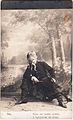
Photograph of a Ukrainian Cossack; postal card, 1913.

"Cosaco Mamai", by Víktor Tsapkó, 2014.

Vitral with a Cossack inside.

Cosaco. Portrait by Serhii Vasylkіvsky.
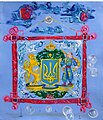
Cosaco with the coat of arms of Ukraine.
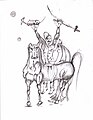
You'll have a Cossack.

You'll have a Cossack.


.
Contenido relacionado
1087
1053
168