
Calculation of water flow in pipes
The calculation of the water flow rate that runs through a set of pipes, which form a network or a circuit, is important to determine the energy needs that will make the water circulate through them under the conditions determined by the project in question.
The set of pipes can belong to networks both in buildings, such as heating or running water, as well as in industry.
Water circulation
In these networks, it is a matter of ensuring that the pipes are capable of carrying a certain flow, at a limited speed (generally to avoid noise due to turbulence), which requires applying a certain amount of energy, in the form of pressure, in the system, pressure that depends on the circulation conditions and the network.
For water to circulate between two points, from an initial point to an end point, there must be a pressure difference between these two points.
This pressure difference must be equal to the energy needed to:
- To overcome the friction due to the roughness of the pipe (linear load loss) and the losses in the road accidents (localized load losses).
- Keep or not the effects of the viscosity of the liquid, regardless of the regime (spin, transitional or turbulent).
- To overcome the difference of heights between the starting point and the highest point of the route (hydrostatic pressure).
To evaluate the necessary energy, the intrinsic physical properties of the fluid in question must be known, as well as a series of characteristics that must be applied to its circulation through the network or circuit, such as:
- Operating regime (laminar regime, transitional regime or turbulent regime)
- Circulating flow rate, volume of water per unit of time (energy by dynamic speed)
- Internal pressure (pressure energy)
- Speed of circulation (kinetic energy)
- Position energy (potential energy)
Basic relationships
The calculation of water flow is expressed by the continuity equation:
- Q=v⋅ ⋅ A{displaystyle Q=vcdot A}

where:
- Q{displaystyle Q} is the flow rate (m3/s)
- v{displaystyle v} is speed (m/s)
- A{displaystyle A} is the area of the cross section of the pipe (m2)


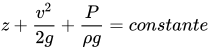
The calculation of flow rates is based on the Bernoulli Principle which, for a liquid flowing in a pipe without friction, is expressed as:
- z+v22g+Pρ ρ g=cornstante{displaystyle z+{frac {v^{2}}{2g}}}+{frac {P}{rho g}}=constant}
where:
- z{displaystyle z} is the position value of the liquid (from its centeride), regarding a coordinate system. It is also known as position height.
- g{displaystyle g} is the value of the acceleration of gravity.
- ρ ρ {displaystyle {rho }} is the value of fluid density.
- P{displaystyle P} is the value of the fluid pressure confined inside the pipe.


- It is important to note that this equation is valid both for absolute pressures (pressure at a fluid point, plus atmospheric pressure), and for relative pressures (only pressure at the fluid point without considering atmospheric pressure). As in the circuits that are usually studied, height differences are relatively low, atmospheric pressure can be considered constant and usually used using relative pressures.
It is appreciated that the three sums are, dimensionally, a length, so the principle is normally expressed stating that, along a current line, the sum of the geometrical height (z{displaystyle z}) the speed height (v22g{displaystyle {frac {v^{2}}{2g}}}}}And the pressure height (Pρ ρ g{displaystyle {frac {P}{rho g}}}}It stays steady.


Considering the friction present in the walls of the pipe when moving the liquid, the equation between two points 1 and 2 can be expressed as:
- z1+v122g+P1ρ ρ g=z2+v222g+P2ρ ρ g+perdidas(1,2){displaystyle z_{1}+{frac {v_{1}{2}}}}{frac {P_{1}}{rho g}=z_{2}+{frac {v_{2}}{2}{2}{2}}}}{2g}}} +{frac {P_{2}{2}{rho g1, }}{2}

or what is the same
- (z1− − z2)+(v12− − v22)2g+(P1− − P2)ρ ρ g=perdidas(1,2){displaystyle (z_{1}-z_{2})+{frac {(v_{1⁄2}{2}-v_{2}{2}})}{2g}}} +{frac {(P_{1}-P_{2}})}{rho g}}}=perdidas(1,2)},

where losses(1,2) is the loss of energy (or height) suffered by the fluid due to friction when flowing between point 1 and point 2. This equation is equally applicable to flow through pipes as well as through canals and rivers.
If L is the distance between points 1 and 2 (measured along the pipeline), then the quotient (losses (1,2)) / L represents the head loss per unit length of the pipeline. This value is called the slope of the power line and is called J.
Experimental Formulas
There are several experimental formulas that relate the slope of the power line to the flow velocity of the fluid. When this is water, perhaps the simplest and most widely used is Manning's formula (For open conduits such as channels or partially filled pipes. Full and pressurized pipes have another method although it maintains the same laws of hydraulics):
- V=1n⋅ ⋅ Rh23⋅ ⋅ J0,5{displaystyle V={frac {1}{n}}cdot R_{h}^{2 over 3}cdot J^{0.5}}}
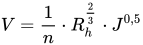
- V{displaystyle V} It's fluid speed.
- n{displaystyle n} is the coefficient of roughness, depending on the pipe material
- Rh{displaystyle R_{h}} is the hydraulic radius of the section (wet area / perimeter = a quarter of the diameter for circular ducts to full section).
- J{displaystyle J} is the slope of driving.


In general, geometric heights are given. In this way, once the conditions at a point are known (for example, in a reservoir the velocity is zero on the surface and the pressure is atmospheric pressure) and the geometry of the conduction, the characteristics of the flow (velocity and pressure) can be deduced. in any other.
, all the localized losses are only a function of speed, being adjusted by means of experimental expressions of the type:
Perdidalorcalizada=K⋅ ⋅ v22g{displaystyle lost located=Kcdot {frac {v^{2}}{2g}}}}} (J) joule.
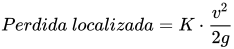
The K coefficients are tabulated in the specialized technical literature, or must be provided by the manufacturers of parts for pipes. In general, if the calculation is carried out without considering the localized losses, the errors made are insignificant for practical purposes. The concept of equivalent length is also often used to calculate localized losses. In this case, a length is calculated from the pipe diameter and the tabulated values for each type of element that can produce a localized loss, which, multiplied by the unit losses J, gives the value of the localized losses.
Contenido relacionado
Addendum:1 E7 s
Preorder Sets Category
(1877) Marsden