
Cajon (percussion)
The cajón is a musical instrument of Peruvian origin, having documented data of its existence in Peru since the middle of the century XIX. The cajón was officially recognized in Peru as "Cultural Heritage of the Nation" in 2001. It is one of the few musical instruments where the artist sits on it and it transmits the rhythm to the body of the cajón player. On November 1, 2014, the Organization of American States declared the Peruvian cajón as an "instrument of Peru for the Americas" and recognized the contribution of Peruvian music to the cultural heritage of the Americas.
At the end of the 20th century, the Peruvian cajón was adopted in Spain to instrumentalize flamenco music, thanks to the work of Paco de Lucía who observed this instrument in Peru in 1977 and considered that the sound it produced resembled the plant and the bailaor's heel, so it seemed appropriate to incorporate it and later it began to be known in Spain as "flamenco cajón".
Features
The instrument is usually built of wooden plates for the sides and upper and lower parts, and for the face where it is struck, a plywood plate is used. The drawers in Peru were made of tornillo, cedar or mahogany wood, and later of mohena and requia. It typically has a height of 47 cm and a base of 33 × 29 cm. The thickness reaches up to 15 mm.
The musician sits astride the cajón, the latter remaining between his knees. The modern cajon has three screws that allow the pitch to be adjusted.
The percussionist can achieve additional sounds by using their palms or fingertips to play the cajon. Many times the tone of the drawer is enriched by adding small metal objects inside. For example, in Spain it usually includes three or four metal strings inside to add resonance.
History
.jpg)
It was created by Africans brought as slaves to Peru from the time of the Viceroyalty and during the first three decades of the republic, until the abolition of slavery at the end of 1854. The use of drums was prohibited by the Church Catholic for considering them pagans in order to avoid distance communication between blacks (talking drums), a type of black song that lamented their slave conditions: every drum found was burned.
Around 1850 the first references to the cajón as a musical instrument appear. Afro-Peruvians are the conjunction of African ethnic groups (Bene, Yoruba, Bantu, Congo, etc.), who came to America as slaves. The Afro-Peruvian populations until the XIX century, were the majority along the entire coast and therefore had a powerful influence on it, until 1890, in that the Afro-Peruvian population begins to decrease.
Being the percussion the main and divine factor of all African music, the black slaves were forced to look for instruments with which they could express themselves. The enslaved Africans soon saw in the wooden crates, used to transport merchandise, a great percussion instrument, thus using them in their sacred rites and in their different artistic manifestations. Given the prohibition issued in the XVII century to use the drum, they used any element to produce sound such as wooden spoons, chairs, tables, alms boxes or the checo (a hollow gourd about 60 centimeters in diameter, with a hole in the back)
There are descriptions of the cajón and its execution in Peru from the middle of the XIX century by Manuel Atanasio Fuentes, Adolphe de Botmilieau, and Max Radiguet, among others. At the beginning of the XX century, the current form of the drawer ("vertical drawer") was imposed on the & #34;horizontal cajón" in Peru and the habit of some executors of sitting on a chair disappeared. And until now it is an important instrument for Peru.
Peruvian Creole Music

Originally, the cajón was used in coastal dances such as the zamacueca and the tondero, dances originating from the central and northern coast of Peru. The use of this instrument was popularized with these dances, not long after the Lima festival of the viceroyalty, called “Fiesta de Amancaes" . This festival was characterized by bringing together all the landowners who breed Paso horses, typical artisans from all regions of Peru and, of course, bohemian musicians from the north and central coasts.
The chroniclers of the time say that in the bars or “chinganas” of Lima in the XVII century, they played a kind of primitive gypsy rhythm similar to flamenco bulería, tapping the knuckles of the fingers against the tables; it included discordant “aguardientosas” voices (pisqueras or clarito) and accompanied by two guitarists.
Years later, entering the XVIII century, the zamacueca was played with palms and making rhythm with the “cajones de la house” or also with “packing boxes” or replacing the primitive jugs made of goatskin. Previously there were several types of drawers to accompany the jaranas. Not long ago, for example, the norteño style was preserved, characterized by being a longer and more drawn-out cajón than the current modern Peruvian cajón.
During the XIX century, harpists were known to play the zamacueca, repeating again as in the bulería, repiques de palma and knuckle on the table of these harps or turning over the guitars. The beating of the harps is very common in the northern zone until today.
Afro-Peruvian music
The black slaves used the boxes in which they transported the merchandise, their now free descendants used the same system, they used everything that gave them that peal, with a rebellious rhythm. The cajoneros obtain different ringing sounds by playing on different sides of the cajon: the tips of the cajon have one sound, the middle part another, the upper edge, and even unpinning one of the upper tips of the cajon produces another sound. In the XIX century, the cajón lacked a defined shape, but Porfirio Vásquez, a black cultivator of Afro-Peruvian music, standardized its current form. Afro-Peruvian rhythms that use the cajón are festejo, aguenieve, panalivio and those sweet-happy sounds that are clearly Afro-Peruvian.
The celebration is the oldest, most African and most representative Afro-Peruvian dance of the black Peruvian people. The traditional celebration is danced in homes, in the streets of the coastal towns, especially in Cañete, Chincha, Pisco, Ica and Nazca, where it is performed only to the rhythm of the cajones, just as the ancient black slaves danced.

The zamacueca is another of the typical Afro-Peruvian dances, which stems from an older dance, called "ombligada" in which sexuality was represented; man and woman danced in clear allusion to fertility. Nicomedes Santa Cruz cites this dance as one of the original sources of the zamacueca, observing similarities with the sexual initiation dances of other countries such as Cuba or Brazil, where the "vacunao" was practiced.
The tondero is a dance that was born from the competition between the indigenous people and the blacks of the north to show who practiced and possessed the most beautiful dance; the natives with their “pava” or the blacks with their “lundero”. The tondero comes from the word lundero, which would have been applied to name those who played or practiced the "lundu" (word of Bantu origin, meaning "successor").
Recognized cajoneros are Francisco Monserrate, Víctor Arciniegas, Carlos "Caitro" Soto (the drawer of Chabuca Granda), Eusebio Cirio "Pititi", Porfirio Vásquez, Alberto Vásquez, Julio "Chocolate" Algendones, Luis "Cotito" Medrano, Reynaldo "Canano" Barrenechea, among others.
Migration to Europe: the flamenco cajón
The international diffusion of the cajón was due to its adoption by Paco de Lucía for flamenco in 1977 after a tour of Latin America that included Peru:
It happened that during a tour of Paco de Lucía in Latin America in 1977, a drawer was reached by the percussionist of the band at a party organized by the Spanish ambassador in Peru. Rubem Dantas incorporated it into the music of the guitarist's sextet that, as a mark (and brand) the pattern, meant incorporating it directly into flamenco music. Manuel Soler was present at the time of the adoption, as he went in the group as a dancer and even “touching a few little bits”. According to an interview given to Flamenco-world.com in 1999, “the drawer was more sober for flamenco” than other percussion instruments that had already been used as congas, bongos or battery.Silvia Calado, « Once upon a time... a new instrument», Flamenco-world.com, 2005.
With the adoption of the Peruvian cajón by the flamenco music community, percussionists emerged one after another who found in the new instrument the quintessence of percussion within contemporary flamenco:
Twenty-five years after Paco de Lucía imported it from Peru, the cajón is now an irreplaceable space in flamenco. The key to such natural integration is that “it is halfway between the palms and the heels.” The instrument was made to the jonda music to the compass that marked Rubem Dantas within the mythical sexteto. The Brazilian percussionist was followed by musicians Antonio Carmona, José Antonio Galicia, Manuel Soler, Tino di Geraldo and Ramón Porrina. And, little by little, a ‘second generation’ of cajoneros is being established, highlighting names such as Piraña, Bandolero, Chaboli, Antonio Coronel, Cepillo, Guillermo McGill... Golpe a hit, the criticized excesses, finding their balance and turning to become the fourth modality of flamenco.Silvia Calado, «Between the palm and the heels», Flamenco-world.com, 2005.
.jpg)
The phrase "flamenco cajón" It was coined then from the generalization of the use of the Peruvian cajón within flamenco, a generalization that exposed it to experiment variations in its construction. Those who use the phrase maintain that the contemporary variations on the Peruvian cajón introduced by flamenco, such as the use of strings inside and the way the acoustic cover is attached to the structure of the box, are sufficient reason to deserve the name. The spread of the phrase "flamenco drawer" or "Spanish drawer" leads to the mistaken assumption of an Iberian origin of this instrument. The use of the strings inside the box precedes the transport of the first drawer to Spain. In the 1950's, in Trujillo and Chiclayo, this variation was made with the cajón to increase its brilliance or response towards the treble, although it was not very well received because some cajón players of the time considered it “cheating”. Afro-Peruvian music ensembles on tour in Europe and Peruvian artists such as Grammy Award-winning singer-songwriter Susana Baca have pointed out that Afro-Peruvian music does not use the "flamenco cajón" but it is exactly the opposite.
Execution variants
Along with normal use, the cajón has experienced several influences on the way it is played over time. With its expansion worldwide, not only percussionists but also drummers have approached the use of this instrument. This has allowed the cajón to be played with other types of drumsticks as well, especially with metal and plastic brushes, the same ones used with drums.
Another way to play it is using a simple drum pedal, transforming the cajón into indirect percussion, this allows it to be used as a true kick drum, but with the limitation of the traditional position. In February 2008, the Italian percussionist Ovidio Venturoso invented and patented a pedal system to play the cajón with the hands and with the pedal, keeping the traditional position unchanged.[citation required]
Gallery

Peruvian cajonero.

Afro-Peruvian cajonero.
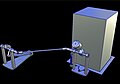
Pedal invented by the Italian Ovid Venturous.

Using a drawer on a battery set.

Street music set (a string duo and a drawer).

Jazz outfit.


Videos
Example of execution.
Peruvian drawer.
Flamenco drawer.
Use of the drawer on rock.
Use of scobillas.
Guinness World Record
Rafael Santa Cruz organized the «II Festival Internacional del Cajón Peruano», where a Guinness Record was broken for the number of cajones playing together. More than 1000 cajon players under the direction of maestro Marco Oliveros, performed his work entitled "La Fiesta del Cajón", in homage to the disappeared cajon players and to the cajón as a musical instrument. This event occurred in Lima on April 11, 2009.
See also
- Rumba drawer - Cuba
- Dome box - Mexico
- Web specializing in flamenco drawers