
Boolean algebra
In mathematics, digital electronics and computing, Boolean algebra, also called Boolean algebra, is an algebraic structure that schematizes logical operations.


History

It is named after George Boole (1815-1864), a self-taught English mathematician who was the first to define it as part of a logical system, initially in a small pamphlet from 1847, The Mathematical Analysis of Logic, published in response to an ongoing controversy between Augustus De Morgan and sir William Rowan Hamilton. Boolean algebra was an attempt to use algebraic techniques to deal with expressions of propositional logic. It was later extended as a larger book: An Investigation of the Laws of Thought on Which are Founded the Mathematical Theories of Logic and Probabilities (also known as An Investigation of the Laws of Thought or simply The Laws of Thought), published in 1854.
The respective interpretations of symbols 0 and 1 in the logic system are Nada and Universo.George Boole
Today, Boolean algebra is widely applied in the field of electronic design. Claude Shannon was the first to apply it in the design of bistable electrical switching circuits, in 1948. This logic can be applied to two fields:
- To analysis, because it is a concrete way to describe how circuits work.
- To design, since having a function the algebra is applied in order to develop a function implementation.
Definition
Given a set B{displaystyle {mathfrak {B}}}} which defines two internal composition laws ,Δ Δ {displaystyle oplusodot}. The structure (B, ,Δ Δ ){displaystyle ({mathfrak {B},oplusodot)}It's a Boole algebra if and only if (B, ,Δ Δ ){displaystyle ({mathfrak {B},oplusodot)}is a Distribution Reticle, and complementary, that is:


- Δ Δ {displaystyle odot } is distributive to {displaystyle oplus }:


- aΔ Δ (b c)=(aΔ Δ b) (aΔ Δ c){displaystyle aodot (boplus c)=(aodot b)oplus (aodot c)}

- {displaystyle oplus } is distributive to Δ Δ {displaystyle odot }
- a (bΔ Δ c)=(a b)Δ Δ (a c){displaystyle aoplus (bodot c)=(aoplus b)odot (aoplus c)}

Based on this definition, the following is determined.
Beginning
Given a set: B{displaystyle {mathfrak {B}}}} formed at least by the elements: ∅ ∅ ,U{displaystyle varnothing;U} which has been defined:

- An internal unit operation, we'll call Complement:
- ♥ ♥:B→ → Ba→ → b= ♥ a{displaystyle {begin{array}{rrcl}sim: fake{mathfrak {B}}}{mathfrak {B}}}{ fake a strangerto &b=sim aend{array}}}}}
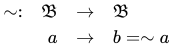
- In this operation we define an application that, to each element a of B, assigns you a b of B.
- Русский Русский a한 한 B:consuming consuming !b한 한 B/b= ♥ a{displaystyle forall ain {mathfrak {B}},:quad exists !bin {mathfrak {B}};/quad b=sim a}

- For every element a in B, it is fulfilled that there is only one b in B, such that b is the complement of a.
- The internal binary operation, we'll call amount:
- :B× × B→ → B(a,b)→ → c=a b{displaystyle {begin{array}{rrcl}oplus: stranger{mathfrak {B}}}times {mathfrak {B}}{to &{mathfrak {B}}}}{mathfrak {B}}}}{pos(a,b) nightmareto > aoplus bend{array}}}}}}}}
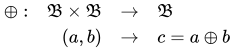
- by which we define an application that, at each ordered pair (a, b) B for B, assigns you a c of B.
- Русский Русский (a,b)한 한 B× × B:consuming consuming !c한 한 B/c=a b{displaystyle forall (a,b)in {mathfrak {B}}times {mathfrak {B},:quad exists !cin {mathfrak {B}};/quad c=aoplus b}

- For all ordered pairs (a, b) in B for B, it is fulfilled that there is only one c in B, such that c is the result of sumar a with b.
- The internal binary operation, we'll call product:
- Δ Δ :B× × B→ → B(a,b)→ → c=aΔ Δ b{displaystyle {begin{array}{rrcl}odot: fake{mathfrak {B}}}}times {mathfrak {B}}{mathfrak {B}}}{mathfrak {B}}{B}}{pos(a,b) pretendto &c=aodot bend{array}}}
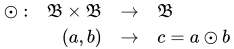
- With what we define an application that, at each ordered pair (a, b) B for B, assigns you a c of B.
- Русский Русский (a,b)한 한 B× × B:consuming consuming !c한 한 B/c=aΔ Δ b{displaystyle forall (a,b)in {mathfrak {B}}times {mathfrak {B},:quad exists !cin {mathfrak {B}};/quad c=aodot b}

- For all ordered pairs (a, b) in B for B, it is fulfilled that there is only one c in B, such that c is the result of the product a and b.
Given the definition of Boolean algebra as a generic algebraic structure, depending on the specific case in question, the symbology and the names of the operations may vary.
Necessary axioms
We will say that this set and operations as defined: (B,♥ ♥ , ,Δ Δ ){displaystyle ({mathfrak {B},simoplusodot)} They're a Boole algebraif you fulfill the following axioms:











Fundamental Theorems
Starting from the five previous axioms, the following fundamental theorems can be deduced and proved:








- 11: Involution Act:
- Русский Русский a한 한 B:♥ ♥ (♥ ♥ a)=a{displaystyle forall ain {mathfrak {B}}:;sim (sim a)=a}

- 12: Supplementary Act:
- ♥ ♥ U=∅ ∅ ,♥ ♥ ∅ ∅ =U{displaystyle sim U=varnothing ;,quad sim varnothing =U}

Order in Boolean algebra
Be: (B,♥ ♥ , ,Δ Δ ){displaystyle ({mathfrak {B},simoplusodot)} an algebra of Boole, be it a, b two elements of the whole, then we can say that a before b and we denote it:
- a b{displaystyle apreceq b}

if any of the following conditions are met:
- a b=b{displaystyle aoplus b=b}
- aΔ Δ b=a{displaystyle aodot b=a}
- ♥ ♥ a b=U{displaystyle sim aoplus b=U}
- aΔ Δ ♥ ♥ b=∅ ∅ {displaystyle aodot sim b=varnothing }


These four conditions are considered equivalent and the fulfillment of one of them necessarily implies the fulfillment of the others. Defining a partially ordered set.
If it is true that:
- a,b한 한 B:a b b aΔ Δ a,b→ → cormparables{displaystyle a,bin {mathfrak {B}};:quad apreceq b;lor ;bpreceq aquad longrightarrow quad a,brightarrow {mathit {comparable}}}}}

For values a, b of B{displaystyle {mathfrak {B}}}}that they fulfill a before bor what b before aIt's said that a and b They are. comparable.
If it is true that:
- a,b한 한 B:a b∧ ∧ b aΔ Δ a,b→ → norcormparables{displaystyle a,bin {mathfrak {B}};:quad anpreceq b;land ;bnpreceq aquad longrightarrow quad a,brightarrow {mathit {no;comparable}}}}

For values a, b of B{displaystyle {mathfrak {B}}}}that they fulfill a does not precede band what b does not precede aIt's said that a and b They are. not comparable.
Principle of duality
The concept of duality allows this fact to be formalized: any logical relationship or law will correspond to its dual, formed by the exchange of the operators amount with the productand U{displaystyle U;} with ∅ ∅ {displaystyle varnothing }.


Addendum Output 1 a ♥ ♥ a=U{displaystyle aoplus sim {a}=U,} aΔ Δ ♥ ♥ a=∅ ∅ {displaystyle aodot sim {a}=varnothing } 2 a ∅ ∅ =a{displaystyle aoplus varnothing =a,} aΔ Δ U=a{displaystyle aodot U=a,} 3 a U=U{displaystyle aoplus U=U,} aΔ Δ ∅ ∅ =∅ ∅ {displaystyle aodot varnothing =varnothing ,} 4 a a=a{displaystyle aoplus a=a,} aΔ Δ a=a{displaystyle aodot a=a,} 5 a b=b a{displaystyle aoplus b=boplus a,} aΔ Δ b=bΔ Δ a{displaystyle aodot b=bodot a,} 6 a (b c)=(a b) c{displaystyle aoplus (boplus c)=(aoplus b)oplus c,} aΔ Δ (bΔ Δ c)=(aΔ Δ b)Δ Δ c{displaystyle aodot (bodot c)=(aodot b)odot co,} 7 a (bΔ Δ c)=(a b)Δ Δ (a c){displaystyle aoplus (bodot c)=(aoplus b)odot (aoplus c,} aΔ Δ (b c)=(aΔ Δ b) (aΔ Δ c){displaystyle aodot (boplus c)=(aodot b)oplus (aodot c,)} 8 a aΔ Δ b=a{displaystyle aoplus aodot b=a,} aΔ Δ (a b)=a{displaystyle aodot (aoplus b)=a,} 9 ♥ ♥ (a b)= ♥ aΔ Δ ♥ ♥ b{displaystyle sim {(aoplus b)}=sim {a}odot sim {b}} ♥ ♥ (aΔ Δ b)= ♥ a ♥ ♥ b{displaystyle sim {(aodot b)}=sim {a}oplus sim {b},}













Other forms of notation for Boolean algebra
In binary Logic, notation is usually used ({0,1!,! ! ,+,⋅ ⋅ ){displaystyle ({0.1},{bar {},+,cdot}}, common in digital technology, being the most common and most comfortable way to represent.
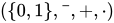
For example, De Morgan's laws are represented like this:
- a+b! ! =a! ! ⋅ ⋅ b! ! {displaystyle {overline {a+b}}={bar {a}}{cdot {bar {b}},}
- a⋅ ⋅ b! ! =a! ! +b! ! {displaystyle {overline {acdot b}}={bar {a}}{bar {b}}{,}
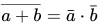
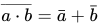
When Boolean algebra is used in electronics, the same denomination is usually used as for the AND (AND), OR (OR) and NOT (NOT) logic gates, sometimes being extended with X-OR (exclusive OR) and its negated NAND (NOT AND), NOR (NOT OR) and X-NOR (equivalence). Variables can be represented by uppercase or lowercase letters, and can take the values {0, 1}.
Using this notation, De Morgan's laws are represented:
- NOTE(aORb)=NOTEaANDNOTEb{displaystyle {mbox{NOT }}(a{mbox{ OR }}b)={mbox{mbox{mbox{ AND }{mbox{mbox{NOT }}b,}
- NOTE(aANDb)=NOTEaORNOTEb{displaystyle {mbox{NOT}}(a{mbox{ AND }}b)={mbox{NOT }{mbox{ OR }{mbox{NOT }b,}


In its application to logic is used notation ∧ ∧ ¬ ¬ {displaystyle land lor lnot } and variables can take the values {F, V}, false or true, equivalent to {0, 1}

With logical notation, De Morgan's laws would look like this:
- ¬ ¬ (a b)=¬ ¬ a∧ ∧ ¬ ¬ b{displaystyle lnot {(alor b)}=lnot {a}land lnot {b}},
- ¬ ¬ (a∧ ∧ b)=¬ ¬ a ¬ ¬ b{displaystyle lnot {(aland b)}=lnot {a}lor lnot {b}},


In the Theory format of sets the Boole Algebra takes the look: (P(U),♥ ♥ , , ){displaystyle ({mathcal {P}}(U),simcupcap)}

In this notation, De Morgan's laws would be as follows:
- ♥ ♥ (a b)=♥ ♥ a ♥ ♥ b{displaystyle sim {(acup b)}=;sim {a};cap sim {b},}
- ♥ ♥ (a b)=♥ ♥ a ♥ ♥ b{displaystyle sim {(acap b)}=;sim {a};cup sim {b},}


Another form in the algebra of sets of Boolean Algebra, De Morgan's laws would be like this:
- (A B)C=AC BC{displaystyle {(Acup B)}^{C}=;{A}^{C}{B}^{C}{C}}
- (A B)C=AC BC{displaystyle {(Acap B)}^{C}=;{A}^{C}{B}^{C}{C}}


From a practical point of view there is a simplified way to represent boolean expressions. Apostrophes (') are used to indicate negation, the operation addition (+) is represented in the normal way in algebra, and for the product no sign is used, the variables are represented, normally with a capital letter, the sequence of two variables indicates the product between them, not a variable named with two letters.
The representation of De Morgan's laws with this system would look like this, with lowercase letters for the variables:
- (a+b)♫=a♫b♫{displaystyle (a+b)'=a'b',}
- (ab)♫=a♫+b♫{displaystyle (ab)'=a'+b',}

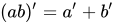
and so on, using capital letters to represent the variables:
- (A+B)♫=A♫B♫{displaystyle (A+B)'=A'B',}
- (AB)♫=A♫+B♫{displaystyle (AB)'=A'+B',}


All these forms of representation are correct, are used in fact, and can be seen by consulting the bibliography. The use of one or another notation does not modify Boolean algebra, only its appearance, and it depends on the branch of mathematics or the technology in which it is being used to use one or another notation.
Algebraic structures that are Boolean algebras
There are numerous cases of different analyzes of algebraic structures that correspond to Boolean algebra, although in appearance they are very different, their structure is the same. We are going to see some of them, with the purpose of making palpable the similarities in the structure and the different fields of application and different terminology to refer to operations or variables.
Binary Logic
A series of topics, apparently so different, has two things in common, the binary logic based on zeros and ones and the algebra of Boole, possibly the best known form of this algebra, which sometimes gives rise to the interpretation that the algebra of Boole is the binary logic exclusively, so the whole B{displaystyle {mathfrak {B}}}} In this case it is formed by two elements {0.1}, or {F, V}, or {no, yes}, two opposing values, which are the two possible alternatives between two possible situations, here, without loss of generality, we will take the set: {0.1} as we have already said:
- B={0,1!{displaystyle {mathfrak {B}}={0,1}}

Where:
- ∅ ∅ =0{displaystyle varnothing =0}
- U=1{displaystyle U=1;}


- The internal unit operation, we'll call denial:
| aa! ! 0110{displaystyle {begin{array}{ccultc}a stranger{bar {a}}{\hline 0 fake11}{array}}}}} |

- ! ! :B→ → Ba→ → b=a! ! {displaystyle {begin{array}{rcl}{bar {}}}: fake{mathfrak {B}}{mathfrak {B}}{mathfrak}{B}}}{ pretenda strangerto &b={bar {a}}{end{array}}}}}}}{
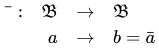
The internal unary operation negation, we define a mapping that to each element a of {0,1}, assigns a b of {0,1}.
- Русский Русский a한 한 B:consuming consuming !b한 한 B/b=a! ! {displaystyle forall ain {mathfrak {B}},:quad exists !bin {mathfrak {B}};/quad b={bar {a}}}}}

For every element a in {0,1}, it is true that there is a unique b in {0,1 }, such that b is the negation of a. As seen in the table.
- The internal binary operation, we'll call amount:
| aba+b111101011000 010111+10{displaystyle {begin{array}{cc ultimateb}a fakeb\\hline 1 fake11 fake11 fake1 fake1 fake1 fake1 pretend0 fake0end{array}}}quad longleftrightarrow quad {begin{array}{ccult11{end}{1}{1}{1{1}{1}{1}{1}{1}{1}{1}{1}{1}{1}{1}{1}{11111111111111}{1}{1}{1}{1}{1}{1}{1}{11}{1}{1}{11}{1}{1}{1}{11111 |
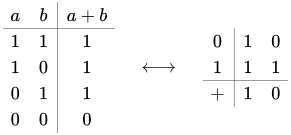
- +:B× × B→ → B(a,b)→ → c=a+b{displaystyle {begin{array}{rrcl}+: stranger{mathfrak {B}}}times {mathfrak {B}}{to &{mathfrak {B}}}{mathfrak {B}}{pos(a,b)}{bend{array}}}}}}}
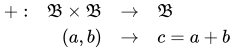
With the addition operation we define a map that, to each ordered pair (a, b) of B by B, it assigns a c of B to it.
- Русский Русский (a,b)한 한 B× × B:consuming consuming !c한 한 B/c=a+b{displaystyle forall (a,b)in {mathfrak {B}}times {mathfrak {B},:quad exists !cin {mathfrak {B}};/quad c=a+b}

For every ordered pair (a,b) in B times B, it is true that there exists a unique c in B, such that c is the result of adding a with b.
- the internal binary operation, which we will call product:
| aba⋅ ⋅ b111100010000 000110⋅ ⋅ 10{displaystyle {begin{array}{cc ultimateb}a fakebcdot b\\hline 1 fake11 fake01 fake0 fake1 fake0 fake1 fake0}{end{array}}}{quad longleftrightarrow quad {begin{array}{array{x1}{x1}{x1}{c(1}{c}{1}{c}{cs}{c}{1}{1}{1}{c}{1}{x1}{1}{1}{c}{1}{1}{x1}{1}{c}{1}{1}{1}{1}{1}{1}{1}{1}{c}{c}{c}{1}{1}{1}{1}{1}{c}{c}{c}{1}{1}{c}{c}{ |
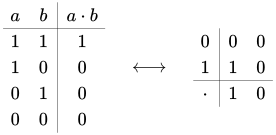
- ⋅ ⋅ :B× × B→ → B(a,b)→ → c=a⋅ ⋅ b{displaystyle {begin{array}{rrcl}cdot: fake{mathfrak {B}}}}times {mathfrak {B}}{mathfrak {B}}}{mathfrak {B}}{B}}{pos(a,b) pretendto &cdot bend{array}}}}}
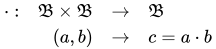
With the product operation we define a map that, to each ordered pair (a, b) of B by B, it assigns a c of B to it.
- Русский Русский (a,b)한 한 B× × B:consuming consuming !c한 한 B/c=a⋅ ⋅ b{displaystyle forall (a,b)in {mathfrak {B}}times {mathfrak {B},:quad exists !cin {mathfrak {B}};/quad c=acdot b}

For every ordered pair (a, b) in B times B, it holds that there exists a unique c in B, such that c is the result of the product a and b. As can be seen in the table.
Axioms
So. ({0,1!,! ! ,+,⋅ ⋅ ){displaystyle ({0.1},{bar {},+,cdot}} It's a Boole algebra following axioms:
- 1st: The associative law of the sum:
- Русский Русский a,b,c한 한 {0,1!:(a+b)+c=a+(b+c){displaystyle forall a,b,cin {0,1}:;(a+b)+c=a+(b+c)}

- 1b: The associative law of the product:
- Русский Русский a,b,c한 한 {0,1!:(a⋅ ⋅ b)⋅ ⋅ c=a⋅ ⋅ (b⋅ ⋅ c){displaystyle forall a,b,cin {0,1}:;(acdot b)cdot c=acdot (bcdot c)}

- 2nd: Existence of the neutral element for the sum:
- Русский Русский a한 한 {0,1!:a+0=a{displaystyle forall ain {0.1}:;a+0=a}

- 2b: Existence of the neutral element for the product:
- Русский Русский a한 한 {0,1!:a⋅ ⋅ 1=a{displaystyle forall ain {0.1}:;acdot 1=a}

- 3a: The commutative law of the sum:
- Русский Русский a,b한 한 {0,1!:a+b=b+a{displaystyle forall a,bin {0.1}:;a+b=b+a}

- 3b: The commutative law of the product:
- Русский Русский a,b한 한 {0,1!:a⋅ ⋅ b=b⋅ ⋅ a{displaystyle forall a,bin {0.1}:;acdot b=bcdot a}

- 4a: Distributive law of the sum for the product:
- Русский Русский a,b,c한 한 {0,1!:a+(b⋅ ⋅ c)=(a+b)⋅ ⋅ (a+c){displaystyle forall a,b,cin {0,1}:;a+(bcdot c)=(a+b)cdot (a+c)}

- 4b: Distributive product law in respect of the sum:
- Русский Русский a,b,c한 한 {0,1!:a⋅ ⋅ (b+c)=(a⋅ ⋅ b)+(a⋅ ⋅ c){displaystyle forall a,b,cin {0,1}:;acdot (b+c)=(acdot b)+(acdot c)}

- 5a: There is a supplementary element for the sum:
- Русский Русский a한 한 {0,1!;consuming consuming a! ! 한 한 {0,1!:a+a! ! =1{displaystyle forall ain {0,1};exists {bar {a}}in {0,1}:;a+{bar {a}}}=1}

- 5b: There is a complementary element for the product:
- Русский Русский a한 한 {0,1!;consuming consuming a! ! 한 한 {0,1!:a⋅ ⋅ a! ! =0{displaystyle forall ain {0,1};exists {bar {a}}in {0,1}:;acdot {bar {a}}}=0}

Later. ({0,1!,! ! ,+,⋅ ⋅ ){displaystyle ({0.1},{bar {},+,cdot}} It's Boole algebra.
Fundamental theorems
Starting from these axioms, the following theorems can be proved:
- 6a: Law of idempotence for the sum:
- Русский Русский a한 한 {0,1!:a+a=a{displaystyle forall ain {0.1}:;a+a=a}

- 6b: idempotency law for the product:
- Русский Русский a한 한 {0,1!:a⋅ ⋅ a=a{displaystyle forall ain {0.1}:;acdot a=a}

- 7a: Law of domination for the sum:
- Русский Русский a한 한 {0,1!:a+1=1{displaystyle forall ain {0.1}:;a+1=1}

- 7b: Law of domination for the product:
- Русский Русский a한 한 {0,1!:a⋅ ⋅ 0=0{displaystyle forall ain {0.1}:;acdot 0=0}

- 8th: Identity Law for the sum:
- Русский Русский a한 한 {0,1!:a+0=a{displaystyle forall ain {0.1}:;a+0=a}
- 8b: Identity Law for the Product:
- Русский Русский a한 한 {0,1!:a⋅ ⋅ 1=a{displaystyle forall ain {0.1}:;acdot 1=a}
- 9a: Absorption Act for the sum
- Русский Русский a,b한 한 {0,1!:a+(a⋅ ⋅ b)=a{displaystyle forall a,bin {0,1}:;a+(acdot b)=a}

- 9b: Product Absorption Act
- Русский Русский a,b한 한 {0,1!:a⋅ ⋅ (a+b)=a{displaystyle forall a,bin {0,1}:;acdot (a+b)=a}

- 10th: Morgan Act for the sum:
- Русский Русский a,b한 한 {0,1!:a+b=a! ! ⋅ ⋅ b! ! ! ! {displaystyle forall a,bin {0,1}:;a+b={overline {{bar {a}}{cdot {bar {b}}}}}}}}}}}

- 10th: De Morgan Act for the product:
- Русский Русский a,b한 한 {0,1!:a⋅ ⋅ b=a! ! +b! ! ! ! {displaystyle forall a,bin {0,1}:;acdot b={overline {{bar {a}}}{bar {b}}}}}}}}}}}

- 11: Involution Act:
- Русский Русский a한 한 {0,1!:a! ! ! ! =a{displaystyle forall ain {0,1}:;{bar {bar {a}}}}=a

- 12: Supplementary Act:
- 1! ! =0{displaystyle {bar {1}}=0}

- 0! ! =1{displaystyle {bar {0}}=1}

Order in Boolean algebra
Starting from ({0,1!,! ! ,+,⋅ ⋅ ){displaystyle ({0.1},{bar {},+,cdot}} Boole algebra, given two binary variables: a, bwhich meet any of these conditions:
- a+b=ba⋅ ⋅ b=aa! ! +b=1a⋅ ⋅ b! ! =0!Δ Δ a≤ ≤ b{displaystyle left.{begin{array}{l}a+b=bacdot b=a{bar {a}}+b=1acdot {bar {b}=0end{array}}}rightlongrightarrow quad aleq b}
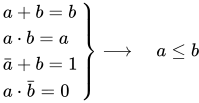
so a is less than or equal to b. Given the binary values 0 and 1, we can see:
- 0+1=1{displaystyle 0+1=1}
- 0⋅ ⋅ 1=0{displaystyle 0cdot 1=0}
- 0! ! +1=1{displaystyle {bar {0}}+1=1}
- 0⋅ ⋅ 1! ! =0{displaystyle 0cdot {bar {1}}=0}


These four conditions are equivalent and the fulfillment of one of them supposes the fulfillment of the others, in this case it is easy to check them all. Then we can say that 0 precedes 1 and denote it:
- 0≤ ≤ 1{displaystyle 0leq 1}

If we also know that 0 and 1 are different values:
- <math alttext="{displaystyle left.{begin{array}{l}0leq 1\0neq 1end{array}}right}longrightarrow quad 00≤ ≤ 10I was. I was. 1!Δ Δ 0.1{displaystyle left.{begin{array}{l}0leq 1neq 1end{array}}}rightlongrightarrow quad 0≤1}<img alt="{displaystyle left.{begin{array}{l}0leq 1\0neq 1end{array}}right}longrightarrow quad 0
The binary value 0 is less than the binary value 1.
Algebra of sets

Given any set U, it's called power set Uto all possible subsets of U and we denote it. P(U){displaystyle {mathcal {P}(U)}}.

As an example we can consider:
- U={a,b,c,d,e,f!{displaystyle U={a,b,c,d,e,f},}

Which has as a power set:
- P(U)={{!,{a!,{b!,...... ,{a,b!,{a,c!,...... ,{a,b,c,d,e!,...... ,U!{displaystyle {mathcal {P}}(U)={Big {}{{},{a},{b},dots{a,b},{a,c},dots{a,b,c,c,d,e},dotsU{Big }}}}}}}}

The empty set is the one that has no elements and is represented:
- {!≡ ≡ ∅ ∅ ≡ ≡ ∅ ∅ {displaystyle {}quad equiv quad emptyset quad equiv quad varnothing }

We can define:
- B=P(U){displaystyle {mathfrak {B}}={mathcal {P}}(U)}

And of course:
- ∅ ∅ =∅ ∅ {displaystyle varnothing =varnothing }
- U=U{displaystyle U=U;}


- The internal unit operation, we'll call Complement:

- C:P(U)→ → P(U)A→ → B=AC{displaystyle {begin{array}{rrcl}{}{}{{{c}: fake{mathcal {P}}(U){mathcal {P}}{mathcal {P}}}{P}{pos(U)}{A faketo &B=A^{C}{end{array}}}}}}}}}}}}}
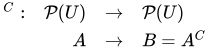
In this operation we define a mapping that, to each element A of P(U), assigns a B of P(U).
- Русский Русский A한 한 P(U):consuming consuming !B한 한 P(U)/B=AC{displaystyle forall Ain {mathcal {P}}(U),:quad exists !Bin {mathcal {P}}(U;/quad B=A^{C}}}}}}

For every element A in P(U), there is a unique B in P(U), such that B is the complement of A.
Defining the complement of a set like this:
- B=ACΔ Δ Русский Русский x한 한 B:x한 한 U∧ ∧ x A{displaystyle B=A^{C}longrightarrow quad forall xin B:quad xin U;land ;xnotin A}

B is the complement of A, if it holds that for every x that belongs to B, x belongs to U and x does not belong to A.
- The first binary operation will be called union:

- :P(U)× × P(U)→ → P(U)(A,B)→ → C=A B{displaystyle {begin{array}{rrcl}cup: stranger{mathcal {P}}(U)times {mathcal {P}}(U) exposeto &{mathcal {P}}}}(U) phrase(A,B) shadowto

With this inner binary operation we define a map that, to each ordered pair (A, B) of P(U) by P(U), assigns it a C of P(U).
- Русский Русский (A,B)한 한 P(U)× × P(U):consuming consuming !C한 한 P(U)/C=A B{displaystyle forall (A,B)in {mathcal {P}}(U)times {mathcal {P}(U),:quad exists !Cin {mathcal {P}}(U);/quad C=AcupB}

For every ordered pair (A,B) in P(U) by P(U), it is satisfied that there exists a unique C in P(U), such that C is the union A and B.
Defining the union of two sets as:
- C=A BΔ Δ Русский Русский x한 한 C:x한 한 A x한 한 B{displaystyle C=Acup Blongrightarrow quad forall xin C:quad xin A;lor ;xin B}

The set C is the union of A and B, if for every element x of C, it is true that x is an element of A or B
- The second binary operation will be called. intersection:

- :P(U)× × P(U)→ → P(U)(A,B)→ → C=A B{displaystyle {begin{array}{rrcl}cap: stranger{mathcal {P}}(U)times {mathcal {P}}(U) exposeto &{mathcal {P}}}}(U) phrase(A,B){Acap Bend{array}}}}}

With which we define a map that, to each ordered pair (A, B) of P(U) by P(U), assigns a C of P(U) to it.
- Русский Русский (A,B)한 한 P(U)× × P(U):consuming consuming !C한 한 P(U)/C=A B{displaystyle forall (A,B)in {mathcal {P}}(U)times {mathcal {P}(U),:quad exists !Cin {mathcal {P}}(U);/quad C=Acap B}

For every ordered pair (A,B) in P(U) by P(U), it is true that there exists a unique C in P(U), such that C is the intersection A and B.
Defining the intersection of two sets as:
- C=A BΔ Δ Русский Русский x한 한 C:x한 한 A∧ ∧ x한 한 B{displaystyle C=Acap Blongrightarrow quad forall xin C:quad xin A;land ;xin B}

The set C is the intersection of A and B, if for every element x of C, it is true that x is an element of A and B.
Axioms
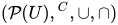
With what we can say: (P(U),C, , ){displaystyle ({mathcal {P}}(U),{}^{C},cupcap)}For a U known as Boole algebra if you fulfill the following axioms:
- 1st: The Associative Law of the Union:
- Русский Русский A,B,C한 한 P(U):(A B) C=A (B C){displaystyle forall A,B,Cin {mathcal {P}}(U):;(Acup B)cup C=Acup (Bcup C)}

- 1b: The Associative Law of Intersection:
- Русский Русский A,B,C한 한 P(U):(A B) C=A (B C){displaystyle forall A,B,Cin {mathcal {P}}(U):;(Acap B)cap C=Acap (Bcap C)}

- 2nd: Existence of the neutral element for the union:
- Русский Русский A한 한 P(U):A ∅ ∅ =A{displaystyle forall Ain {mathcal {P}}(U):;Acup varnothing = A}

- 2b: Existence of the neutral element for intersection:
- Русский Русский A한 한 P(U):A U=A{displaystyle forall Ain {mathcal {P}}(U):;Acap U=A}

- 3a: The commutative law of union:
- Русский Русский A,B한 한 P(U):A B=B A{displaystyle forall A,Bin {mathcal {P}(U):;Acup B=Bcup A}

- 3b: The commutative law of intersection:
- Русский Русский A,B한 한 P(U):A B=B A{displaystyle forall A,Bin {mathcal {P}(U):;Acap B=Bcap A}

- 4a: Distributive Law of the Union regarding intersection:
- Русский Русский A,B,C한 한 P(U):A (B C)=(A B) (A C){displaystyle forall A,B,Cin {mathcal {P}}(U):;Acup (Bcap C)=(Acup B)cap (Acup C)}}

- 4b: Distributive law of intersection with respect to union:
- Русский Русский A,B,C한 한 P(U):A (B C)=(A B) (A C){displaystyle forall A,B,Cin {mathcal {P}}(U):;Acap (Bcup C)=(Acap B)cup (Acap C)}}

- 5a: There is a complementary element for the union:
- Русский Русский A한 한 P(U);consuming consuming AC한 한 P(U):A AC=U{displaystyle forall Ain {mathcal {P}}(U);exists A^{C}in {mathcal {P}(U):;Acup A^{C}=U}

- 5b: There is a complementary element for intersection:
- Русский Русский A한 한 P(U);consuming consuming AC한 한 P(U):A AC=∅ ∅ {displaystyle forall Ain {mathcal {P}}(U);exists A^{C}in {mathcal {P}(U):;Acap A^{C}=varnothing }

Concluding that (P(U),C, , ){displaystyle ({mathcal {P}}(U),{}^{C},cupcap)} It's a boole algebra.
Fundamental theorems
Starting from these axioms, the following theorems can be proved:
- 6a: Law of idempotence for union:
- Русский Русский A한 한 P(U):A A=A{displaystyle forall Ain {mathcal {P}}(U):;Acup A=A}

- 6b: idempotence law for intersection:
- Русский Русский A한 한 P(U):A A=A{displaystyle forall Ain {mathcal {P}}(U):;Acap A=A}

- 7a: Law of domination for union:
- Русский Русский A한 한 P(U):A U=U{displaystyle forall Ain {mathcal {P}}(U):

- 7b: Law of domination for intersection:
- Русский Русский A한 한 P(U):A ∅ ∅ =∅ ∅ {displaystyle forall Ain {mathcal {P}}(U):;Acap varnothing =varnothing }

- 8th: Identity Law for Union:
- Русский Русский A한 한 P(U):A ∅ ∅ =A{displaystyle forall Ain {mathcal {P}}(U):;Acup varnothing = A}
- 8b: Identity Law for Intersection:
- Русский Русский A한 한 P(U):A U=A{displaystyle forall Ain {mathcal {P}}(U):;Acap U=A}
- 9a: Law of absorption for union:
- Русский Русский A,B한 한 P(U):A (A B)=A{displaystyle forall A,Bin {mathcal {P}(U):;Acup (Acap B)=A}

- 9a: Law of absorption for intersection:
- Русский Русский A,B한 한 P(U):A (A B)=A{displaystyle forall A,Bin {mathcal {P}(U):;Acap (Acup B)=A}

- 10th: Law of De Morgan for union:
- Русский Русский A,B한 한 P(U):A B=(AC BC)C{displaystyle forall A,Bin {mathcal {P}}(U):;Acup B={({A}^{C}cap {B}^{C}}}}{C}}}}

- 10b: Morgan's Law for Inerstion:
- Русский Русский a,b한 한 P(U):A B=(AC BC)C{displaystyle forall a,bin {mathcal {P}(U):;Acap B={({A}^{C}cup {B}^{C}}}{C}}}}{C}}}}

- 11: Involution Act:
- Русский Русский A한 한 P(U):ACC=A{displaystyle forall Ain {mathcal {P}}(U):;{{{A}^{C}}{C}{C}=A}

- 12: Supplementary Act:
- UC=∅ ∅ {displaystyle {U}^{C}=varnothing }

- ∅ ∅ C=U{displaystyle {varnothing }^{C}=U}

Order in Boolean algebra
Done (P(U),C, , ){displaystyle ({mathcal {P}}(U),{}^{C},cupcap)} Boole algebra, we can check:
- A B=B{displaystyle Acup B=B}
- A B=A{displaystyle Acap B=A}
- AC B=U{displaystyle {A}^{C}cup B=U}
- A BC=∅ ∅ {displaystyle Acap {B}^{C}=varnothing }


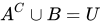

For the sets A and B that satisfy these properties, we can say that A precedes B, that in the case of sets we would say A is equal to or a subset of B and we denote it:
- A B{displaystyle Asubseq B}

Understanding that A is equal to or a subset of B when:

- A BΔ Δ Русский Русский x한 한 A:x한 한 B{displaystyle Asubseq Blongrightarrow quad forall xin A:;xin B}

The set A is equal to or a subset of B, if for every element x belonging to A, x belongs to B.
You can also check:
- Русский Русский B한 한 P(U):B U=UB U=BBC U=UB UC=∅ ∅ Δ Δ B U{displaystyle forall Bin {mathcal {P}}(U):;{begin{array}{cultl}Bcup U=UBcap U=B{B}{B}{B}{C}{C}cup U=UBcap {U}{U^varnothing end{array}

For all B of the parts of U, if it is fulfilled that: the union of B and U is U, the intersection of B and U is B, the union of the complement of B and U is U, the intersection of B and the complement of U is the empty set, then B is equal to or a subset of U.
This conclusion is part of the definition of the parts of U, but it can be reached by fulfilling one of the four conditions exposed, as already mentioned, the four conditions are equivalent and the fulfillment of one of them implies the fulfillment of the others.
Applying the same reasoning we can see:
- Русский Русский A한 한 P(U):∅ ∅ A=A∅ ∅ A=∅ ∅ ∅ ∅ C A=U∅ ∅ AC=∅ ∅ Δ Δ ∅ ∅ A{displaystyle forall Ain {mathcal {P}}(U):;{begin{array}{begin{array}{varnothing cup A=Avarnothing cap A=varnothing \{varnothing ^}{C}{C}{Uvarnothingvarnothing end}{A end}{ A
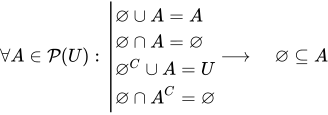
Being A a set of the parts of U, concluding that the empty set is equal to or a subset of A.
Propositional Logic
A proposition, or a predicate, is a truth value that can be expressed verbally or with mathematical or logical expressions or relationships, for example:
- 'Today is Wednesday.'
- 'The building is high.'
- 'The dog is barking.'
They are verbally expressed propositions, and so are:
- 'x = 3'
- 'mcd(a, b) = 2n + 1'
Since each of them can be true or false, propositions are often designated by letters:
- p= rain
- ♪ It's raining a lot ♪
- R= 'I've got umbrellas'
- S= 'The street is wet.'
Statements true and false are also propositions, we will designate with: B{displaystyle {mathfrak {B}}}} to the set of propositions, in order to see that the logic of propositions is an algebra of Boole, we will also consider:
- ∅ ∅ Δ Δ =F=falsor{displaystyle varnothing longrightarrow quad bot =F=falso}
- UΔ Δ =V=verdaderor{displaystyle Ulongrightarrow quad top =V=true}


- The internal operation, which we shall call negation:
- ¬ ¬ :B→ → Ba→ → b=¬ ¬ a{displaystyle {begin{array}{rrcl}lnot: fake{mathfrak {B}}}{mathfrak {B}}}{ fake a strangerto &b=lnot aend{array}}}}}

The internal unary operation negation, we define an application that to each proposition a, assigns another proposition b.
- Русский Русский a한 한 B:consuming consuming !b한 한 B/b=¬ ¬ a{displaystyle forall ain {mathfrak {B}},:quad exists !bin {mathfrak {B}};/quad b=lnot {a}}

For every proposition a, it is true that there exists a unique proposition b, such that b is the negation of a.
- The first internal binary operation, which we will call disjunction:
- :B× × B→ → B(a,b)→ → c=a b{displaystyle {begin{array}{rrcl}lor: stranger{mathfrak {B}}}times {mathfrak {B}}}{mathfrak {B}}}}{mathfrak {B}}{pos(a,b)}{black phraseto &c=alor bend{array}}}}}}}}}}}}}}}}
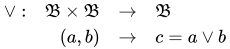
With the disjunction operation, we define a mapping that to each ordered pair (a, b) of B by B, it assigns a c of B to it.
- Русский Русский (a,b)한 한 B× × B:consuming consuming !c한 한 B/c=a b{displaystyle forall (a,b)in {mathfrak {B}}times {mathfrak {B},:quad exists !cin {mathfrak {B}};/quad c=alor b}

For every ordered pair (a,b) in B times B, it is true that there exists a unique c in B, such that c is the result of the disjunction of a and b.
- The second internal binary operation, which we will call conjunction:
- ∧ ∧ :B× × B→ → B(a,b)→ → c=a∧ ∧ b{displaystyle {begin{array}{rrcl}land: fake{mathfrak {B}}}times {mathfrak {B}}}{mathfrak {B}}}}{mathfrak {B}}{pos(a,b) nightmareto &c=aland bend{array}}}}}}}}}}}}}
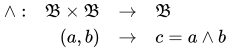
With the conjunction operation we define a map that, to each ordered pair (a, b) of B by B, it assigns a c of B to it.
- Русский Русский (a,b)한 한 B× × B:consuming consuming !c한 한 B/c=a∧ ∧ b{displaystyle forall (a,b)in {mathfrak {B}}times {mathfrak {B},:quad exists !cin {mathfrak {B}};/quad c=aland b}

For every ordered pair (a, b) in B times B, it holds that there exists a unique c in B, such that c is the result of the conjunction of a and b.
Axioms
So. (B,¬ ¬ , ,∧ ∧ ){displaystyle ({mathfrak {B}},lnot {},lorland}} It's a Boole algebra the following axioms:

- 1st: Associative Law of Disjunction:
- Русский Русский a,b,c한 한 B:(a b) c=a (b c){displaystyle forall a,b,cin {mathfrak {B}}:;(alor b)lor c=alor (blor c)}

- 1b: The association law of the conjunction:
- Русский Русский a,b,c한 한 B:(a∧ ∧ b)∧ ∧ c=a∧ ∧ (b∧ ∧ c){displaystyle forall a,b,cin {mathfrak {B}}:;(aland b)land c=aland (bland c)}

- 2nd: Existence of the neutral element for disjunction:
- Русский Русский a한 한 B:a F=a{displaystyle forall ain {mathfrak {B}}:;alor F=a}

- 2b: Existence of the neutral element for the conjunction:
- Русский Русский a한 한 B:a∧ ∧ V=a{displaystyle forall ain {mathfrak {B}}:;aland V=a}

- 3a: The commutative law of disjunction:
- Русский Русский a,b한 한 B:a b=b a{displaystyle forall a,bin {mathfrak {B}}:;alor b=blor a}

- 3b: The commutative law of the conjunction:
- Русский Русский a,b한 한 B:a∧ ∧ b=b∧ ∧ a{displaystyle forall a,bin {mathfrak {B}}:;aland b=bland a}

- 4a: Disjunction Distributive Act for the conjunction:
- Русский Русский a,b,c한 한 B:a (b∧ ∧ c)=(a b)∧ ∧ (a c){displaystyle forall a,b,cin {mathfrak {B}}:;alor (bland c)=(alor b)land (alor c)}

- 4b: Distributive law of the conjunction with respect to disjunction:
- Русский Русский a,b,c한 한 B:a∧ ∧ (b c)=(a∧ ∧ b) (a∧ ∧ c){displaystyle forall a,b,cin {mathfrak {B}}:;aland (blor c)=(aland b)lor (aland c)}

- 5a: There is a complementary element for disjunction:
- Русский Русский a한 한 B;consuming consuming ¬ ¬ a한 한 B:a ¬ ¬ a=V{displaystyle forall ain {mathfrak {B}};exists lnot {a}in {mathfrak {B}}:;alor lnot {a}=V}

- 5b: There is a complementary element for the conjunction:
- Русский Русский a한 한 B;consuming consuming ¬ ¬ a한 한 B:a∧ ∧ ¬ ¬ a=F{displaystyle forall ain {mathfrak {B}};exists lnot {a}in {mathfrak {B}}:;aland lnot {a}=F}

Later. (B,¬ ¬ , ,∧ ∧ ){displaystyle ({mathfrak {B}},lnot {},lorland}} It's boole algebra.
Fundamental theorems
Starting from these axioms, the following theorems can be proved:
- 6a: Law of idempotence for disjunction:
- Русский Русский a한 한 B:a a=a{displaystyle forall ain {mathfrak {B}}:

- 6b: Law of idempotence for conjunction:
- Русский Русский a한 한 B:a∧ ∧ a=a{displaystyle forall ain {mathfrak {B}}:;aland a=a}

- 7a: Law on Domination for Disjunction:
- Русский Русский a한 한 B:a V=V{displaystyle forall ain {mathfrak {B}}:;alor V=V}

- 7b: Law of domination for conjunction:
- Русский Русский a한 한 B:a∧ ∧ F=F{displaystyle forall ain {mathfrak {B}}:;aland F=F}

- 8a: Identity Law for Disjunction:
- Русский Русский a한 한 B:a F=a{displaystyle forall ain {mathfrak {B}}:;alor F=a}
- 8b: Identity Law for conjunction:
- Русский Русский a한 한 B:a∧ ∧ V=a{displaystyle forall ain {mathfrak {B}}:;aland V=a}
- 9a: Absorption Act for Disjunction:
- Русский Русский a,b한 한 B:a (a∧ ∧ b)=a{displaystyle forall a,bin {mathfrak {B}}:;alor (aland b)=a}

- 9b: Absorption Act for conjunction:
- Русский Русский a,b한 한 B:a∧ ∧ (a b)=a{displaystyle forall a,bin {mathfrak {B}}:;aland (alor b)=a}

- 10th: Morgan Act for Disjunction:
- Русский Русский a,b한 한 B:a b=¬ ¬ (¬ ¬ a∧ ∧ ¬ ¬ b){displaystyle forall a,bin {mathfrak {B}}:;alor b=lnot {(lnot {a}land lnot {b}}}}}}}}}}}}

- 10b: Morgan Act for conjunction:
- Русский Русский a,b한 한 B:a∧ ∧ b=¬ ¬ (¬ ¬ a ¬ ¬ b){displaystyle forall a,bin {mathfrak {B}}:;aland b=lnot ({lnot {a}lor lnot {b}}}}}}}}}}}

- 11: Involution Act:
- Русский Русский a한 한 B:¬ ¬ ¬ ¬ a=a{displaystyle forall ain {mathfrak {B}}:;lnot lnot a=a}

- 12: Supplementary Act:
- ¬ ¬ V=F{displaystyle lnot V=F}

- ¬ ¬ F=V{displaystyle lnot F=V}

Order in Boolean algebra
Knowing that (B,¬ ¬ , ,∧ ∧ ){displaystyle ({mathfrak {B}},lnot {},lorland}} it's Boole algebra, you can check that:
- a b=b{displaystyle alor b=b}
- a∧ ∧ b=a{displaystyle aland b=a}
- ¬ ¬ a b=V{displaystyle lnot alor b=V}
- a∧ ∧ ¬ ¬ b=F{displaystyle aland lnot b=F}


For the propositions: a, b that meet any of these conditions, it can be said that a precedes b. That in the case of propositions or predicates it is said that a is as strong or stronger than b, or that b is weaker than a, and we represent it:
- a b{displaystyle apreccurlyeq b}

So for example given the propositions:
- A It rains a lot
- b= Rain
we can see:
- a b=b{displaystyle alor b=b}
- Yes: It's raining. or ♪ then. ♪.
If either of the two circumstances occurs, it rains a lot or it rains, clearly it rains in either case.
- a∧ ∧ b=a{displaystyle aland b=a}
- Yes: It's raining. and ♪ then. It's raining..
If we affirm that it rains a lot and that it rains, and both circumstances are met, then it rains a lot.
- ¬ ¬ a b=V{displaystyle lnot alor b=V}
- Yes: No. It's raining. or ♪ That's it. true.
It does not rain a lot indicates that it may rain a little or not at all, if it does not rain a lot or rain it covers all the possibilities, from dry to very rainy weather, then the statement is true in any case.
- a∧ ∧ ¬ ¬ b=F{displaystyle aland lnot b=F}
- Yes: It's raining. and No. ♪ That's it. false.
If we affirm that it rains a lot and simultaneously that it rains, the affirmation is clearly false.
The most restrictive statement is the strongest and the least restrictive is the weakest, in this case:
- lluevemuchor llueve{displaystyle llueve;muchopreccurlyeq llueve}

The proposition it rains a lot is as strong or stronger than it rains, the statement it rains a lot is a particular case or the same case of it's raining.
Operations in Boolean algebra
Boolean algebra is based on a set in which three internal operations have been defined: one unary and two binary, as we have already seen, this definition being comfortable. Strictly speaking, only two are necessary, the unary and one of the binary, so, for example, in binary logic with the negation and the product we can define the sum.
 |  |  |  |
 | |  | |
|  |  | |
 |  |  |  |
| |  | |
With De Morgan's law:
- Русский Русский a,b한 한 {0,1!:a+b! ! =a! ! ⋅ ⋅ b! ! Δ Δ a+b=a! ! ⋅ ⋅ b! ! ! ! {displaystyle forall a,bin {0,1}:;{overline {a+b}}}={bar {a}}{cdot {bar {b}}longrightarrow quad a+b={overline {{{bar {a}}}{cdot {bar {b}}}}}}}}}

This expression is more complex, but starting from the binary negation and the binary product, the binary sum is defined.
In the image on the right we can see a parallel circuit of two buttons a and b, which corresponds to the binary sum of a and b, and their series-circuit equivalent of a and b, both give the same truth table, and therefore they are equivalent, the artifice of the series circuit to obtain the same result as in a parallel circuit shows how convenient it is to consider this function, the possibility of obtaining the sum of two binary variables through the negation and the product indicate that, in such a way primary, Boolean algebra is based on only two operations, and that any expression involving addition can be transformed into an equivalent expression involving only negation and product.
In the case of set theory with the complement and the intersection we can define the union:
- (A B)C=AC BCΔ Δ A B=(AC BC)C{displaystyle {(Acup B)}^{C}={A}{A}^{C}cap {B}{C}{C}{longrightarrow quad Acup B={({A}^{C}cap {B}}}}}

In a similar way to binary algebra, or any other Boolean algebra, the definition of the algebra with only two operations complicates the expressions, but allows us to determine some very useful relationships, as well as various other operations.
In the Boole algebra defined in a set B{displaystyle {mathfrak {B}}}} operations are internal, as part of element B{displaystyle {mathfrak {B}}}}to get a result in B{displaystyle {mathfrak {B}}}}.
Without loss of generality, and given the different forms that Boolean algebra can take, we will consider propositional logic with the propositions: a, c, b etc. Which can take the values true: V or false: F. And the logical connectives over those propositions that result in other logical propositions, each proposition: a, b, c, etc. Defines an array A, B, C, etc. That we can represent graphically in a Venn diagram.
We can see these logical connectives for: 0, 1 and 2 variables in a Hasse diagram:
Operations by the number of arguments
If we see the different operations by their number of arguments we can distinguish:


No arguments
The logical operations without arguments are:
Nullary operation Positive Negative {displaystyle top } Tautology {displaystyle bot } Contradiction


With one argument
Operations with only one argument are:
Unit operation Positive Negative a{displaystyle a,} Logical assertion ¬ ¬ a{displaystyle neg a} Logical denial


With two arguments
Operations that need two arguments are:
Binarian operation Positive Negative a b{displaystyle alor b} Logical disjunction a↓ ↓ b{displaystyle adownarrow b} Opposition a∧ ∧ b{displaystyle aland b} Logical conjunction a↑ ↑ b{displaystyle auparrow b} Opposite conjunction a→ → b{displaystyle ato b} Logical involvement a b{displaystyle anot rightarrow b} Logical attachment a← ← b{displaystyle aleftarrow b} Opposite implication a b{displaystyle anot leftarrow b} Opposite attachment a▪ ▪ b{displaystyle aleftrightarrow b} Biconditional a b{displaystyle anot leftrightarrow b} Exclusive disjunction


Null operations
A unitary operation is the one that returns a value without the need for arguments, we can see tautology and contradiction.| V{displaystyle {begin{array}{bout}{bout}}{hline >hline > } |  |

The tautology presents the true value without the need for arguments or regardless of the variables on which it is calculated. In set theory it corresponds to the universal set.
In propositional logic it corresponds to the value: true:
- :∅ ∅ Δ Δ U()Δ Δ a= ()≡ ≡ a=V{displaystyle {begin{array}{ccll}top: strangervarnothing &longrightarrow &mathbb {U} \ fake() alienlongrightarrow &a=top ()equiv a=Vend{array}}}}}}}

In a switching circuit it corresponds to a fixed connection or closed bridge.
 |
 |
| F{displaystyle {begin{array}{bHFFFFFF}{hline >hline hline > } |  |

The contradiction, on the other hand, always presents the value false, without needing arguments or independently of the arguments presented. In set theory it corresponds to the empty set.
In propositional logic it corresponds to the value: false:
- :∅ ∅ Δ Δ U()Δ Δ a= ()≡ ≡ a=F{displaystyle {begin{array}{ccll}bot: strangervarnothing &longrightarrow &mathbb {U} \ fake() alienlongrightarrow &a=bot ()equiv a=Fend{array}}}}}}}

In a switching circuit, it corresponds to no connection or open jumper.
 |
 |
Unary Operations
A unary operation is one that only needs one argument to present a result, we can see two unary operations: identity and negation.
| aaVVFF{displaystyle {begin{array}{bHFFFFFF}{cHFFFF}{hline a fakea\hline V fakeVF\\hline end{array}}}}}}}} |  |

The identity operation of an assertion returns the value of the variable.
- id:UΔ Δ UaΔ Δ b=id(a)≡ ≡ b=a{displaystyle {begin{array}{ccll}id: strangermathbb {U} 'longrightarrow &mathbb {U}mathbb {U} \longrightarrow &b=id(a)equiv b=aend{array}}}}}}}

This operation can be done with the buffer amplifier electronic device.
 |
In a commutation circuit it corresponds to a normally open switch: NO switch.
 |
| a¬ ¬ aVFFV{displaystyle {begin{array}{bHFFFFFF}{hline a fakelnot a\hline hline V fakeF\F blindV\hline end{array}}}}}}} | |

The logical negation operation of a variable presents the opposite value of the argument, or the opposite cases of those included in the argument.
- ¬ ¬ :UΔ Δ UaΔ Δ b=¬ ¬ (a)≡ ≡ b=¬ ¬ a{displaystyle {begin{array}{ccll}lnot: strangermathbb {U} 'longrightarrow &mathbb {U} \ aliena strangerlongrightarrow &b=lnot (a)equiv b=lnot aend{array}}}}}}}

This operation is done with the NOT Gate.
 |
In a commutation circuit it corresponds to a normally closed switch: NC switch.
 |
Binary operations
The binary operation is the one that needs two arguments, in fact it is the most generalized form of operation, normally when we refer to operations, we refer to binary operations, in Boolean algebra we can see the following binary operations:
| aba bVVVVFVFVVFFF{displaystyle {begin{array}{ age}{ age}{bsp}{bsp}{bsp}{bsp}{bsp}{bsp}{bsp}{v}{v}}{fline a fake b\\hline hline V pretendVb\bspf}}}}}}}}} | |
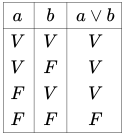
- The Logical Disjunction accepts two arguments presenting as a true result if one or another of the arguments is true.
Disjunction can be expressed:
- a b=¬ ¬ (¬ ¬ a∧ ∧ ¬ ¬ b){displaystyle alor b;=lnot (lnot aland lnot b)}

The logical disjunction operation of propositions is equivalent to the union of sets in set theory, to the logical OR gate:
 |
and to the parallel circuit in switching circuits
 |
| aba↓ ↓ bVVFVFFFVFFFV{displaystyle {begin{array}{ age}{ age}{bsp}{bsp}{bsp}{bspr}{bsp}{bsp}{bsp}{bsp}}{bspbspbspbbspbspbbspbbbspbspbspbbspbbbbbbbbbbspbbbbbbbspbbbbbspbbbspbbbbbbbbbbbbbbbbbbbbbbbbbbbbbbbbbbbbbbbbbbbbbbbbbb |  |

- The opposite Disjunction presents true result only when its two arguments are false. This operation is the denial of disjunction.
- a↓ ↓ b=¬ ¬ (a b)=¬ ¬ a∧ ∧ ¬ ¬ b{displaystyle adownarrow b;=;lnot (alor b);=;lnot aland lnot b}

The joint negation of propositions is equivalent to the logical NOR gate.
 |
 |
| aba∧ ∧ bVVVVFFFVFFFF{displaystyle {begin{array}{ age}{ ages}{bsp}{bsp}{bsp}{bsp}{bsp}{bsp}{bsp}{v}{v}{fbs}{fn}{fline a hip b\\hline }{hline }}}}}}}}{end{end{ar | |
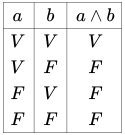
- The logical conjunction presents true results only when its two arguments are true.
- ∧ ∧ :U× × UΔ Δ U(a,b)Δ Δ c=∧ ∧ (a,b)≡ ≡ c=a∧ ∧ b{displaystyle {begin{array}{ccll}land: strangermathbb {Utimes mathbb {U} 'longrightarrow &mathbb {U} \mathbb {U} \longrightarrow &c=land (a,b)equiv c=aland bend{array}}}}}}}}}

Usually represented:
- a∧ ∧ b{displaystyle aland b}
The logical conjunction of propositions is equivalent to the intersection of sets in set theory, or the logical AND gate:
 |
in switching circuits it would be a series circuit of switches.
 |
| aba↑ ↑ bVVFVFVFVVFFV{displaystyle {begin{array}{ age}{ ages}{bsp}{bsprrow buparrow bhline hline V sterV }{V }{V }{F}{F}{F}{F}{F}{F}{F}{F}{F}{F}{F}{F}{F}{F}{F}{F}{F}{F}{F}{F}{F}}{bsp}{bsp}{bsp}}}{bsp}{bsp}}}{bsp}}}{best} |  |
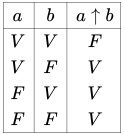
- The opposite conjunction presents true results in all cases except when their two arguments are true. This operation is the denial of the conjunction.
- a↑ ↑ b=¬ ¬ (a∧ ∧ b)=¬ ¬ a ¬ ¬ b{displaystyle auparrow b;=;lnot (aland b);=;lnot alor lnot b}

The logical conjunction of statements is equivalent to the NAND logic gate.
 |
 |
| aba→ → bVVVVFFFVVFFV{displaystyle {begin{array}{ age}{bsp}{bsp}{bsp}{bsp}{bsp}{bsp}{bsp}{v}{vv}}{fbs}{hline a hip b\b\\hline }{bspbspf}}}}}}}}}}{fb-b-b-b-b-b-b-b-b-b-b-b-b-b-b-b-b-b-b-b-b-b-b-b-b-b-b-b-b-b-b-b-b-b-b-b-b-b-b-b-b-b-b-b-b-b-b-b-b-b-b-b-b-b-b-b-b-b-b-b-b-b-b-b-b-b-b-b-b-b-b-b-b-b- |  |
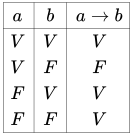
- Logical Implication presents a false result if the first argument is true and the second false, in the rest of the cases presents true result, this operation is not commutative and can be expressed:
- a→ → b=¬ ¬ a b=(a∧ ∧ b) ¬ ¬ a{displaystyle ato b;=;lnot alor b;=;(aland b)lor lnot a}

This operation is also called implication: a implies b:
- Yeah. a It's true. b It's true.
- Yeah. a It's fake and b It's true, involvement is false.
- Yeah. a is false, implication is true independently the value of b.
This operation corresponds to a set of complex logic gates:
 |
 |
 |
| aba bVVFVFVFVFFFF{displaystyle {begin{array}{ age}{ age}{bsp}{brightarrow b\hline hline V }{bsp}{bsp}{v}{v}{v}{f}{fnrightarrow b\hline }{hline }{end{array}}}}}}}}}}} |  |
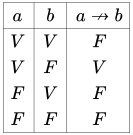
- The logical Attachment presents true result if the first argument is true and the second false, in the rest of the cases presents false result, this operation is not commutative and is the denial of the material conditional, also called a and b difference, can be expressed:
- a b=¬ ¬ (a→ → b)=a∧ ∧ ¬ ¬ b=a− − b{displaystyle anrightarrow b;=;lnot (ato b);=;aland lnot b;=;a-b}

This operation corresponds to a set of complex logic gates:
 |
 |
| aba← ← bVVVVFVFVFFFV{displaystyle {begin{array}{intexcluding)}{hline a fake bleftarrow b\hline hline V fakeVV\V exposeV\F fakeVF supposedVFF supposedF supposedF V\\\pos(hline end{array}}}}}}} |  |
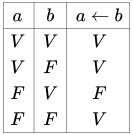
- The opposite Implication is the operation that presents false result if the first argument is false and the second true, in the rest of the cases presents true result, this operation is not commutative and is the result of permuting a and b on conditional material, can be expressed:
- a← ← b=a ¬ ¬ b{displaystyle aleftarrow b;=;alor lnot b}

This operation corresponds to a set of complex logic gates:
 |
 |
| aba bVVFVFFFVVFFF{displaystyle {begin{array}{ age}{bsp}{bspr}{bsp}{bspr}{bspr}{bsp}{bsp}{bsp}}{fbs}hline a hip bnleftarrow b\\hline }{hline V }{end{array}}}}}}}}}}}}} |  |
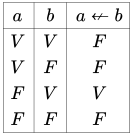
- The opposite Attachment presents true result if the first argument is false and the second true, in the rest of the cases presents false result, this operation is not commutative and is the denial of the reverse condition, also called difference: b - a, can be expressed:
- a b=¬ ¬ (a← ← b)=¬ ¬ a∧ ∧ b=b− − a{displaystyle anleftarrow b;=;lnot (aleftarrow b);=;lnot aland b;=;b-a}

This operation corresponds to a set of complex logic gates:
 |
 |
| aba▪ ▪ bVVVVFFFVFFFV{displaystyle {begin{array}{ age}{excluding}}{hline a fakeb}{leftrightarrow b\hline hline V fakeV\V pretendV\V fakeF\F supposedV}}}}}}{hline a hip bb-b-b-b-b-b-b-b-b-b-b-b-b-b-b-b-b-b-b-b-b-b-b-b-b-b-b-b-b-b-b-b-b-b-b-b-b-b-b-b-b-b-b-b-b-b-b-b-b-b-b-b-b-b-b-b-b-b-b-b-b-b-b-b-b-b-b-b-b-b-b-b-b-b-b-b-b-b-b-b-b-b-b-b-b-b-b-b- |  |
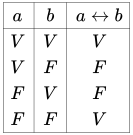
- The Biconditional presents true result if the two arguments are equal, that is: if a and b They're real or a and b They're fake.
- a▪ ▪ b=(a∧ ∧ b) (¬ ¬ a∧ ∧ ¬ ¬ b){displaystyle aleftrightarrow b;=;(aland b)lor (lnot aland lnot b)}

The XNOR Gate corresponds to it.
 |
 |
| aba bVVFVFVFVVFFF{displaystyle {begin{array}{ age}{bsp}{bsp}{bsp}{nleftrightarrow b\hlinehline V fakeV}{V}{V}{F}{F}}}{fbfbspfbfbwrightarrow b\hline\hline }{end{end{array}}}}}}}}}}}}}}}}}}} |  |
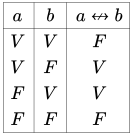
- The Exclusive Disjunction presents true result if the two arguments are disparate, this is whether of the two arguments one is true and another false, is the denial of the biconditional:
- a b=¬ ¬ (a▪ ▪ b)=(a∧ ∧ ¬ ¬ b) (¬ ¬ a∧ ∧ b){displaystyle anleftrightarrow b;=;lnot (aleftrightarrow b);=;(aland lnot b)lor (lnot aland b)}

This operation is also called or exclusive, one or the other but not both, it corresponds to the logic gate: XOR.
 |
 |
Well-formed Boolean formula
Starting from a set: B{displaystyle {mathfrak {B}}}} and where a, b, c, d,... are variables or constants that can take values of the set B{displaystyle {mathfrak {B}}}}where the following internal operations have been defined:
- ♥ ♥:B→ → Ba→ → b= ♥ a{displaystyle {begin{array}{rrcl}sim: fake{mathfrak {B}}}{mathfrak {B}}}{ fake a strangerto &b=sim aend{array}}}}}
- :B× × B→ → B(a,b)→ → c=a b{displaystyle {begin{array}{rrcl}oplus: stranger{mathfrak {B}}}times {mathfrak {B}}{to &{mathfrak {B}}}}{mathfrak {B}}}}{pos(a,b) nightmareto > aoplus bend{array}}}}}}}}
- Δ Δ :B× × B→ → B(a,b)→ → c=aΔ Δ b{displaystyle {begin{array}{rrcl}odot: fake{mathfrak {B}}}}times {mathfrak {B}}{mathfrak {B}}}{mathfrak {B}}{B}}{pos(a,b) pretendto &c=aodot bend{array}}}
we can say that they are well-formed formulas: wff:
1: A variable or constant:
- a{displaystyle a;}

2: The negation of a variable or constant:
- ♥ ♥ a{displaystyle sim a;}

3: The binary operation between two variables or constants:
- a b{displaystyle aoplus b;}

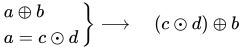
4: The result of substituting in a well-formed formula, a variable or constant by a well-formed formula:
- a ba=cΔ Δ d!Δ Δ (cΔ Δ d) b{displaystyle left.{begin{array}{l}aoplus ba=codot dend{array}}rightlongrightarrow quad (codot d)oplus b}
Repeated application of these criteria will always give a well-formed formula.
example:
- ♥ ♥ aa=bΔ Δ c!Δ Δ ♥ ♥ (bΔ Δ c)c=d e!Δ Δ ♥ ♥ (bΔ Δ (d e)){displaystyle left.{begin{array}{l}left.{begin{array}{lsim aa=bodot cend{array}}}{rightlongrightarrow quad sim (bodot c;c=doplus eend{array}longright}right

You can use as many parentheses as necessary to avoid ambiguities, always avoiding the superfluous use of parentheses.
Hierarchy of operators
When evaluating a Boolean expression, operations must be performed according to their hierarchical level, performing the highest-ranking one first. If parentheses exist, the innermost ones must be resolved first and worked out. In the absence of parentheses, the hierarchy of operations is, from highest to lowest, as follows:
- ♥ ♥ {displaystyle sim }
- Δ Δ {displaystyle odot }
- {displaystyle oplus }

If there are several operations with the same hierarchy, they can be evaluated from right to left or from left to right, the result will be the same.
As an example, consider the evaluation of the following Boolean expressions:
- ♥ ♥ aΔ Δ b (♥ ♥ a)Δ Δ b{displaystyle sim aodot bquad longleftrightarrow quad (sim a)odot b}

- a bΔ Δ c a (bΔ Δ c){displaystyle aoplus bodot cquad longleftrightarrow quad aoplus (bodot c)}

- a b c (a b) c a (b c){displaystyle aoplus boplus cquad longleftrightarrow quad (aoplus b)oplus cquad longleftrightarrow quad aoplus (boplus c)}

Contenido relacionado
RSA
Dennis Richie
Yotta