Blade element theory
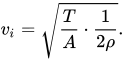
The blade element theory, also called Blade element momentum theory is a mathematical process originally designed by William Froude (1878), David W. Taylor (1893) and Stefan Drzewiecki to determine the behavior of the propellers. It involves dividing a blade into several small parts and then determining the forces in each of these small blade elements. These forces are then integrated over the entire length of the blade and over one rotor revolution to obtain the forces and moments produced by the entire propeller or rotor. One of the main difficulties lies in modeling the induced velocity in the rotor disk. Because of this, blade element moment theory is often combined with moment theory to provide the additional relationships needed to describe the induced velocity in the rotor disc. At the most basic level of approximation a uniform induced velocity in the disk is assumed:
- vi=TA⋅ ⋅ 12ρ ρ .{displaystyle v_{i}={sqrt {{frac {T}{A}}{cdot {frac {1}{2rho }}}}}}}}}}}} !
It is used to calculate the thrust that a propeller can produce and consists of considering the forces that act on a small slice of differential thickness of one of the blades, later performing an integration to find out the resultant of forces acting on each of the blades and multiplying by the number of blades to calculate the total resultant.
Although this theory is closer to reality than the one consisting of considering the propeller as a disk on whose surface there is a constant pressure jump, it is still an idealization in the sense that it does not consider factors such as the loss of efficiency of one of the blades due to the turbulence that the immediately preceding blade may leave behind.
Simple theory of blade elements


While momentum theory is useful in determining ideal efficiency, it gives a very incomplete explanation of the action of screw propellers, since it does not take into account, among other things, torque. To study the action of the propellers in more detail, it is considered that the blades are made up of a series of small elements and the air forces on each of them are calculated. Thus, while the theory of momentum is concerned with airflow, the theory of blade elements is primarily concerned with the forces on the propeller blades. The idea of analyzing the forces on elementary strips of propeller blades was first published by William Froude in 1878. Drzewiecki also worked it out independently and included it in a book on mechanical flight published in Russia seven years later, in 1885. Again, in 1907, Lanchester published a somewhat more advanced form of the blade element theory without knowledge of earlier work on the subject. However, the simple theory of blade elements is often called Drzewiecki's theory, since it was Drzewiecki who put it into practice and generalized it. In addition, he was the first to sum the forces on the blade elements to obtain thrust and torque for an entire propeller and the first to introduce the idea of using airfoil data to find the forces on the blade elements..
In Drzewiecki's blade element theory, the propeller is considered a warped or twisted airfoil, each segment of which follows a helical path and is treated as a segment of an ordinary wing. In simple theory it is usually assumed that the aerodynamic coefficients obtained from wind tunnel tests of wing models (usually tested with an aspect ratio of 6) are applied directly to the propeller blade elements in the same way as cross section.
Airflow around each element is considered two-dimensional and therefore not affected by adjacent parts of the blade. The independence of blade elements at any given radius from neighboring elements has been established theoretically and has also been shown to be substantially true for blade working sections by special experiments carried out for this purpose. It is also assumed that the air passes through the propeller without radial flow (that is, there is no eddy contraction as it passes the propeller disc) and that there is no interference from the blades.
Aerodynamic forces on a blade element
Consider the radio element r, represented in Fig. 1, which has infinitesimal length dr and width b. The movement of the element in a flying plane propeller follows a helical path determined by the speed of progress V of the plane and the tangential speed 2πrn of the element in the plane of the propeller disk, where n represents revolutions per unit of time. The speed of the element with respect to air Vr is then the result of the progress and tangential speeds, as shown in the Fig. 2. Call. ≈ to the angle between the direction of movement of the element and the plane of rotation, and β at the angle of the shovel. The α attack angle of the element regarding the air is then α α =β β − − φ φ {displaystyle alpha =beta -phi }.

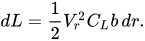
Applying ordinary aerodynamic coefficients, the lift force on the element is:
- dL=12Vr2CLbdr.{displaystyle dL={frac {1}{2}}V_{r}^{2}C_{L}b,dr. !
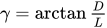
Sea γ the angle between the supporting component and the resulting force, or γ γ =arctan DL{textstyle gamma =arctan {frac {D}{L}}}}. Then the total resulting air force on the element is:
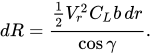
The thrust of the element is the component of the resultant force in the direction of the propeller axis (Fig. 2), or
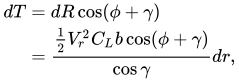
and since Vr=Vwithout φ φ {textstyle V_{r}={frac {V}{sin phi }}}}

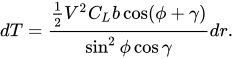
For more comfort
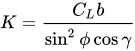

So
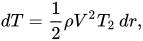
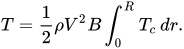
Returning to Fig. 2, the tangential or torsion force is
- dF=dRwithout (φ φ +γ γ ),{displaystyle dF=dRsin(phi +gamma),}

and the pair in the element is
- dQ=rdRwithout (φ φ +γ γ ),{displaystyle dQ=r,dR,sin(phi +gamma),}

What, yeah. Qc=Krwithout (φ φ +γ γ ){textstyle Q_{c}=Krsin(phi +gamma)}}, you can write

- dQ=12ρ ρ V2Qcdr.{displaystyle dQ={frac {1}{2}}rho V^{2}Q_{c}dr. !
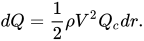
Therefore, the expression for the torque of the entire helix is
- Q=12ρ ρ V2B∫ ∫ 0RQcdr.{displaystyle Q={frac {1}{2}}rho V^{2}Bint _{0}^{R}Q_{c}dr. !
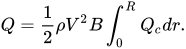
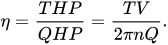
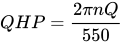
The power absorbed by the propeller, or torque power, is
- QHP=2π π nQ550{displaystyle QHP={frac {2pi nQ}{550}}}}
and the effectiveness is
- MIL MIL =THPQHP=TV2π π nQ.{displaystyle eta ={frac {THP}{QHP}}}={frac {TV}{2pi nQ}}}}. !