
Biface

A biface is a prehistoric stone tool that was used to cut, scrape and drill other materials. It is a very hard stone, generally flint, that is carved on both sides until it obtains a triangular shape with a semicircular base. The biface characterizes a stage of the Stone Age: the Acheulean, although it is also found in the Middle Paleolithic and even later. Its contemporary name comes from the fact that the archetypal model would be a carved piece, generally bifacial (that is, with two faces), with an almond-shaped morphology and tending toward symmetry along a longitudinal axis and along a flattening plane. The most common bifaces have a pointed terminal area and a rounded base, which gives them their representative shape, which is added to the bifacial carving that covers both faces totally or partially.
The bifaces were the first prehistoric tools recognized as such: in the year 1800 the first representation of a biface appears, in an English publication by John Frere. Until then, they were attributed a natural and superstitious origin (it was He called them "lightning stones"—or ceraunias—because popular tradition held that they were formed inside the earth when lightning struck, and that they then came out into the earth. the surface; in fact they are still used in certain rural regions as amulets against storms). The word «biface», biface in French, is used for the first time in 1920 by the antiquarian Vayson de Pradenne, this term coexisting with the expression «hand axe» («coup de poing»), proposed by Gabriel de Mortillet a long time before, and it can be said that only due to the scientific authority of François Bordes and Lionel Balout did the definitive word prevail.
However, since these first definitions of the biface were based only on ideal (or classic) pieces, of such perfect size that they attracted the attention even of non- understood, for years there has been a too boxed-in notion of the object. Over time, the deepening of knowledge of this lithic type has implied a better understanding of its characteristics, distinguishing between a biface itself and a bifacial lithic piece; In fact, as it is understood today, a biface is not always a bifacial piece and there are many bifacial pieces that are not bifaces at all. In the opinion of Professor Benito del Rey, from the University of Salamanca: « The name "bifaz" should be reserved for old pieces, prior to the Würm II-III interstadial», although it also admits that certain later objects can exceptionally be called bifaces (Benito del Rey, op. cit., 1982, page 305 and note 1).
Nor should biface be identified with an axe. Unfortunately the word axe has been, for a long time, a wildcard word in lithic typology for a great diversity of lithic utensils, especially at a time when the true usefulness of many of them. In the specific case of the Paleolithic biface, axe is an inappropriate term. It was already indicated in the 60s: «we must reject[it] as a misinterpretation of those objects that are not "axes"». Argument corroborated by subsequent investigations, especially on traces of use, as will be seen later.
Polythetism
It is true that the most characteristic and repeated biface model presents, at its terminal end, a pointed area or ogival, lateral cutting edges and a base more or less rounded (that is, the bifaces of lanceolate morphology and the amygdaloids, as well as others of the same “family”). However, the biface is an instrument whose shape can vary greatly, as there are circular, triangular, elliptical, etc. Their average size ranges between 8 and 15 centimeters, although there are larger and smaller ones.

Technologically, they are characterized because they are manufactured on edge, block or flake, by means of a bifacial workmanship, with flake negatives that, usually, invade the piece on both sides. This carving can be done with a hard hammer (stone), but can be completed, to obtain finer results, with a soft hammer (horn). However, in the technological aspect the biface also presents numerous exceptions: for example, the so-called monofaces are carved on only one side and the partial bifaces preserve a large portion of the natural bark of the support, which is sometimes easy to confuse with carved edges; and the «economy bifaces», being carved on very suitable supports (generally flakes), are only made with a few touch-ups.
In summary, despite the fact that the biface is a lithic type of personality recognized by multiple typological schools and by different archaeological paradigms, and despite, also, being easily recognizable (at least the most characteristic specimens), its limits are practically impossible to determine due to its polythetic personality: that is, the ideal model brings together a series of well-defined attributes, but none of them is necessary or sufficient for a piece specifically, it is considered a biface. A few of these attributes are enough to identify the tool, even if many others are missing.
"The size of a biphaz works as a complicated chain of technical gestures that we only sometimes unveil in their final stages, which complicates their study. If that complication of intentions when making a bifaz we join in its variety of forms [...] we will realize that the bifaz is a useful one of the most problematic and complexes in Prehistory»Benito del Rey, op. cit. 1982, pages 314 and 315.
Chronology and geography of the biface
Concerning the bifaces from the Lower and Middle Paleolithic, there is considerable consensus about the appearance of the biface from the African Oldowan. In fact, the oldest known bifaces come from Africa, about one million nine hundred thousand years ago (at least, in the site of Konso-Gardula and Melka Kunturé, at the southern Ethiopia): the first are crude, so it is more appropriate to classify them as «protobifaces» (they are rudimentary, thick and scarce), although the true bifaces with symmetrical contours date, in those same places, from approximately one million two hundred thousand years ago.
The oldest levels of Dmanisi (Georgia), designated with the numbers II, III and IV, have yielded nearly a thousand carved objects, but do not include any biface. Although numerous Preacherite sites were known in Europe and Asia without bifaces (some of them solidly dated), until the Dmanisi fossils were discovered (in addition to those from Atapuerca, somewhat later) it was not possible to question the idea defended by certain scholars who considered that human beings had left Africa with relatively evolved tooling, which would include bifaces; Since then it has been possible to properly speak of an archaic Lower Paleolithic (Pre-Acheulean) outside of Africa. That is to say, the first non-African humans were unaware of bifaces and their industries were based on rudimentarily carved flakes and edges. There are certain theories proposed to explain why bifaces were used in Africa for hundreds of thousands of years, while outside of this continent the technology was much more primitive:
If they left Africa it was because something happened that made them leave. Humans, if we're okay in one place, we usually stay. And what made them leave, most likely, was competition with other humans. From the moment when some groups acquired the Achelense technology and began to exploit natural resources more efficiently, groups that did not acquire it were forced to change their residence to earn a living. And they had to do it just over a million and a half years ago, which is the date the Achelense appeared.Eudald Carbonell and Josep Corbella, op. cit., 2000, page 76.
It is confirmed that, in Europe, and more specifically in France and England, the oldest bifaces do not appear until the Günz-Mindel interglacial, more or less, 750,000 years ago, in the so-called Cromerian complex, although its generalization would occur in the so-called Abbevillian, considered in principle an independent culture - ancestor of the Acheulean - and which, today, has been included in this, as an archaic facies, within the Ancient Acheulean, or as a form to designate certain roughly worked bifaces.

The heyday of the bifaces occurred in a very extensive area of the Old World, especially during the Riss glaciation, in a cultural complex of almost cosmopolitan character known as Acheulean. In a smaller area, it survives during the Middle Paleolithic, being especially important in the so-called Mousterian facies of the Acheulean tradition, until the middle of the Würm glaciation.
(In Europe) «There are small bifaces from the upper Achelense to the AuriñaciensePierre-Jean Texier (page 18)
As far as the Asian continent is concerned during the Lower Paleolithic, bifaces appear in the Indian Subcontinent and the Middle East, south of the 40° N parallel, but are absent east of the 90° E meridian; in such a way that the American archaeologist Hallam L. Movius established a border between the cultures with bifaces, towards the west, and those that maintain the lithic tradition based on carved edges and retouched flakes, such as the Zhoukoudian industry, Fen culture and Ordos culture in China, or their Indochinese equivalents. Exceptionally, the Padjitanian of Java is the only one that presents bifaces in such an eastern situation.
From the first carving experiments it was possible to verify the relative ease with which it is possible to manufacture a biface: this could be, in part, the key to its success. On the other hand, it is not a very demanding instrument regarding the type of support or rock, as long as the fracture is conchoidal. It allows improvisation and corrections, on the fly, without the need to plan excessively and, above all, it does not require long or sacrificial learning. All together, it has made bifacial carving objects extremely persistent throughout all of Prehistory. Added to this is their lack of functional specialization, making them potentially effective in a huge variety of tasks, from the heaviest, such as digging the ground, felling a tree or breaking a bone, to the most delicate, such as cutting the joint of a articulation, filleting meat or piercing various materials.
Finally, the biface constitutes a prototypical shape that, when refined, gives rise to more evolved, specialized and sophisticated types, such as projectile points, knives, hoes, axes, etc.
Analysis
Given the typological difficulties in determining the limits of what a biface is, it is important, in its analysis, to take into account the archaeological context from which it comes (geographical location, stratigraphy, other associated elements of the same level, chronology....). Likewise, as it is a piece of such ancient origins, it is necessary to study its physical state (establishing the natural alterations: patina, luster, bearing, mechanical alterations (breaks), thermal and/or physical-chemical alterations that it has suffered, in order to distinguish them from the scars left by the human hand).
The raw material is a significant factor in the study of bifaces, not so much because of the result that can be obtained when working with it, but to try to understand the supply economy of prehistoric humans and their movements through their environment. In the Olduvai Gorge (Tanzania), the closest places to supply raw materials are about ten kilometers from the settlements; On the other hand, on the river terraces of Western Europe, flint or quartzite are accessible everywhere; This necessarily implies different tactics for supplying and taking advantage of the available resources. On the other hand, the best or worst response to the size of the raw material is, compared to the above, a subsidiary factor, since the Paleolithic artisans were capable to adapt their work strategy to what they had at hand, obtaining the more or less desired results, even with the most stubborn rocks, as numerous specialists have verified (Bordes, Tixier, Balout: in Benito del Rey, 1982, op. cit. pages 306-307; Hayden, Carol et alter, Jeske, etc.: in Torrence, 1989). Despite this, it is important to note the type of grain, its texture, the presence of joints, veins, impurities, fracture cones...
To cover the study of use, it is indicated whether there are visible macroscopic traces of use: such as pseudo-retouches, breaks and flexes of use, even polish. If the piece was in good condition, it could be prepared for a microscopic traceological study, a matter that will be discussed below. Apart from these generalities, common to all carved archaeological pieces, the bifaces require a technical analysis of their workmanship and a morphological analysis.
Technical analysis
Technical analysis tries to elucidate each of the phases of the operational chain of a biface, which is very flexible: it can load most of the work in any of its links or distribute it evenly. This type of examination begins with the raw material supply strategies, the manufacturing itself, the use, the revival or transformation of the utensil throughout its useful life and, finally, its abandonment.
It is possible to put effort into searching for a higher quality raw material, or a more suitable support (thus, more is invested in obtaining a good foundation, but the carving work is then saved, that is, the effort is transferred to the beginning of the operational chain); Likewise, the craftsman can focus most of the work on the workmanship, so that it does not matter if he starts from a more or less appropriate base, minimizing risks at the cost of a greater burden at the end of the operational chain.
Support and reservation

The most common thing is that the bifaces are made on pebbles or nodules, but many of them also had a large flake as support. Bifaces on flake appear from the beginning of the Acheulean and become more widespread over time. When this is the case, the workmanship is simpler, shallower, since the support does not have to be modified as much, since the flakes often have a very adequate shape, allow for greater performance and a few flakes allow the tool to be available. finished, it is even easier to obtain straight edges. When analyzing a biface on a flake, the possibility that it is predetermined (Levallois or similar) must be considered; In any case, it is necessary to indicate the characteristics it has: type of flake, heel, direction of percussion.
Reserve: reserve means the natural crust of the lithic support (pebble, small block, nodule, large flake or stone platelet), which, due to the Erosion and physical-chemical alterations, that is, weathering, make the outside of the song different from the inside. It is often called cortex or simply cortical zone, in the case of chert, quartz or quartzite; The alteration is basically mechanical and, apart from the color and bearing, maintains the same characteristics (hardness, tenacity...). However, the flint is surrounded by a limestone crust, soft and of no use for lithic carving. In the case of the bifaces, as they are nuclear useful, it is advisable to indicate the quantity and location of the cortex to better understand the type of workmanship, or work that has been performed. Although it is normal to think that the greater the presence of bark, that is, the larger the raw areas, the more archaic the piece appears, the reserve should not be taken as an evolutionary or chronological criterion.
Many partially carved bifaces are not necessarily archaic, they simply did not need more work, they are economy bifaces. On the contrary, when a support is not suitable, it needs a longer workmanship. There are bifaces whose support is unrecognizable due to the deep and complete carving that the piece has undergone, which eliminates any original vestige of it.
The following sections can be differentiated in this field:
 |  |
- Monofaces: (sometimes, also called unifaces) are only carved by one of their faces and the reserve occupies the opposite. The monofacial size does not prevent the classification of such pieces as bifaces; on the other hand, this is not a feature of arcaism, so the presence of monofaces is not, in any case, a chronological indicator.
- Partial bifaces: The reserve affects the base and the central part. The rough zone that is obviously not cut, reaches up to 2/3 parts of the length of the piece.
- Bifaces of reserved base: They only have the reserved base, which is not cutting, but the cortex does not exceed a third of the maximum length. In some cases, a side reservation may be added to the basal reserve, affecting one of the edges, which would therefore be rhoma: it is what is called «natural bear». Already in the centuryXIX, Gabriel de Mortillet put the emphasis on the presence of cortical or basal backs that leave a non-cut zone on the perimeter of the piece: "Even some of the best-worked pieces are usually appreciated, sometimes at the base, more often on a side, a small area left uncut, raw. You could think of a carelessness or defect. But most frequently, therefore, the most plausible, is to think that it is something intentional. There are a good number of bifaces with the raw base, without carving or partly unraveled... are pieces in which a grip area is attached which is called a heel. This heel serves as a handle, as it is an easy-pressure zone»(currently, this idea is not ruled out, but it has not been proved or widespread).
 |  |
- Bifaces with residual reservation on the edge: They are bifaces with all the cutting perimeter, except some small partial back or cortical area (leaving a small zone without edge). That small back can be basal, lateral or oblique. In any case, this back should be small, leaving on each side, cutting edges.
- Bifaces with all the cut perimeter: In this case the whole perimeter of the biphaz is carved and has a cutting edge, which does not prevent the residual areas of bark in any of the faces, without affecting the effectiveness of the edges.
The workmanship
The workmanship is the manufacturing itself. The most normal thing is that this is the most important phase in the manufacture of a biface, although this is not always the case, as has been indicated in the case of bifaces on flake or on a very suitable pebble. When studying the production of a biface it is necessary to identify the type of firing pins that have intervened in it. If there are several types of striker, it is essential to indicate the order and result of each one. Of course, there will be cases in which it is not possible to appreciate the type of striker, but the most common options are:
.png)
- Bifaces carved exclusively with hard percutorwithout further rectification of edges. The use of a stone percutor is the most common in the owl of an achelense biphaz; the result is, most of the time, very characteristic since it provides thick pieces and with irregular edges, because the negatives of the lacquers have a very pronounced contraconcoid. The lacquers are scarce, wide and short (very deep), which take, in the heel, large pieces of arist: the concavity so accentuated of the lascquers causes sinuous edges. The section is irregular, often sub-lossical; the intersection between the two sides of the piece generates an open angle, from the order of 60° to 90° sexagesimales. Since these bifaces do not rectify the irregularities of the size, their appearance is similar to that of the nuclei; in fact, the lascas obtained were used in the production sequence. It is common for this type of owl to provide “partial bifaces” (that is, with incomplete size, leaving large areas of the original surface of the support), "monofaces" (bifaces carved by one face) « Abbevillense style bifaces» and "bifaces nucleiformes". Generally, this type of hechure is a symptom of arcaism, but it cannot be taken as a chronological indicator, unless the whole of the litigation is accompanied by contextual archaeological data that allow to data the industry.
.png)
- Bifaces carved with hard percustor and rectified edges also with a hard percutor have a somewhat more balanced look, since the rectification consists, precisely, in a second (or third) series of lacquers, also as it has been said, with a hard percustor, that regulates imperfections and provides a more correct finish. Correction is often called also Retailand, sometimes, it is done through invasive lacquers and, other times, are smaller, marginal blows, applied only in the most marked sinuosities, and often reflected, leaving escaleriform marks. The rectification of edges with hard percutor is given from the beginning of the Achelense, and persists even to the Musteriense, so it cannot be taken as a chronological indicator (to be considered as an evolutionary signal, it must be accompanied by other complementary and independent archaeological data). In any case, the resulting bifaces usually have a less heavy silhouette, more ClassicOf «almond shape» u «oval», tending to symmetry and with a lower proportion of bark (i.e. the original surface of the support). It is not safe, as is the case in the cases listed below, that the detail always aims to attenuate the sinuosity of the edges and to eliminate irregularities; in fact, it is possible to verify fervently that in certain cases the retail has as its purpose to rekindle a foil dull by use or a deteriorated tip.

- The bifaces to get a preform and finished with soft percutor: are those in which it is possible to differentiate the lacquers wide and short, with deep contraconcoids (remains of the first phase of the owl, this is the outburst), and then have been tuned with soft percutor (of quarrel or hardwood) leaving scars softer, with a barely visible contraconcoid, with less profound marks, but more dilated, It is complicated, often, to distinguish lascquers made with one and another percustor, since the hard percustor, if small and properly applied, can deparate very similar, confusing marks. Bifaces thus obtained are usually balanced, symmetrical and sometimes even relatively flattened. Either way, the soft percutor size appears in the full achelense, so it is, at least, an orientation post quembut it does not allow further clarification. Its greatest advantage over the hard percutor is that it allows to extract the most invasive layers, but also more thin and with a barely developed heel, which allows to maintain, or even improve, the efficiency of the edge, with a minimum expense of raw material. The drawback is that it is very demanding with raw material, requiring better quality rocks. However, there are still no studies that allow to contrast if the coating with soft percutor increases the yield of raw material per kg, there is also no data on the difference in energy spending in one or another percustor, although there are those who consider that the soft percutor requires more effort, a higher learning curve, although, in counterpart, it offers more lacquers with a lower expenditure on raw material.

- Bifaces carved and rectified exclusively with soft percutorThey're much weirder. In fact it is more than possible that they have also been initially overwhelmed with hard percutor, but the covering, regular and invasive size of the soft percutor has erased all traces of it. The soft percutor cannot directly attack any percussion platform and is not entirely suitable for certain raw materials, and both must be accessible to this technique; therefore, it is necessary, either a previous size with a hard percutor, or to start with a lacquer as a support, since its edge is fragile (they also serve very flattened edges and platelets). That is to say, although all the owl of a biphaz has been made with a soft percutor, it is plausible to assume that there is also a phase of removal to prepare a preform, and one or several rectification phases to finish the piece; what is not clear is the separation of both phases (it may be that all work is done in a single operating cycle). The soft percutor owl allows greater control over the size, and also spends less raw material, so that longer, more sharp, more uniform, edges are obtained, and the useful life of the piece is lengthened. Fully carved bifaces with soft percutor are often extremely harmonious, symmetrical and flat, with very rectilinear or torsas edges and with very subtle lacquer negatives, whose contraconcoids are diffuse, elongated, with palpable waves and nerves so soft that it is difficult to distinguish where a lascquer begins and where another finishes. The section is usually regular and biconvex, the intersection of the faces forms a edge with a sharp angle, often around 30°. They are pieces of great mastery so it is normal to be aesthetically attractive. That is why they are often associated with evolved industries such as the last phases of Achelense (v.g.: Micoquiense) or Musteriense. However, it is necessary to be cautious, because the owl with a soft percustor cannot date for itself any legal industry.
It must be taken into account that a biface was not the objective of prehistoric craftsmen, but rather a means, a tool and, as such, it wore out, deteriorated or broke during its use; Therefore, when they reach the hands of the paleolithic archaeologist or typologist, they find a piece that may have undergone drastic changes throughout its useful life. It is common to detect revived edges, reconstructed tips and silhouettes deformed by a carving destined to continue using the piece until it is abandoned. The pieces can even be recycled later; In this sense, François Bordes explains that bifaces“are sometimes found in the Upper Paleolithic. This presence, which is undoubtedly normal in the Perigordian I, is often due, in the other levels, to a collection of Mousterian or Acheulean bifaces.
The detailed study of the workmanship of a subpopulation of bifaces belonging to a given lithic industry serves to establish a precise description of the biface manufacturing process and to make statistical comparisons with other groups of bifaces (what is technically called E. D. A. — exploratory data analysis in English—or “exploratory data analysis”.
Morphological analysis
Traditionally, the biface has been oriented with the narrowest part facing up (assuming that this would be its most active part, which is not unreasonable considering the large number of "reserved base bifaces" that appear). The symmetry axis that divides the biface in two is called morphological axis, and the most regular and best carved one is usually selected as the main face. These are simple typological conventions to be understood between specialists. For the same reason, when describing the morphology of a biface (and any carved lithic object) it is necessary to discard terms that refer to purely technical concepts. In this specific case, it is necessary to reject the term heel to refer to the base of the biface, since this word, in lithic typology, already limits itself to a very specific part of the flake (which has nothing to do with the base of a biface). Likewise, it would be a mistake to use the expression distal zone, to refer to the terminal zone or apex of the biface.

The Terminal Zone of a biface is generally the narrowest part and opposite to the base, its most common shape is the pointed one—more or less acute, and more or less ogival—, also There are bifaces with a rounded or polygonal terminal area—not pointed—and, finally, bifaces with a terminal edge transverse to the morphological axis of the piece, that is, cleaving bifaces and spatulated bifaces...
The Basal Zone, opposite to the terminal zone (which is usually wider or thicker), can be described from the front: reserved, partially or completely carved, but not cutting, or, finally, cutting base. The profile indicates whether it is rounded (polygonal), flat or pointed; etc
The Edges: They are described morphologically from the front, in which case they can be convex, rectilinear or concave; apart from that they can be more or less regular. Special cases are those with denticulated (scalloped) or notched edges. In this section, the existence of non-sharp cortical backs must be indicated, if necessary. Observed in profile, the edges can have a delineation without irregularities (straight or twisted, that is, in the shape of a soft S) or be, from slightly sinuous to very sinuous (always referring to the cutting areas). Other important data to consider in this section is the development of the edge itself, that is, whether it occupies the entire perimeter of the biface or only certain areas and which ones.
The Section is taken in the central area of the biface or in a sector close to the apex; This allows us to understand how each part of the piece is worked, it is even possible to discern scraps or reconstructions of damaged areas of the edge. We distinguish the following types of section: triangular (subtriangular and triangular with back), rhombic (rhomboidal and rhombic with back), trapezoidal (trapezoidal and trapezoidal with back), pentagonal (pentagonoid and pentagonal with back), polygonal, biconvex or lenticular (sublenticular)…
The Silhouette: By definition, the biface should have, seen from the front, a more or less balanced contour, with a morphological axis that also serves as an axis of bilateral symmetry and a flattening plane. which serves as a plane of bifacial symmetry. This is not to say that all bifaces are perfectly symmetrical. First of all, symmetry is an achievement obtained after millennia of technological improvement, so it is not surprising that the most archaic pieces are somewhat asymmetrical. Secondly, symmetry is a typological criterion, but it does not necessarily help create more effective pieces. It is necessary to get rid of presentist aesthetic prejudices and not forget that the bifaces were used in hard and varied tasks: they deteriorated, wore out and broke; Therefore, they were often «repaired», re-grinding their edges, recovering their points or completely remanufacturing them. In museums and private collections, exceptionally beautiful and exemplary pieces are usually exhibited, which is very educational, but in an archaeological excavation, most of what reaches prehistorians are remains, pieces probably discarded after a long and complex life as tools: they have had to adapt to particular circumstances, to specific needs that we are unaware of and that, without a doubt, altered the original piece; For this reason, symmetry—natural to the classical and ideal concept of biface—is not always maintained in real archaeological pieces.
Ignoring the problem that has just been explained, for practical reasons, the silhouettes of the bifaces are classified into the following categories:
 |  |  |  |  |
 |  |  |  |  |
 |  |  |  |  |
Dimensions and coefficients

The measurements of a biface must be taken taking its morphological axis as a reference and orienting it appropriately. Apart from the three basic dimensions (length, width, thickness), specialists have proposed other magnitudes, which can be very diverse, the most common being those indicated by François Bordes (1961) and Lionel Balout (1967):
- Maximum length (L)
- Maximum width (m)
- Maximum thickness (e)
- Distance from base to maximum width area (a)
- Width at 3/4 length (or)
The last two, that is, the area of maximum width (a) and the one located at 3/4 of the length (o), are very suitable for outlining the contour of the biface section and for measuring the angles of the cutting edge (in case it was not a reserved area). These angular measurements of the edges are taken with a goniometer.
In addition, other measurements can be taken such as the length of the edge (with an elastic or canvas measuring tape), the weight, the chord of the edge (in the case of a biface with a transverse terminal bevel), etc. All of these measurements, in addition to being used in the E.D.A.s, serve to establish various morphological and technical coefficients (for example, the relationship between the weight and the length of the cutting edges, or the relationship between the striker and the angle obtained...
But the most commonly used coefficients are the Indices that Bordes proposed for his morphological-mathematical classification of what he called "classical bifaces" (Balout proposed others, but they are very similar, so It is not necessary to repeat the topic):
- Base rounding index: which serves to separate the three large families of classic bifaces (triangular, almonds and ovales): is established with the coefficient L/a providing the following separation thresholds:

| Family | Umbral |
|---|---|
| Triangular bifaces (the most regular) or sub-triangular (for irregulars) | |
| Almond bifaces | |
| Bifaces ovales |


- Enlargement Index: that separates the common bifaces from the shorts (and, occasionally, elongated). For example, in the family Bifaces ovales serves to separate the bifaces from the other types; in the family of Almond bifaces is used to recognize the lanceolate and micochian bifaces. The operation is performed with L/m and the thresholds are:

| Alargage | Umbral |
|---|---|
| Short bifaces | |
| Common bifaces | |
| Elongated bifaces |

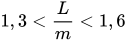

- Sectional or flattering index: that separates the bifaces thick of plans and used only in certain types. In the family of Almond bifaces (combined with the lengthening index), it serves to separate the amigdaloid (grues) bifaces from the cordiforms (planes). The coefficient is used m/e and the thresholds are:

| Planting | Umbral |
|---|---|
| Thick bifaces | |
| Flat bifaces |


There are other indices, apart from which it is necessary to insist that these must be applied to what Bordes calls classic bifaces, which leaves out a good number of specimens (partial bifaces, reserved base bifaces, splitter bifaces, spatulate, Abbevillian style, nucleiform, diverse...).
Use
From the first moments, the pioneers of the study of Paleolithic tools attributed to the biface the role of an ax or, at least, the performance of heavy activities. The idea soon arose that the biface was a tool with multiple functions, not only was each biface a multifunctional tool, but the different shapes and sizes of the various specimens made the type itself what has been colloquially called «the swiss army knife» of the Acheulean.

As we have just indicated, the biface is intended for heavy work, very hard work; Likewise, each of them served several different tasks; what's more, given that the bifaces could be recycled, resharpened, and even remanufactured through carving, throughout their useful life they could serve very unequal purposes. For this reason, it is not advisable to use the word axe to refer to them, since, without a doubt, they were used to dig, cut, scrape, split, pierce, hit... Likewise, the biface - given its mass — could be, occasionally, used as a core, and, taking advantage of the grinding or repairing recut, obtain flakes that could be used as knives or transformed into specialized tools through retouching.
- Trace analysis: The studies of paleolithic bifaces use have been carried out in emblematic deposits of almost the entire European West, being Semenov and, in particular, Keeley pioneers in this type of specialty. Lawrence H. Keeley states: "The morphology of typical bifaces suggests a range of potential activities much higher than the lascas". But at the same time it addresses a number of problems: the first one resides in the difficulty of observing large pieces under the microscope, so, despite being known millions of copies, very few have been able to be properly studied. The second great unknown arises from the fruitful demonstration that the same tasks were performed with lacquer utensils, more effectively, even:
The question arises: why manufacture bifaces, whose production is more complicated and costly, if the lascas can do the same work with the same efficiency? The answer could be that the bifaces in general (excluding certain specialized types...) were not conceived for a particular function [...], not only were carved for a main task, but they encompassed a much more general purpose.Keeley, op. cit., page: 136.
- Keeley, based on his observations in several English sites, proposes that in the base settlements, where there would be more foresight and control over routine activities, the preferred utilities were razors, knives of dorso, scrapers, drillers, etc. (i.e. useful on the specialized fields). On the other hand, in the seasonal expeditions and camps, where there was a possibility of unforeseen work, the bifaces saved the situation better, thanks precisely to their lack of specialization and their ability to adapt to the eventualities. A bifaz has a long edge with different curvatures, different angles, more sharp, more resistant, tips, mosses, etc. All combined in one piece and, if the circumstances were given, the profitable ones could be extracted. In the same work, Keeley points out that several of the bifaces he has been able to study were used as knives to cut meat (both at the site of HoxneLike in the Caddington); the same author has identified in another bifaz, which comes from the famous deposit Clacton-on-Sea (all in the east of England), traces at the tip of having been used as drill, turning with it in the sense of the clock needles. In similar conclusions came the American Nicholas Toth with some copies of the Spanish Ambrona (Soria); the truth is that none of the 37 pieces with prints of use had been applied to plant matter, all were destined to work meat and animal skins. But perhaps the most recent analyses, paradoxically, about the oldest bifaces, are those carried out by the Spanish Manuel Domínguez-Rodrigo and his collaborators in the very primitive achelense deposit of Peninj (Tanzania). There, a series of pieces of this type, dated in more than 1.5 Ma had a clear microdisgaste produced by plant phytoolites, which invites to think that such bifaces were used to work the wood.

- The macroscopic footprints: Microscopes are not the only ones that give clues about the use of bifaces: some were subjected to such hard work, that the marks are evident in plain sight or, can be induced by the scars of the repair coating to which they were subjected since, at times, it is possible to distinguish it from the Primary. One of the most widespread cases is breakage of the tipobserved by several researchers in deposits, both European and African and Asian. One of those deposits is The Basalito (Salamanca), whose excavation parked fragments of biphaz with reflections on the tip whose characteristics seemed to respond to a strong action as a wedge, subjecting the object to strong torsions that broke the apex. Fracture, or large-scale deterioration, not only affected the tip, but any part of the biphaz. But, many times, this was reconstructed through a secondaryas discussed above. In some cases this reconstruction is perfectly identifiable, and can be done by means of techniques as concrete as the so-called "coup de tranchet".trench blow in French), or simply with squamous retouchings or ladderriforms, which alter the symmetry and trajectory of the edges.

Some types of bifaces
Bifaces are such varied types that do not have, in fact, a single common characteristic... [...] Despite the numerous attempts to classify the bifaces, some of which date from the beginning of the century [X]... your study does not adapt to any fully satisfactory typological listsGabriel Camps
Taking into account the above, this should be considered an indicative section, based on traditional concepts, strongly rooted in the so-called «Borders method» (it is a basically morphological classification, for some schools, possibly outdated) but may be useful due to its widespread use. This classification is quite reliable when we talk about the so-called classical bifaces, which are precisely those that can be defined and cataloged by the system of mathematical dimensions and indices, with hardly any need. no subjective criteria. However, this supposed objectivity is still a conventionalism adopted by its author, based on his scientific experience and, the truth is that, in most cases, it accommodated previously established types (redefining them slightly). Likewise, it is possible to find a similar attempt in the work of Lionel Balout.
| Group | Image | Type |
|---|---|---|
T R I A N G U L A R E S |  | Triangular The triangular bifaces were initially defined by Henri Breuil as a flat base, globulous and reserved, with two straight edges, convergent in a very acute apical area. Later, François Bordes redefined the concept, making it more restricted (op. cit., 1961: pages 58-59). For Bordes, a triangular biphaz is an evolved piece of size and very balanced morphology; they are flat pieces with three rectal or slightly convex edges, have to be flats (m/e /2005 2'35) and with the cutting base and very straight (rounding index of the L/a base 2'75). Within such strict data, specialists differentiate small variants such as Allerated triangles (L/m ≤6), or those that have slightly concave edges (to which Bordes baptized as « Shark teeth»for their resemblance to fossils Carcharodon megalodon which often appeared in the vicinity of the deposits). Finally it would be the Subtriangular bifaces, whose general form evokes that of the triangle, but are more irregular and less symmetrical. Triangular bifaces are virtually non-existent in the Lower Paleolithic (except in the final Achelense of some French regions), and although they are more common in the Middle Paleolithic (MTA, especially), they disappear almost without trace. They are therefore a rare guy and at the same time spectacular for his aesthetics. |
A L M E N D R A D O S |  | Amigdaloides They are the most abundant type of biphaz of this group, they are defined by its almond shape, tending to symmetry and with the metric indices common to this category. Apart from its form, it is the one that gives them name (amygdala In Latin it means almond), they are bifaces of common length (1'3, L/m, 1'6), thick (m/e, 2'35) and with a rounding index of the middle base (2'75, L/a, 3'75). They may have a reserved base or not; they may also have a puntiaguda or ojival apical area, although in some cases it may be slightly rounded (and narrow). Bifaces amigdaloids are virtually identical to cordiform bifaces, except for those are thick and these are flat. Amigdaloids usually have a more coarse finish and a greater amount of bark, which is not necessarily an evolutionary or chronological indicator. |
 | Cordiforms The biphaz cordiforme is literally identical to the amigdaloid, seen from the front, sharing with it the same mathematical parameters (indice of elongation: 1'3. L/m. 1'6; and index of rounding of the base: 2'75 ≤ L/a ≤3'75), but, seen laterally, is a flat biface (m/e 2'35). Occasionally, although this is not part of its essential definition, they are carved objects with greater mastery, better finished, with less amount of bark and more balanced, optionally have sharper edges and rectilines (or torsas) and therefore more effective. His name also comes from Latin (cor means heart), it was proposed by Boucher de Perthes in 1857, but it was not generalized until it was used by Henri Breuil, Víctor Commont and Georges Goury in the 1920s. Bordes is the one who defined them mathematically and described them as flat bifaces of rounded base and cutter and terminal zone pointed or ojival, distinguishing up to eight variants, including an elongated (L/m 1'6) and another somewhat more irregular, baptized as subcordiforme. Coriform bifaces are common in both the Achelense and the Musteriense. | |
 | Lanceolate Lanceolate bifaces are among the most aesthetically appreciated and often become the paradigmatic image of the evolved achelsea bifaces. His name is logically due to his «form similar to the iron of a spear» and, also, is an appellant coined by Boucher de Perthes («make in lance»), quickly popularized. Bordes understands by lanceolate biface the one that is elongated (L/m /2005 1'6), of rectal or slightly convex edges, extremely sharp apex and rounded base (2'75 ≤ L/a ≤3'75), often globulous (even reserved), so that No. is a flat biphaz (m/e ≤2'35), at least in its basal zone. On the other hand, it is usually a balanced piece, very well finished, of edges perfectly straightened by a smear rectifier. They are very characteristic of the final phases of the Achelense—or its epigonal, the Micoquiense— and the Musteriense of the Achelense tradition (they are closely related to the mycoquilian bifaces described below). When a biphaz has lanceolate silhouette, but it is more coarse and irregular, perhaps due to lack of rectification, the French word is usually used «bifaz type ficron». | |
 | Micoquienses Mycoquise biphaz receives its name from the French cave The Micoque, in the commune of Les Eyzies-de-Tayac (in the Dordogne), and which also gives name to a terminal phase of the Achelense, the Micoquiense, characterized by the evolution of its technology. It is currently considered that the Micoquiense is not an independent culture of the Achelense, but one of its final stages, and precisely, the mycoquilian bifaces could be one of the few types of biphaz that could become a chronological indicator, that is, what is called a fossil director, characteristic of the end of the Achelense, developed during the interglaciar Riss-Würm. Mycoquise bifaces are very similar to lanceolates, i.e. almonds (2'75 Δ L/a ≤3'75), elargados (L/m 1'6), thick (m/e ≤2'35), rounded base, often reserved, but with markedly concave edges and extremely acute tip. Both lanceolate and micoquise bifaces tend to be associated (in fact, it is possible that a re-filled lanceolate biphaz will give rise to a micoquise biphaz), and are not rare in any of the Old World regions. | |
O V A L E S |  | Discoids Discoid bifaces are objects between circulars and ovals characterized by a rounding index of the base above 3'75 and a lengthening index less than 1'3. They have rounded both the base and the terminal zone. If your hechure is subdue, they are very difficult to distinguish from the nuclei of centripetal extraction or, if they are economy bifaces, they will look like simple retouched lacquers or carved songs on the lacquer. It is very normal that this type of bifaces emerges from the continuous refilling of the active area of a longer biphaz, which gradually is shortened as if of a pencil it was treated; they can also be recycled and recast broken bifaces. Discoid bifaces do not serve as chronological indicators, except that, during the Solutrense del Périgord, there are some specimens of very fine size. |
 | Ovoid It is understood by ovoid biphaz (u ovoidal), the one who, in great features, has the form of oval (a type of curve whose description is somewhat ambiguous, but which, more or less, recalls the silhouette of an egg). Its definition is very early: Boucher de Perthes already publishes it in 1857, without the concept having undergone many changes since then. Bordes states that ovoid bifaces are similar to the odoids but more elongated (1'3 ≤ L/m ≤6), apart from that, logically, they have the index of rounding of the base proper to the group of oval bifaces (i.e., more than 3'75) and, both this and the terminal area, must be rounded (if the base is cutter are almost symmetrical), although the larger width should be below half the length. While at some point it has been suggested that ovoid bifaces appear in the middle of the Achelense, the truth is that they lack chronological value and, together with amigdaloids, are the most common variant among the Achelense bifaces of the whole Old World. | |
 | Ellipticals Elliptical bifaces, also known as Limandes (French word meaning platija), they are triplely symmetrical, since, apart from having a bilateral symmetry axis and a bifacial symmetry plane, they have a third axis of horizontal symmetry that makes the base (if this is a cutter) virtually identical to the terminal zone (both sometimes it is difficult to decide how to guide the piece). In practice they are equivalent to ovoids in all their dimensional relationships, except that elliptical bifaces are usually more elongated (L/m /2005 1'6) and have the maximum width (m) close to half their length. Bordes explains that elliptical bifaces, or, in their terminology, Limandes, they are given throughout the Achelense and persist in the Musteriense, with the only difference that its finish is made, over time, more careful and balanced. On the other hand, this same author accustoms to differentiate the flat elliptical bifaces (m/e 2'35, «true Limandes»of the thick elliptic (m/e ≤2'35, «Protolimandes»). |
Non-classical bifaces
Despite the attempts of various specialists to develop a typology of bifaces based on objective data - especially François Bordes and Lionel Balout, who used dimensions as a criterion - numerous specimens have, until now, escaped all recognition. classification unrelated to personal considerations or judgments of the researcher, or that does not require extensive professional experience that allows distinguishing the most relative nuances. For this reason Bordes created the group of so-called "non-classical bifaces" that is, those to which mathematical indices cannot be applied.
- Bifaces nucleiformes: It is a very delicate type of definition biphaz, because it is difficult to determine whether it is true bifaces or, simply, are nuclei with rectified edges and that, occasionally, may have been used as useful. It could also be bifacial preforms, or casual parts.
Despite its coarse appearance, nucleiform bifaces appear both in the Achelense and in the Musteriense.
.png) Torralba, in Soria, Spain. | .png) Torralba, in Soria, Spain. |
- Bifaces-hendidor: It is a bifaces whose apex is neither pointed nor rounded, but possess a terminal edge relatively wide, transversal to its morphological axis. This edge is usually more or less sub-rectilinear, but also slightly concave or convex. Although these are bifaces incompatible with mathematical indices, they are sometimes included in classic types as they are balanced and well-finished forms. The bifaces-hendidor were defined by Jean Chavaillón in 1958 under the name "Bifaz de bisel terminal".biface à biseau terminal) while Bordes simply called them "singers" (hachereaux); the current term was proposed for France by Guichard in 1966 (biface-hachereau). In the Spanish case, in 1982 it was proposed the expression bifaz-hendidor, understanding «bifaz» as a noun referring to the type group to which it belongs, by its bifacial size, and "made" as adjective for his morphology; that is to say, technically it is a biphaz and morphologically reminds the misunderstandingr, although his personality is completely different:
Some authors qualify them as hendidores (F. Bordes, 1961, p 63), which, following J. Chavaillon, I cannot agree with; the size technique for obtaining a bifaz has nothing to do with the manufacturing procedure of the hendidoresAlimen, 1978, op. cit. page 121.
- Indeed, in this case, the general polythetism of the biphaz, even that of this variant, clashes with the technological monothetism of the ridge, however they can coincide in its morphology and its function.
- Abbevillense style bifaces: This bifaz takes its name from the French municipality of Abbeville, in a seaweed quarry of the highest terrace of the valley of the Somme River and, in principle, it became associated with the Abbevillense culture, of which it would be its fossil director (although, paradoxically, in the site of Abbeville the bifaces are particularly scarce). The Abbevillense was considered, until recently, the European predecessor of the Achelense, although it has now been integrated as an initial, archaic phase, of this — although it does not always appear in the stratigraphic record. Similarly, it was found that archaic bifaces such as Abbeville could take place throughout the Inferior Paleolithic, without implying any kind of chronological or cultural reference, so the expression was proposed. bifaz style abbevillense. Such bifaces were carved exclusively with hard percutor, without rectification of any kind on the edges, so these are extremely sinuous. Its form is clearly asymmetrical, varied and irregular, usually determined by the form of pebble that serves as a support (unless possible finding two equals); they have the base reserved, in addition to large cortical areas, and are very thick.
 de San Isidro, in Madrid, Spain. | .png) |
- Partial bifaces: It is a bifaces carved, without the owl affecting more than a small part of the support. However, with a few strokes the morphology of the biphaz is achieved, almost always at the cost of choosing a suitable support. They are specimens that are often on the edge of the carved edges, but their overall appearance and finish induce them to be classified as bifaces.
Sometimes it has been pointed out that the reason for being of these bifaces is the arcaism of the industry to which they belong; other times, it is spoken of unfinished objects; there are some, however, responding to a clear economy of expenditure:
A hechura so partial, but so careful, added to the morphology of the support, allows us to say that it is a finished biface, to which they no longer carved because they did not need it, saving, so, effort.Benito del Rey and Benito Alvarez, page 175.
Tools that have sometimes been associated with bifaces
Within the panoply of the Lower Paleolithic and, more specifically, the Acheulian, bifaces constitute an important group, especially in open-air sites (since, it seems that, in cave sites, such objects were rarer, at least according to L. H. Keeley's hypotheses). Often, bifaces, due to their size and technological conception, have been radically separated from flake tools (for example, scrapers, scrapers, perforators, etc.), which is why a distinction is usually made between what is called group of flake utensils and group of nuclear utensils. The bifaces, the carved edges and the trihedral peaks would be nuclear utensils, since it is common to make them on pebbles, blocks or rock nodules; However, this grouping is problematic, since all of these types were often manufactured also on flakes, although, it is true, larger in size. Another common proposal is to speak of flake tools as “microindustry”, as opposed to the general size of the so-called “macroindustry” —which are the same types mentioned above, plus the splitters. Once again problems arise, since there are scrapers as large as bifaces or, if you want, bifaces as small as scrapers (and the same goes for the other types mentioned). Aside from this, associating bifaces with carved edges and splitters is, from any budget, a problem.
- First, it's true that carved songs more elaborate and partial bifaces seem to intertwine, being, even, difficult, to put limits between both. But the concept of carved singing is not only based on the lack of formal standardization (proper of the bifaces), but includes the possibility that it is not useful, but of subdued nuclei, unthinkable in the bifaces (except the nucleiforms).
- In the case of the the the annexation is more questionable (if any)—even though François Bordes in his popular typology of 1961 puts them all in the same sack—for reasons that have already been discussed above. It is not undeniable that, occasionally, bifaces and snipers could have served similar tasks, but their technological concept is diametrically opposite (as, on the other hand, they have expressed numerous specialists).
- Them Trieric peaks, for some time they were considered a specialized variant of bifaces. However, since they were carefully studied and classified, it was clear that they required independent status consideration.
Another type of association of the bifaces is that of the other bifacial foliaceous tools from the Lower Paleolithic and, above all, from the Middle Paleolithic of the Old World. The difference lies in its much finer and much lighter finish, systematically carried out with a soft hammer, and in a more specialized morphology that also suggests a specific function, perhaps, as a projectile tip or as a knife. As sample button we take utensils well known from specialized classical literature:
The term foliaceous piece must be anteposed to the foliaceae tip, since many of them are not puntiagued. These are sporadicly given in various French musteriens deposits, but, above all, they abound in the Musteriense of Central Europe and the African Final AterienseBordes, 1961, op. cit., page 41
- The Bifacial Uses of Foliaceae Central Europe receive the specific name of blattspitzen. It is undoubtedly the tip of the Middle Paleolithic with a foliaceous form, often biapuntadas and very flat, so much that they remember the laurel leaves of the Solutrense, and it is only possible to differentiate them thanks to the archaeological context in which they appear. The blattspitzen survive in some culture of the Higher Paleolithic and, as the avisa Denise of Sonneville-Bordes, the pieces of the Eastern European Szeletiense (both softtspitzen and mycochian bifaces) could be the link that connects the tradition of the Higher Bifacial Objects of the Lower and Middle Paleolithic.

Blattspitzen centroeuropea 
Foliaceae foot
ateriense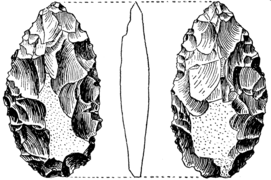
Foliácea stillbayense 
Foliaceae foot
African


- In Africa Bifacial pieces appear both in the Ateriense of the North and in the Stillbayense of the central-eastern zone of the continent. In both cases it is a musteroid tradition, although with a strong personality and relatively late: at the end of the call Middle Stone Age African. In both cases there are objects of various forms, sometimes triangular, oval and other foliaceae; in the same way there are objects with invasive bifacial size, but also monofacial.
The significance of the biface
When, centuries ago, the debate arose about evolution, and above all, about the origin of the human being, many refused to accept the kinship of humans with inferior beings. The first finds of human fossils, such as Neanderthals or pithecanthropes (clumsily interpreted), seemed to corroborate that we descended from savages lacking intelligence, who had survived only thanks to their brute strength. The bifaz played a more important role than is thought in breaking this prejudice. The publications of John Frere, in England, and, above all, of Boucher de Perthes, in France, throughout the 19th century (pioneer work comparable to that carried out by Juan Vilanova i Piera in Spain at that time; followed by José Pérez de Barradas and Casiano del Prado, already at the beginning of the century XX), showed pieces of excellent, balanced workmanship, full of symmetry and astonishing formal purity. Such tools could only have emerged from intelligent—and even numinous—minds with a certain sense of aesthetics:
Art took a long time for a formative period before being beautiful; but that is not why it ceases to be a sincere and great art, sometimes more sincere and great than beauty itself; for in man there is a creative nature that manifests itself as soon as its existence is assured. As soon as he has no worries or fears, this semi-decided active in tranquillity, he seeks the matter around him to inflate his spirit.Goethe, colloquium with Eckermann.
.png)
As André Leroi-Gourhan explains, for such remote periods it is worth asking what is meant by art, especially taking into account the psychological differences between "non-modern" humans and us. The archaeological documentation he handles leads this author to be amazed at the rapid progression towards symmetry and balance, in such a way that he recognizes in many prehistoric tools beauty in the strictest sense, which appears - according to him - in the course of the Acheulean, that is, very soon:
It seems very difficult to admit that these beings have not experienced some aesthetic satisfaction, because they were excellent workers who knew how to choose their matter, fix their defects, orient the fractures with total precision, remove from the core of gross sylex a form that corresponds exactly to their desire. His work was not automatic; guided by series of gestures of a rigorous chaining, he mobilized at every moment the reflection and, indeed, the pleasure of creating a beautiful object.Leroi-Gourhan, 1977, op. cit. p. 35.
However, we must not lose perspective: many authors only refer to exceptional pieces; Most bifaces tend toward symmetry, true, but they do not necessarily awaken an aesthetic sense. In most cases we are talking about selected series with the most striking pieces, especially those that were made in the 19th century, or at the beginning of the 20th century, when the profound lack of knowledge of prehistoric technology did not allow us to clearly recognize human action in the crudest objects; Other times they are collections of amateurs, whose interests are not scientific, so they collect only the cream, what they consider most notable, abandoning the most humble elements that, sometimes, are the key to the interpretation of a site. However, there are exceptions; There are sites studied by specialists with strict methodology, where the bifaces are abundant and masterfully carved, which leads to expressing the admiration that such works produce:
Such is the perfection of the size of some bifaces, which actually gives the impression that the artist delights in it per setherefore, at least apparently, does not add any effectiveness to those pieces. Anyway, we can't pronounce ourselves here, whether it was the art or the usefulness of the bifaces that sought to carve them so finely; although, inside us, we think they were looking for beauty, aesthetics, so, really, with more coarse pieces could be achieved, perhaps, the same efficiency.
The discovery, in 1998, of an oval biface, of excellent workmanship, in the Sima de los Huesos of Atapuerca, mixed with the remains of fossils of Homo heidelbergensis fueled this controversy. Given that it was the only lithic vestige of this section of the site (which, perhaps, could be a cemetery), together with the qualities of the piece, it received special treatment, it was even baptized Excalibur and became a star-piece. Some have dared to consider it a funerary offering, which may or may not be true, but scientifically it is impossible to contrast and should not even be a valid hypothesis (at least for now).). However, the symbolic consideration of this specimen, in particular, and of bifaces, in general, has multiplied in recent years, fueling debate and literature, not always scientific.
As a counterpoint, the opinion of Professor Martín Almagro Basch, who was a professor at the Complutense University of Madrid, is offered here:
Art is always the same, and it can only be called an artist to those who know how to create, within the objective limits, an equivalent to the numerical complex experienced individually and adequately expressed in relation to the society in which he lives.
Thus you can differentiate the essentially artistic work of the useful tool, even though it is also beautiful. When a prehistoric man was able to gain the wonder which are those axes of Achelense, he did not do the work of art; nor did the primitive man do it by building his house with skill and experience or by adapting the rupestre coat or cave for housing or sanctuary.Martín Almagro
.png)
from the terraces of the river Duero.
What seems to be clear from this controversy, at least, is that the biface could be interpreted as a sign of intelligence. But, the paradox is that, within the Acheulean panoply, the biface is one of the simplest tools to manufacture and does not require as much planning as other types of objects, generally on flake, much less striking., but, without a doubt, more sophisticated.
It has been mentioned above that typical bifaces appear more than a million years ago. Although it is now known that they are the heritage of several human species, of which Homo ergaster seems to be the First, until 1954 there was no solid evidence about who manufactured the bifaces: that year, in Ternifine (Algeria), Camille Arambourg discovered remains of what he called "Atlanthrop", along with some bifaces. All associated species bifaces (from Homo ergaster to neanderthalensis) demonstrate advanced intelligence that in some cases is accompanied by such modern features as relatively sophisticated technology, defense systems against inclement weather (building of cabins, control of fire, warm clothing), certain testimonies of spiritual thought (first artistic indications, such as body adornment, the engraving of bones, the ritual treatment of corpses, the development of articulate language, etc.). The biface should not be considered more than one of the many symptoms of the intellectual development of primitive humans.