
Bersuit Vergarabat
Bersuit Vergarabat, known as La Bersuit, is an Argentine rock group, originally from the Barracas neighborhood, south of the city of Buenos Aires, formed in 1988 They became notable at the end of the 1990s for combining this musical genre with Latin rhythms —such as cumbia, tango, murga, reggae, folklore and candombe— and lyrics charged with criticism of the political system and the society.
Since his first record work, the work of Bersuit Vergarabat was characterized by containing messages against Menemism and criticism of politicians such as Carlos Menem, Domingo Cavallo, Eduardo Duhalde, Carlos Ruckauf, among others. The lyrics of his songs were censored and, in other cases, the television channels that broadcast his video clips were sued and had to pay fines for the attacks suffered by certain politicians, as well as for the criticism of Argentine society in the 1990s.
Despite the censorship, the popularity of the band did not decline, which began to enjoy massiveness and became one of the most important groups of Argentine rock and one of the main ones in Latin America.
He went through various formations and his most famous lineup was made up of: Gustavo Cordera (voice), Juan Subirá (keyboards, accordion and voice), Carlos Martín (drums and percussion), Oscar Righi (electric guitar), Pepe Céspedes (bass and vocals), Daniel Suárez (vocals and backing vocals), Alberto Verenzuela (guitar) and Germán "Cóndor" Sbarbati (voice, choirs and charango).
One of the characteristics of the band is the way they dress in their concerts, by dressing up in pajamas, which in itself is a tribute to the inmates of the psychiatric residence of the José Tiburcio Borda Municipal Hospital in Buenos Aires and a response Contrary to the leather outfit, worn by groups normally associated with hard rock and heavy metal. An urban legend is attributed to him, in which it is said that Cordera spent some time in that institution, but this fact is not true. The band has shown an affinity for all things crazy and marginalized.
In addition to finding success in Buenos Aires and later throughout the country, Bersuit Vergarabat has attracted fans from many Latin American countries, as well as Spain, the United States, the United Kingdom, Germany, Japan, among others. The band's success beyond Latin America depends to a large extent on its ability to constantly reinvent itself.
The band went on hiatus in 2009, with the idea that each musician would dedicate themselves to different personal projects. After disagreements between his vocalist and the other members, because the former preferred to continue with his career as a soloist, in 2011 the group would return to the stage without Gustavo Cordera. In 2016, Oscar Righi left the group.
Some of his most popular songs are «El tiempo no para» (version by Cazuza), «Espíritu de esta selva», «Yo tomo», «Se viene», «Sr. Collection» (version of Las Manos de Filippi), «La argentinidad al palo», «La bolsa», «Negra murguera», «La solitude», «My caramel», «Simply», «A pact», «Waiting for the impact”, “Murguita del sur”, among others.
Without a doubt it is one of the emblematic bands of Argentine Rock, with very strong popular roots, but it could not recover from that break with its lead singer, losing intensity within society.
History
Beginnings
.jpg)
The history of the band dates back to the late eighties, when Juan Subirá, Pepe Céspedes, Carlos E. Martín and Alberto Verenzuela, who were childhood friends and went to the same school in the Barracas neighborhood (near south of the City of Buenos Aires), they began to learn to play instruments in their adolescence and at the same time they formed the group "Los Prehistóricos", a name that according to them, was because their music was "prehistoric". In 1987, already with Some musical experience to their credit, they began to rehearse at La Casa de las Artes de la Vieja Avellaneda, a place where artists from different fields met.
There, Subirá and Céspedes met a young man recently arrived from Avellaneda named Gustavo Cordera, who, after a trip to Brazil, had suddenly abandoned his university studies, shaved his head, and sold his own car dealership to dedicate himself to business. music.
In 1988, the band was made up of Gustavo Cordera (vocals), Charly Bianco (guitar), Miguel Jara (bass and backing vocals), Pepe Céspedes (bass), Juan Subirá (keyboards) and Carlos Enrique Martín (drums). The band until that moment did not have a fixed name, for which reason their presentations were made under the name of "Henry y La Palangana". The first name came from a nickname that they used to call Cordera in his neighborhood, while the band called themselves La Palangana. At that time, they began to tour the Buenos Aires underground circuit, playing in renowned pubs such as Babylonia, Cemento and parties at the Condon Clú, among other important places of the rock scene. Around that same time they would begin to wear pajamas as an identity, in the form of a tribute to the patients of the Borda Hospital. In August 1988 they participated in an ATC contest.
In 1989, they recorded a demo that contained six songs, among them: «Mouse snout», «La Logia (Iambo Iombo)» and «Masturbación en masse»; of which the first two would be released on the group's first album, and the third is still unpublished on official albums.
Origin of name

At the end of that same year, the band would change its name constantly and alternative names appeared that were made up words without any meaning, due to the use of lexicons and a meaningless philosophy of language. Among the names were: "Ernios de arcabio", "Aparrata Vergi", "Lambo Lombo" and "Seria Soneub" (the latter is "Buenos Aires" spelled backwards). Finally they decided on "Bersuit Vergarabat Van de Ir", leaving only "Bersuit Vergarabat", its most emblematic name:
It was at my house. One night, with Rubén (Sadrinas), Carlitos (Martín) and I think Charly (Bianco), we started playing with the words. I've been doing that since I was a teenager, I've put incomprehensible names to the broom, the closet, the TV... Each name had a sound, it was like a new vocabulary, although I never wrote them. That night we started playing with acoustic images and words without content and the one that best sounded to us was "Bersuit Vergarabat van de Ir". It was like an insult.Gustavo Cordera.
They would also say in an interview, the reason for this practice of using meaningless words:
As words often wear out, lose their meaning, we put a name that would not directly say anything.Gustavo Cordera in 1999.
The song «Lo logia (Iambo Iombo)», released on the group's first album, directly explains a new way of undertaking a universal vocabulary using unconnected and meaningless words.
1990-1996: First stage: Establishment and Inactivity


In 1990, he entered the emerging Rubén Sadrinas group, an opera singer, known from the band, who used to make choirs but formally admission and who had participated briefly in Patricio Rey and his Redonditos de Ricota; Raúl Pagano on keyboards, Marcela Chediak in percussion and Oscar Right, known friend of the band, who entered as a secondary guitarist.
With this formation they recorded their first album called Y punto. This disc contains a version of "O Tempo Não Pára" (Time Doesn't Stop); a song by the Brazilian musician Cazuza (1958 - 1990), which Cordera heard during a trip to Brazil. It also contained the song "Mouse snout", which the band had composed at the beginning of their career. They made presentations around Buenos Aires and played at Cemento, interpreting the songs from their first album and some unpublished songs, together with Daniel Araoz, Humberto Tortonese, Batato Barea, Miguel Zavaleta among other guests. On December 26 of that same year, they made their first Obras Sanitarias, to present their album and some other unpublished songs. This recital did not have the expected result and the band would take a long time to reverse this fact.
In 1993, they published their second album, entitled disgusting joy. After the launch of the album, they moved away from the band Marcela Chediak, Raúl Pagano and Charly Bianco. In replacement of the latter, the guitarist of Venezuelan origin, named Alberto Venzuela, also an old friend of the band, entered. Among the successes of this album, are: "The elephantites", "Your pill was", "Out of here", "Clara", "Tell your mom" and "absence of chorus." A year later, the group would be presented at " old mail " and would be recorded on video. In this concert, the band members were not in their best moments, due to their unexpected success and the addictions of Cordera and Sadrinas, their two vocalists.
Already in the mid-90s, the band entered a period of inactivity, so Cordera began using drugs, came to live in an abandoned hardware store, borrowed from his friends, sold sandwiches on the street and even in In a state of desperation, he came to steal from supermarkets, practicing what is popularly known in Argentina as "lighter."
He also worked in that period, selling savings plans, for a company whose owners turned out to be scammers, so they accused him of being a participant in these facts, which years later his innocence would be proven. Sadrinas, on his part, stopped rehearsing, due to the constant wear of his physical performance and his voice, he began to deteriorate, due in large part to his excesses. The remaining members would dedicate themselves to activities not directly related to the musical: Upload it wrote poems and books, Martin towards frames for paintings, etc. Although yes, Céspedes, Verenzuela, Righti, continued playing sporadically, but also dealt with their addictions.In 1996, during an absence of three years and the rumor of a possible separation that denies, although due to the lack of control and individualism of their members, they worked on their third album, initially baptized the story of Don Leopardo Vir Thomsio , although the final name would be Don Leopardo . The album was produced by Pichón Dalpont and with the launch of this album, " Bersuit " He began to gain more place within the music scene, including his participation in mass festivals, such as the Ferro Alternative Festival, the closure of Buenos Aires does not sleep in Park Centenario, and the Mothers Festival in Ferro and the grandmothers of Plaza de Mayo. The following year the group made 55 presentations for different cities of the country such as Rosario, Córdoba, Trelew, Puerto Madryn, Comodoro Rivadavia and the Atlantic coast, among others. From this material, the songs "Spirit of this jungle" stand out (which would be the first song of the group to have its first video clip); «Military bolero», «Eye for Ojojo ôô», «The perfect woman», «Bolivian Surf» and «Mi Caramelo». The first fifteen songs are part of a conceptual work, about an imaginary character named Don Leopardo Vir Thomsio and were mostly composed in Mar del Plata in the summer of 1993.
In the middle of that same year, after disagreements with Cordera, he would move away from the band, Rubén Sadrinas, for personal conflicts. With him, he would be the last original member of the first formation of the band.
1998-1999: Second stage: FREETING AND MASS SUCCESS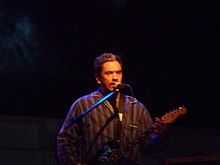 Alberto Verenzuela in 2012. He's the band guitarist since 1994.

The album that made the band known nationally and internationally was Libertinaje, double platinum in Argentina, released in 1998 and produced by Gustavo Santaolalla. After Sadrinas' departure in 1997, Daniel Suárez and Germán Sbarbati joined; These last two had formed a band called Springs Antagonists, a group that released two records and shortly after Héctor «Limón» García, leader and vocalist of Vía Varela, would enter to perform the choirs. They began a presentation tour throughout Latin America, Spain and the United States.
In 1999, they joined the "Watcha Tour", a circuit of Hispanic bands in the United States and made three successful tours of Spain (including a participation in the Festimad), they went through Mexico four times in one year They played in Chile, Venezuela, Colombia, Costa Rica, Uruguay, Bolivia, Peru, Nicaragua, Ecuador and Puerto Rico. They closed the year 1999, with a massive recital before 50,000 people in the open air in Buenos Aires, in front of the Obelisk. The disc includes the song "Mr. Cobranza", originally from Las Manos de Filippi, a protest song against the State, which caused controversy and was censored by COMFER, due to its explicit and foul language, due in part to the attacks by politicians contained in the lyrics. Despite this fact, the song, at the same time generating scandal, made the band achieve great popularity. In that same year, they participated in the album Tribute to Sandro, a rock album with a version of the song "Una mucha y una guitarra". In that same year, "Limón& #3. 4; Garcia.
Conflict with Filippi's Hands

The song “Mr. Collection »was performed by Bersuit Vergarabat in his shows, sometimes together with Las Manos de Filippi, authors of the song. After signing the contract with Universal Music, Bersuit records Libertinage, including this song in the song list with the modified lyrics. Twenty thousand copies of the disc are manufactured, which could not be marketed because they are "Mr. Cobranza» an unpublished song, requiring authorization from its authors to be able to publish the album.
Universal then signs a contract with Las Manos de Filippi to publish the album Arriba las manos, esto es el Estado in exchange for the rights to the eleven songs contained in the album, among which are I found "Mr. Collection». The company reneged on its part of the deal, which led to the band's anger with the record company and with Bersuit Vergarabat.
The vocalist of Las Manos de Filippi would say about this fact:
They fucked us everywhere: Sadaic, the Universal seal, the Bersuit. Gustavo Cordera made us the entry to Universal for interest, because we had to sign a paper to authorize them to record "Mr. Cobranza". It turned out a claw flower [argentinism of "scammer"] the Peel.Hernan de Vega.
Both Bersuit Vergarabat and its producer, Gustavo Santaolalla and businessman Daniel Grinbank, were ridiculed in the art of the next album of the hands of Filippi The holy hands go to Mass (2000).
2000-2004: Children of the ass and head
In 2000, children of the ass of the ass, with which they again reached the double platinum, and the group continued to grow in a call. This album contains songs like the football anthem "I touch and leave", a quartet like "The Bag", a "Black Murguera" candombe (in which they participated in the recording, the Uruguayan murga missing and rest) and a cumbia song, "The old man above." During the recording of said album, he will climb was shot by a man who lived in the department that was above his (called " the Joan " inn;) where parties were held every day of the week. The incident inspired by two songs: the first is "El Viejo de Arriba", where he tells about the parties and shots and the second is "Juan's song"; where you talk about the part that Juan is taken to the hospital with a shot in the knee.
This material was presented at the Works Stadium, around June 2001 and subsequently, several of the songs of that material would be published in a live album.
In 2002, the band turned 10 from their first album published, so in mid -2002 they edited the head with Bersuit Vergarabat , lived live at the Sanitary Works Stadium and in show Center of Haedo. "A covenant" and "Love dog explodes," were the only new themes of the album. With this work they began the " head of the head with Bersuit " with which they toured the country, in addition to being presented in Latin America, Spain and the United States and making a series of recitals at the Luna Park Stadium in Buenos Aires. The album reached triple platinum for the more than 150 thousand copies sold. The two shows in which the album was recorded were filmed and edited on a DVD with the same name in 2004, with which they got the platinum DVD award.
2004-2007: Definitive consecration and world tours


In the month of March 2004, Argentina launched the stick , a double album that went out into the street in two stages: Argentinity to the stick (se) and, a month later, Argentinity to the stick (what is). The homonymous song was a success and its video clip, was directed by journalist Jorge Lanata. This plaque received the Platinum Sextuple award and were recognized by the media as the best band of 2004.
In this material the songs «La soledad», «Porno Star», «El viento trae una copla», «Otra Sudestada» and «La argentinidad al palo» are the most successful songs.
Afterwards, Bersuit gave more than 100 national and international recitals throughout 2004. The year closed with a massive show in Mendoza, from which the images and audio were recorded for a DVD edition.
After the vigorous year, the Bersuit is invited to the opening of the World Social Forum in Porto Alegre, Brazil. She there shared the stage with figures such as Gilberto Gil and Manu Chao, among others, thus participating in a gigantic show on the Puerto del Sol stage.
In 2005, they received the Carlos Gardel de Oro Award and released Testosterona, recorded between April and May at Del Cielito studios. The album includes collaborations by Andrés Calamaro, La Mona Jiménez and the Argentine Hip Hop Union. On August 11 they presented the album in the mini stadium of Club Atenas de La Plata. Also in 2005 the band accompanied Andrés Calamaro in a series of concerts at Luna Park. A live album of those concerts has been recorded, El regreso. They then traveled to Spain and performed three concerts, closing at the Palacio de los Deportes in Madrid. They released an album of that concert, Made in Spain, along with a DVD that recorded a concert at Obras Sanitarias in which Litto Nebbia and Vicentico participated.
During 2006, the band made a tour of Italy in the grid along with Negrita, an Italian group with which they then toured Spain. The album sides BV , published in 2006, contains previously unpublished issues and oddities.
2007-2009: "? "
On May 12, 2007, Bersuit held a concert at the River Plate Stadium, with a crowd of 70,000 people, in which they presented the new song "De ahí soy yo".
In November 2007, they published a new studio album, simply titled ? and to environmental pollution. The album quickly reached double platinum. During 2008 they appeared again at the River Plate stadium, within the framework of the Quilmes Rock Festival, in which they closed the night before 60,000 spectators. In addition, they made a tour that included Spain and several countries in Latin America. In the album cover the question symbol ("? "); It is formed by the head and neck of its singer, Gustavo Cordera.
In 2009, they announced a series of concerts at the Luna Park Stadium, called the Luna Full Luna on the moon Full of that same year. However, only two of the stipulated concerts (April and May) were made, given Cordera's commitments for her solo career.
2009-2010: separation and parallel projects
In June 2009, the band decided to separate for three years, as assured by its members, because singer Gustavo Cordera had started a solo project.
"We can't go back, because suddenly this path (single) we love. And it's like the couple, when you live other situations and you like it, don't come back."Gustavo Cordera in "El País" of Uruguay.
Despite agreed commitments that the band had until December, everything was canceled.
For the next two years, Cordera launched the albums loose (2009) and forms its project the magic caravan, with which the disc in the magical caravan (edit 2010). Daniel Suárez, Pepe Céspedes, Germán Sbarbati and Oscar Righti, formed a band called Bueyes, which edited an album called more than a yunta in 2009. For his part, Juan will also start a solo race in 2008, with its disc exposed , which mixes tango and rock. On the other hand, the projects of Alberto Venzuela (demand) and Carlos Martín (Viva Music and Carlitos in Banda), did not edit records during that period.
2011-present: Bersuit return without Gustavo Cordera


In 2011, the band played again, touring Spain, London, and a short tour of Mexico (playing Guadalajara and Mexico City), playing their biggest hits. In addition, they performed on May 22 at the Quilmes Rock festival, with guest singers, and on November 20 at the commemoration of the 10th anniversary of the closure of the former Zanón factory, along with Arbolito, Oye Primate and Manu Chao. They also attended various solidarity festivals and free recitals.
On February 29, 2012, they released La Revuelta, produced by Cachorro López, whose first song was "Cambiar el alma" and the hits stood out: "Así es", "Dios te salve », «Don't forget yesterday», whose video stars Romina Gaetani, (Righi's girlfriend). From this material there is a ranchera-style song, titled "Afónico", dedicated to Cordera, after her separation. In it they talk about his new stage, her farewell and they end with "The whore who gave birth to you!". The band members argued that it was dedicated "with love" to the ex-vocalist. For his part, Cordera said he felt a little "ashamed and very sorry for them."
On May 4, 11 and 17, 2013, they performed three thematic concerts with the aim of celebrating 25 years since the formation of the band. These recitals, presented at the Vorterix Theatre, reviewed their entire discography: on the first day they performed the records Y punto, Libertinaje and Testosterona; in the second, Don Leopardo, Hijos del culo and ?; and in the third, Asquerosa Alegría, La argentinidad al palo and Lados BV. In addition, they played songs from La Revuelta and songs only released by De la cabeza. In this show he would have the participation of former members of the band such as Rubén Sadrinas, Charly Bianco and Héctor "Limón" Garcia. In 2013, the band collaborated with the Spanish group El Puchero del Hortelano, on the song "Hay días".
On March 11, 2014, El baile interior was released, which began recording at the end of 2013 and whose broadcast cut was “Cuatro vientos” (chosen as the musical curtain for the telenovela Señores Papis). On September 6, the album was officially presented at the Luna Park stadium, after a tour not only in Argentina, but also in European countries such as Germany and Spain.
From this album, the songs "Me voy", "Para bailar" and "Para Luis" also stand out, the latter dedicated to the musician Luis Alberto Spinetta. In June 2015, the band won a Gardel Awards, for their album El baile interior, in the category "Best Rock Group Album".
On January 30, 2016, it was announced that Óscar Righi decided to leave the band, for personal reasons, in addition to starting a new musical project called "La Rayada". In it, a series of statements against women were considered controversial by Cordera, which generated a strong rejection in public opinion. The band would release a statement repudiating the singer's statements and they disassociated themselves from this (despite the fact that Cordera was not part of it since 2009).
A week after the announcement, their thirteenth album was released, titled La nube rosa. This album is the first in the band's history in which Righi is not present. Their broadcast cut was the song "Que habable de vos", of which a video clip was released at the end of 2015. In 2019, the band released De la cabeza 2 half in the studio and half in alive, alluding to the album released in 2002, entitled De la cabeza con Bersuit Vergarabat.
In July 2020, two events would take place involving two former members of the band: on July 3, guitarist Oscar Righi is denounced for sexual and psychological abuse by his daughter Lucila Righi, accusing him of doing the same in other women. Raúl Pagano, former keyboardist of the band's first formation, died of hypothermia on the street, because he had lived in destitution for years. The musician was found with advanced hypothermia in a field and He died hours later in a hospital in the town of Pinamar.
Band identity
Aesthetics
It was said that the pajamas were in homage to the patients of the Borda Hospital, but in a presentation they made on the program "Encuentro en el Estudio" It was announced that they wore pajamas because in the first show in which they performed they had to convince the jury also with their clothing and that is why they all chose to wear pajamas since it was something that they all had and they agreed in terms of clothing.
Style and influences
The mixture of various musical styles such as tango, chamamé, cumbia, bolero, jazz rock, symphonic rock, progressive, murga, candombe, zamba, reggae, chacarera, hard rock, flamenco, trova, calypso, ranchera, quartet, tropical, among others, have classified them as an "unclassifiable" group, beyond considering them as "fusion" or "alternative". The influence of the music of Brazil, Uruguay and Argentina and Latin America as a whole; They have been a great inspiration for the group. Among the many artists who influenced the band, it is worth mentioning: Cazuza, Luis Alberto Spinetta, Caetano Veloso, Leo Maslíah, Jaime Roos, Litto Nebbia, The Bee Gees, Los Gatos, Sandro, Mauricio Ubal, Deep Purple, Led Zeppelin, Alcides, La Mona Jiménez, Pink Floyd, Charly García, Rubén Rada, Dino Saluzzi, Egberto Gismonti, Gustavo Santaolalla, Keith Jarrett, Serú Girán, Pat Metheny, Meredith Monk, Hermeto Pascoal, The Beatles, Genesis, etc.
In other media
- The song Or you go to mass... He was part of the soundtrack of the FIFA 07 football video game, although the chorus was modified to censor the phrase "or you go to my salon".
- The song "Toco y me voy" was chosen for a publicity of the newspaper Clarín against the violence of football, as well as in the public TV ads, for the ads of Football For All in the first months, among other songs.
- The song "Me dolor festejar" of the album "Testosterona", was used in the summer advertising campaign of the Eleven Foundation for Spain in 2007.
- The song "Perro amor exploits" was used for an Adidas Japanese advertising campaign.
- The theme "Perro amor exploits" also appears in the soundtrack of the movie Love Dogs in 2003, although it does not appear in the film.
- The song "Waiting the Impact" was used for the mini-series Brothers and Detectives.
- The song "Ragalonga de Malandras" Bersuit, an unpublished record) was used as a curtain for the Argentine TV series "Malandras".
- The song "Murguita del Sur" is used in numerous songs of fans of Argentine soccer teams.
- The song "Mr. Cobranza" was censored by the Federal Broadcasting Committee (COMFER) because of the verbal attacks suffered by Argentine politicians in the letter. Besides, this song got inside the count. The 100 great songs of the 90s in Spanish by the VH1 Latin American musical TV chain, obtaining the position 72. The song appears in the film Heroes and demons during the protest and raid at the National Congress.
- The lyrics of the song "Yo" of the album Testosterona inspired the name of the Venezuelan rock band No direction.
- The song "Four Winds" was used in the daily series of Papis Lords of 2014.
Discography
Since the band began their career in 1988, they have released a total of fourteen (14) musical projects, including eleven (11) studio albums, one live album, one compilation album and one remaining with two parts: studio and live.
| Year | Title | Discographic | Recording |
| 1992 | And point | Radio Tripoli Discos | Study |
| 1993 | Gross joy | DBN | Study |
| 1996 | Don Leopardo | BMG | Study |
| 1998 | Libertinaje | Universal | Study |
| 2000 | Ass children | Universal | Study |
| 2002 | From the head with Bersuit Vergarabat | Universal | Vivo |
| 2004 | The argentinity of the stick | Universal | Study |
| 2005 | Testosterone | Universal | Study |
| 2006 | BV sides | Universal | Redeployment |
| 2007 | ? | Universal | Study |
| 2012 | The revolt | Sony Music | Study |
| 2014 | The inner dance | Sony Music | Study |
| 2016 | The pink cloud | Sony Music | Study |
| 2019 | Head 2 | Pirca Records | Studio and Vivo |
Filmography
| Launch | Title | Format |
| 1994 | Old Mail | DVD |
| 2002 | From the Head | DVD |
| 2006 | Bersuit | DVD |
| 2006 | That's rock. | DVD |
Members
Current members
- Juan Subará - keyboards and voice (1988-presente)
- Carlos E. Martín - Battery (1988-presente)
- Pepe Grass - bass (1988 - present)
- Alberto Verenzuela Guitar and Voice (1994-presente)
- Daniel Suárez - voice (1997 - present)
- Condor Sbarbati - voice (1997 -present)
- Manuel Uriona - percussion (2001-present)
- Nano Campoliete - guitar, choirs (2011-present)
- Juan Bruno - guitar (2016-presente)
Previous members
- Gustavo Cordera - voice (1988-2009)
- Miguel Jara - bass (1988-1989)
- Rubén Sadrinas - Voice (1989-1996)
- Carlos «Charly» Bianco - Guitar (1990-1994)
- Oscar Righi - guitar (1990-2016)
- Marcela Chediak - percussion (1990-1993)
- Raúl Pagano † - keyboards (1990-1993)
- Limón García - vocal (1996-1999)
Timeline of band members

Awards and nominations
| Year | Prize | Category | Outcome |
|---|---|---|---|
| 2002 | MTV VMA 1999 | MTV Latin America | Nominee |
| 2002 | MTV VMALA 2002 | Best Southeast Artist | Nominee |
| 2003 | MTV VMALA 2003 | Best artist from Argentina | Winner |
| 2003 | Gardel Awards 2003 | Best Album Group Rock From the Head | Nominee |
| 2004 | MTV VMALA 2004 | Best rock artist - Best artist from Argentina | Nominee |
| 2005 | MTV VMALA 2005 | Best Southeast Artist | Nominee |
| 2005 | Gardel 2005 Awards | Best Album Rock Group - Album of the Year | Winner |
| 2005 | Gardel 2005 Awards | Song of the Year - Realization of the Year - Best DVD - Best Videoclip - Best Cover Design | Nominee |
| 2005 | Gardel 2005 Awards | Gardel de Oro | Winner |
| 2006 | MTV 2006 Awards | Best rock artist | Nominee |
| 2006 | Gardel 2006 Awards | Best Cover Design, Best Videoclip, Interpretation, Production, Song and Album of the Year | Nominee |
| 2007 | MTV 2007 Awards | Best Rock Artist | Nominee |
| 2007 | Gardel 2007 Awards | Best DVD | Nominee |
| 2015 | Gardel 2015 Awards | Best Album Rock Group | Winner |
Contenido relacionado
2-step garage
In Plenty and In Time of Need
The Video