
Benito Perez Galdos
It may well be said that strategy, and force and tactics, which are human things, cannot and will never be able to do anything against enthusiasm, which is divine. -Benito Pérez Galdós. Dance (1873). National Episodes, 1.a series No. 4, chap. IV; p. 18) |
Benito Pérez Galdós (Las Palmas de Gran Canaria, May 10, 1843-Madrid, January 4, 1920) was a Spanish novelist, playwright, chronicler and politician.
He is considered one of the best representatives of the realist novel of the XIX century, not only in Spain, and a capital narrator in the history of literature in the Spanish language, to the point of being proposed by various specialists and scholars of his work as the greatest Spanish novelist after Cervantes.
He transformed the Spanish novel scene of the time, moving away from the romantic current in favor of naturalism and contributing great expressiveness and psychological depth to the narrative. In the words of Max Aub, Pérez Galdós, like Lope de Vega, assumed the spectacle of the common people, and with "his serene, deep and total intuition of reality" he returned it to them, like Cervantes, redone, "artistically transformed." Hence, "since Lope no writer has been so popular, none so universal since Cervantes."He was a member of the Royal Spanish Academy since 1897.
He was nominated for the Nobel Prize for Literature in 1912, but his anti-clericalism caused him to be besieged and successfully boycotted by the most conservative sectors of Spanish society, represented in traditionalist Catholicism, who did not recognize his intellectual value and literary.
He was very fond of politics, although he did not consider himself a politician. His political beginnings were liberal, to later embrace a moderate republicanism and, later, socialism at the hands of Pablo Iglesias Posse. In his liberal beginnings he joined the Progressive Party of Sagasta and in 1886 managed to be deputy for Guayama (Puerto Rico) in the courts. At the beginning of the XX century, he joined the Republican Party and in the legislatures of 1907 and 1910 he was deputy to Cortes for Madrid for the Socialist Republican Conjunction; in 1914 he was elected deputy for Las Palmas.
Biography
Childhood and youth

Galdós —baptized Benito María de los Dolores— was the tenth son of an army colonel, Sebastián Pérez Macías, a native of the municipality of Valsequillo in Gran Canaria, who had formed part of the volunteer battalion known as The Canarian Grenadier who fought in the War of Independence and Dolores Galdós Medina, a native of Las Palmas de Gran Canaria although of Gipuzkoan origin, a woman of 'strong character' – as described by her son, himself writer–, and daughter of Domingo Galdós Alcorta, an official of the Audiencia de Canarias, a native of Azcoitia. He was the brother of the soldier Ignacio Pérez Galdós, captain general of the Canary Islands between 1900 and 1905.
When he was still a child, his father made him fond of historical accounts by telling him passages and anecdotes lived in the War of Independence, in which, as a soldier, he had participated. In 1852, he entered the Colegio de San Agustín, in the Vegueta neighborhood of Las Palmas de Gran Canaria (island of Gran Canaria), with an advanced pedagogy for the time, in the years in which the controversial theories began to spread throughout Spain. Darwinists, controversies that some critics have traced in works such as Doña Perfecta.
Galdós, who had already begun to collaborate in the local press with satirical poetry, essays and some short stories, obtained a Bachelor of Arts degree in 1862, at the Institute of La Laguna (Tenerife), where he had stood out for his ease for drawing and his good memory. The arrival of a cousin of his, Sisita, to the island family environment, emotionally upset the young Galdós, a circumstance that has been considered a possible origin of the final decision of Mama Dolores to send him to Madrid to study Law.
He arrived in Madrid in September 1862, enrolled in the university and was taught by Fernando de Castro, Francisco de Paula Canalejas, Adolfo Camús, Valeriano Fernández and Francisco Chacón Oviedo. At the university he met the founder of the Institución Libre de Enseñanza, Francisco Giner de los Ríos, who encouraged him to write and made him curious about Krausism, a philosophy that is felt in his early works. He frequented the theaters and the "Tertulia Canaria" in Madrid, forming gatherings with other writers from his countrymen (Nicolás Estévanez, José Plácido Sansón, etc.). He also went to read the main European narrators in English and French at the Athenaeum. It was at that institution where he met Leopoldo Alas, Clarín, during a conference by the Asturian critic and novelist, in what would be the beginning of a long friendship. Apparently he was a scattered and lazy student, missing class often:
I entered the university, where I distinguished myself by the frequent bulls I did, as I have referred elsewhere. By escaping the chairs, he was gandulating through the streets, squares and alleyways, enjoying observing the bullying life of this vast and abysmal capital. My literary vocation began with dramatic pruritus, and if my days were to “flan” through the streets, I spent some of the nights in ambusing dramas and comedy. I frequented the Teatro Real and a coffee from the Puerta del Sol, where a good blow was gathered from my countrymen.B. Perez Galdós, Memories of a Memoir, cap. II.
In 1865, he attended the terrible Night of Saint Daniel, whose events deeply impressed him:
I witnessed, confused with the student motto, the scandalous riot of St. Daniel's night—April 10, 65—and in the Puerta del Sol I was reached by some lanterns of the Veteran Guard, and in the following year, on June 22, memorable for the uprising of the sergeants at the San Gil barracks, from the guest house, Olivo Street, in which I was able to dwell with other days. The cannons thundered the air... Madrid was hell.B. Perez Galdós, Memories of a Memoir, cap. II.
A regular at the theaters, he was especially impressed by the play Catalan Vengeance, by Antonio García Gutiérrez. Chroniclers and biographers record that that same year he began to write as a meritorious editor in the newspapers La Nación and El Debate , as well as in the Revista del Movimiento Intelectual from Europe. The following year and as a journalist, he attended the pronouncement of the sergeants of the San Gil barracks.
In 1867, he made his first trip abroad, as a correspondent in Paris, to report on the Universal Exposition. He returned with the works of Balzac and Dickens and translated from the latter, from a French version, his most Cervantine work, The Posthumous Papers of the Pickwick Club, which was published in installments in The Nation. All this activity led to his absence from Law classes and he was definitively erased from the enrollment in 1868. In that same year, the so-called revolution of 1868 took place, in which Queen Elizabeth II fell, precisely when he was returning from his second trip to Paris and returning from France to the Canary Islands by boat via Barcelona; During the stopover that the ship made in Alicante, he got off the steamer in the Alicante capital and thus arrived in Madrid on time to see the entry of Generals Francisco Serrano and Prim. The following year, he dedicated himself to writing journalistic chronicles about the preparation of the new Constitution.
The first works
In 1869, he lived in the Salamanca neighborhood, at number 8 Serrano street, with his family, and he passionately read Balzac while he was part of the editorial staff of Las Cortes. The following year (1870), thanks to the financial help of her sister-in-law, she published her first novel, La Fontana de Oro, written between 1867 and 1868 and which, even with the defects of all first-time works,, serves as a threshold to the great work that he later developed as a chronicler of Spain in the National Episodes.
La sombra, published in 1871, had been appearing in installments since November 1870, in the Revista de España, directed by José Luis Albareda and more late by Galdós himself between February 1872 and November 1873; in that same year (1871), also at the hands of Albareda, he entered the editorial office of El Debate and during his summer vacation in Santander he met the novelist José María de Pereda. In 1873, he allied with the Tenerife engineer Miguel Honorio de la Cámara y Cruz (1840-1930), then owner of La Garnalda, in which he has collaborated since January with a series of “Biografías de damas famous Spaniards” among other articles.
The National Episodes

In 1873, Galdós began to publish the Episodes nacionales (the title suggested by his friend José Luis Albareda), a great chronicle of the century XIX that collected the historical memory of the Spaniards through their intimate and daily life, and their contact with the events of national history that marked the collective destiny of the country. A work made up of 46 episodes, in five series of ten novels each (with the exception of the last series, which was left unfinished), which starts with the battle of Trafalgar and goes up to the Bourbon Restoration in Spain.
The first series (1873-1875) deals with the War of Independence (1808-1814) and stars Gabriel Araceli, “who became known as a beach urchin and ended up his historical existence as a chivalrous and brave officer of the Spanish army".
The second series (1875-1879) covers the struggles between absolutists and liberals until the death of Fernando VII in 1833. Its protagonist is the liberal Salvador Monsalud, who embodies, to a large extent, the ideas of Galdós and in whom "the political prevails over the heroic, a characteristic sign of those troubled times".
The third series (1898-1900). After a twenty-year hiatus, and after recovering the rights to his works held by his publisher, with whom he had an endless lawsuit, Galdós continued with the third series, dedicated to the first Carlist war (1833-1840). The period of Spanish history collected in the pages of this series begins with the first Carlist war and the Regency of María Cristina, to close with the wedding of Isabel II.
The fourth series (1902-1907) takes place between the Revolution of 1848 and the fall of Elizabeth II in 1868. The fifth (1907-1912), incomplete, ends with the restoration of Alfonso XII.
This set of novels constitutes one of the most important works of Spanish literature of all time and marked an almost unattainable level in the evolution of the Spanish historical novel. The point of view adopted is varied and multiform (it begins from the perspective of a young man who, while fighting for his beloved, finds himself involved in the most important events of his time); the perspective of the author himself varies from the epic breath of the first series to the final bitter skepticism, passing through the radical position of socialist-anarchist tendency of the third and fourth series.
In order to get to know Spain well, the writer dedicated himself to traveling through it in third-class railway cars, living with the miserable people and staying in “dummy” inns and hostels.
As a writer

Benito Pérez Galdós used to lead a comfortable life, living first with two of his sisters and then with his nephew, José Hurtado de Mendoza.
In the city, he would get up with the sun and write regularly until ten in the morning in pencil, because the pen was wasting his time. Later he would go for a walk in Madrid to spy on other people's conversations (hence the enormous freshness and variety of his dialogues) and to observe details for his novels. He didn't drink, but he smoked leaf cigars incessantly. On the first afternoon he read in Spanish, English or French; he preferred the English, Spanish and Greek classics, particularly Shakespeare, Dickens, Cervantes, Lope de Vega and Euripides, all of whom he knew inside out. In his maturity he began to hang out with Leo Tolstoy. Later he would return to his walks, unless there was a concert, because he adored music and for a long time he did music criticism. He went to bed early and almost never went to the theater. Each quarter he minted a volume of three hundred pages.
From the point of view of Ramón Pérez de Ayala, Galdós was careless in his dress, using somber tones to go unnoticed. In winter it was common to see him wearing a white woolen scarf wrapped around his neck, with one end hanging from his chest and another on his back, a half-smoked cigar in his hand and, already seated, his Alsatian dog next to him completed the typical picture.. He was in the habit of wearing his hair "cropped" and apparently suffered from severe migraines.
Maturity
From the Ateneo to Santander

Since his arrival in Madrid, one of Galdós' greatest hobbies was visiting the old Ateneo on Calle de la Montera, where he had the opportunity to make friends with intellectuals and politicians of all stripes, including characters so foreign to his ideology and sensitivity like Marcelino Menéndez Pelayo, Antonio Cánovas del Castillo or Francisco Silvela. He also frequented gatherings at the Café de la Iberia, the English Brewery and the old Café de Levante. Starting in 1872, Galdós became fond of spending the torrid summers of Madrid in Santander (Cantabria), an environment with which he would come to identify to the point of buying a house in El Sardinero, the lively "finca de San Quintín". The rise of naturalism in France and his readings of it began to affect his narrative ideas and in 1881 he gave a notable turn to his novel production by publishing La desheredada, as his friend and literary critic Leopoldo Alas would observe, Clarín:
Galdós has gone into the stream; he has published a program of arson literature, his naturalist program: he has written in 507 pages the story of a prostitute.
With La desheredada he abandoned the genre of the thesis novel and opened the cycle of Contemporary Spanish Novels (1881-1889) which —mostly— describe the Madrid society in the second half of the XIX century. From then on, the elements of the novel most dear to Galdós appear widely under naturalistic perspectives: generous and self-sacrificing madness, feminine sentimental weakness, masculine egoism, the exploration of romantic restlessness and, next to it, the analysis of pragmatic harshness.. The characters will no longer be in one piece and their dreams or the contradictions of their thinking will occupy a long distance, as happens in El amigo Manso (1882), an intense novelization of a love resignation narrated by a character whose crisis of existence seems to anticipate the much later ones of Miguel de Unamuno. Likewise, as in Balzac's Human Comedy, characters from some novels began to appear in others. Between January and June 1887, he published Fortunata y Jacinta in four volumes.
Between Madrid and Toledo
Galdós was one of the writers who best knew and lived the city of Toledo more thoroughly. In the words of Gregorio Marañón, his friend and main biographer of his from the Toledo ranches: "His love for Toledo was part of the intimate and literary life of the writer."
Two characters were his link with Toledo: A friend of his nephew José Hurtado de Mendoza, the engineer Don Sergio Novales, owner of the La Alberquilla farm, located between the railway and the Tagus river, where D. Benito retired often to enjoy country life; and the painter Arredondo, with whom he used to wander through the intricate medieval streets, competing with each other to find the shortest route on a predetermined itinerary. It was the latter who recommended that he settle in a simple pension on Calle Santa Isabel, to research the second part of the novel Ángel Guerra.
Galdós used to come to Toledo on two specific dates: to play the hermitage's corner on the day of the Virgen del Valle Pilgrimage (every May 1st) and for the Corpus Christi procession in Toledo, where he was located always between Calle de Feria and Plaza de las Cuatro Calles. Among his favorite places was the Cathedral of Toledo, where he learned all the bell ringing together with the bell ringer Mariano. At dawn he used to go to the Toledo convents to listen to psalmodies, counting among his favorites the Jerónimas de San Pablo and the Monastery of Santo Domingo el Real. He usually used to have lunch in the crowded house of Granullaque, in the small square of the Barrio Rey, right next to the Plaza de Zocodover, in his opinion, the umbilical center of Toledo. And he was also a regular at the photographer Casiano Alguacil's shop on the nearby Calle de la Plata, the same street where the uncle of the young writer Francisco Navarro Ledesma lived, who provided D. Benito with essential documentation for Ángel Guerra. Finally, D. Benito used to watch the sunset from the Monastery of San Juan de los Reyes, whose cloister he knew in detail when he was accompanied by the restorer and friend of his, Arturo Mélida.
As a result of these visits to the city, several works by the Canarian writer arose: Ángel Guerra, his national episodes (El audaz, Los apostólicos, Un facticio más and some less friars) or The artistic generations of the city of Toledo.
Galdós deputy
Galdós's parliamentary career began, in a somewhat bizarre way, when in 1886 and having approached the Liberal Party, his friendship with Sagasta led him to enter Congress as a deputy for Guayama (Puerto Rico). The writer would never visit his Antillean constituency, but his forced attendance at the Cortes —where, shy by nature, he would hardly open his lips— served him as a new and unusual observatory from which to analyze what he would later title as "Spanish society as novel matter".

Later, in the general elections in Spain in 1910, he would present himself as the leader of the Conjunción Republicano-Socialista, formed by republican parties and the PSOE, in which said coalition would obtain 10.3% of the vote.
In his novelistic production, still within the cycle of Contemporary Spanish Novels, he began a second phase in which, after publishing Reality in 1889, the reading of León Tolstoy He made him abandon the influence of naturalism and incline towards spiritualism, publishing between 1891 and 1897 ten novels in this new aesthetic: Ángel Guerra (1891), Tristana (1892), < i>The Crazy Woman (1892), Torquemada on the Cross (1893), Torquemada in Purgatory (1894), Torquemada and San Pedro (1895), Nazarín (1895), Halma (1895), Misericordia (1897) and El grandfather (1897).
The theatrical adventure

Galdós's theatrical vocation was very early and as he himself wrote in his Memories of a forgetful man already as a student he took his first steps as a playwright: «If my days were going to “flane” for the streets, spent part of the night blurring dramas and comedies». It began with Who does evil, well don't wait (1861) and the historical drama The expulsion of the Moriscos (1865), which have not been preserved, and continued with the high comedy A young man of benefit (1867), posthumous edition; but he abandoned that vocation very soon to devote himself completely to the novel, until on March 15, 1892, the first mature work of the Galdós theatrical production premiered at the Teatro de la Comedia in Madrid: Realidad . The author would later remember that night in the Memoirs of him as "solemn, unforgettable for me." The success of the work, and Guerrero's good disposition, would lead them to premiere in the early days of 1893 the theatrical version of La loca de la casa (which as a novel had gone almost unnoticed). But his confirmation as a successful and critical author was given by La de San Quintín, released on January 27, 1894; his fourth work taken to the stage, after the failure of the adaptation of the episode Gerona.
But the most remembered premiere of Galdós (together with the later one of Casandra in 1910) was perhaps that of his Electra, on January 30, 1901, so which was a timely "argument against the powers of the Church and against the religious orders that served it" at a historical moment in which in Spain, after the liberal advances of the period 1868-1873, the influence of political interests grew again of the Vatican. That slap, which to the astonishment of Galdós himself was much louder than he had expected, would ignite the fuse of an ultramontane conspiracy, which over the years would lead to a disproportionate, sad and very little Christian revenge.: to prevent the literary genius of Galdós from being recognized with the Nobel Prize for Literature.
In general, the Galdós theater had only a discreet success; he detested with all his might the routine of businessmen, actors and spectators who did not accept his overly long works and numerous characters, his tendencies towards symbolism, his demands for decorations and environmental elements (as evidenced by the angry prologue that he put before the edition of Los condenados, 1894), although he had powerful defenders who strove to bring his dramatic ideas to the stage, such as Emilio Mario.
His first attempt was very revealing about what he was looking for on stage: he turned an epistolary novel on the subject of adultery, La incógnita (1888-1889) into a dialogue novel and then into a drama, in the two cases under the title of Reality (1889 and 1892, respectively), wanting the voice and dialogue to directly express the confusion and pain of a ménage à trois where everyone they suffer and preserve, in one way or another, their dignity. Some of his pieces suffer from their narrative origin, although many of them come from dialogue novels. His dramas contain regenerationist reflections on the redemptive value of work and money, on the need for a spiritual aristocracy, on the greatness of repentance and on the stimulating and mediating role of women in social life: The madwoman of house (1893), La de San Quintín (1894), Mariucha (1903), El abuelo (1904), < i>Love and Science (1905), Alceste (1914). His two great successes were the anticlerical scandal of Electra (1901) and the political scandal of Cassandra (1910).
The fame of the author caused some authors to write some theatrical parodies of his works, in which Gabriel Merino y Pichilo specialized, such as Electrotherapy, 1901, a parody of Electra (which came to have four parodies by different authors); El camelo, a parody of El abuelo and La del Capotín or Red-handed, from La de San Quintín.
Academic
Finally, on February 7, 1897, and despite opposition from the country's conservative sectors —and especially the neos (neo-Catholics)—, Galdós was elected a member of the Royal Spanish Academy.
It could be said that society reaches a point of its way in which it is surrounded by huge rocks that close it. Various cracks open in the hard and turbulent pineapple, indicating paths or exits that may lead us to clear regions (...). We certainly told the tireless travelers that a supernatural voice would tell us from above: here it goes, and nothing but here. But the supernatural voice does not yet hurt our ears, and the wisest among us are entangled in endless controversies on what might or should be the cleft or passage through which we will be able to get out of this swamp hole in which we revolve and suffocate. Some, who intrepid are thrown by such or as narrow, return with their hands in their heads, saying that they have seen nothing but darkness and tangled bushes that sneeze the step; others want to open it up, with patient labor, or break the stone with the physical action of destructive substances; and all, finally, we mourn, with discording shouting, we shall surely come out of the way,Fragment of the speech read by Pérez Galdós before the Royal Spanish Academy, Society present as a novelty matter.
Editorial issues

An 1897 arbitration award made Galdós independent of its first editor, Miguel Honorio de la Cámara, and everything was divided into two parts, as a result of which Galdós, in twenty years of joint management, had received some 80,000 pesetas more than his share. Later it was ascertained that De la Cámara had not been completely legal regarding the number and date of the editions of his works; the truth is that Galdós left a deficit of 100,000 pesetas. However, he owned fifty percent of the fund of his books that were waiting for sale, 60,000 copies in total. To get rid of them, the writer opened a publishing house under the name of Obras de Pérez Galdós on Calle de Hortaleza (number 132 bajo). The first two titles he put on the market were Doña Perfecta and El abuelo . He continued this editorial activity until 1904, the year in which, tired, he signed a contract with Editorial Hernando.
Love life

The sentimental life of Galdós, which the writer jealously kept secret, took time to be studied with a certain method. It was necessary to wait until in 1948, the Lithuanian Hispanist established in the United States, Chonon Berkowitz, published his biographical study titled Pérez Galdós. Spanish Liberal Crusader (1843-1920).
All the critics agree on the biographical sterility of his Memories of a forgetful man (Galdós had a prodigious memory), written in the form of a travel diary, and it is not known whether to discourage further biographical endeavors.
Galdós remained single until his death. Some friends and contemporaries left news of his weakness for relationships with professionals, although it has not been possible to demonstrate how much myth and exaggeration there is in it. He is known to have a natural daughter, María Galdós Cobián, born in 1891 to Lorenza Cobián. The list of more or less carnal amorous passions can be complemented with the names of the meritorious actress Concha (Ruth) Morell and the novelist Emilia Pardo Bazán. An extensive collection of studies trying to unravel the clear relationships of the rumors, These three mentioned women are allowed to be added to a varied list that includes the names of the actress Carmen Cobeña; the poet and narrator Sofía Casanova who premiered her comedy La Madeja at the Teatro Español (with artistic direction by Galdós himself); actress Anna Judic; singer Marcella Sembrich; the artist Elisa Cobun; actress Concha Catalá, who worked in Rosario Pino's company; and the widow Teodosia Gandarias Landete, his last and something more than his platonic love.
In line with these issues, the writer and painter Margarita Nelken, in her article entitled «The anniversary of Galdós/intimacies and memories», and published in the newspaper El Sol on January 4, 1923, he commented on Galdós' fondness for surrounding himself with "young women who would laugh and become more ailing so that we could pamper him more".
Last years

In the last period of his life, Galdós divided his time between political commitments and activity as a playwright. His last years were progressively marked by the loss of vision and the consequences of his economic neglect and tendency to getting into debt continuously, intimate aspects that the then young journalist Ramón Pérez de Ayala, taking advantage of his interested friendship with the old writer, later collected in his Literary Rampages :
On one occasion don Gabino Pérez, his editor, wanted to buy his literary rights from the first two series of the National Episode for five hundred thousand pesetas, a fortune then. Don Benito replied: «Don Gabino, would you sell a child?». And yet, Don Benito never had a quarter, but he had incurred enormous debts. Flakes with the sin of love are heavy gabs. But this was not the only hole in which the devil was carrying the flow, but also his irreversible givingness, that I will then speak. In his perennial troubles he came, like so many other victims, to the usurper. He was a client and dairy cow of all the usurers and matritan usurers, whom, as he was supposed to have studied and fully knew in his own salsa and a half typical, with all his tretas and sordid voracity. What an admirable social cancer for a novelist! Fortunata and Jacinta and the series Torquemadas). When one of the unctuous and cherished lenders presented to the firm one of the diabolical receipts in which a hand-delivery of five thousand pesetas becomes, by art of enchantment, as an executive document or I will pay the deadline of one year, in an imaginary debt of fifty thousand pesetas, Don Benito covered the text with the left hand, without wanting to read it, and signed resignedly. The interests of the fictitious debt thus contracted led him almost everything Don Benito had to receive for monthly liquidations of the sale of his books. A few years before the death of Don Benito, a journalist found out for this his precarious economic situation and made it public, which sparked a general movement of shame, sympathy and piety (...) At the beginning of the month they came to Don Benito's house, or they lurked him in the usual streets, stalking him to the pass, covetous and picturesque collection of poor people, left of the hand of God; they belonged to both sexes and the most diverse ages, many of them of semblant and assuasive guise suspects; all of calamitous life, already in the physical, leaves no more moral, Don Benito was constantly taking his left hand to the inner pocket of the jacket, taking out those magical little pieces called banknotes, which for him had no value but for that one end, and he was selling them.Ramón Pérez de Ayala (1958)
As part of the republican political forces, Madrid elected Galdós representative in the Cortes in 1907. In 1909, he presided over the republican-socialist coalition together with Pablo Iglesias, although Galdós, who "did not feel political", he soon withdrew from the struggles "for the act and the farce" directing his already waning energies to the novel and the theater.
At the same time, the skilful political instinct of the Count of Romanones concocted encounters between the young King Alfonso XIII and the popular writer that placed him in an ambiguous context. However, in 1914, Galdós, sick and blind, presented and won his candidacy as Republican deputy for Las Palmas de Gran Canaria. This coincided with the promotion, in March 1914, of a National Board of Tribute to Galdós, made up of personalities of the stature and character of Eduardo Dato (Head of Government), Captain General Miguel Primo de Rivera, banker Gustavo Bauer (representative of Rothschild in Spain), Melquiades Álvarez, head of the reformists, or the Duke of Alba, as well as renowned writers such as Jacinto Benavente, Mariano de Cavia and José de Echegaray. Politicians such as Antonio Maura or Lerroux did not appear on said board, and for antagonistic reasons: the Church and the socialists.
In the literary aspect, it can be noted that his admiration for the work of Leo Tolstoy is revealed in a certain spiritualism in his latest writings and, in the same Russian line, he could not hide a certain pessimism about the destiny of Spain, as has been perceives in the pages of one of his last Episodes nacionales, Cánovas (1912), to which this paragraph belongs:
The two parties that have agreed to take a peaceful turn in power are two packs of men who aspire only to pasture in the budget. They lack ideals, no high purpose moves them, they will not at least improve the living conditions of this unhappy, very poor and illiterate race. They will pass after each other leaving everything as it is today, and they will lead Spain to a state of consunction that, as a matter of fact, will end in death. They will not tackle either the religious problem, the economic, or the educational problem; they will do nothing but pure bureaucracy, caciquism, sterile work of recommendations, favors to the friends, legislate without any practical effectiveness, and go ahead with the pllights...Benito Pérez Galdós, Cánovas, Madrid, 1912
Ending
_01.jpg)
On January 20, 1919, a sculpture erected by public subscription was discovered in the Retiro Park in Madrid. Due to his blindness, Galdós asked to be raised to feel the work and wept with emotion when verifying the fidelity of the work that a young and almost novice Victorio Macho had sculpted without charging for his work. A year later, Benito Pérez Galdós, chronicler of Spain by designation of the sovereign people, died in his house on Calle Hilarión Eslava in Madrid, at dawn on January 4, 1920. On the day of his burial, some 30,000 citizens accompanied his coffin to the Almudena cemetery (old area, barracks 2B, block 3, letter A).
Cold but crowded funeral
It is usual to read, in the abundant bibliography and other documents that have been produced on the figure of Galdós, that the writer died poor and forgotten. It is a debated matter, but be that as it may, José Ortega y Gasset publicly denounced the official, institutional and political forgetfulness of the author, in a fiery obituary published in the newspaper El Sol on January 5, 1920, and which began like this: «The official Spain, cold, dry and formal, has been absent in the unanimous demonstration of sorrow caused by the death of Galdós. The visit of the Minister of Public Instruction is not enough... Others have been missing... The people, with their fine and accurate perspicacity, have noticed that absence... They know that the tallest and most pilgrim of their princes." Faced with this lack of passion, Ortega predicts that the press in the following days will echo the emotion and general pain. For his part, Unamuno wrote on the same date that, reading his work, "we will realize the embarrassment that weighs on the Spain in which he has died».
According to the press at the time, one of the first to appear at the mortuary was, indeed, Natalio Rivas, Minister of Public Instruction, as well as politicians such as Alejandro Lerroux (always attentive to the symbology of the public) or the Countess and close friend of the deceased, Emilia Pardo Bazán. Shortly after, the bullfighter Machaquito and an endless procession of friends, acquaintances and various personalities arrived. The parade would increase progressively when, starting at eleven o'clock at night on the day of his death, the funeral chapel was installed in the Patio de Cristales of the Madrid City Council. The head of the Government and five of its members attended there along with "hundreds of thousands of citizens". They included that the burial be paid for by the State and the assistance of the Royal Academies, Universities, Ateneo and Centers of Education and Culture, in addition to other ministerial officials. The Senate, for its part, held a session to agree on the institution's condolences and its official attendance at the funeral. A death notice was published offering condolences to the relatives (Galdós's daughter and her husband, her sister Manuela, absent in Las Palmas de Gran Canaria, the executor Alcaín...).
In a sign of mourning, that night of January 4, all the theaters in Madrid were closed with the sign No show. In the Madrid and national press, some newspapers such as the conservative < i>La Época published extraordinary issues glossing the image of the deceased writer from the Canary Islands.
On Monday, January 5, 1920, the Municipal Guard surrounded the coffin, in full dress, and covered by wreaths of flowers, began the burial of Benito Pérez Galdós. The newspapers reported that 30,000 people had passed through the funeral chapel and that some 20,000 formed an unofficial procession to the cemetery. Although at that time it was not customary for women to attend burials, on that occasion the exception was made the actress Catalina Bárcena, and as soon as the official mourning ended, at the height of the Puerta de Alcalá, the other women of Madrid gradually came to attend: the craftswomen, the workers, the mothers of families of the popular classes. grandfather who told stories that they could understand and feel, the writer brother who had immortalized them with many different names and sentiments, undertook his last journey that cold afternoon.
Works
Editions
Among the numerous editions, the one prepared by the Pérez Galdós Chair, a scientific space created by the University of Las Palmas de Gran Canaria and the Cabildo Insular de Gran Canaria that since 2005 has published the critical text of the Complete works in several series: one of 24 volumes between 2005 and 2011 with the novels, and four years later, another with the dramatic production (four volumes between 2009 and 2012). In 2013 they collected the stories in a single volume.

Style
Galdós, possessor of a privileged memory and self-taught training supported by his tireless curiosity, his capacity for observation and his passion for reading, coined a personal narrative style with the following characteristics:
- Direct style that manages to hide his academicism in merely narrative passages or his comments to action, but always natural, especially in dialogues, following realistic aesthetic postulates.
- Literary use of language, both cult and street, following the model of cervantino.
- Domain of classically inspired dialogue.
- Building the story in an open line to humor and irony.
- Ability to undress your reflections and your overwhelming culture of all academicism.
- Colloquial treatment of the text, recovering resources from oral narrative or family discourse. This exercise, which several authors consider to be voluntary and meditated, and which earned Galdós a privileged position among the popular classes, was considered by some critics and contemporary colleagues or younger generations as ridiculous, infantile and populachero, although Pio Baroja came to recognize that Galdós "wired the people" as no one.
Female Universe
Numerous critical studies have highlighted Galdós' skill in his construction of female characters; in this sense, and in addition to the aforementioned titles, we should add the female protagonists of Gloria (Gloria Lantigua); La de Bringas (Rosalía Pipaón); Torment (Amparo); The Disinherited (Isidora Rufete); The family of León Roch (Egyptian Mary); Marianela; or the Benina of Mercy.
Most representative novels
Of the vast literary and historical work undertaken by Benito Pérez Galdós, critics from the Western world have coincided in highlighting novels with worldwide resonance such as the following:
- In Doña Perfecta, and on the stage of an imaginary city, Orbajosa, anchored in the most radical traditionalism, develops "the tragedy of Spain", where they converge and face "the two concepts of the world, the medieval (Doña Perfecta) and the modern (Pepe Rey)", which try to conquer the Spain that lived Galdós, incarnated in the character of the daughter of that and girlfriend of this: Rosary... Ricardo Gullón insists on that same conflict by placing Doña Perfecta to the head of those which he groupes as "novels of intolerance", as "the novel of fanaticism and hypocrisy", and whose protagonist, Perfecta, and the "group of people who surround it personify the intransigent will of an attitude that seeks to impersonate charity for violence". Gullón also coincides with other galdosists in the possibility that Galdós "evoke the memory of his own mother, whose authoritarianism marked the pattern during the first twenty years of his life".
- Fortunata and Jacinta, realistic novel with a complicated love triangle between two women of different social classes and the same man, the bourgeois Juan Santa Cruz. Novel universal, is also one of the works of Galdós that best define the concept of «Madrid galdosiano». This is what hispanists and helmists have referred, from Leopoldo Alas, Clarín to Pedro Ortiz-Armengol. The portrait that the Canarian writer makes of the city and its people is comparable to that which Francisco de Goya once made.
- Mercy was the last novel of the period that would mark the zénit of professionalism and honesty as a writer of the Galdós immersed in the "spiritualist" approach of the creative act. Casalduero, in his exemplary study MercyHe discovers the consequences of Galdós' effort, "... his bitter pessimism in contemplating Spanish reality, is undone in irony, optimism and goodness by dreaming in a better future."
Thesis novels

| Title | Year of publication |
|---|---|
| La Fontana de Oro | 1870 |
| The shadow | 1870 |
| The bold | 1871 |
| Doña Perfecta | 1876 |
| Glory | 1876-1877 |
| Marianela | 1878 |
| The family of León Roch | 1878 |
Contemporary Spanish novels (subject cycle)

| Title | Year of publication |
|---|---|
| The disinherited | 1881 |
| Friend Manso | 1882 |
| Doctor Centeno | 1883 |
| Tormento | 1884 |
| The one from Bringas | 1884 |
| It's forbidden. | 1884-85 |
| Fortunata and Jacinta | 1887 |
| Miau | 1888 |
| Torquemada in the bonfire | 1889 |
| The unknown | 1889 |
| Reality | 1889 |
Contemporary Spanish novels (spiritual cycle)

| Title | Year of publication |
|---|---|
| Angel War | 1890-91 |
| Tristana | 1892 |
| The crazy house | 1892 |
| Torquemada on the cross | 1893 |
| Torquemada in the purgatory | 1894 |
| Torquemada and San Pedro | 1895 |
| Nazareth | 1895 |
| Halma | 1895 |
| Mercy | 1897 |
| Grandpa | 1897 |
| Casandra | 1905 |
Mythological novels (final cycle)
| Title | Year of publication |
|---|---|
| The gentleman delighted | 1909 |
| The reason for the nonsense | 1915 |
National episodes

First series
| Title | Year of publication |
|---|---|
| Trafalgar | 1873 |
| The Court of Charles IV | 1873 |
| On 19 March and 2 May | 1873 |
| Dance | 1873 |
| Napoleon in Chamartin | 1874 |
| Zaragoza | 1874 |
| Gerona | 1874 |
| Cadiz | 1874 |
| Juan Martín el Empecinado | 1874 |
| The Battle of the Arapiles | 1875 |
Second series
| Title | Year of publication |
|---|---|
| The luggage of King Joseph | 1875 |
| Memories of a courtier of 1815 | 1875 |
| The second house | 1876 |
| The Great East | 1876 |
| 7 July | 1876 |
| One hundred thousand children of Saint Louis | 1877 |
| The Terror of 1824 | 1877 |
| A realistic volunteer | 1878 |
| The Apostolic | 1879 |
| One more factile and some less friars | 1879 |
Third series
| Title | Year of publication |
|---|---|
| Zumalacárregui | 1898 |
| Mendizábal | 1898 |
| Oñate to the Farm | 1898 |
| Luchana | 1899 |
| The Campaign of the Teacher | 1899 |
| The romantic stave | 1899 |
| Vergara | 1899 |
| Mounts of Oca | 1900 |
| The Ayacuchos | 1900 |
| Actual | 1900 |
Fourth series
| Title | Year of publication |
|---|---|
| The storms of 48 | 1902 |
| Narváez | 1902 |
| The elves of the clique | 1903 |
| The July Revolution | 1903-1904 |
| O'Donnell | 1904 |
| Aita Tettauen | 1904-1905 |
| Carlos VI in the Rápita | 1905 |
| Back to the World in Numance | 1906 |
| Prim | 1906 |
| The sad fates | 1907 |
Fifth series
| Title | Year of publication |
|---|---|
| Spain without king | 1907-1908 |
| Tragic Spain | 1909 |
| Amadeo I | 1910 |
| The First Republic | 1911 |
| From Cartago to Sagunto | 1911 |
| Cánovas | 1912 |
| Sagasta, Lost colonies, The Regent Queen and Alfonso XIII | (projects) |
National episodes for children
| Title | Year of publication |
|---|---|
| National Episodes for Children | 1909 |
Theater

| Title | Year of publication |
|---|---|
| Who does wrong, well don't wait | 1861 (loss) |
| The expulsion of the Moors | 1865 (loss) |
| A young man of profit | 1867? |
| Reality | 1892 |
| The crazy house | 1893 |
| Gerona | 1893 |
| La de San Quintín | 1894 |
| Convicts | 1895 |
| Will | 1895 |
| Doña Perfecta | 1896 |
| The fiera | 1896 |
| Electra | 1901 |
| Soul and Life | 1902 |
| Mariucha | 1903 |
| Grandpa | 1904 |
| Barbara | 1905 |
| Love and science | 1905 |
| Zaragoza | 1908 |
| Pedro Minio | 1908 |
| Casandra | 1910 |
| Celia in Hell | 1913 |
| Alceste | 1914 |
| Sister Simona | 1915 |
| The King Solomon | 1916 |
| Santa Juana de Castilla | 1918 |
| Antón Caballero | 1921 (empty) |
Memoirs, travels, essays and various works
| Title | Year of publication |
|---|---|
| Chronicles of Portugal | 1890 |
| The house of Shakespeare | 1895 |
| «Income speech at the Royal Spanish Academy» | 1897 |
| Santillana | 1905 |
| Memoranda | 1906 |
| Memories of a Memoir (autobiography) | 1915 |
| Spanish Policy I | 1923 |
| Spanish Policy II | 1923 |
| Art and criticism | 1923 |
| Social phenomena | 1923 |
| Our theatre | 1923 |
| Cronicon 1883-1886 | 1924 |
| Toledo | 1924 |
| Travel and fantasies | 1928 |
| Madrid Chronicle | 1933 |
| Letters to Mesonero Romanos | 1943 |
| Chronicle of the Fifth | 1949 |
| Madrid | 1956 |
| The prologues of Galdós | 1962 |
Translations
| Title | Author | Year |
|---|---|---|
| The Pustumos Club Papers Pickwick | Charles Dickens | 1868 |
Stories
In the beginning, Galdós began to write short stories. Throughout his entire literary career, he published multiple short stories in various newspapers and literary magazines of the time. Some of the most prominent are the following:
| Title | Year of publication |
|---|---|
| A round trip through the high school Sansón Carrasco | 1861 |
| Tertulias de 'El Ómnibus' | 1862 |
| One night on board | 1864 |
| An industry that lives from death | 1865 |
| Future Chronicles of Gran Canaria | 1866 |
| Necrology of a prototype | 1866 |
| Social political asylum | 1868 |
| The conjuration of the words | 1868 |
| 2 May 1808, 2 September 1870 | 1870 |
| A literary tribunal | 1871 |
| Background article | 1871 |
| The wife of the philosopher | 1871 |
| The novel in the tram | 1871 |
| The feather in the wind or the journey of life | 1872 |
| That's it. | 1872 |
| A story that looks like a story or a story that looks like | 1873 |
| The mule and the ox | 1876 |
| The princess and the rascal | 1877 |
| Theros | 1877 |
| June | 1878 |
| Tropics | 1884 |
| Celin | 1887 |
| Where's my head? | 1892 |
| The porch of glory | 1896 |
| Jigsaw Puzzle | 1897 |
| Smoking the colonies | 1898 |
| Old cities. The Toboso | 1915 |
Galdós journalist
Galdós was almost as prolific a journalist as a narrator and long before that, already in his Canary Islands period. He founded in 1862 the newspaper La Antorcha ; he collaborated in El Ómnibus (1862), La Nación (1865-1868), Revista del Movimiento Intelectual de Europa (1865-1867), i>Las Cortes (1869), The Illustration of Madrid (1871), El Debate (1871), Revista de España (1870-1873 and 1876) and La Garnalda (1873-1876) and La Prensa of Buenos Aires (1885) and, with individual articles, in Vida Nueva (1898), Electra (1901), Heraldo de Madrid (1901), Spanish Soul (1903), The Republic of Letters (1905), New Spain (1909), Tyflofila Monthly Magazine (1916), Ideas and Figures (1918) and Humanity (1919). According to Carmen Bravo Villasante, her collaborations in El Día, La Esfera, La Diana, El Imparcial are less investigated., El Mutín, El País, El Progreso Agrícola Pecuario, El Sol, La Tertulia from Santander and El Tribuno from Las Palmas de Gran Canaria.
Unpublished work
The most important contribution to the knowledge of the unpublished work of Galdós was made by the Argentine Alberto Ghiraldo, with the publication in 1923 of the nine volumes of the Obras inéditas in the Renacimiento publishing house in Madrid. Based on this text (volumes VI and VII), Rafael Reig prefaced the 2003 edition of The crime on Fuencarral street. The crime of the priest Galeote, inspired by a shady matter that was very popular in the summer of 1888, which started a wave of sensationalism in the press that would reach its peak around 1898, coinciding with the war in Cuba. In Reig's opinion, these stories, extracted from chronicles sent to the Argentine newspaper La Prensa, are comparable to the style of Dashiell Hammett and give notice of a pioneer Galdós in the detective genre that had hardly been seen in literature until then. Spanish.
In 1979, the Hispanist Alan E. Smith located among manuscripts kept in the National Library of Madrid an extensive fragment of a novel that, largely reconstructed, was published in 1983 under the title Rosalía. Due to its style, it seems like a failed novel from the "spiritualist cycle" of the second period of Galdosian novels.
Importance of the work of Galdós
... Image of life is the Novel, and the art of composing it lies in reproducing the human characters, passions, weaknesses, the great and the small, the souls and the physiomies, all the spiritual and the physical that constitutes and surrounds us, and the language, which is the mark of race, and the dwellings, which are the sign of family, and the garment, which designs the last true reproduction of the personality...Benito Pérez Galdós (1897): Society present as a novelty matter. Address of entry at the Royal Spanish Academy.
Galdós is considered by many specialists as one of the best novelists in Spanish after Cervantes. This seems to be endorsed by his work, with close to 100 novels, almost 30 plays, and an important collection of short stories, articles and essays. He is also considered the undisputed master of Realism in Spain and naturalism of the XIX century. Its worth has been recognized by many different creators, such as, among many others: Luis Buñuel or Max Aub in Spain, or Carlos Fuentes, Rómulo Gallegos or Sergio Pitol in Latin America. Among the recognitions of renowned Hispanists, one could cite for example this reflection from Hayward Keniston:
With the passing of time, I believe that we will talk less and less of the purely formal and artistic aspect of his work, of his facet as realistic or naturalist or of his dramatic technique. For there is in the work and life of this man... a vital vision. In the breadth and power of this vision, Galdós enjoys a special merit in his time. What a glorious irony there is in the fact that he, so often regarded as the enemy of the Faith, becomes the greatest defender of faith, faith in democracy, faith in justice, faith in eternal truths, faith in the human being! This is the message that he preached to a generation that advanced to tempting and confusing in the apparent despair of life. This will also continue to be the simple lesson of his interpretation of life even when the problems and struggles that form the material background of his work have fallen into oblivion.Hayward Keniston, Galdós, Interpreter of Life. Address to the American Association of Teachers of Spanish and Portuguese, New York, 13 April 1920.
Anticlericalism and boycott of his Nobel Prize candidacy
As would happen —although to a lesser degree— to his contemporary and close friend Leopoldo Alas Clarín, Galdós was besieged and boycotted by the most conservative sectors of Spanish society, oblivious to his intellectual and literary value.
Several scholars of Galdos's work and its social projection, agree that this collective sabotage of a sector of the Spanish population, although with a well-defined head, was due, as Casalduero points out, to his honesty as a man and as a writer, and his anticlerical ideas, which caused traditionalist Catholicism, very powerful in Spain and following some aspects of the policy of the Catholic Monarchs, to have him in the spotlight until his death, and even after her; In the words of Rosana Torres, «the finger that Galdós put on the wound of his contemporaries, and has dragged him to the same wound that more than a century later has still not healed: that of the confrontation between the Enlightenment and the obscurantism, between reason and fanaticism, between science and religion..."
When Galdós was nominated for the Nobel Prize for Literature in 1912, "the official and reactionary element" (including the Royal Spanish Academy itself and the traditionalist Catholic press), saw the opportunity to finally avenge the offenses that, from his sensitivity and stubbornness, supposed —due to "his serenity and sincerity"— the person of Galdós and his work. The "conspiracies", in the form of a national and international campaign, prevented him from being awarded the prize not only on that occasion of 1912, but also in 1913 and in a third convocation in 1915 (whose proposal on that occasion had come from a majority of members of the Swedish Academy itself, who, as Ortiz-Armengol comments, were ignored without further explanation), managing to distort a subscription public in favor of Galdós.
In 1922, seven years later, the Swedish Academy awarded the Nobel Prize for Literature to the Spanish playwright Jacinto Benavente (Echegaray had also received it before, although shared). It is likely that such a gesture was intended as political compensation, but as also happened with other great masters of literature such as Tolstoy, Ibsen, Emile Zola or Strindberg, vetoed by the conservative bias within the Academy itself in Stockholm, Galdós's work, "one of the three or four greatest figures of Spanish literature", was removed from the Nobel Prize "due to the blind hostility of political adversaries whom viciousness transformed into their enemies and the glory of their country".
Galdós in stone
There are several stone interpretations that different sculptors at different times have made of the personality and image of the Canarian writer. Of all of them, perhaps the most emotional is the one that is preserved in the Retiro park in Madrid, on Paseo de Fernán Núñez, sculpted by a young Victorio Macho and inaugurated in 1919 in the presence of Galdós himself. Other tributes in stone —without follow a chronological order—they are:
A sculpture, the second of the writer sculpted by Victorio Macho, made in limestone in 1922, originally facing the ocean and later preserved in the Pérez Galdós House-Museum in Las Palmas, in a prudent act of betrayal of the Castilian sculptor whose wish, in his own words, was: «... I dream that 'mi Galdós' it blends in with the landscape and looks like a rock...»"
Dating from 1969 is the sculpture by Pablo Serrano installed in La Feria square, also in Las Palmas. And from 1991, in that same capital of Gran Canaria, another Galdós recumbent in stone, in a foreshortening that copies the one sculpted by Serrano, commissioned to Manuel Bethencourt and which has been in front of the Pérez Galdós Theater since February 21, 2008, but that before was in the station of "guaguas" of San Telmo. Also in Las Palmas are: the bust placed in Parque Doramas, a work by Teo Mesa from the year 2000, and a bronze Galdós, life-size, sitting reading on a bench in the square that bears his name in the neighborhood of Alfredo Schamann.
Installed since May 24, 2012 on Avenida del Cabildo in the municipality of Telde, another bust, agreed upon by the plenary session of the City Council in 1911, became a reality a century later, with the help of the Cabildo de Gran Canaria. And on the other side of the Atlantic, a white stone bust from Córdoba, the work of sculptor Erminio Blotta, installed on May 10, 1943 in the Independencia Park in Rosario, Argentina. The monument had a bronze plaque, on which could be read: «Benito Pérez Galdós, 1843-1920. Tribute from the Spanish Republicans to the city of Rosario in commemoration of the centenary of the illustrious writer. Rosario, May 10 MCMXLIII»... and that it was stolen on an unknown date. Also in South America, in Caracas, in the Galdós square on Avenida las Acacias is the sculpture made in 1975 by the Canarian-Venezuelan Juan Jaén Díaz.
And returning to the Iberian Peninsula, from 1998 is the bronze made by the sculptor Santiago de Santiago and located in a corner of Parque de Mesones in the Sardinero de Santander.

Victorio Macho's second Galdos (1922) eroded by the Atlantic wind

Galdos on his native island, by Pablo Serrano (1969)
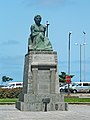
Galdós de Manuel Bethencourt, meets the Perez Galdós Theatre

Bust of Galdós in Rosario (Argentina), by Erminio Blotta (1943)
.jpg)


.jpg)
Movie adaptations
- The doubt (1916). Spanish film by Domingo Ceret that adapts the novel Grandpa.
- Grandpa (1925). Spanish mute film, directed by José Buchs, which adapts the homonymous novel.
- The crazy house (1926). Spanish film directed by Luis R. Alonso adapting the homonymous novel by Galdós.
- Marianela (1940). Spanish film directed by Benito Perojo and based on the homonymous novel.
- Adult (1943). Mexican film directed by José Díaz Morales that adapts the novel Grandpa.
- Doña Perfecta (1950). Mexinaca film directed by Alejandro Galindo and starring Dolores del Río. It is an adaptation of the homonymous novel.
- The crazy house (1950). Mexican film directed by Juan Bustillo Oro, adapting the homonymous novel.
- Mercy (1953). Mexican film by Zacarías Gómez Urquiza that adapts the homonym novel by Galdós.
- Other woman (1954). Mexican film directed by Juan Bustillo Oro from an own script that adapts the novel Reality.
- Grandpa (1954), also known as Storm of hatred. Argentine film directed by Román Viñoly Barreto adapting the homonymous novel.
- Marianela (1955). Argentine film directed by Julio Porter on his own script, based on the homonymous novel.
- Nazareth (1958). Mexican film by Luis Buñuel that starred Francisco Rabal and adapted the homonymous novel. He won the International Cannes Film Festival Award.
- Marianela (1961). Mexican telenovela produced by Ernesto Alonso and starring Magda Guzmán. It is an adaptation of Galdós's homonymous novel.
- Viridiana (1961). Hispanic-Mexican film directed by Luis Buñuel, based on the novel Halma. Received the highest award of the Festival de Cannes, la Palma de Oro, ex aequo with the French Une aussi longue absence.
- Grandpa (1969). Spanish film for television directed by Alberto González Vergel for Spanish Television. It's an adaptation of the novel Grandpa.
- Fortunata and Jacinta (1970). Spanish film that adapted the homonymous novel by Galdós. It was produced by Emiliano Piedra and directed by Angelino Fons.
- Tristana (1970). Spanish film directed by Luis Buñuel that adapted the homonymous novel by Galdós. She was a candidate for the Oscar Awards for Best Non-English-speaking Film.
- The doubt (1972). Spanish film directed by Rafael Gil and starring Fernando Rey from a script that adapts the novel Grandpa.
- Marianela (1972). Spanish film directed by Angelino Fons and starring Rocío Dúrcal. Adaptation of the homonymous novel.
- The Golden Plumb (1973). Television film directed by Jesús Fernández Santos for Spanish Television. It is the adaptation of the homonymous novel.
- Tormento (1974). Spanish film directed by Pedro Olea adapting the homonymous novel.
- Doña Perfecta (1977). Spanish film by César Fernández Ardavín adapting Galdós's homonymous novel.
- Mercy (1977). Spanish film directed by José Luis Alonso and Juan Mediavilla. Adapt the homonymous novel.
- Tormento (1977). Venezuelan telenovela produced and transmitted by the RCTV chain. It's a version of Galdós's homonymous novel.
- Fortunata and Jacinta (1979). Mini series of 10 episodes produced and issued by Televisión Española.
- Request husband to cheat (1987). Mexican film directed by Ismael Rodríguez, from It's forbidden..
- Flower and cinnamon (1988). Mexican telenovela produced by Eugenio Cobo for Televisa that adapted the novel Marianela. It is considered a remake of the 1961 version.
- Grandpa (1998). Directed by José Luis Garci and starring Fernando Fernán Gómez, she was a candidate for the Oscar Awards for Best Non-English-speaking Film. He adapted the homonymous novel, Grandpa.
Orders and Charges
Orders
- July 1, 1902: Big Knight of the Order of Alfonso XII.
Charges
- Representative to Courts
- 7 February 1897: Academician of the Royal Spanish Academy (Sillon N)
| Predecessor: Lion Galindo and Vera |  Academician of the Royal Spanish Academy Silla N 1897-1920 | Successor: Leonardo Torres Quevedo |
Galdosis
Contenido relacionado
Balthazar Gracian
Epistle
Harry Potter