
Battle

A battle could be defined as a combat between two or more contenders in which each of them will try to defeat the others. Battles most often take place during wars or military campaigns and can usually be well defined by space, time, and action taken. Wars and campaigns are guided by strategy while battles are the phases in which tactics are employed. The German strategist Carl von Clausewitz stated that "the use of battles to win the end of the war" it was the essence of the strategy.
Formerly, the center of an army was also called a battle, thus distinguishing it from its vanguard and its rear. Although, battle was also used in the past to define each of the groups into which an army was divided.
|"The battles are monotonous repetitions of the same absurd spectacle and in very few can the triumph of wit over force be noted."|
Characteristics of a battle

British military historian Sir John Keegan suggested an ideal definition of a battle as "something that occurs between two armies led by morality and then physically disintegrates between them" even though the Origins and results of many battles can rarely be summed up like this.
The "action" of a battle is based on achieving an objective — the ideal objective is victory but the strategy and the various circumstances that can occur often require a compromise. A contestant is considered to have achieved victory when his adversary has surrendered, fled, been forced to retreat, or otherwise become militarily ineffective. However, a battle can end in a Pyrrhic victory that ultimately favors the defeated contestant. If no battle objective is met, the result is considered a tie. A conflict in which one side inadvertently reaches an objective often ends up becoming an insurgency.
Until the 19th century most battles have been of short duration, lasting a day or less — The Battle Gettysburg and the Battle of Leipzig were exceptionally long, lasting three days. This was mainly due to the difficulty of supplying an army on the battlefield. The typical way to prolong a battle was to carry out a siege. Improvements in transportation and trench warfare increased the duration of battles to weeks and months, as was seen during World War I. However, in a long battle, the regular rotation of units meant that the periods of intensive combat to which an individual soldier was subjected tended to be shorter.
Battles can be on a small scale, involving a small number of individuals, perhaps two brigades, or on a large scale, thus involving entire armies where thousands of soldiers fight at once. The space that a battle occupies depends on the offensive capacity of the combatants' weapons. Until the advent of artillery and aircraft, the space where a battle was taking place did not go further than the eye could see. In addition, the depth of the battlefield has also increased in modern warfare, with backup units at the rear—supply, artillery, infirmary, etc. — that outnumber forward combat troops.
Typically, battles are a multitude of individual combats where the individual will experience only a small part of the events. For the infantryman, it may be very difficult to distinguish between combat as part of a minor assault or as part of a major offensive, and highly unlikely that he will be able to anticipate the course of the battle. Very few British infantrymen present on the First Day of the Somme, July 1, 1916, would have anticipated that they would be fighting that very battle in less than five months.
Battle Space
Battle space is a modern military term to define that unified strategy that integrates and combines the armed forces with the military theater of operations, including all areas: land, sea, air, information and space. This in turn implies taking into account and understanding all those factors and conditions necessary to obtain the maximum combat force, the maximum protection or the maximum guarantees of success in the execution of a mission. These factors imply full knowledge of the allied and enemy forces, the facilities, the climate, the terrain and the electromagnetic spectrum within the areas where the action is going to take place.
Factors that influence a battle
The course of a battle and its outcome are influenced by various factors. The number of men, the commanders of each army, and the advantages due to terrain are among the most important factors. In general terms, we can describe the following:
- Moral. The battles that have taken place throughout history have shown that the mood and quality of the troops are often more important than the quantity. Medical Wars, for example, show us as an army with superior morals can overcome against numerical disadvantages, especially in the Battle of Thermopilas. A good example of the opposite is the Battle of Gaugamela. The quality of the army is determined by the mood, which will depend on the spirit of the troops, the equipment and the training they have received. A unit that carries without any kind of discipline but with the high morals can come out victorious from the confrontation. This tactic was effectively employed by the French Revolution army.
- Arms. Arms and armor can also become a decisive factor, but it is not always so, as it could be seen in the Scottish Independence Wars, where the Scottish defeated the English despite having a very inferior weapon.
- Discipline. Discipline within troops is another very important factor. In the Battle of Alesia, the Romans, despite finding themselves in numerical inferiority, beat thanks to the fierce discipline of their training.
- Land. Battles can also be decided on the ground in which they develop. Capturing a high ground, for example, has been the main strategy in countless battles. An army that settles on a high ground forces the enemy to climb, which wears off and places the army in a position of inferiority. In addition, it is physically easier to attack from an elevated position than from a lower position. Although this factor has lost importance in modern war with the advent of aircraft, the land can still be vital for camouflage, especially for guerrilla warfare.
- General. The generals and commanders also play a decisive role in the fight. Julius Caesar and Napoleon Bonaparte were both excellent generals whose armies had a legendary success. An army that can rely on the orders of its leader with conviction of its success will always have a higher mood than an army that doubts every movement. The British at the Battle of Trafalgar, for example, blame their success for the reputation of the famous Admiral Lord Nelson.
- Strategy. The strategy employed in a battle can be decisive as Hannibal demonstrated in the Battle of Cannas having very few casualties against a higher enemy in number. Within a strategy, the battle order would be broken.
Types of battles

Battles can take place on land, sea or air. While the naval battles predate the V century BCE. C., air battles barely have a century of history, the most emblematic being the Battle of Britain in 1940. During World War II, naval and land battles have become air support. In fact, during the Battle of Midway, five aircraft carriers were sunk without the need for the fleets to come into direct contact.
There are several types of battles:
- One.Meeting battle"it is a premeditated battle, where both contenders face in the battlefield without having prepared their attack or defense.
- One.battle of wear"they intend to inflict greater loss on the enemy than on oneself. Many battles of the First World War were intentionally (Verdun) or involuntarily (Somme) battles of wear.
- One.step forward battle"the main objective is to end the defenses of the enemy by exposing the flanks, which remain in a vulnerable position and thus can be destroyed.
- One.ringing battle" — the German Blitzkrieg Kesselschlacht — surrounds the enemy in a bag (it is almost equal to a larger-scale enveloping battle, but breaking a gap through the enemy lines to sneak through them quickly advanced, and to be able to be unhindered until the movement of tongs ends.
- One.battle envelope" implies an attack by one or both flanks. The classic example is the double envelope of the Cannas Battle.
- One.battle of annihilation"it is that in which the defeated part is destroyed in the battlefield, as happened with the French fleet in the Battle of the Nile.
- One.decisive battle"it is of particular importance, because it puts an end to hostilities, as in the Battle of Hastings, either because it determines a decisive moment among the contenders, as in the Battle of Stalingrad. A decisive battle can have a great impact both politically and militarily, changing the balance of power and borders between countries. The concept of "decisive detail" became popular with the publication in 1851 by Edward Creasy The Fifteen Decisive Battles of the World. British military historians J.F.C. Fuller (The Decisive Battles of the Western Worldand B.H. Liddell Hart (Decisive Wars of History), among many others, have written books in the style of Creasy's work.
Differences between land battles throughout history
There is an obvious difference in the way battles are fought over time. The first battles must have been between totally disorganized rivals. The first convincing evidence of a major Bronze Age battle has recently been discovered. However, during the Battle of Megiddo, the first battle documented by a reliable source, in the 15th century BC. C., it can already be seen how royal discipline is being imposed on both armies. This continued throughout the Ancient Ages and the Middle Ages.
However, during the wars of the Roman Empire, the barbarians continued to use methods that involved disorganized (or only sparsely organized) mobs, such as for an ambush. Already in the Age of Enlightenment, armies began to fight in highly disciplined lines, where each one followed the orders of its officers and fought as a single unit instead of as isolated individuals, taking up the Roman tradition of combat. Each army was divided into regiments, battalions, companies, and platoons. These armies would march in line and in divisions. The Native Americans, on the other hand, did not fight in lines, but used guerrilla methods instead. The United States during the American Revolution also used this tactic. In Europe, during the Napoleonic Wars, disciplined lines continued to be used, even in the American Civil War. Later, during the First World War, a new style called trench warfare was imposed, essential given the low mobility of the army and the massive use of artillery and machine guns, the war became static as it could not open breaches of sufficient depth. This was followed by the radio, for communication between battalions. Subsequently, chemical warfare also emerged with the use of poison gas during World War I and the Austro-Prussian War.
In World War II, the use of smaller divisions, platoons, and companies became much more important as precise and vital operations bodies. Instead of the closed trench warfare of World War I, during World War II a dynamic web of combat took place where small groups met other platoons. As a consequence, the elite brigades became recognized and distinguished units. War vehicles have also developed and evolved rapidly in the last century, with the advent of the tank, which was able to replace the archaic cannons of the Enlightenment era. Since then, artillery has gradually replaced the use of frontal troops. Currently, modern battles maintain a style similar to that of World War II, although the latest technological advances have been added. Indirect combat through the use of planes and missiles has replaced a large part of the battles of war, where battles are reserved for those cities that are captured.
Differences between sea battles throughout history
_in_a_dry_dock_at_the_Pearl_Harbor_Naval_Shipyard,_29_May_1942_(80-G-13065).jpg)
A significant difference between modern naval battles and early forms of naval combat is the use of marines, which introduced amphibious warfare. Today, the marines are, in effect, an infantry regiment that sometimes fights only on land and does not remain attached to the navy for long. A good example of an ancient naval battle is the Battle of Salamis. In most ancient naval battles the engagement was carried out by very fast ships that used a ram at the bow in order to collide with the enemy ships and sink them, or else they maneuvered quickly to get close enough to allow a boarding. and thus enter into hand-to-hand combat. This tactic was often used by those civilizations that did not have the ability to attack the enemy with long-range artillery. Another invention of the early Middle Ages was the use of Greek fire by the Byzantines, in order to set fire to enemy fleets from a distance. Wrecking ships used the method of violently crashing and exploding against enemy ships.
With the invention of cannons, warships gained additional utility as support units for land warfare. During the 19th century, the development of explosive mines gave rise to a new type of naval warfare. Also, during the American Civil War, ironclad ships, a new type of ship capable of withstanding cannon hits, were used for the first time, quickly displacing wooden ships and making them obsolete. Later, during the First World War, the Germans invented the U-Boot, extending the spectrum of action from naval warfare to underwater terrain. With the development of aviation during World War II, the battles began to have a new stage, the air. Since then, aircraft carriers have become a staple in the field of naval warfare, acting as a mobile base for war aircraft.
Air battles throughout history

Although the use of aviation, in most cases, has always been as a support unit for land or naval confrontations, it has progressively acquired greater importance since its implementation in the First World War, where it began to be used as a small scale reconnaissance and bombardment unit, highly ineffective as they dropped hand bombs. The use of aviation in warfare became crucial after the Spanish Civil War and especially during World War II. Aircraft design went mainly in two directions: bombers, capable of launching explosive charges at land or ship targets; and the interceptors, which were used to shoot down enemy planes or to escort bombers to their destination (the clashes between planes were known as "dog fights" (from English: dog fights)). Notable air battles of this period include the Battle of Britain and the Battle of Midway.
Another major advance in the world of aviation came with the development of the helicopter, first used effectively during the Vietnam War. Currently the helicopter is still widely used to transport ground units to areas difficult to access for an aircraft.
Today, direct aerial confrontations are quite rare. The most modern interceptors are much more prepared and equipped to bomb ground targets with great precision, than to engage another aircraft in flight. In fact, to defend against enemy interceptors it is more common to use anti-aircraft batteries than fleets of aircraft. Despite this, aviation is used today as the main and fundamental support tool for the army and the navy, as has become clear in the essential use of helicopters to transport and support troops, in the use of bombers as the first attack in many confrontations and in the replacement of warships by aircraft carriers, which act as a mobile airbase and operations center.
Name of battles

Battles are almost always named after some geographic feature of the battlefield, such as the name of a city, forest, or river. Occasionally, battles may be named for the date they took place, such as The Glorious June 1. In the Middle Ages it was considered very important to choose a suitable name for the battles, since these could be immortalized by the chroniclers. For example, after England's victory over the French army on October 25, 1415, the then King Henry V of England met with the French herald chief to agree on the name of the battle, which, due to the proximity of the castle, it was called the Battle of Agincourt. It has also been the case that both contenders adopt different names for the same battle, as is the case with the Battle of the Dardanelles, which in Turkey is known as the Battle of Gallipoli. Sometimes, in battles that take place in deserts, since there are no nearby cities with which to name the battles, a name is adopted that coincides with the coordinates of the area on a map, as in the case of the Battle of 73 East in the First Gulf War.
Certain names of some places have become synonymous with the battles that took place there, such as Passchendaele, Pearl Harbor or the Alamo. Military operations, many of which end in battle, have code names that are not necessarily related to the type or location of the operation. Some of these operations that have ended in battle have given their code name to the battle, such as Operation Market Garden and Operation Rolling Thunder.
When more than one battle of the same conflict takes place on a battlefield, distinctions are made with ordinal numbers, such as the First and Second Battles of Bull Run. An extreme case of this situation can be observed in the twelve Battles of the Isonzo – First to Twelfth – between Italy and the Austro-Hungarian Empire, during the First World War.
Some battles are named by agreement among military historians in order to order and distinguish the periods of combat from each other. After World War I, a British Battle Nomenclature Committee was formed, with the aim of deciding on standard names for all battles and their subsidiary actions. For soldiers who had fought, the distinction was purely academic: a soldier who had fought at Beaumont Hamel on November 13, 1916, was probably unaware that he was taking part in what the committee would call the "Battle of Ancre."
Many fights are too small to deserve a name. Terms such as “action”, “skirmish”, “assault” or “offensive patrol” are used to describe small-scale engagements or battles. These combats usually take place within a battle itself and, although they have specific objectives, they are not necessarily decisive. Sometimes soldiers are unable to decide if the engagement they have been in is really a battle or just an action. After the Battle of Waterloo some British officers doubted whether the events that occurred throughout that day deserved the title of "battle" or had been a mere "action".
Effects of a battle
Battles have both individual (personal) and global (political) effects. The personal level effect of a battle can be both psychological and physical. The psychological effects can cause serious mental disorders in those individuals who have experienced traumatic situations during battle. For example, many battle survivors suffer from recurring nightmares or abnormal reactions to certain sights and/or sounds. The physical effects are those that only affect the physical integrity of the person such as scars, amputations, injuries, hearing loss, blindness and paralysis.
The effect at the political level is also evident. When a contestant wins a decisive battle, he can achieve the capitulation of the enemy by forcing him to submit to the victor's interests, either by ceding territory or by changing international policies in favor of the victor. The battles that have taken place in civil wars have decided the fate of monarchs and warring political factions. An example of this can be seen in the War of the Roses and the Jacobite Rising. It is also worth noting how battles can affect the continuation or end of a war. An example of this is the Battle of Inchon. Lastly, we must also mention the case of numerous battles that, having considerable personal effects, ultimately lack political effects. An overused example is what is known as a Pyrrhic victory.
Battles in art
Battle painting is a pictorial, subgender genre of history painting, which specializes in the representation of battles. The differentiated characteristics of a naval battle and a terrestrial battle (and within the land, those of a singular battle, a skirmish, a campal battle, a siege, an artillery duel -with or without trenches-, a load of cavalry, etc.) are marked both in the painting of landscapes and in the elements of the battle (uniforms, weapons and gears, ships, horses, etc.
Although it has precedents from ancient art (Naram-Sin star, relief from the battle of Qadesh in the temple of Ramses II (Abu Simbel), war scenes in Greek ceramics, battle of Issos in the mosaic of Alexander), it is in the Renaissance when it begins to develop, with examples such as the battle of St.Roman Ucello (which represents in three tables represented), the battle of Ostia

Battle of San Romano (Florence).

Battle of San Romano (Paris).
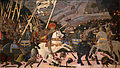
Battle of San Romano (London).
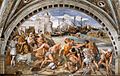
Battle of Ostia.

Battle of Cascina.

Battle of Anghiari.

_01.jpg)
_01.jpg)


Already at the time of Mannerism, Philip II commissioned in the battle gallery of the Monastery of El Escorial a group of Italian fresquisites to represent a set of battles that glorify the Hispanic Monarchy of Philip II, beginning with some medieval times and ending in the battle of San Quintin; on the surface they are one of the most ambitious pictorial programs. The battle of Lepanto was among the most used by the painters of the late 16th century.

St. Quintin siege (La Escorial Battles Gallery).

Battle of Lepanto (anonymous).

The Virgin of the Rosary protects the Christian navy in Lepanto (church of the Magdalena de Sevilla).
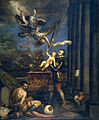
Philip II offers to heaven Prince Don Fernando, at the bottom is the battle of Lepanto (Tiziano).
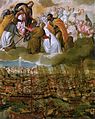
The saints pray for the Christian victory in Lepanto (Veronés).


In the Baroque we reached an extreme of precision and detallism of engravings and oils of large dimensions in the spatial representation of the topographic views where the battles were located, with the sieges of the cities and the corps of army seen to "bird sight" or with forced perspectives (high up the horizon line). The foreground, especially on the sides, was reserved for special figures, such as the leading military. Among the artists specializing in the genre were Sebastian Vrancx, Jacques Callot, Pieter Snayers, Jacques Courtois, Pieter Meulener, Michelangelo Cerquozzi, Adam Frans van der Meulen, etc. A particularly remarkable artistic program was the decoration of the Hall of Kingdoms of the Palacio del Buen Retiro, where works of Velázquez, Zurbarán, Mayno, etc. were located.
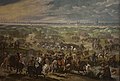
Vrancx.

Callot.

Snayers.

Cerquozzi.

Meulener.

Courtois.

Van der Meulen.
_-_Veldslag_(1640)_-_Sevilla_Bellas_Artes_22-03-2011_12-07-38.jpg)
_().jpg)


.jpg)
In contemporary painting the genre has continued.

The Battle of Trafalgar (J.M.W. Turner).

Napoleon in the battle of Eylau (Antoine-Jean Gros)

The Rendition of Bailen (House of Alisal).

Battle between the Kearsarge and the Alabama (Manet).

Battle of Magenta (Gerolamo Induno).

Charge of the Royal Squadron of Carlos VII (Augusto Ferrer-Dalmau).
.jpg)

.jpg)


Contenido relacionado
Defense of Normandy
George Patton
Antonio de Villarroel
Squad 201
Philippine-American War