
Barquisimeto
Barquisimeto is a Venezuelan city, capital of Lara State, located in the Central-Western Region of Venezuela. Barquisimeto became known nationally and internationally as the musical city of Venezuela and for being the hometown of the poet and 2022 Cervantes Prize winner: Rafael Cadenas
Barquisimeto is the fourth most populated city in the South American nation after Caracas, Maracaibo and Valencia and the first in the state of Lara. It is considered the main urban, cultural, economic, educational and industrial center of the Central West with a population of 1,259,092 inhabitants. Its metropolitan area, Greater Barquisimeto, has an estimated population (2011) of 1,853,177 inhabitants and is made up of 7 parishes in the Iribarren municipality and 3 in the Palavecino municipality.
Toponymic origin

The city began during the process of Spanish colonization in America from 1530 when it was named Caquetía de Variquicemeto Province in 1530 by the Tudesco Nicolás Federmann, laying the foundations on which the regional colonial social and spatial formation will be built; then during the year 1552 by the Segovian Juan de Villegas, in the current town of Villas de Buria, which makes it one of the 10 oldest cities in Venezuela and consequently in America.
Finally, Barquisimeto would be located on a terrace to the north of the Turbio River. The valley region was already inhabited by indigenous people such as the Caquetíos, Gayones and Jirajaras upon the arrival of the Spanish. The city gets its name thanks to this last indigenous group, a fact that was documented by the German Nicolás Federmann, in the book Indiana History of 1557. The name of those born in Barquisimeto is "barquisimetano" in the masculine and "barquisimetana" in the feminine. However, historically, the inhabitants of Barquisimeto have also been nicknamed "guaros" this expression has its origin in a characteristic phrase of the people of Barquisimeto; "Na' Guará" or "Una Guará".
Recently it became known that the matrix of the expression can also come from Central America, since in earlier times, specifically in the mid-16th century, this city was part of what was the jurisdiction of El Tocuyo.
It is known from written documents that they were great merchants who did multiple businesses in the Kingdom of New Granada, and Tocuyan merchandise arrived as far as Peru and Central America. This thesis is supported by tangible realities since the creation of the Tocuyo-Tunja road is documented in the archives of that city. What is noteworthy is that the Tocuyanos brought back multiple products from the places where they arrived. This is how Tunja Bread became so deeply rooted in this area, even to this day.
According to a local study for a Sunday magazine, the origin of this expression was studied in the southwestern towns of what is now Lara State, where it was learned by oral testimony that many years ago some cattle dealers brought a liquor known as guaro which came packaged in a leather, from which they made a kind of rejo or guaral, which was called "guará". Which they used to drive cattle, and even to correct the "boys". From there it is believed to be its use. It is used to signal surprise or exclamation, it is customary to recognize a countryman born in Larense. It is also popularly called "barquisimetido/a", those who are born in other places and come to live in the city, expressing a great sense of belonging as if they had been born here.
History
Colonial Period
The valley where the city is located was inhabited for centuries by different ethnic groups, such as the Axaguas, the Caquetíos, the Gayones and Jiraharas, among which the Caquetíos predominated with great influence, to whose language most of the Larense place names that still survive. These settlers were part of a great Arawaca nation that stretched from the Caribbean Sea to the Orinoco River.
The arrival of the Europeans for the first time in the Barquisimeto valley was led by Nicolás de Federmann, a German officer, from the house of the Welsers of Augsburg, who left Coro with 110 Spaniards on foot, 16 on horseback and 100 Caquetíos. In relation to this trip, Federmann alludes to the fact that the indigenous people of the area "formed a numerous and very warlike people" and that they lived on "the banks of a great river." According to Federmann, those had been forced by the Caquetíos to live in the mountains, because they wanted to be the only ones to occupy and govern the flat and very fertile land of the Turbio Valley.
The history of Barquisimeto as a city begins in the year 1552 when the Segovian official Juan de Villegas was in El Tocuyo, the first city founded in the center west of Venezuela; base of operations from where the process of the Spanish conquest of the current national territory began.
There, Juan de Villegas receives an urgent message sent to him by an Indian, Damián del Barrio, with news to his liking: in the mountains of Buría, the river of the same name, dragged pieces of gold in the current, reason for which De Villegas marches towards the place of discovery. The novelty caused a stir among the residents of El Tocuyo, who, given the opportunity to get rich quickly and easily, abandoned agricultural work and followed Juan de Villegas. The expedition manages to reach Buría the same year, where Juan de Villegas founded Nueva Segovia and added the indigenous word "Buría", the name of the area. This city served as support for the exploitation of gold mines.
In the town of El Tocuyo, singles and some "German" or "tudescas": like the Meckle, Grübel, Heslin, Lebzelter; that they were no longer in favor of the Welsares, additionally the Swiss-German Joachim Ritz was the first notary of the newly founded city, as well as Bernard Heslin, who was also Mayor of Barquisimeto.
The settlement in Buría did not last long, since the rapid extinction of the mines, the decimating diseases and the deadly scourges that struck those inhabitants, were the decisive consequences of the compulsory emigration, an event that occurred in 1556.
In 1556, the town began to rise again, this time in the place called El Carabalí. This time under the name of "Nueva Segovia de Barquisimeto". When the small city began to consolidate, in 1561 it was turned into ashes by the tyrant Lope de Aguirre and his cashews from Peru.
Lope de Aguirre was persecuted and killed by one of his cashews. This action caused the small city to change its settlement again for the third time. Nueva Segovia was built on the site known as "Desembocadero de Barquisimeto" where the Turbio and Claro rivers converge. Unfortunately, it suffered heavy flooding due to the instability of the chosen site, so it was built again in another place.
Finally, and for the fourth time, Nueva Segovia de Barquisimeto changed location in 1563, occupying the plateau where it is currently located, eleven years after Juan de Villegas founded Nueva Segovia de Buría. It is from this settlement that the city began to truly develop, whose most outstanding characteristics were the mathematical symmetry with which it was built, becoming an advanced population in terms of its colonial aspect, whose development from that moment on was uninterrupted and growing, finding us with the current Barquisimeto.
The first plan of the city with a descriptive report was obtained by the first mayors of Nueva Segovia in 1579, (seven years after the resolute decision to build the city on the savannah plateau), who noted in detail the names of its streets: Calle de Santiago, Calle de Mar, Calle de Damas, Calle de San Cristóbal and Calle del Tocuyo. Likewise, the report lists all its inhabitants with their names and surnames, coming from “from the Kingdoms of Castilla”, highlighting “Joan de Villegas, a native of Segovia, General by the Royal Court of Santo Domingo in the year fifty-two”. Also noteworthy on the list are Captain Diego de Losada as a resident Councilor, Captain Esteban Mateo and Captain Damián del Barrio, among thirty other names. It is noted that there were only 40 houses and a total of approximately 200 inhabitants.
Since its beginnings, the city of Barquisimeto, due to its privileged position, begins to notice signs of development. On March 9, 1779, in an intense pastoral visit, Bishop Mariano Martí arrived in Nueva Segovia, to carry out a detailed census where he observed that "this city is owned by Spanish neighbors who are its main inhabitants". He pointed out that there were 303 houses, 392 families and 8,776 inhabitants, describing that “This hospital [San Lázaro] is built in a corner of the main square of the said city of Barquisimeto, at a distance of a quadra little more or less from its parish church (La Concepción) towards the west”.
The report of the founders of Nueva Segovia points out that the hospital was built by the “cleric priest of this town whose name was Pedro del Castillo. The invocation belongs to Mr. San Lázaro, he left him one hundred pesos, and with this poverty he supports himself with their income".
He was independentista
During the Independence of Venezuela, Barquisimeto joined the emancipatory movement and its deputy José Ángel Álamo signed the Declaration together with other heroes on July 5, 1811. Barquisimeto was visited several times by the liberator Simón Bolívar, the city was the scene of one of the battles of the Admirable Campaign, the battle of Los Horcones, where today a monument is erected in its commemoration.
Barquisimeto in the 19th century and early 20th century


At the beginning of the 19th century, there are records that the city had between eight and ten thousand inhabitants, and it was possible to notice the boom of growth and progress that it took, since the number of houses and buildings did not drop below three thousand The names of the longitudinal streets, starting on the side of the Turbio river were: Obispo Villarroel, from La Paz, later called Regeneración; del Puente, which they officially named the Illustrious American; of the Islanders, named after Ayacucho; and Calle Real, which they called del Libertador, the last street on the side of the savannah. The first existing churches in the first decade of the 19th century were La Concepción, which was still the parish church; Our Lady of Altagracia, Our Lady of San Juan and that of San José.
The main square of the city was to the south of the Concepción Church, the current square that was first called Miranda and currently Bolívar, which was a block occupied by houses. The city cemetery was located in the spaces where the church of Altagracia is currently. In the year 1812 an earthquake devastated the city, destroying important structures, such as the façades of several churches and many houses.
In 1873, the State of Lara had a population of 143,818 inhabitants, corresponding to Barquisimeto 42,203 people, according to demographic information from the old chroniclers of the city. With the passing of time, specifically in 1891, the city had 9 longitudinal and 13 transversal blocks, expanding its urban grid in 1922 to two main avenues: Libertador street, which divided Barquisimeto from west to east, and Juáres street, that separated it from north to south, complemented by 11 longitudinal streets and 21 transversal ones. The streets were cobbled and most of them had a dirt floor. Most of the sidewalks were made of brick and it was General Aquilino Juárez –governor of the city-, who cemented some of them when he built Plaza Miranda (Today Bolívar).

In February 1877, the President of the Republic, General Antonio Guzmán Blanco, started up the Bolívar Railway in its Tucacas-Aroa section, and later Dr. Raimundo Andueza Palacios -in January 1891- inaugurated the El Hacha stage- Duaca-Barquisimeto, a fundamental work that commercially united the west with the center of the country. The railway station was located in the spaces that today are dominated by the Cathedral of Barquisimeto, this being the epicenter of commercial, artistic, cultural and sports activities. One of the largest works was undoubtedly the Public Market, in the spaces now occupied by the National Building, built in 1881 by General Jacinto Fabricio Lara, son of Jacinto Lara, hero of Independence, who held the post of first magistracy. of the Great State of Lara.
In 1890, the aqueduct was inaugurated in Barquisimeto, decreed by the Liberator as he passed through the city in 1821. In 1896, there was a notable improvement in the public lighting service with the change of lanterns for electric bulbs.
In 1897, to reduce the circulation time of goods and passengers, the Barquisimeto tramway was inaugurated, built by the engineer Andrés Palacios Hernández and managed by the Bolaño company whose manager was Celestino Frayle García. At the initiative of Aquilino Juáres, governor of the state of Lara, said tramway was built and Comercio street is furrowed with rails on which a wagon pulled by beasts moved. It was put into operation in September 1897.


The little horse tram -as it was known- started from Bolívar square (Today Plaza Lara) with a main branch along Catedral street (23rd street) then going up Comercio street (20th avenue), crossing 5th avenue de Julio (30th Street) to the railway station located in the current Lara Police General Command, “epicenter of commercial, artistic, cultural and sports activities”. The great splendor of the tram forced the Government to hire another branch from the corner of Villoria (23rd Street and 20th Avenue) to the Altagracia church, and another additional one to the west for commercial houses.
The responsibility for the construction of the tram lines fell to Andrés Palacios Hernández and the first manager of this means of transport was the Spanish Celestino Fraile García.


20th century
In 1929, the city went through a modernization program carried out by General Eustoquio Gómez. The streets and avenues were fixed and buildings such as the Jacinto Lara General Headquarters, the Government Palace and the Ayacucho Park were built.
In the General Guide of Venezuela, Lara state section, published in Germany on January 15, 1929, its author Frederick Benet, points out that there were 131 educational establishments in the jurisdiction with 6,262 students distributed as follows: the Federal Government maintains 3 colleges with 63 students, 12 graduate schools with 1,391 students; 78 one-teacher schools with 3,090 students for a total of 4,544. The State Government maintains 7 one-teacher schools with 223 students and 3 special institutes with 89 students, for a total of 309. In the same year, it details the demographic density at that time, noting that in the Barquisimeto District there were a total of 28,029 males., 31,158 females for a total of 59,187 inhabitants and 10,607 homes.
Regarding agricultural production, he points out that in Lara 250,000 liters of cane brandy were produced per year and 500,000 liters of cocuy brandy; and 6 million pieces of paper in the different sugar mills. He also mentions the production of other items, including coffee with 8 million kilograms, beans and legumes with 15 million, corn with 40 million, among others. Livestock wealth is also mentioned, highlighting 82,503 heads of cattle; horse 8,803; bottlenose 6,427; donkey 16,704; goat 402,920; sheep 23,325 and pigs 24,325.
Regarding buildings, he points out that Barquisimeto, the capital of Lara state, "has a large hospital: La Caridad, located on Calle Obispo y del Cuartel". Also a public library: La Bolívar, located on Calle de Lara; and a theater called Juárez between Juárez and Libertador streets. Two asylums and a seminary: Santo Tomás de Aquino on Obispo Sur street.
Details of the Catholic temples Altagracia on Falcón street; Cathedral on Cathedral Street; Conception, Obispo street; San José, Marqués and Juárez streets; San Juan, San Juan street; "a magnificent post office building, on Calle del Comercio". Likewise, two sanctuaries: Nuestra Señora de La Paz and Nuestra Señora de Lourdes, on the Trasandina highway. In addition to two temples: a Protestant one, the Bethel Chapel, and the Masonic one, the Lodge Estrella de Occidente Nº 50.

According to the official chronicler of the city, the main buildings in Barquisimeto stood out not because of their monumentality but because compared to the rest of the houses, their structure was much larger: Government Palace (25th street with 15th street), Juárez Theater, La Caridad Hospital (today the Barquisimeto Museum), the Public Market, located where the so-called National Building now stands, the Public Slaughterhouse, today the San Juan Market, Bolívar Bridge, Railroad Offices located on the land now occupied by the Barquisimeto Cathedral on Avenida Venezuela, the Episcopal Palace, on land where the Tower of David now stands and, of course, the temples of San Francisco, which was then the Cathedral, the Immaculate Conception, La Paz, Altagracia, San José, which was being rebuilt, and the one in San Juan was barely in the factory, its construction was paralyzed.

In 1952, the Cuatricentennial of the Barquisimeto Foundation was celebrated, a city with approximately 100,000 inhabitants. On September 12 of that year, the members of the Governing Board, the executive ministers, arrived at the airport National and other personalities. That day, the Board made up of Germán Suárez Flamerich, who chaired it, and Colonels Marcos Pérez Jiménez and Luis Felipe Llovera Páez, inaugurated the statue of Miranda, the Fine Arts Building, the Nueva Segovia Hotel, (today the UCLA Chancellor's Office) and the Obelisk, an emblematic work for the date, announced by the governor of Lara, Esteban Agudo Freites, on June 24 and being commissioned by the engineer Rodríguez Delpino and the architect Gutiérrez Otero, 65 meters high, internal elevator, stairway, access ramps, perimeter avenues and a large parking lot. The structure is built of reinforced concrete and was the tallest in the country. From its viewpoint, you could see the entire city.
In 1953, the new headquarters of the Antonio María Pineda General Hospital of Barquisimeto was inaugurated at a cost of thirty-five million bolivars. The new headquarters consists of six floors and a basement. Pedro Gutiérrez, Minister of Health and Social Assistance, and Julio Bacalao Lara, Minister of Public Works representing President Marcos Pérez Jiménez, were present at its inauguration.
In 1953 construction began on a new cathedral for the city under the responsibility of the architect Jahn Bergkamp. In 1968 the Metropolitan Cathedral of Barquisimeto was completed, the first major project built by the renowned architect.
Finally, Barquisimeto in the last decades of the 20th century, like the rest of the country, entered a strong crisis that moderately slowed down the development of the city.
Barquisimeto of the 21st century and today
The beginning of the century for the city brought with it thriving development and improvements for the city, a huge rebound in terms of investment in construction, industry, shops and services, which has reinvigorated the growth of this city, which has consolidates its position as the fourth city in Venezuela. That is why in recent years, numerous shopping malls, hotels, office buildings, residences, and business centers have appeared in all its growth poles.
Among the important achievements of the 21st century we have, the implementation of the recovery of the historic center of the city, a work of great tourist importance; the creation of a financial and development district in the area called "Triángulo del Este"; the development as a commercial center of Avenida 20, an important commercial development nucleus of the city center; the implementation of different road infrastructure works, such as the modification of Av. Ribereña to turn it into an express road; the construction of different distributors; the start-up of a rapid transit bus system that serves as a mass transportation system for the city, among other works.
Urban development


The area occupied by Barquisimeto was three times greater in 1990 than it was in 1964. This vertiginous growth is associated with the low pattern of density with which the metropolitan area expanded in that quarter of a century.
The city is a huge urban extension, with some 37.8 thousand hectares occupied in 1993, which has been expanding from a central nucleus, incorporating other small rural towns that are being transformed to urban uses, but maintaining the functional domain of the traditional center.
Barquisimeto in its central area maintains the reticular structure typical of settlements of Spanish colonial origin. The main institutions of the State of Lara and the city are located there and a good part of the metropolitan commerce is concentrated. It preserves some residential sectors, however, it is evident the displacement of residents towards the rest of the urban area, leaving the central area more and more as an administrative and services nucleus, whose hierarchy gives the city a centralist character.
On the other hand, another sub-center is identified in the process of development in the vicinity of Avenidas Lara and Los Leones, in the East sector, characterized by the concentration of private sector offices, financial institutions and metropolitan services.
In addition to the main center and the aforementioned sub-center, the urban structure of the current city is made up of axes that concentrate various commercial and service activities such as: Carrera 19, Avenidas 20, Pedro León Torres, Lara and Florencio Jiménez in an east-west direction and Avenidas Vargas, Andrés Bello, Rómulo Gallegos and Calles 24, 25 and 26 in a north-south direction.
Another important component of the urban structure of the city are wide spaces with specialized uses such as industrial zones and the wholesale market, centers of higher education and the headquarters of communications services such as the airport and the railway station, all to the west center.
The Turbio Valley is integrated into this urban configuration, whose landscape characteristics give the area environmental identity and constitutes a separator element of the urban fabric between Barquisimeto, Cabudare and the El Manzano sector to the South, allowing spatial and functional differentiation. Likewise, a set of hills separates the central area of Barquisimeto from the developments in the El Cují and Tamaca sectors to the north and Pavia to the northwest.
The urban image is not uniform in the different sectors that compose it, the state of the buildings, roads and public spaces offer a different urban landscape towards the East of Barquisimeto, where there is a high level of consolidation and urban comfort in comparison with the rest of the city; where a more heterogeneous situation is observed, especially in the most depressed sectors.
The central area of Barquisimeto reflects an important combination of traditional constructions and modern buildings, all in the same urban fabric, where the continuous substitution of buildings and the proliferation of empty lots are perceived. Also noteworthy are the squares, churches and the headquarters of public institutions that constitute landmarks in the midst of a heterogeneous landscape.
Around the central area, there are large, more homogeneous spaces for residential, educational, and industrial uses, and towards the ends of the urban polygon, sectors occupied by residences that outline a transitional landscape between the urban and the rural.
Thanks to its practically flat topography, the city of Barquisimeto has grown orthogonally since its inception, which makes it unique among the different cities of Venezuela, since the space occupied by this organization is quite large and does not cover only the center, as in the other cities. Around the 50s and 60s, the city stopped growing in a grid to begin to adapt to the geographical situations of the areas towards which it expanded.

Geography

It is located on the terrace of the same name, on the banks of the Turbio river. Barquisimeto is geographically located in the center-west of Venezuela (353 kilometers (219 mi) from Caracas, the capital of the country), which can be traveled in between 4 and 5 hours by car, being a convergence point for many of the main land and railway routes (Instituto de Ferrocarriles del Estado IFE Eje Ferroviario Simón Bolívar); Barquisimeto is also characterized by its order and appropriate signage, thanks to the location of the city with an almost completely flat relief, which facilitated the distribution of the urban area in a grid and with the streets numbered in ascending correlative order, factors that help the citizen and the foreigner to locate addresses with ease. Its climate is pleasant in the months of December to March.
Climate
In Barquisiemto the climate is warm semi-arid (Köppen climate classification: BSh) although it is attenuated due to its altitude at about 650 meters above the sea, which makes its climate pleasant to what it should be normally. In Barquisimeto, the summers are short, hot, muggy, dry, and overcast and the winters are short, hot, oppressive, wet, and mostly cloudy. During the course of the year, the temperature generally ranges from 20°C to 31°C and rarely drops below 19°C or rises above 34°C. A wet day is a day with at least 1 millimeter of liquid or liquid equivalent precipitation. The chance of wet days in Barquisimeto varies significantly throughout the year. The wetter season lasts 7.3 months, from April 15 to November 25, with a greater than 26% chance of a given day being a wet day. The peak chance of a wet day is 49% on July 4. The drier season lasts 4.7 months, from November 25 to April 15. The smallest chance of a wet day is 4% on January 15. Among the wet days, we distinguish between those with only rain, only snow, or a combination of both. Based on this categorization, the most common form of precipitation throughout the year is rain alone, with a peak chance of 49% on July 4. The rainy period of the year lasts for 9.8 months, from March 8 to January 2, with a sliding 31-day rainfall of at least 0.5 inches. The most rain falls during the 31 days centered around May 14, with an average total accumulation of 3.5 inches. The rainless period of the year lasts for 2.2 months, from January 2 to March 8. The approximate date with the least amount of rain is January 24, with an average total accumulation of 8 millimeters. The muggier period of the year lasts for 9.4 months, from March 21 to January 1, during which time the comfort level is muggy, oppressive, or miserable at least 67% of the time. The muggiest day of the year is August 17, with humidity 96% of the time. The least humid day of the year is January 23, with humid conditions 58% of the time.
 Average climatic parameters of Barquisimeto, Venezuela Average climatic parameters of Barquisimeto, Venezuela | |||||||||||||
|---|---|---|---|---|---|---|---|---|---|---|---|---|---|
| Month | Ene. | Feb. | Mar. | Open up. | May. | Jun. | Jul. | Ago. | Sep. | Oct. | Nov. | Dec. | Annual |
| Average temperature (°C) | 25 | 29 | 33 | 33 | 30 | 29 | 31 | 30 | 30 | 30 | 30 | 28 | 29.8 |
| Average temperature (°C) | 20 | 22 | 23 | 24 | 24 | 23 | 23 | 26 | 24 | 24 | 24 | 21 | 23.2 |
| Temp. medium (°C) | 12 | 15 | 18 | 18 | 19 | 15 | 16 | 17 | 16 | 18 | 19 | 15 | 16.5 |
| Total precipitation (mm) | 10.2 | 7.6 | 15.2 | 66.0 | 76.2 | 78.7 | 76.2 | 53.3 | 38.1 | 48.3 | 48.3 | 25.4 | 543.6 |
| Rainy days (≥ 1.0 mm) | 1.5 | 1.2 | 1.7 | 5.5 | 7.9 | 12.0 | 10.6 | 8.1 | 5.8 | 6.1 | 6.4 | 4.0 | 70.8 |
| Hours of sun | 145.4 | 177.3 | 190.8 | 163.0 | 186.2 | 181.0 | 183.5 | 191.8 | 178.0 | 190.3 | 178.0 | 148.0 | 2113.3 |
| Relative humidity (%) | 68.5 | 66.5 | 65.5 | 70.0 | 74.0 | 75.0 | 74.5 | 73.0 | 72.5 | 73.0 | 73.0 | 72.0 | 71.5 |
| Source: The Weather Channel Interactive, Inc. January 2012 | |||||||||||||
The highest record temperature is 39 °C in 1998 and its lowest record temperature is 7 °C in 1980. Record low temperatures 9 °C July 21, 1983, 10 °C August 8, 1992, 11 °C July 8, 1991, 12 °C April 4, 1997, 13 °C November 23, 2008.
Large magnitude earthquakes (Richter scale):
- 6.6 (3/08/1950)
- 5.6 (5/3/1975)
- 6.3 (12/09/2009)
Demographics
Population
The population of Barquisimeto has been experiencing a significant increase since its inception. This is due to the positioning of the city, suitable for urban growth. This growth and the lack of urban planning led to the organization of substandard housing and residential areas, mainly in the northern and western parishes, where public services have not yet fully arrived.
In 1873, still colonial in the independence phase, the population of the region was 143,818 people, in a density of 7.3 (Hab/Km²); in 1941, the year in which the census began to be carried out by the National Institute of Statistics, the population was 332,975 and the density 16.8 (Hab/Km²); in the 2011 census, the population was 1,774,867 and the density had increased to 89.6 (Hab/Km²). If the figure recorded by the 2011 Census is compared with that of 1961, it turns out that the population volume has increased 3.6 times, going from 489,140 to 1,774,867 inhabitants.
Barquisimeto is one of the seven metropolises of Venezuela and ranks fifth in terms of population. It is the head city of the central-western region, which caused several migrations to occur that are still standing to this day. A notable population of foreign origins coincides in it, including Asians and Europeans, mainly Italians and Spanish.
- Demographic developments in Barquisimeto since 1779

- Source: Urban population in Venezuela: a look at the past and a prospective vision of the present and the future, INE, census 2011. Projections 2013 INE - CNE
Note: The censuses between 1779 and 1881 were carried out between the colonial and independence eras. From 1941 to 2011 they are censuses carried out by the National Institute of Statistics and the population of 2013 is a projection of the INE for the CNE. Since 1941 the population of the Palavecino municipality began to add up
Ethnography
Its population is made up of a majority of mestizos and whites, with significant black/Afro-descendant and Amerindian minorities.
In the city there are different population groups from various parts of the world, the most relevant being the Chinese community, which comprises 1.3% of the city's population.
The population for 2013 was divided as follows:
- Mestizos: 50.8 %
- White: 43.0 %
- Black/Afrodescendants: 2.2%
- Amerindians: 1.0 %
- Other: 3.0%

Political-Administrative Organization
The city of Barquisimeto is governed by two Town Halls, one based in the center of the city (the main and largest one) and the other based in Cabudare, to the south of the city. Whose representatives are elected every four years by universal suffrage. The bodies are chaired by the mayor of Iribarren, Luis Jonás Reyes, and the mayoress of Palavecino, Mirna Vies, from the PSUV.
Barquisimeto is administratively divided into 2 municipalities, which in turn are subdivided into parishes. Each of the municipalities is administered by the Mayor and by the Municipal Council, with powers focused on citizen regularization and the creation of ordinances, while the parishes are presided over by Civil Chiefs who are in charge of legal and bureaucratic efforts.
|


Source: INE - CNE 2013 projections
Metropolitan Region
Because it is the capital and most populous city of the state of Lara and is the head city of the central western region, Barquisimeto exerts great influence on its neighboring towns of Lara and other states such as Portuguesa and Yaracuy. Some populations of the named states have a direct relationship in the commercial, labor, educational, health and even recreational areas.
The populations that are considered as the area of influence of the metropolitan area of Barquisimeto are: In the state of Lara, Duaca, El Tocuyo, Quibor, Sanare and Sarare; In the state of Yaracuy, Yaritagua, Chivacoa, Urachiche, San Felipe and Sabana de Parra and in the state of Portuguesa, but not so directly in the Acarigua-Araure conurbation.
| Municipality | ! % of Poverty | % of Extreme Poverty |
|---|---|---|
| 1. Municipality Iribarren | 22.27% | 10.38% |
| 2. Municipality Palavecino | 9.79% | 3.63% |
Symbols
Shield

The Coat of Arms of Barquisimeto was instituted to celebrate the four hundredth anniversary of the founding of the city. It was chosen through a contest opened by the Municipal Council, the same in which the prototype presented by the plastic artist José Requena was the winner, who describes it as follows:
At the top right quarters a blue field and on this, the effigy of the founder of the city Juan de Villegas, supported by two rampant lions. The golden beam of the middle symbolizes the trade and wheel dented within this symbolizes the industry, cardinal elements of urban development. In the upper left quarter, also blue, there is a sisal tree, which abounds in the barquisimetan plateau. In the middle horizontal part of the shield, an arch with the national tricolor gives way to the solar rays that bathe the lower barracks where the weapons of the city are in turn represented by pavilions, slangs, a brilliant sword and a cover full of arrows, against position symbolize the arts and spiritual wealth of the Barquisimetanos by means of a lira, a pallet, a pental. The entire perimeter of the shield is wrapped by a baroque arabesque and at the top as a crown, a fortress holding a tape with the word “justice” and on it two goat heads coming out of a ring.
Flag
Rich in symbology, the flag of the city of Barquisimeto, waved for the first time on September 14, 1990, its author describes it as follows:
The grey represented in this flag represent the ashes waters of the Rio Turbio. The yellow and red colors displayed in diagonal lines simulate the Monument to the Nascent Sun and at the time allude to the twilights; on them the image of The Obelisk, symbol that for 50 years has been erected as an emblem of the Barquisimetanos, all together evoke the purest representations of the barquisimetan idiosyncrasy.
Anthem
The hymn of the city seeks to represent it in poetic symbology. The lyrics go hand in hand with Alberto Aguirre Rojas and the music was composed by Rodrigo Riera and Carlos Mendoza.
COROGood, industrious and fertile land
High emblem, nobility and loyalty!
With the laur and the bronze in which it abounds
gave the country its stable inheritance! I
There they are, of their fertile meadows,
The parrot splendor that in the ages,
He's wearing golden cuffs.
His wandering of opulent flags II
She melts in the burning jar
The plows the people wear,
Labra surcos with sudorous face
And conquer the bread his moose III
Generosa a la par diligent,
Transparent hydalguía castiza!,
Alma procer del garbo occidente
Segoviana, brunette and bravia!
Economy

The location of Barquisimeto in the interior of Venezuela allows it to be a confluence of land routes between the central and western regions, with the western plains and the south, with the coastal axis to the north, with the Andes to the west and with Zulia to the northwest. In addition, it is located next to a fertile valley, which has contributed to agricultural production, the development of commerce, service, and the manufacturing industry, which are the main economic activities in the urban area. Because it is located on a high plateau, the city of Barquisimeto is one of the few Venezuelan cities with a hypodamic urban plan.
After a profound stagnation in the 1990s, in this decade, there has been a huge rebound in terms of investment in construction, industry, shops and services, which has reinvigorated the growth of this city, which is consolidated in its place as the fourth city of Venezuela. That is why in the last three years, numerous shopping centers, hotels for all strata, office buildings, residences and business centers have appeared in all its growth poles.
We can also mainly highlight the proximity to the Twin Cities of Acarigua - Araure, Center of Agroindustrial and Food Pole of the country; which facilitates commercial relations and the development of food activity in the city, thus having great economic growth between both cities.
In this city, the clearly urban activities linked to industry, commerce and services stand out, as well as the exploitation and transformation of non-metallic minerals and agricultural production, mainly coffee harvested in the Río Claro area.
In addition, it concentrates more than 80 percent of the manufacturing establishments of the State, with a strong orientation towards the production of food and the manufacture of foundry and mechanical metal products.
Since 1983, the largest wholesale market in Venezuela has existed in the Industrial Zone III of Barquisimeto, known as MERCABAR (Barquisimeto Wholesale Food Market), which has a land area of 108 hectares (42 of which are developed)., whose main activity is the production of public services, intended for sale and whose income comes from this activity. One of its main objectives is to provide, maintain and manage adequate spaces for the organization of wholesale trade in its area of influence.
Communications and transportation

The city of Barquisimeto is one of the few Venezuelan cities that still preserves the urban pattern appropriate to the Spanish grid; this due to rigorous urban planning as well as sustainable growth; however, cities close to the city, such as Duaca, Quíbor or Cabudare, have constituted, due to their demographic growth, a challenge for the urban link with these "dormitory cities". Barquisimeto is distributed between streets, streets and avenues, which by numbering facilitate the location of an address or a particular site.
The city does not have a highway network like Valencia or Caracas; It only has one road that surrounds it to the north, the Circunvalación Norte, which connects the Cimarrón Andresote highway with the Florencio Jiménez intercommunal highway (Vía a Quibor) and on the south bank, it has a connection that departs from the General Jacinto Lara Airport to Cabudare, this road, which at present is progressively converted into an express road, is known as the Ribereña and about sixty thousand vehicles pass through it every day; in the center of the city, in an east-west direction, a large road corridor called "Av. Venezuela" that provides vehicular relief to the city at peak hours.
There are also several express roads that go from south to north, such as Av. Vargas, which through Av. Uruguay connects with Av. Ribereña, in the same way, is Av. Andrés Bello (Calle 22), Av. Simón Rodríguez (Calle 29) and Av. Rómulo Gallegos (Calle 42); in the east of the city, the main access to the city to the south (Barquisimeto-Acarigua Highway) is Av. Intercomunal Barquisimeto-Cabudare, which is an extension of Av. Lara, a road corridor that starts at the Country Club and culminates in the town of Santa Rosa. Two north-south connections depart from this Avenue, forming the wide sector known as the Eastern Triangle; these are Av. Paseo Los Leones and Av. Argimiro Bracamonte.
Collective public transport

The Barquisimeto Transbarca mass transportation system was inaugurated in 2013 and mobilizes an average of 170,000 people/day. This system, with 80 units, covers 30 km of exclusive road for electric units in the Barquisimeto Metropolitan Area: Iribarren and Palavecino municipalities, for which the complete closure of the main commercial road of the city, 20th Avenue.
This system would have an express route of 22 km and a commercial route of 8 km. with 52 stops and 13 overpasses or intersection tunnels. Each unit (150 passengers) will complete its tour cycle in 45 minutes. The trolleybus has a centralized system of traffic lights, control, communication and security; in addition to a structure for easy access for the disabled and the elderly, air conditioning, communication and video system. The system has 18 electrical substations, a workshop equipped with spare parts to operate for two years. It has a fare collection mechanism and a free communication system for the communities along the entire road section.
The system will also be complemented with feeder routes; These will travel throughout the metropolitan area where the trolleybus will not have access and will have stops located near the Transbarca stops, making it easier for users to move around the city. After the transfer of 90 percent of the shares of the project to the National Executive, the Ministry of Infrastructure remains the entity responsible for supervising the work and compliance with work policies.
Rail transport

Since May 2018, the city of Barquisimeto has a railway connection with the town of Yaritagua, located in the neighboring state of Yaracuy. This connection was made possible when the construction of the 70-meter bridge over the La Quebrada Ruezga. This connection allows the transport of passengers and especially cargo so that exports are taken to Cabudare and then to the international seaport of Puerto Cabello.
Air transportation

The "Jacinto Lara" International Airport is the main air terminal in Central West Venezuela. It is managed by the Autonomous Institute of Lara State Airports Directorate, which also manages the aerodrome in the city of Carora.
In 1930, commercial aviation took its first steps in the state of Lara when a control tower next to a small terminal was installed in what is now known as the Aeroclub, thus providing the first air traffic services in the city of Barquisimeto. Twenty years later, in 1950, construction work began on the current runways of the Jacinto Lara International Airport, being in 1961 when former President Rómulo Betancourt inaugurated the new air terminal facilities.
Later, in 1969, the airport acquired international status with the start of Viasa airline flights to the Miami and Kingston routes. Currently, the infrastructure of the Air Terminal has undergone numerous modifications to keep up with the demands of users and by the National Institute of Civil Aeronautics (INAC). The Lara State Airports Directorate Autonomous Institute (IADAL) is an independent body attached to the Regional Executive, through the Lara State Government General Secretary.
Today, more than 25,000 passengers travel to the cities of Caracas, Maracaibo, Mérida, San Antonio and Valencia. Likewise, it has a great geographical advantage for the execution of trips to Miami and Aruba, as it is one of the closest airports to these places, even closer than the main air terminal in Venezuela, the Simón Bolívar International Airport, located in Maiquetía.
"Jacinto Lara" It maintains commercial operations with nine departure flights and the same number of arrival flights, from and to the main cities of Venezuela, being handled by the most recognized airlines in the country such as Avior Airlines, Venezolana, Conviasa and Rutaca.
Its extensive facilities allow locating all the public services necessary for users and the general public: Banks, ATMs, Restaurants, Cafes, Travel Agencies, Vehicle Rentals, Protocol Agencies, Communications Centers and Taxis, among others services, all this in order to provide better service to the passenger who arrives in the city. It also has the presence and support of state security agencies; Bolivarian National Intelligence Service (SEBIN), Criminal and Criminal Scientific Investigation Corps (CICPC), INTERPOL, National Guard, State Police, ONIDEX and Seniat, in order to maintain security and public order within the facilities.
For years this institution has been characterized as one of the most important air terminals in the country.
Media
Barquisimeto is one of the cradles of national cinema, with Mariano Kossowsky being one of the pioneers in audiovisual production. The main chain of cinemas in the country was born in Barquisimeto. It is the well-known Cines Unidos, which today extends to a large part of the territory of Venezuela, with a large number of theaters in shopping centers."Cines Unidos celebrates 70 years in Venezuela." Momentum. June 6, 2018. Consulted on September 15, 2021.
On the other hand, Barquisimeto is an important journalistic place, where El Impulso, the newspaper with the longest track record in the country, was published. But the crisis over paper in Venezuela has caused several newspapers to close their circulation. They currently include:
Press
- The Informationer (Founded in 1968)
- Lara Press.
- The Impulse (founded in Carora in 1904, today only through digital media).
Radius
- B96FM (95.9 Mhz)
- Radio Minuto 790 AM
- Radio Barquisimeto 690 AM
- Rumbera Network 106.3 FM
- OK 101 FM
- Dynamics 92.9 FM
- Love 105.3 FM
- Onda Superstation 104.5 FM
- Leader 94.9 FM
- Radio K-pop Replay 94.6 FM (new)
Television
- Telecentro (Canal 11, today only visible through TV by subscription Inter and Net Uno)
- Promar Television
- NC Television (He disappeared in 2003 by bankruptcy).
- We're TV.
- V + TV
- Latina TV
Health
Barquisimeto has a wide range of healthcare centers, both public and private, that provide various services, both to Barquisimetans and to foreign citizens. The main one is the Central University Hospital "Dr. Antonio María Pineda", is the most important care center in Lara State and one of the most important in the entire country. The Agustín Zubillaga Pediatric Hospital. The Pastor Oropeza Social Security Hospital, the Rotary Hospital of Barquisimeto>, the Social Security and Welfare Institute for Personnel of Popular Power for Education IPASME, and the “Dr. Luis Gomez Lopez.
It also has numerous private centers, the most noteworthy of which are the Barquisimeto Polyclinic, the Valentina Canabal Clinical Center, the Private Hospital Surgical Medical Center, the Razzetti Clinic, the Concepción Polyclinic, the San Juan Medical Center, the of Oncology and the Acosta Ortiz Clinic.
Culture
Barquisimeto is the seat for mass celebrations, such as: The International Carnivals of Barquisimeto (February-March), where a great variety of floats are observed, and musical artistic shows of renowned trajectory, The Barquisimeto International Fair which begins on September 14 (anniversary of the founding of Barquisimeto), and culminates on September 25 of each year, where you can see, among many things, various exhibitions and musical shows, and finally, a wide range of options to enjoy La Christmas in Barquisimeto, where you can see various exhibitions, musical shows and many fireworks.
It is customary to receive the New Year in the Flor de Venezuela, with family and friends.
Around Barquisimeto and due to migration, "Los Tamunangues" or devotional parties to San Antonio de Padua, as payment of promises to favors received.
The Festival has its origins in the Andes Larenses (Sanare-El Tocuyo) and is celebrated every June 13; but a Tamunangue can be done at any time of the year. Maestro Luis Felipe Ramón y Rivera explains that the name "Tamunangue" derives from the name given to the drum used in the interpretation of the characteristic songs of this dance, the tamunango. This popular expression consists of eight dances or sones known by the names of: the battle, the beautiful, the juruminga, the yeyevamos or yiyiivamos, the little by little, the perrendenga, the galerón and the six by eight or six " figuriao". Each of these songs and dances are preceded by the Salve and La Batalla, which is performed during the procession.
The instruments that participate in the interpretation of the tamunangue music are: four, five, tiple, drum and maracas.
It has numerous cultural centers. Some of the most important are the Ateneo de Barquisimeto, the Juárez Theater, the "Pio Tamayo" Public Library; Public Library "Pascual Venegas Filardo", the Oliver Soto Chess House, the Eustoquio Gómez House of Culture, the Guachirongo Popular Culture Center, the General Jacinto Lara Military Archaeological Museum, the La Salle Museum, the from Barquisimeto, the Divina Pastora Museum, the Charles Chaplin Cinema Club, and the "Juan Carmona" (Headquarters of the newspaper El Impulso).
Music
Because of its extensive musical tradition, Barquisimeto is called the Musical Capital of Venezuela. The Mavare, Santoral and Carota, Ñema and Taja Orchestras are musical groups with a long history in the city, which mix Barquisimeto folklore with new rhythms. One of the most outstanding personalities from Barquisimeto in the world of music is the conductor Gustavo Dudamel and Pastor López. In the traditional music of this state the use of the cuatro marks a touch of the state.
Gastronomy
The emblematic dish of the city is Talkarí de Chivo rice; the Goat in Coconut; The Mondongo de chivo; Mute larense: Similar to mondongo, it is prepared with the entrails of the goat, and preferably, its head. It is accompanied with vegetables and potatoes. In addition, Cocuy liquor is present as a native drink throughout the region.
It is also easy to find the artisan products of Larense gastronomy such as creole whey and goat cheese; Hand cheese: Specially prepared cheese: cow's milk is emptied into rawhide receptacles. Then, beef rennet is added to thicken it and, once curdled, it is cut into pieces. Let it rest for a few hours; the whey and the curd are separated, and finally it is molded into a roll or disc. Among the bakery products are Pan de Tunja, Catalina and Acemita Tocuyana.
Sports
Barquisimeto is home to several professional sports teams in Venezuela. It features Cardenales de Lara, one of the most traditional teams in the LVBP, with Unión Lara SC and UD Lara based at the Estadio Farid Richa in soccer as well as Guaros BBC in the LPB.
Baseball
Historically, Barquisimeto has been a baseball city and is home to the Cardenales de Lara, one of the oldest and most traditional teams in Venezuelan baseball.
| Equipment | Foundation | League | Headquarters |
|---|---|---|---|
| Cardinals of Lara | 1942 | LVBP | Estadio Antonio Herrera Gutiérrez |
Basketball
Barquisimeto is currently a basquetera city.
| Equipment | Foundation | League | Headquarters |
|---|---|---|---|
| Guaros de Lara | 2003 | Professional Basketball League | Domo Bolivariano |
| Guaros de Lara | 2014 | National Basketball League of Venezuela | Domo Bolivariano |
| Guaras de Lara | 2015 | National League of Women ' s Basketball of Venezuela | Domo Bolivariano |
Football

| Equipment | Foundation | League | Headquarters |
|---|---|---|---|
| Lara FC | 1965 | Missing equipment | Farid Richa Stadium |
| Barquisimeto FC | 1977 | Missing equipment | Farid Richa Stadium |
| Deportivo Lara | 1978 | Missing equipment | Farid Richa Stadium |
| UD Lara | 1985 | Third Division of Venezuela | Farid Richa Stadium |
| International | 1998 | Missing equipment | Farid Richa Stadium |
| Union Lara SC | 1999 | Second Division of Venezuela | Farid Richa Stadium |
| Lara FC Police | 2005 | Second Division of Venezuela | Farid Richa Stadium |
| UCLA FC | 2004 | Missing equipment | Farid Richa Stadium |
| FC Guaros | 2006 | Missing equipment | Farid Richa Stadium |
| ACD Lara | 2009 | Missing equipment | Farid Richa Stadium |
Barquisimeto has been a "footballer" city, since long before the so-called "Boom Vinotinto", there have been several city teams that have seen action in the Venezuelan First Division, however its expansion in the 2007-2008 season, which was promoted by Unión Lara SC, combined with the great performance of the Guaros FC squad, who had achieved promotion on their own merits, led to the following season having two teams from Lara in the first division. which would increase attendance at stadiums and fanaticism in Barquisimeto for National football. These teams failed to stay in the elite of Venezuelan soccer, which is why Unión Lara was relegated that same season and Guaros FC went bankrupt. For the year 2009, the ACD Lara would be founded to maintain the Lara State with a representative in Venezuelan soccer, which from the year 2010 the club moves to the Cabudare Metropolitan Stadium. Unfortunately this last team would also disappear due to financial problems.
Numerous teams have passed through the twilight city, such as the now-defunct Barquisimeto Fútbol Club, Deportivo Lara, Internacional de Lara Fútbol Club, Guaros Fútbol Club, ACD Lara and the emblematic Lara Fútbol Club, which was the first team from Lara to be proclaimed champion in the First Division in 1965.
Predecessor: La Paz La Paz | Bolivarian Republic 1981 | Successor: Ambato, Cuenca and Portoviejo Ambato, Cuenca and Portoviejo |
Heritage
Miguel Romero Antoni Zoological and Botanical Park

Known in the city as Bararida Zoo (because of its close location), it is one of the most important zoological and botanical parks in Venezuela. It has an amphitheater, serpentarium, nursery, and library.
Fair Monument
The Barquisimeto Fair Monument is the emblematic monument located in the fair complex, it is a spike that has colored parts, founded perhaps in 1972 inside the enclosure, later it would be located where the Banderas square was located and in 2012 it was moved Back to the fairgrounds.
The Obelisk

The obelisk of Barquisimeto is an outstanding monument of the city and one of the greatest icons of the state of Lara. It is located to the west of the city and its construction dates back to 1952 on the occasion of the 400th anniversary of the founding of the city. The structure consists of a large tower with a rectangular base 75 meters high, which is mainly made of concrete and steel, with an internal elevator and a clock at the top.

The Metropolitan Cathedral
Barquisimeto has one of the most modern and original cathedrals in Latin America, the work of the architect Jahn Bergkamp. Its exterior shape is that of a flower upside down and it has a bell tower outside the building.

The cathedral of Barquisimeto was the first major project built by Jahn Bergkamp; It was built between 1967 and 1968 and a quite advanced work of architecture and engineering for his time. This unconventional work is in the shape of a hyperbolic paraboloid, two wings joined through a central tower and required extensive structural calculations as well as extreme care and precision in construction. The cathedral ceiling is made up of acrylic panels supported by a network of ribs made of post-tensioned steel cables covered with concrete.

Juares Theater

This theater is located in the center of the city, at Carrera 19 with the corner of Calle 25. It was inaugurated in 1905 under the name of Municipal Theater and was almost completely rebuilt for the four-centenary of Barquisimeto.
With 110 years of construction, it has witnessed the growth and history of this town. A large number of artists of various genres have passed through its stages: dance, singing, ballet, and theater among others. It is a place of special attraction for tourists, due to its structure and the different cultural manifestations of the Larense people that are presented there. This theater is the first theater in the state of Lara.
Flower of Venezuela

.jpg)
This structure was the Venezuelan pavilion at the Universal Exhibition in Hanover in 2000. Designed by renowned Venezuelan architect Fruto Vivas and titled "A Flower for the World," the structure is inspired by the monolithic tepuis that rise imposingly amid the landscape of the Gran Sabana, as well as Venezuela's national flower, the orchid.. When open, or in full bloom, if you will, the flower has a diameter of 39 meters.
The structure represented Venezuela at the world expo in Hanover, Germany in 2000. It was progressively transferred to Venezuela starting in 2006 and inaugurated in its current position in 2008 as property of the Venezuelan State, which granted it in bailment to the Lara state governor
Barquisimeto Museum

Located in the historic center of the city; In the vicinity of the Turbio Valley, the Barquisimeto Museum is located in an old building of historical and architectural value built using traditional techniques on three plots of land that used to be the old San Lázaro Hospital, the Public Prison that was destroyed by the earthquake of 1812 and a residence. On this land the building of the Hospital de la Caridad is built on the initiative of Doctor Antonio María Pineda Bujanda, with resources from the community and the state, based on the project of the German engineer Justo Rosenberg, it was inaugurated on May 8, 1918; In 1922 the San Miguel chapel began to be built and it was finished two years later, in May 1939, the municipal council changed the name of the charity hospital to the Antonio María Pineda hospital.
In 1954, the Antonio María Pineda Hospital moved to a modern building built on Avenida Vargas and the old building was destined to serve as a barracks for the Piar Battalion, who vacated it in a very poor state of conservation, for which reason it was thought about its demolition, but a group of people excited by the president of the municipal council, Dr. Gustavo Adolfo Anzola, took steps for its restoration and subsequent museum use that began on July 18, 1982.

Mary's Mantle

The Manto de María Monument is a Marian monumental structure that was completed on January 12, 2016 in the City of Barquisimeto. It is dedicated to the patron saint of the city: the Divina Pastora. This monument was built as a gift to the Virgin for her 160th visit to the city, as she has done every January 14 since 1856. Construction began in July 2014 after the governor of Lara State, Henri Falcón, will agree to its construction together with the National Government, with both national and regional resources. Plans to build the building were started as early as 2011.
The design corresponds to three architects from the Central University of Venezuela. It is the largest Marian monument in the world (60 meters high) and is the largest in Venezuela, surpassing the Monument to the Virgin of Peace (46.72 meters high).
Architecture
Different architectural styles converge in Barquisimeto, ranging from simple colonialist structures to buildings with modernist and brutalist characteristics. The Barquisimetana colonial architecture is characterized by being simple and modest. Since at that time Venezuela did not offer the settlers enough wealth to attract them to invest much more. An apparently not very rich province could not afford the luxury of constructing high-cost buildings in imitation of the great viceroyalties that existed at the time, and the colonial society did not offer a picture as prosperous as that of other Latin American countries.
All of these elements, found in all Venezuelan colonial architecture, contributed to establishing a very modest but well-defined colonial architecture in Barquisimeto.
During the dictatorship of Juan Vicente Gómez, the governor appointed for Barquisimeto, Eustoquio Gómez, undertook a modernization of various structures in the city, changing the public decoration and building squares and parks in the French style. Various architectural attributes of the Gómez era can be seen today in Barquisimeto in buildings such as the Jacinto Lara General Headquarters or in different colonial houses, where details and ornaments were added.
The modern era of architecture in Barquisimeto began with the Government of Marcos Pérez Jiménez, where great works were built such as the Obelisk, the Antonio María Pineda Central Hospital, or the headquarters of the city courts, a building known as as a National Building.
The modern architecture of the city is closely related to architecture of this type in different parts of Venezuela, where Brutalism stands out, which can be seen in buildings such as the Municipal Palace or the Municipal Tower where square figures and towers stand out. straight lines formed arid compositions that give a solid appearance. One of the most important icons of this type of architecture in Barquisimeto is the Metropolitan Cathedral built according to the design of the architect Jahn Bergkamp, which has a hyperboloid structure that falls like flower petals.
There are other more current emblematic works such as the Flower of Venezuela designed by the architect Fruto Vivas.
- Barquisimeto architectural icons

Flower of Venezuela
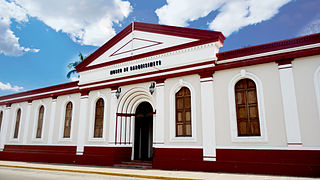
Museum of Barquisimeto
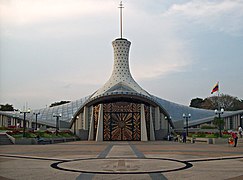
Metropolitan Cathedral

Municipal Palace


Centro Sambil Barquisimeto

Tower David
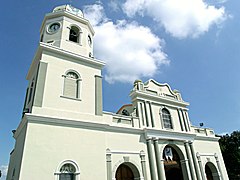
Church of Santa Rosa

Juares Theatre


Ayacucho Park

Court of Barquisimeto

Plaza Bolívar

Paseo Iribarren


Education
Barquisimeto is known for being one of the important nuclei in artistic and cultural education in Venezuela, being the birthplace of numerous artists and musicians of national and international trajectory. It has the Vicente Emilio Sojo Conservatory, a famous music institute in the region, and the Vicente Emilio Sojo School of Plastic Arts, which trains plastic artists in numerous disciplines such as sculpture, painting, photography, and cabinetmaking, and the Sacromonte International Dance and Ballet Center., founded in 1954, the oldest in Venezuela.
It is also considered a university city, due to the large number of study opportunities offered by different institutions that live in the city, including UCLA, UPEL, the Antonio José de Sucre National Experimental Polytechnic University, the UNA, UNES and the Andrés Eloy Blanco Territorial Polytechnic University, ranked among the best in the country.

Barquisimeto is a city with a historical vocation for academic knowledge; It houses a considerable sample of universities and institutes of higher education in Venezuela, has a high and growing student population from the area and other regions of the country. Its geographical location, the hospitality of its people and favorable socio-economic conditions have motivated the migration of many young people from other places in search of knowledge, currently positioning the city of Barquisimeto as one of the most important centers of higher education in Venezuela..
Institutions of Higher Education
Public
- Universidad Centroccidental Lisandro Alvarado (UCLA)
- Universidad Nacional Experimental Politécnica "Antonio José de Sucre" (UNEXPO)
- Universidad Pedagógica Experimental Libertador (UPEL)
- Universidad Politécnica Territorial de Lara Andrés Eloy Blanco (UPTAEB)
- Central University of Venezuela (UCV) - Barquisimeto Regional Centre
- Bolivarian University of Venezuela (UBV)
- National Polytechnic University of the Bolivarian Armed Forces (UNEFA)
- Universidad Nacional Experimental Simón Rodríguez
- Instituto Universitario Jesús Obrero (IUJO)
Private
- University Institute of Technology "Antonio José de Sucre" (IUTAJS)
- University College Fermín Toro
- Fermin Toro University (UFT)
- Yacambú University (UNY)
- Instituto Universitario de Tecnología Industrial Rodolfo Leoro Arismendi(IUTIRLA)
Ranged
- Open National University (UNA)
- Catholic University Cecilio Acosta (UNICA) (Private)
Religion

Diverse professions of faith concur in Barquisimeto, among which can be found the Greek Orthodox Church, Anglicans, Lutherans, Evangelicals of various groups, Mormons, Jehovah's Witnesses, Seventh-day Adventists, Jews and Muslims. Being the most far-reaching the Catholic Church.
- Popular devotion to the Divine Shepherd

La Divina Pastora is an important religious icon in Venezuela. She is the spiritual patron of the city and is one of the Marian devotions with many followers in the region. Every January 14, a massive procession is held in which this image is carried from Santa Rosa to the Cathedral of Barquisimeto. More than two and a half million people have been counted. It is the third largest Marian concentration in the world, concentrating more than three million people in recent years, behind the Virgin of Guadalupe (Mexico) and the Virgin of Fátima (Portugal), respectively.
Twinned cities
Barquisimeto participated on October 12, 1982 in the declaration of city twinning among all the Ibero-American capitals, establishing this link with the following cities:
 Segovia, Spain
 Ibagué, Colombia
 Chicago, United States
 La Plata, Argentina


