
Austrian flag
The flag of Austria is made up of three horizontal stripes of equal width, the upper and lower ones being red, and the central one being white. The State flag adds the national coat of arms in the center. This flag was officially adopted on May 1, 1945.


 State flag

Flag of the President (out of use since 1984)

Flag in vertical position
.svg)


.svg)

History
Together with the flag of Denmark, the Austrian flag is one of the oldest in the world.

According to a legendary account, the flag was invented by Duke Leopold V of Austria (1157-1194) after the tough Battle of Acre in 1191, during the Crusades, when his white robes were completely stained with blood, except the part that covered his belt, which remained white.
The flag was actually designed in the 13th century by Duke Frederick II of Austria (1210-1246), the last of the Babenberg dynasty, who sought greater independence from the Holy Roman Empire. The oldest representation of this design is found on a shield preserved in the Lilienfeld monastery, dating from November 30, 1230.
Since 1804, when the Austrian Empire led by the House of Habsburg was formed, the adopted flag used the colors of the House of Habsburg: yellow and black. In 1869, following the Compromise of 1867 by Emperor Franz Joseph I that gave rise to the Austro-Hungarian Empire, Austria adopted the old imperial emblem as its own, while Hungary adopted its own flag. For matters concerning both States, the Empire used two special flags: the war flag was a red stripe with a shield centered on the left half, while the merchant flag added the minor Hungarian shield to the right side, and the lower strip It was red in the left sector and green in the right.
After the end of the Empire, the Republic of Austria readopted the red-white-red scheme on October 20, 1918 until the Anschluss, when Austria was annexed to the Third Reich. After the Nazi defeat in World War II, the flag was reinstated on May 1, 1945.
Gallery


 Imperial Standard of the Holy Roman German Empire (1400-1806)
 Flag of the Duchy of Austria and the Archdiocese of Austria (1156-1804)

 Flag of the Austrian Empire (1804-1868) Flag of Cisleitania (1868-1918)
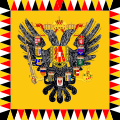
 Imperial Standard (1815-Finals of the nineteenth century)
 Merchant Flag of the Austrian Empire (1786-1869)
  War Flag of the Austrohungar Empire (1869-1918)
 Austro-Hungarian Empire merchant flag (1869-1906)
 Imperial standard (end of the 19th century-1915)
- Flag of the Republic of German Austria (1918-1919), the First Republic of Austria (1919-1934) and finally the Federal State of Austria (1934-1938)
 State Flag of the Federal State of Austria (1934-1938)
 Flag of the Reichsgau Ostmark (1939-1945)
 Flag of Austria (1945-current)
.svg)
.svg)


.svg)


.svg)
.svg)
.svg)
.svg)

Flags of the federal states

Upper Austria

Lower Austria

Burgenland

Carinth

Stiria

Salzburg
Tyrol
Vienna
Vorarlberg


Construction of the flag
.svg)
Contenido relacionado
Symbol
Coat of arms of Saint Lucia
Flag of Maracaibo
Pink triangle
Benin flag