
Austrian Empire
.svg)
The Austrian Empire (German: Kaisertum Österreich) was founded in 1804 as a reaction to the creation of Napoleon Bonaparte's First French Empire. The first emperor of Austria was Francis I, who also held the title of Holy Roman Emperor under the name Francis II. He would later abdicate this when the empire was abolished in the Napoleonic reorganization of Germany in 1806. To maintain the imperial title he elevated Austria from the status of archduchy to that of empire.
History
Creation of the Austrian Empire


.JPG)
Changes in the configuration of the nature of the Austrian Empire were carried out during the conferences in Rastatt (1797-1799) and Regensburg (1801-1803). On March 24, 1803, the Imperial withdrawal (German: Reichsdeputationshauptschluss) was declared, which considerably reduced the number of administrative territories from 81 to 3 and imperial cities from 51 to 6. This measure It was intended to replace the old constitution of the Holy Roman Empire, but the real consequence of the Imperial Retreat was the end of the Holy Roman Empire. Taking into account a significant change, Francis II created the title of Emperor of Austria, and his successors gradually abandoned the title of Holy Roman Emperor beginning in 1806.
The fall and dissolution of the Empire was accelerated by French intervention in September 1805. On October 20, 1805, an Austrian army led by General Karl Mack von Leiberich was defeated by French armies near the city from Ulm. The French victory resulted in the capture of twenty thousand Austrian soldiers and many cannons. Napoleon's army won a new victory at the Battle of Austerlitz on December 2, 1805. In light of these events, Francis was forced to negotiate with the French from December 4 to December 6, 1805. These negotiations They concluded with an armistice on December 6, 1805.
French victories encouraged rulers of certain imperial territories to assert their formal independence from the Empire. On December 10, 1805, the prince-elector of Bavaria, who was a duke, proclaimed himself king, followed by the duke-elector of Württemberg on December 11. Finally, on December 12, the Margrave of Baden was given the title of Grand Duke. Furthermore, each of these new countries signed a treaty with France and became its allies. The Treaty of Pressburg between France and Austria, signed in Pressburg (now Bratislava, Slovakia) on December 26, expanded the territory of Napoleon's German allies, at the expense of defeated Austria.
On July 12, 1806, the Rhine Confederation was established, comprising 16 countries. This confederation, under French influence, put an end to the Holy Roman Empire. On August 6, 1806, even Francis had to recognize the new state of affairs and proclaimed the dissolution of the Holy Roman Empire.
When, on August 11, 1804, Francis II assumed the title of first emperor of Austria, the empire extended from present-day Italy to present-day Poland and the Balkans. The multinational composition of the Empire is illustrated by the fact that its population consisted of Germans, Czechs, Poles, Romanians, Hungarians, Italians, Ukrainians, Croats, Slovaks, Slovenes, Serbs and numerous smaller nationalities. The Emperor of Austria not only ruled as such, but also held the title of king of Hungary, Bohemia, Croatia, Slavonia and Dalmatia, and commanded the multinational army of the Empire, his title being Kaiserliche-Königliches Armée (Royal Imperial Army). The Empire had a centralist structure, although a certain degree of autonomy was allowed to Hungary, which was governed by its own diet, and Tyrol.
Biedermaier Period (1815-1848)


Klemens von Metternich became foreign minister in 1809. He also served as state chancellor from 1821 to 1848, both in the reign of Francis I and his son Ferdinand I. Under Metternich's control, the Austrian Empire entered a period of censorship and police state between the years 1815 and 1848, known as the Biedermaier Period or Vormärz Period. The latter term refers to the period before the March Revolution of 1848. Metternich kept a firm hand in resisting the constitutional freedoms demanded by the liberals. He was governed by custom and imperial decrees (Hofkanzleidekrete). He was known for his strong conservative views and focus on politics. Metternich's policies were strongly against revolution and liberalism. In his view, liberalism was a form of legalized revolution. Metternich believed that absolute monarchy was the only adequate system of government. This notion influenced his anti-revolutionary policy to ensure the continuity of the Habsburg monarchy in Europe.
_p1.0281_F%C3%BCrst_Metternich_dankt_ab.jpg)
Under Metternich, nationalist revolts in Austria, northern Italy, and the German states were crushed by force. At home, he pursued a similar policy to suppress revolutionary and liberal ideals. The Karlsbad Decrees of 1819 were used, in which strict censorship in education, the press and expression was applied to repress revolutionary and liberal concepts. Metternich also uses a wide-ranging spy network to discourage unrest.

The minister had wide freedom in foreign policy under the reign of Francis I. Francis died in 1835. This date marks the decline of Metternich's influence in the Austrian Empire. Francis's heir was his son Ferdinand I, but he suffered from a mental illness that prevented him from governing. The leadership of the Austrian Empire was transferred to a Council of State consisting of Metternich, Francis I's brother Archduke Ludwig, and Count Franz Anton Kolowrat, who later became the first minister-president of the Austrian Empire. The revolutions of 1848 in the Austrian Empire forced Metternich's resignation. Metternich is remembered for his success in maintaining the status quo and the influence of the Habsburgs in international affairs.
Historians often remember the Metternich era as a period of stagnation: The Austrian Empire did not fight foreign wars, nor did it undergo any radical internal reforms. However, it is also considered a period of economic growth and prosperity in the Austrian Empire. Austria's population rose to 37.5 million in 1843. Urban expansion also occurred and Vienna's population reached 400,000. During the Metternich era, the Austrian Empire also maintained a stable economy and achieved a nearly balanced budget., despite having a significant deficit after the Napoleonic Wars.
Revolutions of 1848


From March 1848 to November 1849, simultaneously with the European revolutionary cycle, which began in France and known historiographically as the revolution of 1848, the Empire was threatened by revolutionary movements, most of which were nationalist in nature. On top of that, liberal and even socialist currents resisted the empire's long-standing conservatism.
In addition to its liberal ideological condition, which directly questioned the absolutist principles of the political system, the revolutionary activity had a strong nationalist character, which was especially serious for a multinational State, governed from Vienna but composed of multiple ethnic minorities in process. of definition as nations (Germans, Hungarians, Romanians, Italians, different types of Slavs - Poles, Czechs, Slovaks, Ruthenians (Ukrainians), Slovenes, Croats, Bosnians, Serbs -, etc.), each of them with different aspirations, incompatible with each other (autonomy, independence or even hegemonic imposition on others).
Revolution in the Kingdom of Hungary


Unlike the others, the revolution in Hungary became a war for Hungarian independence from the Austrian Empire. The Revolution began on March 15, 1848 with non-violent events in Pest and Buda, followed by insurrections throughout the kingdom, which allowed Hungarian reformists to declare Hungary's autonomy within the Habsburg Empire. However, after the revolution was put down and Franz Joseph I succeeded his uncle Ferdinand I as emperor, he refused to accept Hungarian independence. During the subsequent civil war, the Magyars together with foreign revolutionaries had to fight against the Austrian army, but also against the Serbs, Romanians, Croats, Slovaks and Germans who inhabited territories of the Kingdom of Hungary, who had their own national ideologies and were against accepting a dominion of the Magyars.
Initially, the Hungarian forces (Honvédség) achieved several victories against the Austrian army (at the Battle of Pákozd in September 1848 and at the Battle of Isaszeg in April 1849), with which Hungary declared its complete independence from Austria in 1849. Due to the triumph of the resistance to the revolution, Francis Joseph I had to ask for help from the Tsar of Russia, Nicholas I, and the Russian army invaded Hungary, giving rise to antagonisms between the Hungarian and Russian sides. After Vienna was recaptured by Imperial forces, General Windisch-Graetz and 70,000 soldiers were sent to Hungary to end the last threat to the Austrian Empire. By the end of December, the Hungarian government evacuated Pest.
Julius Jacob von Haynau, the head of the Austrian army who succeeded the government of Hungary for a few months, ordered the execution of the Hungarian army leaders in Arad and of Prime Minister Batthyány in Pest. In this way, the event known as the execution of the 13 Martyrs of Arad occurred on October 6, 1849.
The Bach years


After the death of Felix of Schwarzenberg in 1852, Minister of the Interior Alexander von Bach largely dictated policy in Austria and Hungary. Bach centralized administrative authority in the Austrian Empire, but also received approval for reactionary policies that reduced freedom of the press and the abandonment of public trials. He later represented the absolutist leadership (or Klerikalabsolutist), which culminated in the concordat of August 1855 that gave the Catholic Church control over education and family life. This period in the history of the Austrian Empire would become known as the era of neo-absolutism or Bach's absolutism.
During this period the prisons remain full of political prisoners: for example during his administration, the Czech nationalist journalist and writer Karel Havlíček Borovský was forcibly expatriated (1851-1855) to Brixen. This exile undermined Borovský's health and he died shortly afterwards. This affair earned Bach a very bad reputation among Czechs which subsequently led to the strengthening of the Czech national movement.
However his relaxed ideological views (apart from preserving the monarchy) led to a great increase in economic freedom in the 1850s. Under his rule, internal customs duties will be abolished, and the peasants will be emancipated from their feudal obligations.
In the international context, Austria, as leader of the German Confederation, participated in the first Schleswig War (1848-1850). The duchies of Holstein, Saxe-Lauenburg and Schleswig were three mainly agricultural fiefdoms, whose lord was the king of Denmark, but the majority of their population was German. Thus, the first two were part of the German Confederation, while Schleswig was not. On 20 January 1848, shortly after his accession to the throne, Frederick VII published a new constitution for Denmark which provided for the annexation of all three duchies. This did not leave the Prussian foreign minister Armin-Suckow indifferent, who pressured the king of Prussia to intervene. The Austrian Empire, concerned about Prussia's growing role in the affairs of the German Confederation, believed that a Prussian success in Denmark would have been able to further increase its influence, leading the empire to join the war against Denmark. Finally, the intervention of the great powers, specifically Great Britain and Russia, caused the war to end with a victory for Denmark.


In 1853 the Crimean War broke out, the Austrian Chancellor, Count Karl Ferdinand von Buol soon had to face the crisis in the East. In this crisis, Austria's position was tenuous. Russia's intervention to suppress the Hungarian Revolution of 1848, and its subsequent intervention on behalf of Austria against Prussia in the Treaty of Olmütz in 1850, put the Austrians substantially in debt to Tsar Nicholas I. On the other hand, permanent control of Russia from the Danube principalities would greatly endanger Austria's strategic position, and the Austrians were generally opposed to any expansion of Russian influence in the Balkans. An ultimatum was sent to Russia demanding that it evacuate the Principalities. The Russians agreed, and Austria occupied the Principalities for the rest of the war. As the conflict dragged on into 1855, Buol sent another ultimatum to Russia, this time demanding that it adhere to the French and British terms, or face war with Austria. Buol's policy in the Crimean War had succeeded in keeping Austria out of the war, but had isolated it, at odds with Russia and failing to impress France and England.
The consequences of this became evident in 1859. Camillo Benso, the prime minister of Sardinia-Piedmont, eager to incite the Austrians to a war in which he knew he would have the support of France, carried out a series of provocations. against Austria's position in Italy. Piedmont proceeded to provoke Vienna with a series of military maneuvers, successfully provoking an ultimatum to Turin on April 23. His rejection was followed by an invasion of Austria, and war with France was precipitated (Second Italian War of Independence 1859). Austria mistakenly expected support and received none, and the country was unprepared for war. After a series of Austrian defeats, peace was finally signed in Zurich between November 10 and 11. The Habsburgs ceded Lombardy to France, which, in turn, ceded it to Piedmont.
After 1859


International events seriously weakened the emperor's position. In 1860, Franz Joseph and the Austrian Empire were "threatened with a crisis of existence." The government's absolutist policies were not popular and these setbacks led to internal unrest, Hungarian secessionism, criticism of the Austrian government, and allegations of corruption. A federalist solution was then attempted for the problems generated by national minorities, the Diploma of October 1860, which conferred legislative power on a Reichsrat and a series of regional Diets. Almost immediately after the Diploma was approved, it became clear that it was not going to last long. The empire's finances continued to fail, also showing the weaknesses of the administration. Despite this, historians have argued that the October Diploma began the "constitutional" Empire. Consequently, the October Diploma (Oktoberdiplom) was replaced by the February patent (Februarpatent), the Constitution of 1861 created a legislative body bicameral, the Reichsrat, with the House of Lords (Herrenhaus) and a Chamber of Deputies (Abgeordnetenhaus). The upper house consisted of appointed and hereditary positions, while the lower house, the Chamber of Deputies, was appointed by the provincial diets. But most of the nationalities of the monarchy were dissatisfied. The Reichsrat was dominated by liberals, who were to be the dominant political force for the next two decades.
The second war with Denmark in 1864, arising as a consequence of the previous war, ended with the victory of the Austro-Prussian forces. The Gastein Convention resolved the control of the new territories, Holstein remained under Austrian administration, Schleswig and Lauenburg under Prussian administration; However, this did little to alleviate the Austria-Prussian rivalry over the German question.


But internal difficulties continued. Diets replace parliament in 17 provinces, Hungarians push for autonomy, and Venice was drawn to a unified Italy.
Although Austria and Prussia were allies in the War of the Duchies, neither country was satisfied with the agreements. Prussia declared the Gastein convention null and void, invading Holstein. When the German Diet responded by voting for partial mobilization against Prussia, Bismarck declared that the German Confederation was over. Austria declared war on the Kingdom of Prussia on June 14, 1866, beginning the Austro-Prussian War. Three days later, Italy declared war on Austria, beginning the Third War of Italian Independence, being allied with Prussia. Although the Austrians inflicted serious defeats on the Italians, they collapsed before the Prussians. Prussian troops managed to decisively defeat the Austrian army on July 3 at the Battle of Sadowa. After this victory, the Prussian troops advanced south and entered Slovakia on July 19, without much opposition, and on July 22 they faced the Austrians near Pressburg, in the Battle of Lámacs, obtaining another victory. That same day Austria requested an armistice from Prussia.
On August 23, 1866, with the Peace of Prague, the German Confederation was dissolved. Prussia annexed Hanover, Hesse-Kassel, Nassau and Frankfurt; Austria ceded Holstein to Prussia, paid war indemnity, and handed over Veneto to the Kingdom of Italy. In Austria, the consequences of the defeat were a weakening of the State in the face of the nationalist movements of the different peoples that made up the Empire, especially the Hungarians who had already led various revolutions against the centralism of the Habsburgs.
Creation of the Dual Monarchy

The agreement arose after a series of Austrian defeats: against Sardinia in 1859 and Prussia and Italy in 1866 (Austro-Prussian War). To strengthen the weakened empire and in response to Hungarian demands for greater participation in state affairs, Francis Joseph I had a series of meetings with members of the nobility of this country that would result in the creation of a dual federal state, where Hungary would be a Kingdom that would administer the historical territory of the Crown of Saint Stephen autonomously. In practice, two of the state's nationalities, Germans and Magyars, shared power, allying themselves with the Poles and the others with the Croats (in exchange for broad autonomy) to maintain it against the rest. The Slavs, who at first presented a common front against the agreement, soon divided over the concessions of control of Galicia and the Russophilia of the Czechs and South Slavs, foreign to the Poles.
The agreement was in practice a pact between Magyar nationalists and the crown, accepted for convenience by the Germans and, to a lesser extent, by Poles and Croats. The Magyars gained the power to influence the politics of the other half of the country and exercised it by avoiding, for example, federal reform.
In this way the double monarchy or K.u.K. would be born. (kaiserlich und königlich, in German; imperial and royal, in Spanish), known as the Austro-Hungarian Empire, which would maintain the political weight of Austria until its defeat in the First World War in 1918.
Internal policy

Since its creation as a consequence of the Napoleonic Wars and the destruction of the old Germanic Empire, the Austrian Empire was an absolutist monarchy radically opposed to the ideas of the French Revolution. Emperor Francis, who was a convinced reactionary, established his power over measures of police repression and censorship, to ward off the threat of liberalism. In this task he had the invaluable help of Metternich, with whom he came to fully identify in the final years of his reign. With the advent of the end of the Napoleonic wars and the beginning of Restoration Europe, Austria and the other European states will maintain their firm conservative attitude during the great liberal revolutions that will take place in Europe in the 20th century.:small-caps;text-transform:lowercase">XIX. The revolution of 1848 shook the empire, with liberal and national ideas in confrontation against the centralist absolutism of the country. In the midst of these revolts, Chancellor Metternich fell, who went into exile and Emperor Ferdinand I of Austria would not take long to abdicate.
After this, Prince Schwarzenberg closed the Constituent Diet, established the dictatorship and convinced Ferdinand to abdicate (December 2, 1848) in favor of Franz Joseph, who was thus proclaimed emperor at the age of 18. After a period of counterrevolutionary reaction, the absolutist constitution was abolished in 1851. A centralist bureaucracy was imposed and jurisdiction over civil (especially marriage) and educational laws was ceded to the Holy See, which from then on came to be controlled by the Catholic Church. The insufficiency of income ruined the tariff policy, forcing the government to raise them in order to maintain budget balance, which was opposed by the liberals. During the reign of Franz Joseph, the Ausgleich or compromise of February 1867 was established, Austria and Hungary became two entities with their own governments and diets, united under the same monarchy.
Monarchs
The ruling family in Austria was the house of Habsburg.
| Image | Name | Queen | Notes |
|---|---|---|---|
 | Francisco I | 1804-1835 | In 1804, to maintain his imperial title he raised Austria from the category of arched to that of empire. |
 | Fernando I | 1835-1848 | Son of the former, he suffered from mental weakness. During the revolutions of 1848 he was forced to abdicate. |
 | Francisco José I of Austria | 1848-1916 | nephew of the previous one. During his reign the dual monarchy was formed giving way to the Austro-Hungarian Empire, of which he would be ruler until 1916. |
.svg)
Foreign policy
Napoleonic Wars

Between the years 1804-1815 Austria's foreign policy was significantly determined by the Napoleonic Wars. After Prussia signed a peace treaty with France on April 5, 1795, Austria was forced to bear the main burden of the war against the French Republic for almost ten years. This situation led to a distortion of the Austrian economy which contributed to the Austrians viewing this war in a highly unpopular light. Regarding the mentioned state of mind, Emperor Francis II refused to participate in the following war against Napoleonic France for a long time. On the other hand, Francis II did not abandon the possibility of taking revenge on France and therefore entered into a secret military agreement with the Russian Empire in November 1804. This agreement was to ensure mutual cooperation between Austria and Russia in the case of a new war against France.
An apparent unwillingness of Austria to join the Third Coalition was overcome by British subsidies. A decisive defeat at the Battle of Austerlitz ended the Austrian presence in the Third Coalition. Although Austria's budget suffered from war expenses and its international position was considerably weakened, the humiliating Treaty of Pressburg allowed time to strengthen the army and economy. On the other hand, an ambitious Archduke Charles, together with Johann Philipp von Stadion, waged a new war against France.
Archduke Charles of Austria served as head of the War Council and commander in chief of the Austrian Army; Equipped with expanded powers, he reformed the Austrian army in preparation for another war. Johann Philipp von Stadion, the foreign minister, personally hated Napoleon, due to personal experience of the confiscation of his possessions in France. Furthermore, Francis II's third wife, Marie Louise of Austria-Este, agreed with the efforts to start a new war. The defeat of the French army at the Battle of Bailén in Spain on July 27, 1808 sparked the war. On April 9, 1809, an Austrian army of 170,000 men attacked Bavaria.
Despite military defeats, especially of great magnitude, such as those of the battles of Marengo, Ulm, Austerlitz and Wagram, and therefore the loss of territory throughout the French Revolution and the Napoleonic Wars (the Treaty of Campo Formio in 1797, Pressburg in 1806, and Schönbrunn in 1809), Austria played a decisive role in the defeat of Napoleon in the campaigns of 1813-1814.
In the final period of the Napoleonic Wars, Metternich enjoyed great influence over foreign policy in the Austrian Empire, a matter nominally decided by the emperor. Metternich initially supported an alliance with France, arranging the wedding between Napoleon and Francis II's daughter, Marie Louise, but by the campaign of 1812, he had realized the inevitability of Napoleon's fall and took Austria to his side. the war against France. Metternich's influence at the Congress of Vienna was notable, although he did not become a first-class statesman in Europe, but rather the virtual ruler of the Empire until 1848, the year of revolutions, and the rise of liberalism, which caused its fall. policy.
Unification of Italy

After the Congress of Vienna, the Austrian Empire annexed Lombardy and Veneto and also placed Austrian princes on the throne of Parma, Modena and Tuscany. The Kingdom of Piedmont wished to expel the Austrians and unify Italy under the house of Savoy. Added to this were the liberal revolutions that planned to create a united Italy. In any case, the process was finally channeled by the house of Savoy, reigning in Piedmont (notably by the first minister Count of Cavour), to the detriment of other "republican" interventions by notable figures (Mazzini, Garibaldi) throughout complicated vicissitudes linked to the European balance (interventions by France and the Austrian Empire), which culminated with the incorporation of the last stronghold of the Papal States in 1870.
After a series of wars, Piedmont, with French help, managed to expel the Austrians from northern Italy and complete the long-awaited unity. However, there were still things pending, the new Kingdom of Italy continued to claim border territories with the Austro-Hungarian Empire (Trieste/Istria/Dalmatia and Trentino), which were partially resolved in 1919 after the First World War.
German Unification

With the creation of the German Confederation, Austria tried to maintain its supremacy in the German states. As in the case of Italy, the nationalist movement that advocated the union of the different states into a single nation was growing in Germany. The Revolution of 1848 demonstrates this.
Metternich considered that German nationalism could not only repudiate Austrian rule over the Confederation, but also stimulate nationalist sentiment within the Austrian Empire itself. In a multinational polyglot state, in which Slavs and Magyars outnumbered Germans, the prospect of growing nationalist sentiment among Czechs, Slovaks, Hungarians, Poles, Serbs and Croats, together with growing liberalism among the middle class, was certainly creepy.
However, the Kingdom of Prussia wanted unification under its predominance, so after the Austro-Prussian War, Austria was expelled and Kleindeutschland or Little Germany was formed.
Territories of the Austrian Empire

The crown lands of the Austrian Empire after the Congress of Vienna of 1815, including local government reorganizations arising from the Revolutions of 1848 until the October Diploma of 1860 (# in parentheses refers to the attached map):
Archduchy of Austria and neighboring countries
- Archived from Austria (Erzherzogtum Österreich)
- (8) Lower Austria (Erzherzogtum Österreich unter der Enns)
- (14) High Austria (Erzherzogtum Österreich ob der Enns)
- (10) Duchy of Salzburg (Herzogtum Salzburg), 1815-1850 Salzach district (Salzachkreis) of Alta Austria
- (12) Duchy of Styria (Herzogtum Steiermark)
- (13) Prince Tirol County with (15) Vorarlberg (Gefürstete Grafschaft Tirol mit dem Lande Vorarlberg)subdivided in 1861
- (7) Kingdom of Iliria (Königreich Illyrien), subdivided in 1849/1850:
- (3) Duchy of Carinthia (Herzogtum Kärnten)
- (4) Duchy of CarniolaHerzogtum Krain)
- Litoral (Küstenland)
- Princely county of Gorizia and Gradisca (Gefürstete Grafschaft Görz und Gradisca)
- Free Imperial City of Trieste (Triest)
- Margraviato de Istria (Markgrafschaft Istrien)
Bohemian Crown Lands
- (1) Kingdom of Bohemia (Königreich Böhmen)
- (9) Margraviato de Moravia (Markgrafschaft Mähren)
- (11) Duchy of Silesia (Herzogtum Schlesien)
- (6) Kingdom of Galitzia and LodomeriaKönigreich Galizien und Lodomerien) with
- (2) Duchy of Bucovina (Herzogtum Bukowina), divided in 1850
Hungary and neighboring countries
- (16) Kingdom of Hungary (Königreich Ungarn) (up to 1867) with:
- (17 part) Kingdom of Croatia (Königreich Kroatien(up to 1867)
- (17 part) Kingdom of Slavonia (Königreich Slawonien(up to 1867)
Other countries and territories
- (5) Kingdom of Dalmatia (Königreich Dalmatien)
- (19) Kingdom of Lombardy-Venice (Lombardo-Venezianisches Königreich), lost in 1859/1866
- (18) Great Principality of Transylvania (Großfürstentum Siebenbürgen(up to 1867)
- Voivodato de Serbia y Banato de Tamis (Woiwodschaft Serbien und Temescher Banat), since 1849, merged in Hungary and Slavonia in 1860
- (20 part) Serbian voivodine, de facto autonomous entity 1848/49, without official recognition
- (20 part) Banato
- Military border (Militärgrenze)
- Croatian Military BorderKroatische Militärgrenze)
- Military Frontier EslavonicaSlawonische Militärgrenze)
- Military Border of the BanatoBanater Militärgrenze)
- Transylvana Military FrontierSiebenbürger Militärgrenze) merged with Transylvania in 1853
The former Habsburg possessions of Former Austria (in present-day France, Germany and Switzerland) had already been lost in the Peace of Pressburg of 1805. Beginning in 1850, the kingdom of Croatia, the kingdom of Slavonia and The Military Border constitutes a single land with a disaggregated provincial and military administration and representation.
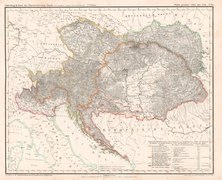
Map of the Empire of 1848.
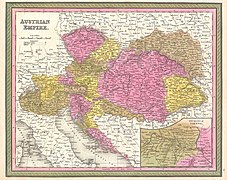
Map of the Empire of 1850.

Ethno-Graphic Map of the Empire of 1855.


Demography
| Population developments Vienna | |
|---|---|
| Year | Population |
| 1830 | 401.200 |
| 1840 | 469.400 |
| 1850 | 551.300 |
| 1857 | 683,000 |
| 1869 | 900.998 |
| Population developments of the territory that today corresponds to present Austria | |
|---|---|
| Year | Population |
| 1780 | 2.970.000 |
| 1790 | 3.046,000 |
| 1800 | 3.064,000 |
| 1810 | 3.054,000 |
| 1821 | 3.202,000 |
| 1830 | 3.476,000 |
| 1840 | 3.649,000 |
| 1850 | 3.879,000 |
| 1857 | 4.075,000 |
| 1869 | 4.497.880 |
Religion


The predominant religion in the Austrian Empire was Catholicism. The Habsburgs, who had ruled since the late 13th century, supported the rule of the Catholic Church and alternative religious communities were persecuted., therefore they could not develop for centuries.
When the Protestant Reformation occurred in the Holy Roman Empire in the XVI century in the Holy Roman Empire, the Habsburg states remained faithful to the papacy. Emperor Rudolph II began the Counter-Reformation in 1580 in the Austrian territories. The Counter-Reformation intensified during the reign of Emperor Ferdinand II, the suppression of Protestantism in its territories precipitating the events that led to the Thirty Years' War. After the end of the Thirty Years' War, Austria was predominantly Catholic.
During the 18th century, the Enlightenment and absolutism lead to increasing interference by the state in the church affairs. The first reforms regarding the Catholic Church were implemented during the reign of María Teresa, however it would be during the reign of Joseph II where important reforms in the religious sphere would be seen. Josephinism was a political theory introduced during the reign of Joseph II. According to this vision, the Church only had powers over the dogmatic-moral field of its faithful; Consequently, matters of a secular nature in Austrian territory (including the administration of the Church itself with its considerable assets and income) had to be subject to the laws and authorities of the State. The exemptions and dispensations granted by the pope in Austrian territory were also suppressed, because they were considered to affect the sovereignty of the monarch. This government system was very tolerant of the rest of the confessions, which was reflected in its patents of tolerance that allowed Greek Orthodox, Protestants (1781) and Jews (1782) to carry out private religious practices, with restrictions.
As an opponent of the Enlightenment, Clemens Maria Hofbauer worked from 1808 in Vienna. He sought a religious renewal and exerted a great influence on scholars, artists, poets and diplomats, who he gathered around him in the Hofbauer circle. He exerted a profound influence on the religious life of the time, as a representative of the romantic religious reaction that occurred in the first third of the 19th century< /span>, in response to the previous anticlericalism. He contributed to ensuring that Josephinism, a political movement in the Austrian Empire that wanted to subject the Church to political power, did not definitively prevail.
Since 1848 there have been several legal initiatives for freedom of belief and conscience and the end of the state church. In 1849, the Ministry of the Interior convened for the first time an Austrian Bishops' Conference and an Evangelical Church Assembly. The Viennese archbishop Joseph Othmar Ritter von Rauscher was instrumental in concluding a concordat with the Holy See in 1855. Protestant churches were given full autonomy by the Protestant patent in 1861.
The Liberal State law of 1867 partially annulled the Concordat.
Education


Before 1774, education in the hereditary lands of Austria was reserved for the upper classes of society. It was above all the task of the church, the monastic schools were the only educational institutions. As school fees generally had to be paid in these institutions, rural serfs in particular and the poorer urban strata of the population remained uneducated and generally unable to read or write.
Empress Maria Theresa of Austria (1740-1780) introduced compulsory primary education, forcing in 1775 that all children of both sexes between six and twelve years old had to attend school. In addition, textbooks were unified and teacher training was regulated. Although schooling became compulsory for both girls and boys over a six-year period, girls could not attend vocational or secondary schools. Austria's literacy rate became one of the highest in the Habsburg Empire during the beginning of the 19th century due to general development.
The heir to the throne of Maria Theresa, Joseph II reformed education and, above all, built schools. A tripartite school system was introduced, based on the national primary school.
In 1804 the Austrian empire was founded, during the first period there were no advances in educational matters by the state due first to the Napoleonic wars and then to the reactionary period of the Metternich era. In the revolutionary year of 1848, a separate ministry for public education was created; The first Minister of Education for a short period of time was Franz Freiherr von Sommaruga. The ministry was designated under Emperor Franz Joseph I from 1849 as the Ministry of Worship and Teaching (Ministerium für Cultus und Unterricht). During the ministerial period of Leo von Thun and Hohenstein (1849-1860) the Austrian educational system was reformed. The basis for this were the proposals of Franz Serafin Exner. He introduced university autonomy in Austria and restructured the Vienna Academy of Sciences. His educational policy was marked by tolerance. Scientists from the Protestant or Jewish denomination were given permission to teach at universities and well-known foreign academics were appointed to the country. The Protestant Theological Institute was given the status of a faculty, and the Austrian Historical Research Institute was transformed into a modern educational institution modeled on the École nationale des chartes. Although Thun was also one of the fathers of the Concordat of 1855. Thun's ministerial and reformative period ended in 1860. From 1868 onwards, education was a separate competence of the two entities of the empire (Cisleitania and Transleitania), in Austria it continued administered by the Ministry of Education and Worship.
Armed Forces
Army
The Imperial Army (German: Kaiserliche Armee) was the branch of the armed forces of the Habsburg monarchy in the territories of the crown of Austria, arising as a consequence of the Napoleonic Wars.
This military body was reformed in 1867 with the constitution of the dual monarchy that led to formal independence from the Kingdom of Hungary under the government of Emperor Franz Joseph of Austria and to the formation of a national army.
Navy
The Navy of the Austrian Empire (German: Österreichische Marine) was the naval branch of its armed forces. It had its origin in the Danube Flotilla of the XVI century and since the end of the XVIII in the Mediterranean fleet. With the compromise of 1867, the navy was reformed, giving way to the Austro-Hungarian navy or Imperial and Royal Navy.

Infantry 1859

Fragata SMS Novara in Venice

.jpg)
Economy

The economy of the Austrian Empire was based on the trade that flowed along the Danube, on the flourishing agriculture of the Hungarian plains, the Po Valley and the Danube Valley, and the main industries that were largely concentrated part in the big cities. Agriculture remained the main activity of the entire Empire, and was the backbone on which the army's supplies depended. The largest agricultural areas of the Habsburg state were in the Danube Valley and the Great Hungarian Plain. In the mountains and hills, livestock and grazing were practiced by the locals.

In the western areas of the empire, the first signs of modern economic growth can be identified from the second half of the 18th century : in Austria and Bohemia there was a strong textile industry with work in homes (linen and wool, and since 1763 embryos of the cotton industry); There were steel and manufacturing settlements and factories for the production of glass and paper. The first attempts at mechanization, concentrated in the textile sector and the steel industry, date from between 1830 and 1847.

The Danube was and still is one of Austria's most important economic assets; The Austrian Empire controlled almost all of it, and this made possible a prosperous river trade traffic. From the Danube a trade was carried out with the German principalities, Switzerland and the Balkan states, which were later strongly influenced by the Empire. Although on a smaller scale, there was flourishing trade flowing along the main arteries of the Danube. Count István Széchenyi (with the help of the Austrian ship company Erste Donaudampfschiffahrtsgesellschaft (DDSG), a shipping company founded in 1829 by the Austrian government for the transport of passengers and cargo on the Danube), established in Hungary built the Óbuda shipyard on Hajógyári Island in 1835, which was the first steam shipbuilding company in the Habsburg Empire.
The industrialization of the Habsburg Empire can be described as a "laborious" process: the presence of numerous natural and institutional obstacles that required additional effort slowed down the development time. Until the construction of the railway network (1840-1850), land transport, given the nature of the predominantly mountainous country, was expensive and river networks were non-existent in mountainous regions. The network of canals is reduced to the course of the Danube and other main rivers (Drava, the Tisza...) that lead towards the south and east, in the opposite direction to the markets and industrial centers.

.jpg)
Where the State was most successful was in the construction of the railway network (144 km in 1850, 6112 in 1870 and 42981 in 1913): this, in addition to generating considerable influence, favored the geographical division of labor within the Empire. In 1810 a horse-drawn railway (22 km) was opened in Styria for the transport of iron. In 1832, a railway line, also for horses, was opened between Linz and Ceske Budejovice (Budweis), with a length of 128.8 kilometers, it was the first interurban railway in Europe. The first section of the railway between Vienna and Krakow (Kaiser Ferdinands Wien) was opened in 1837. In 1854 Austria already had 2000 km of railway tracks, 70% of which were owned by the State. After 1854, due to the financial crisis of the Empire, the Austrian part of the railways were sold at bargain prices, especially to French investors. From 1854 to 1879, private initiative was responsible for the construction of new roads.
Locomotive factories (steam engines and wagons, bridges and iron structures) were established in Vienna (locomotive factory of the state railway company, founded in 1839), in Wiener Neustadt (Wiener Neustädter Lokomotivfabrik, founded in 1841) and in Floridsdorf (Lokomotivfabrik Floridsdorf, founded in 1869).
Situation in Hungary
Until the revolution of 1848 the only owners of the land were the nobles. The agrarian reform of 1852-1853 by the crown tried to create a new social class of peasant owners on which to rely against the Magyar nobility. The reform was, however, a failure. The new possessions were, in general, too small to support the peasantry who, without experience in the market, without accessible credit and due to the agricultural depression of the end of the century XIX was forced to sell her properties to landowners and return to a situation of dependency very similar to that before the reform. However, the emancipation of the peasants encouraged the mechanization of the countryside, although the lack of financing made it difficult to do so outside the landowners' estates. The agricultural methods of the farmers continued to be quite primitive, although there were certain technical advances in the means of production.
Hungarian agriculture in the period immediately before the Compromise benefited from the extension of railway communications that already connected the imperial capital through Pest with eastern Hungary, the grain region of Szeged and the livestock region of Debrecen. Rural prosperity and rising agricultural prices, which had begun in the mid-1830s, continued until the mid-1870s.

The development of the railway encouraged the increase in coal and iron production; The railway also concentrated a large part of the production of machinery. Industrial development between 1848 and 1867 had been slow. The first Hungarian steam locomotive railway line opened on July 15, 1846 between Pest and Vác. The elimination of internal borders in 1850, however, favored the acceleration of the process, both due to agricultural development and communications (railway lines grew from 178 km in 1850 to 2,200 in 1867).
The extension of the railways encouraged the increase in coal production. Iron production also grew partly due to the expansion of the railways, but also due to the industrialization of Cisleitania. In 1860 Hungary produced 480,000 tons of coal and, in 1865, 100,000 t of iron. The evolution of the increase in iron production was the same as that of coal, with sustained growth that only slowed down in the crisis of the 1873 decade.
Despite the notable growth of Hungarian industry during the Compromise period, the region remained primarily agricultural. Industry was heavily dependent on Austrian credit. Agriculture contributed 80% of gross domestic product in 1850 and still 64%. % in 1911-1913; The industry, for its part, increased from 12% to 25.9% in the same period.
Maritime trade


Originally, the Republic of Venice dominated maritime trade in the Adriatic and the Mediterranean. Despite this circumstance, in the middle of the 15th century shipping companies were also established in the Austrian port of Trieste. In the Küstenland or Austrian coast, in Habsburg times, a coastal transport business developed due to the lack of efficient roads and railway lines, which transported various goods and food products between port cities.
An edict by Emperor Charles VI proclaimed on June 2, 1717, threatened to punish any harassment inflicted on the ships of his subjects. Venice accepted, and this brought free commercial traffic to Adriatic navigation. In another patent dated March 18, 1719, Charles VI declared the Ports of Trieste and Fiume (now Rijeka in Croatian) as free ports.
In 1749 the obligation to carry shipping documents was introduced. An important introduction was the "Navigation Edict" of 1774. It contained a precise list of the rights and obligations of port captains, boatmen and crew.
In 1832, the shipping company Österreichischer Lloyd was founded in Trieste, which would be the largest cargo company in Austria-Hungary and the Mediterranean Sea. In 1836, the shipping section was launched. steam. Emperor Ferdinand I and Empress Maria Anna visited Trieste in 1844 and made a trip on this occasion with Lloyd's newest steamer, the 'Imperator'.
For the merchant navy in general and for the city of Trieste in particular, the laying of the foundation stone for the Südbahnhof (railway station of the southern line) on March 18, 1850 by Emperor Franz Joseph I was important to the railway line, that from July 12, 1857 onwards, the train could travel continuously from Vienna to Trieste.
The supreme commercial maritime authority was the k.u.k Ministry of Commerce.
Due to the compromise between Austria and Hungary in 1867/1868, the coastal area and, therefore, the administration were also divided. Trieste came under Austrian administration and Fiume under Hungarian administration.
Communications
- Telegraphs:
In 1847, the first telegraph connection (Vienna - Brno - Prague) began to operate. The first telegraph station on Hungarian territory was opened in December 1847 in Bratislava (in German Pressburg, in Hungarian Pozsony). In 1848, during the Hungarian Revolution, another telegraph center was built in Buda to connect the most important government centers. The first telegraphic connection between Vienna and Pest-Buda (later Budapest) was built in 1850, and the Vienna-Zagreb line (capital of the Kingdom of Croatia) also in 1850.
Currency
The gulden or florin was the currency of the Austrian Empire between 1754 and 1892. The name gulden was printed on Austrian banknotes in German, while coins were minted using the term florin. The name florin was used on Hungarian coins and banknotes.
- Tickets:

Gulden Austriaco of 1806

Gulden Austrian of 1825
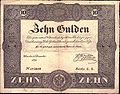
Gulden Austriaco of 1834

Gulden Austriaco of 1841

Gulden Austrian of 1847

Gulden Austrian of 1854

Gulden Austriaco of 1863


.jpg)

.jpg)

- Currency:

Currency 1807

Currency 1816

Currency 1842
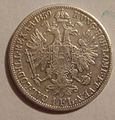
Currency 1859

Currency of 1860

Currency of 1864

Currency 1866


Imperial palaces
- Palaces in Vienna:

Schönbrunn Palace, former imperial summer residence.
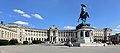
Imperial Palace of Hofburg, winter residence.
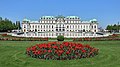
Belvedere Palace

Augarten Palace

Hermesvilla


.JPG)
.JPG)
_-_Hermesvilla.JPG)