
Augusto Cesar Sandino
Augusto Nicolás Calderón Sandino (Niquinohomo, May 18, 1895 – Managua, February 21, 1934), better known as Augusto C. Sandino, was a Nicaraguan Guerrilla and revolutionary.
Augusto Sandino was a leader of the Nicaraguan resistance against the US occupation army in Nicaragua. His guerrilla struggle managed to get the United States troops to leave the country, but not before creating the National Guard and placing General Anastasio Somoza García at its head, who, treacherously, would end up ordering Sandino's assassination on orders from the North American Embassy..
He is considered a National Hero of Nicaragua and is called the "General of Free Men." His Liberal ideals and teachings were taken up again years later in the founding of the Marxist-Leninist group Frente Sandinista de Liberación Nacional (FSLN) by Carlos Fonseca Amador, along with other comrades.
Biography

Augusto Nicolás Calderón de Sandino was born in Niquinohomo, department of Masaya in the Republic of Nicaragua, on May 18, 1895, the illegitimate son of Gregorio Sandino, a wealthy coffee grower, and Margarita Calderón, a servant at his plantation. Indian father. In 1904, at the age of 9, his mother sent him to live with his maternal grandmother. He later goes to live with his father's family, where he works as a farmhand to earn lodging for him.
In July 1912, at the age of 17, he witnessed the first intervention of US troops in Nicaragua, against a liberal-conservative uprising against President Adolfo Díaz Recinos, who had the support of the United States. The liberal general Benjamín Zeledón (originally from La Concordia) died in combat on October 4 when his forces were evicted from the El Coyotepe fortress after fierce fighting in La Barranca, both sites strategically located at the entrance to the city of Masaya. General Zeledón was shot by American and conservative troops. The young Sandino was impressed with the image of the patriot, whose corpse was carried on an ox cart by the United States Marines to be buried in the town of Catarina.
- Genealogical tree of Augusto Sandino
| 8. Apparition Sandino (Spain). | ||||||||||||||||
| 4. Santiago Sandino Castillo | ||||||||||||||||
| 9. Apolonia Castillo (Nicaragua). | ||||||||||||||||
| 2. Gregorio Sandino López | ||||||||||||||||
| 5. Agustina López Oviedo | ||||||||||||||||
| 1. Augusto Nicolás Calderón Sandino | ||||||||||||||||
| 3. Margarita Calderón Ruiz | ||||||||||||||||
Departure from Nicaragua
In 1921, in a brawl, he wounded Dagoberto Rivas, the son of a prominent town conservative, with a bullet because of some comments he had made about his mother. Fleeing from the law and possible revenge from the Rivas family, Sandino traveled to the Caribbean coast of Nicaragua and later to Honduras, where he worked as a clerk at a sugar mill. In 1923 he moved to Guatemala, where he worked in the United Fruit Company plantations, and finally to Mexico to the town of Cerro Azul in Veracruz, where he was employed by oil companies established in that region.
During his stay in Mexico he began to take part in various groups: Freemasons, anti-imperialists, anarchists and revolutionary communists. Although he was strongly influenced by Mexican anarcho-syndicalism, Sandino became a fervent defender of nationalism and, above all, anti-imperialism, particularly in the resistance against the US occupation of Nicaragua.
Start of your armed struggle
After the withdrawal of US troops in August 1925 and after the expiration of his sentence in 1926, Sandino returned to Nicaragua on June 10. He first headed for his hometown, Niquinohomo, with the intention of starting a business, but his project was thwarted by Dagoberto Rivas, then mayor of the town. Sandino was forced to leave his hometown again, heading north, to the departments of Nueva Segovia, Madriz, Jinotega and Estelí, commonly called "Las Segovias", getting a job in the warehouse of the San Albino mine, in the municipality from El Jicaro.
In this context, on January 17, 1926, the conservative leader Emiliano Chamorro had carried out a coup against President Carlos José Solórzano (of the Conservative Party), who handed over power to his constitutional vice president, Juan Bautista Sacasa (of the Liberal Party). Chamorro forces Sacasa to resign and assumes power. The liberals claim that in accordance with the constitution, the presidency corresponds to Vice President Sacasa and to support this demand they provoked a first uprising on the Atlantic Coast in Puerto Cabezas, which was quickly taken over by North American warships in May 1926, but they did not succeed. stop the gradual organization of a Constitutionalist Liberal Army.
In the midst of this situation, Sandino tried to join the Constitutionalist Liberal Army. At first, Sandino with a small group of men headed towards Puerto Cabezas, where, aided by some prostitutes, they collected from the water a large batch of arms and ammunition that had been taken from Juan Bautista Sacasa (the marines had not destroyed them, but they had simply thrown them into the sea). Then Sandino went to Prinzapolka where José María Moncada, general in chief of the Liberal Army of the Atlantic, but this, suspicious of Sandino, denied him the use of those weapons although he later returned them to him. This done, Sandino and his men set out on the trip to Las Segovias (his area of operations) traveling by pipe through the waters of the Coco River. Sandino took up arms on October 26, 1926 leading a group of miners from the San Albino mine, organizing his group of men who came to be known as "Los Montañeses", who attacked the barracks conservative in El Jícaro on November 2, 1926.
In turn, the US did not recognize Emiliano Chamorro and forced him to resign, being replaced on November 11, 1926 by Sebastián Uriza and this, in turn, by Adolfo Díaz, on November 14, 1926. The The liberals did not accept the flagrant violation of the Constitution by the conservatives and the Americans, and launched a new civil war, known as the Constitutionalist War (1926-1927), demanding the return of Juan Bautista Sacasa to power, using as base of operations the city of Puerto Cabezas in the department of Zelaya.

In mid-January 1927, the Western Liberal Army, under the command of its general in chief Francisco Parajón, engaged in combat with the troops of general Alfredo Noguera Gómez in the area of León and Chinandega, in a clear attempt to to wear them down and dismantle the largest concentration of government troops in the West of the country, which they achieve after fierce battles. Shortly after, in a successful deployment operation, the Liberals took the town of El Maniadero, and compromised government positions in the city of Chinandega.
Finally, on February 6, the Liberals set up a fence around Chinandega with the aim of besieging it. During the maneuver, government troops are put to flight after bloody combat. Shortly after, the Liberals tightened the siege of Chinandega until they broke through its defenses and took it, but not before waging a fierce battle block by block, which left countless dead and wounded on both sides. That same day, the Nicaraguan president authorized Major James J. Meade for his marines to relieve the Constabulary troops in the defense of Managua, since with the fall of Chinandega, the capital was seriously threatened.
Chinandega was recovered by the Constabularios after several days of bloody combat, and the almost total destruction of the city. On February 19, a company of marines occupied the city, bringing with them a large quantity of food and medicine.
By then, the number of US sailors in Nicaragua had risen to 5,000 and 464 US officers were in the territory actively participating in Nicaragua's internal conflicts. [citation required]
After a successful baptism of fire in Las Segovias, Sandino is recognized in the ranks of the Constitutionalist Liberal Army by the liberal military chiefs, appointed general in chief of the Liberal Army of Las Segovias, converted into the base of his area of operations until arriving to control Jinotega on March 28, 1927. Sandino achieved several victories over the conservative troops, which in turn attracted troops to his column, the so-called Segoviana Column, which at the time had 800 cavalry men. Thanks in part to Sandino's victories, the Liberals seized the initiative in the war and began the general advance toward the Pacific.
Seeing that now the danger of direct intervention by the United States against the Liberals is imminent, the head of the Liberal army, José María Moncada, decides to come to an agreement. The Americans send a plenipotentiary representative, Henry L. Stimson (who years later will be President Herbert Hoover's Secretary of State) and Moncada, who already had control over almost the entire country, surrenders at the entrance to Managua (in Tipitapa). He accepted the continuity of the Conservative government until the 1928 elections, in which he (and not Sacasa) will be the Liberal candidate (in a flagrant betrayal of who was theoretically his boss). This agreement signed on May 4 would be called the Espino Negro Pact.
The only ones who refuse to recognize the ignominious 'peace treaty' They were Sequeira in Chinandega and Sandino in Nueva Segovia. Sandino opposed the peace imposed by the occupation forces and withdrew to the impregnable El Chipote hill, where he had his main base and in response to the action taken by Moncada, Sandino expressed one of his most famous phrases: "I'm not selling myself, I don't give up I want a free homeland or die." Now hoisting a red flag (liberal) to which he decided to add a black stripe, symbolizing with this that the fight would be until freedom or death was achieved.
Sandino's war against the US occupiers
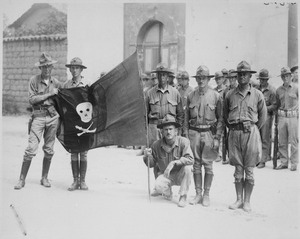
With barely twenty-nine men (there were 30 with him) and 40 rifles, Sandino began a national war against the American invader and the submissive governments of Díaz and Moncada; first encouraging the New Segovian peasants and then all Nicaraguans to the armed struggle.
In the historic battle of Ocotal that took place on July 16, 1927, where Sandino, after taking almost the entire city and forcing the Marines and the National Guardsmen to entrench themselves in the two central blocks, was forced to retreat after its troops were decimated by US Navy planes bombing and strafing the city. Sandino withdrew without major problems, while the civilian population of Ocotal suffered the first aerial bombardment by a squadron of airplanes in the history of military aviation; it was only six months before the city of Chinandega had suffered the first aerial bombardment of Central America during the battle of Chinandega.
In this first combat, Sandino was defeated by the training and firepower of the Marines. This was instructive for him, he decided to use guerrilla warfare from that moment on.
On September 2, 1927, Sandino, through a manifesto, turns his fight around: it is no longer a civil war, but a fight between patriots and invaders; as both conservatives and liberals had called for the intervention of the US Marines. As a consequence of this, in the streets, people used to say: "Five liberals and five conservatives add up to ten bandits."
Little by little, Sandino increased his troops, until they reached around 6,000, who made up the so-called Army for the Defense of National Sovereignty (EDSN); who sought to combat the US Marines, who used to rape peasant women in the places they occupied.
The fight of "El Bramadero" (February 27, 1928), where Sandino's troops inflicted a terrible defeat on a patrol of invading "machos", is memorable because in the final phase of the combat the Sandinistas used the fearsome machetes, work tools of the Nicaraguan peasant turned into effective bladed weapons capable of decapitating a man with a single blow. From that moment on, the marines—who called Sandino's men "bandits or bandits"—began to call them "guerrillas."
The fight lasted 5 and a half hours. We advance 400 Lewis rifles, 16 machine guns, 180 mules, [...] 60 guns 45...Sandino
He carried out various incursions such as attacking and destroying the La Luz mine, owned by former US Secretary of State Knox. Sandino's actions were giving him fame throughout the country and the countries of Latin America. That fame caused many men to arrive willing to join his ranks. In the middle of 1928 the French intellectual Henri Barbusse called him "General of Free Men".
During this phase of the war, Sandino married Blanca Estela Aráuz Pineda, a confidante and close collaborator of the EDSN as a telegraph operator from San Rafael del Norte, Jinotega. From this marriage, Sandino's only daughter would be born in 1932: Blanca Segovia, who was still alive in 2017. Her mother died shortly after her birth due to complications from childbirth.
At the end of November 1928, Rear Admiral D. F. Sallers invited him to abandon the fight and thus obtain the consequent benefits. Sandino's response was not long in coming:
The sovereignty of a people is not discussed, but is defended with arms in hand. Armed resistance will bring the benefits to which you allude, exactly as any foreign interference in our affairs brings the loss of peace and provokes the wrath of the people.Sandino.
The formation of the National Guard

Noticing the US officers that the Marines were not capable of defeating Sandino's soldiers, they decided to employ the tactic of pitting natives against natives. Thus, they began the formation of a new Nicaraguan army, the so-called Nicaraguan National Guard, trained, equipped and financed by the US, and commanded by US officers. Although this meant a considerable increase in the troops fighting Sandino, it did not significantly influence the course of the war.
Far from it, the Sandinistas expanded their areas of operations beyond Las Segovias, reaching areas of Jinotega, Matagalpa, Chontales, Boaco, Chinandega, León, the Caribbean Coast and even the capital of Managua, they were within the radius of action of Sandino's troops. American properties were destroyed in the numerous Sandinista attacks (a fate that did not spare the United Fruit Company plantations), and the collaborators who were captured were summarily executed as Sandino considered them "traitors to the Fatherland."
The American withdrawal
Finally, President Franklin D. Roosevelt comes to power in the US. Compelled by larger domestic issues (the Great Depression), he proclaimed the "good neighbor policy," which meant the withdrawal of all US military forces from the countries of the Caribbean basin, including Nicaragua. However, aware of their defeat, the marines had already been preparing their withdrawal for some time: they gradually stopped participating in the combats, and not only trained classes and soldiers, but also native officers.
In January 1933, the US forces officially abandoned Nicaraguan territory, unable to kill or capture their enemy, let alone defeat it.
Peace
Once the Americans had withdrawn, Sandino sent the new liberal president, Juan Bautista Sacasa, a peace proposal, which was accepted. On February 2, 1933, the war officially ended; Sandino's army, except for a protection group of 100 men, is officially disarmed. The National Guard, which is not yet a military authority recognized as such in the Constitution, is in charge of security throughout the country, which causes abuses against its former enemies (the Sandinistas) as they are unarmed.
Sandino makes a few trips to Managua to point out the breach of the agreements by the National Guard. In those times when Anastasio Somoza García "Tacho" he was the Chief Director of the Guard. As a curiosity, he had participated in the Constitutionalist War on the side of the liberals.
Death and legacy

As chief director of the National Guard, Somoza planned the assassination of General Sandino, signing a document with 14 members of the National Guard.
On the night of February 21, 1934, Sandino, in the company of his father, Gregorio Sandino, the writer Sofonías Salvatierra (Sacasa's Minister of Agriculture) and his general lieutenants Francisco Estrada and Juan Pablo Umanzor, attended a dinner in La Loma invited by President Juan Bautista Sacasa – Somoza's uncle by marriage. At the exit of said event, the car in which they were traveling was stopped in front of the El Hormiguero barracks and prison (now, opposite its east side, is the Campo de Marte) by a group of soldiers led by Colonel Delgadillo, disguised as a guard corporal. The detainees asked that Somoza be called, but they were told that they could not locate him. On the other hand, Sacasa's daughter, having witnessed the arrest, told her father about it, and Sacasa contacted the US embassy to try to prevent the murder. The guards admitted Mr. Gregorio Sandino (Sandino's father) and Mr. Sofonías Salvatierra to said prison, while Sandino and his generals Francisco Estrada and Juan Pablo Umanzor were taken to a vacant lot, known as La Calavera, on the outskirts of the city (today Larreynaga neighborhood). At 11:00 p.m. At m., in front of a previously dug common grave and at Delgadillo's signal, the battalion guarding the prisoners opened fire, killing the three with American Springfield 1903 rifles, caliber 7.62 × 63 mm, and American Thompson 11.43 mm submachine guns. According to Salvatierra's testimony, upon hearing the shots from a firing squad, Gregorio Sandino said: "They are already killing them. It will always be true that he who claims to be a redeemer dies crucified."
Before burying them, the bodies were taken away for Somoza to see in person. Meanwhile, he was at a poetry recital in the Campo de Marte, given by the Peruvian poet Zoila Rosa Cárdenas, who recited poems by the Nicaraguan Rubén Darío.
That same night, the National Guard assaulted the house of Don Sofonías Salvatierra (still standing today), killing a child and managing to escape Colonel Santos López, opening his way with bullets and, later, fleeing to Honduras. The body of this child, as well as those of the three EDSN generals (including Sandino), and that of the latter's brother, Sócrates Sandino, who died in a confrontation with members of the National Guard, were buried in the aforementioned grave..
The following day (February 22, 1934) the National Guard destroyed the cooperative that Sandino had established in the town of Wiwilí, killing or taking its members prisoner. Two years later, Anastasio Somoza García – who even claimed that he received the orders for Sandino's assassination from US ambassador Arthur Bliss Lane – would seize power in the country, overthrowing President Sacasa, who was his uncle by marriage.
In 1944, ten years after Sandino's assassination, the remains that had been buried in the La Calavera grave were exhumed and taken near the south side of the Tiscapa lagoon to be burned, then dumping their ashes into Lake Xolotlán. This occurred due to the student protests at the Central University of Managua that took place that year, against Somoza's re-election to the presidency.
Her legacy
Speak in the squares. |
| —Miguel Angel Asturias |
Without a doubt, Sandino's libertarian feat and legacy aroused the admiration of many contemporary and later intellectuals, both in Latin America and in the rest of the world. Particularly in Latin America where his figure stands as an unyielding example of the struggle for the independence and self-determination of the peoples.
Ideology

Sandino was above all an anti-imperialist and a fighter for the sovereignty of his country, and for social justice. He was linked to revolutionary and left-wing Latin American movements and leaders; with great influence of the Mexican Revolution, of an agrarian and nationalist character, etc. He related fraternally with the renowned Salvadoran communist Farabundo Martí, and with his contacts with other movements and parties on the continent. However, he also expressed ideological differences with Farabundo Martí.
He had great influence from liberalism,[citation needed] but not in the free-trade and oligarchic sense, but in the sense of progressive political liberalism at the end of the century XIX, with popular, anti-oligarchic and democratic roots, and which evolved towards the first forms of self-managed and cooperative Socialism. This phenomenon was replicated throughout Latin America with Martí and Maceo in Cuba, Hostos and Betances in Puerto Rico, the Flores Magón brothers in Mexico whose Mexican Liberal Party (PLM) in addition to playing an important revolutionary role in the cities, ended up declaring itself anarcho- communist; decades later with the liberals of Colombia they would have a similar process, especially after the so-called "Bogotazo" and the vile assassination of its liberal and left-wing leader, Jorge Eliécer Gaitán (1948). That is, assuming oneself as liberal and democratic was generally progressive at the end of the XIX century and beginning of the XX century in Latin America, and of these political positions, many evolved into more radical and socialist positions, in a matter of decades. Likewise, local nationalism evolved into an anti-imperialist nationalism, a term coined by the specialist Dr. Rafael Cuevas, in his work: & # 34;Sandino and the Costa Rican Intellectuals: Anti-imperialist Nationalism in Nicaragua and Costa Rica & # 34;; Accessed 05/20/2019 https://repositorio.una.ac.cr/bitstream/handle/11056/2894/recurso_982.pdf;sequence=1). It evolves from the discourse of the so-called "Patria del Criollo" (Severo Martínez) to the defense of the Patria Grande, Our America says Martí, to Latin Americanism, and of course to socialism as an anti-capitalist form of anti-imperialism.
Sandino at the time stood out as one of the generals of the constitutionalist revolution of 1925 in Nicaragua, which was progressive and liberal in nature (not to be confused with neoliberal), and later began his continental campaign against the US occupation in Nicaragua. A feat with which the most famous Latin American intellectuals supported themselves, such as the Chilean Gabriela Mistral, the Honduran Froylán Turcios, the Dominican educator Ercilia Pepín who sent Sandino a Nicaraguan flag embroidered by the girls from his school.
Somoza García ruled in a dictatorial manner for 22 years, with brief periods in which he imposed a puppet president and always counting on the support of the US. This allowed him to accumulate an enormous fortune and thanks to the growth of the global economy that followed World War II (in which it even declared war on Nazi Germany) was able to give a great boost to agro-export activities, which benefited the country's large producers and not the popular classes.
There the captain of the people waited: |
| —Pablo Neruda |
Anastasio Somoza García was shot in a public act on September 21, 1956 by the young poet Rigoberto López Pérez. At the head of the country, however, his sons Luis Somoza Debayle remained as president, and Anastasio Somoza Debayle as chief director of the National Guard. Both continued the political guidelines of his father, although it is true that Luis allowed a greater political opening.
In this context, the man who fled Salvatierra's house, Santos López, as well as Carlos Fonseca Amador, among others, founded the Sandinista National Liberation Front in 1961 as an armed opposition movement to the Somoza dictatorship and his relatives, managing in 1979 to overthrow the youngest son of Somoza García (Anastasio Somoza Debayle), "Tachito", giving rise to the Nicaraguan Revolution and they ruled Nicaragua until 1990 and again from January 10, 2007, although this time through an electoral process. In both periods of government the president has been Daniel Ortega.
Studies of his life
- Sandino, General of Free Men (1955), written by Gregorio Selser.
- General Augusto C. Sandino, hero of the anti-mperialist struggle in Nicaragua (1972), by Professor Edelberto Torres Espinoza.
- Sandino Guerrillero Proletariat (1972), by Carlos Fonseca Amador.
- Sandino's living thought (1974), work by Sergio Ramírez Mercado.
- Secret Chronicle: Augustus César Sandino before his executioners (1974), by Carlos Fonseca Amador.
- Caribbean man (1977), by Abelardo Cuadra Vega, former Lieutenant G.N.
- Fifty years of Sandinista struggle (1979) by Humberto Ortega Saavedra.
- Damn country! (1979), book by José Román Orozco, published for the first time in 1979, brings together a series of autobiographical documents (diary, accounts, memories) entrusted to the author by General Sandino in the 1930s.XX..
- Political Ideary of Augusto C. Sandino (1980), by Carlos Fonseca Amador.