
Arturo Pratt
Agustín Arturo Prat Chacón (Hacienda San Agustín de Puñual, Ninhue, April 3, 1848-Iquique, May 21, 1879) was a Chilean sailor, soldier, and lawyer. recognized as the "greatest naval hero" in his country.
As a soldier, he remained in the Chilean Navy between 1858 and 1879, a period in which he participated in the wars against Spain (1865-1866) ―where he intervened in the naval battles of Papudo and Abtao― and the Pacific (1879 -1884) ―where he commanded the corvette Esmeralda in the unequal naval combat of Iquique, in which he died―. As a lawyer, between 1876 and 1879 he dedicated himself to resolving both private matters and naval-related issues; he modified the law of navigation, remodeled the legal system of the Navy and regularized promotions in said institution.
In Chile it has been commemorated in various ways: a company of the Santiago Fire Department, units of the Chilean Navy, a town, an association and soccer clubs, an indoor stadium, the Naval School, an Antarctic base, a province, a university and 144 streets, among others, bear his name.
Law 2977 of February 1, 1915 established May 21 as the "celebration of all the glories [of] the Navy of the Republic" and as a holiday in Chile; during this festivity, the raising of the flag Chilean is mandatory in all private and public venues in the country. In addition, May 21 became the date of the Annual Account of the President of the Republic before the full Congress between 1926 and 2016, and on the "Day of the Lawyer" from the 2010s.
Family
Origin
The origins of the Prat family can be found in Santa Coloma de Farnés, province of Gerona, Catalonia (Spain). Ignacio Prat Guigueras (ca. 1780-La Serena, 1824) was born there —son of the farmer Isidro Prat Camps, who was recognized with a decoration and military privilege, and María Rosa Guigueras y Mascaró, daughter of a notary, who leaned towards trade and worked as an exporter of goods, mainly to Argentina; For unknown reasons, he emigrated around 1806 to Chile, where he was a merchant in Santiago in 1810 and was taken prisoner by a royalist in 1817. He married Agustina Barril Rojas —daughter of the military man Félix Barril y Díaz and Tadea de Rojas y Guzmán— in the San Isidro parish of the Chilean capital on February 9, 1811. They had four children: Agustín, Clara del Carmen, who remained single; Manuel Jesús and Concepción Prat Barril, died in infancy.
Agustín Prat Barril dedicated himself to commerce and opened a store on Estado street in Santiago, where he met María del Rosario Chacón Barrios —daughter of merchant Pedro Chacón y Morales and Concepción Barrios Bustos—, with whom he met He married in the El Sagrario parish of the Chilean capital on October 26, 1838. The store was destroyed by a fire; Economically ruined, the couple left Santiago and moved to the San Agustín de Puñual farm, in Ninhue (present-day Itata province), then operated by Andrés Chacón Barrios, brother of María del Rosario. Prat Chacón's first three children. At this time, in addition, Agustín Prat Barril began to suffer from a chronic and incurable disease, a kind of progressive paralysis.
Ancestors
| Ancestors of Agustín Arturo Prat Chacón | ||||||||||||||||||||||||||||||||||||||||||||||||||||||||||||||||||||||||||||||||||||||||||||||||||||||||||||||||||||||||||||||||||||||||||||||||||||||||||||||||||||||||||||||||||||||||||||||||||||||||||||||||||||||||||||||||||||||||||||||||||||||||||||||||||||||||||||||||||||||||||||||||||||||||||||||||||||||||||||||||||||||||||||||||||||||||||||||||||||||||||||||||||||||||||||||||||||||||||||||||||||||||||||||||||||||||||||||||||||||||||||||||||||||||||||||||||||||||||||||||||||||||||||||||||||||||||||||||||
|---|---|---|---|---|---|---|---|---|---|---|---|---|---|---|---|---|---|---|---|---|---|---|---|---|---|---|---|---|---|---|---|---|---|---|---|---|---|---|---|---|---|---|---|---|---|---|---|---|---|---|---|---|---|---|---|---|---|---|---|---|---|---|---|---|---|---|---|---|---|---|---|---|---|---|---|---|---|---|---|---|---|---|---|---|---|---|---|---|---|---|---|---|---|---|---|---|---|---|---|---|---|---|---|---|---|---|---|---|---|---|---|---|---|---|---|---|---|---|---|---|---|---|---|---|---|---|---|---|---|---|---|---|---|---|---|---|---|---|---|---|---|---|---|---|---|---|---|---|---|---|---|---|---|---|---|---|---|---|---|---|---|---|---|---|---|---|---|---|---|---|---|---|---|---|---|---|---|---|---|---|---|---|---|---|---|---|---|---|---|---|---|---|---|---|---|---|---|---|---|---|---|---|---|---|---|---|---|---|---|---|---|---|---|---|---|---|---|---|---|---|---|---|---|---|---|---|---|---|---|---|---|---|---|---|---|---|---|---|---|---|---|---|---|---|---|---|---|---|---|---|---|---|---|---|---|---|---|---|---|---|---|---|---|---|---|---|---|---|---|---|---|---|---|---|---|---|---|---|---|---|---|---|---|---|---|---|---|---|---|---|---|---|---|---|---|---|---|---|---|---|---|---|---|---|---|---|---|---|---|---|---|---|---|---|---|---|---|---|---|---|---|---|---|---|---|---|---|---|---|---|---|---|---|---|---|---|---|---|---|---|---|---|---|---|---|---|---|---|---|---|---|---|---|---|---|---|---|---|---|---|---|---|---|---|---|---|---|---|---|---|---|---|---|---|---|---|---|---|---|---|---|---|---|---|---|---|---|---|---|---|---|---|---|---|---|---|---|---|---|---|---|---|---|---|---|---|---|---|---|---|---|---|---|---|---|---|---|---|---|---|---|---|---|---|---|---|---|---|---|---|---|---|---|---|---|---|---|---|---|---|---|---|---|---|---|---|---|---|---|---|---|---|---|---|---|---|---|---|---|---|---|---|---|---|---|---|---|---|---|---|---|---|---|---|---|---|---|---|---|---|---|---|---|---|---|---|---|---|---|---|---|---|---|---|---|---|---|---|---|---|---|---|---|---|---|---|---|---|---|---|---|---|---|---|
| ||||||||||||||||||||||||||||||||||||||||||||||||||||||||||||||||||||||||||||||||||||||||||||||||||||||||||||||||||||||||||||||||||||||||||||||||||||||||||||||||||||||||||||||||||||||||||||||||||||||||||||||||||||||||||||||||||||||||||||||||||||||||||||||||||||||||||||||||||||||||||||||||||||||||||||||||||||||||||||||||||||||||||||||||||||||||||||||||||||||||||||||||||||||||||||||||||||||||||||||||||||||||||||||||||||||||||||||||||||||||||||||||||||||||||||||||||||||||||||||||||||||||||||||||||||||||||||||||||
Birth

At the San Agustín de Puñual hacienda on April 3, 1848, the fourth son of the Prat Chacón family, Agustín Arturo, was born, attended by the local midwife Juana Daza.
After his birth, he seemed doomed to follow the fate of his three older brothers; he was of delicate build and health, and did not scream at birth.However, the mother entrusted the child's health to "hydropathy" and "hydropathic sweats" of the so-called Priessnitz method.
He was baptized in the parish church of Nuestra Señora del Rosario in San Antonio de Ninhue on March 2, 1849 by the priest J. Bartolomé Venegas; His godparents were the marriage formed by Andrés Chacón Barrios and Josefa Chacón Espinoza, his maternal uncles.
Childhood and youth
Early Years
Tempted by the California gold rush, his uncle Andrés Chacón left, along with his partners José Manuel Moya and Rafael Sotomayor, to try their luck in the United States. This adventure cost him financial ruin; he had to sell the farm — "[of] some 1,200 hectares of soft and dry hills, dedicated mainly to vineyards and citrus, and sheep grazing" —, which was bought by local rancher Ambrosio Molina.
Because of that, the Prat Chacón family returned to Santiago. In the southern winter of 1849, they boarded a sailboat on the Talcahuano-Valparaíso route and her mother applied the Priessnitz method to the child using cold sea water every day of the trip.
The family found solvency with the "Las Delicias" farm —located in the current Providencia commune, then in the vicinity of the Chilean capital—, owned by their maternal grandfather Pedro Chacón y Morales since 1834, where they were born Prat's four siblings and spent his childhood. He developed physically and left behind his "rickety and puny complexion [...] melancholic expression [...] distracted air and sad and sick appearance", according to the description of his maternal uncle Jacinto Chacón. The change was attributed to the Priessnitz method, but it is more likely the result of the stimulating environment of the farm and his fondness for physical exercises, including boxing. He was "a lively and playful child" but docile; He was singled out by an extreme attachment »to his mother.
On November 2, 1854, the farm was sold for 71,000 pesos to the charity of the Casa de Expósitos run by the Sisters of Providence and the Prat Chacón family moved to a modest house located on the third block on Nueva de San Diego street, today called Arturo Prat.
Elementary school
On San Diego street in 1856, the Escuela Superior de Instrucción Primaria was inaugurated, known as the “Escuela de la Campana” due to a tower with a bell that rang to call the classes. José Bernardo Suárez was appointed director and Eliseo Otaíza, deputy director.
On June 1, 1856, he began his studies at said school. He was a student of good conduct, except for lawsuits and mischief typical of childhood; he had problems with mathematics, specifically arithmetic, but he overcame them and earned distinction in reading, geography, religion, and arithmetic itself in 1856.
He left school on August 25, 1858; As a farewell, director Suárez noted in his records: «Application, excellent; capacity, good; conduct, id.; assistance, constant; character, unbeatable."
Naval School

.jpg)
In Valparaíso on August 28, 1858, he entered the State Naval School, directed at that time by the French naval officer Jules-Jean Feillet, seconded by his compatriot Anatole Desmadryl. Upon admission to that institution, President Manuel Montt Torres had created two scholarships per province: One from Arauco was awarded to Prat; the other, to Luis Uribe Orrego. Both had Jacinto Chacón ―Prat's uncle and Uribe's stepfather, for which they became almost brothers―, and were two of the twenty-six cadets who were part of the so-called "Course of Heroes", all of them prominent figures in the subsequent War of the Pacific.
His first year as a cadet was uneven in his studies; distracted, he continued his difficulties with mathematics; however, just like in school, he overcame it and was awarded a silver medal for his achievements.In his second year, he had to start nautical apprenticeship. His first training trip was made in 1859 on the steamer Independencia, under the command of Lieutenant Commander Nicolás Saavedra, where he learned sailing and rigging maneuvers, to later continue with seamanship practices and artillery. In January 1860, Prat boarded the corvette Esmeralda for the first time, then commanded by the frigate captain José Anacleto Goñi Prieto. He continued his nautical apprenticeship: embarkation and disembarkation, combat drills, etc. In July 1861, he graduated from the Naval School as "first seniority", the most distinguished of the course, and obtained the rank of midshipman without examination.
During this period, he also faced events such as the burning —and subsequent sinking— of the French pontoon Infernal, which "stored coal, naval articles, explosives and ammunition", occurred on October 1, 1861 in front of the Fiscal Warehouses of Valparaíso. Right there were the Esmeralda and the steamer Maipú, among other ships. To try to extinguish the fire on the pontoon, the ships in the bay sent boats with crews; one of them was led by midshipman Prat, who after two hours of fighting the fire had to withdraw with the other sailors, shortly before the feared damage to ships and nearby buildings occurred.
Due to the border conflict between Bolivia and Chile over the Atacama desert since 1843, a series of incidents began between the two countries. At the end of 1863, he had to embark on the Esmeralda, commanded by the frigate captain Juan Williams Rebolledo, which set sail for Mejillones to defend the interests of the Chileans from the Bolivian authorities in Cobija.
He gave the theoretical and practical tests necessary to obtain the midshipman's dispatches examined on July 21, 1864.
War against Spain


Between the end of 1863 and the beginning of 1864, incidents occurred that sparked Chilean disapproval of the occupation of the Peruvian Chincha Islands by the Spanish squadron, commanded by Admiral Luis Hernández-Pinzón Álvarez, which led to war against Spain, declared on September 25, 1865.
Before the deployment of the Spanish ships, made by Vice Admiral José Manuel Pareja —replacing Pinzón— to harass the Chilean coast, the frigate captain Williams Rebolledo, commander of the Esmeralda, planned the recovery of the Chilean transport Matías Cousiño and the capture of the Spanish schooner Covadonga. On November 26, 1865, the naval combat of Papudo took place, which favored the Chilean side, which captured the Spanish schooner. This meant that, on the one hand, all the Chilean sailors participating in the act were promoted in a grade, for which Prat became a second lieutenant; and that, on the other hand, Vice Admiral Pareja committed suicide.
To make up for Papudo's defeat, sea brigadier Casto Méndez Núñez, then commander of the Spanish squadron, sought another confrontation with the allied ships —Chile's declaration of war had been seconded by Peru on December 13, 1865, by Ecuador on January 30, 1866 and by Bolivia on March 22, 1866—, which occurred in the vicinity of the Chiloé archipelago, in the naval combat of Abtao on February 7, 1866. The combat consisted of a distance cannonade between the Covadonga, supported by Peruvian ships, and the Spanish frigates Villa de Madrid and Blanca —some allied ships did not participate or because of lack of coal or because of the rocky estuary. Under the command of the frigate captain Manuel Thomson, Prat was then serving on the Covadonga, which resisted the Spanish bombardment and fired some shots at the frigate Blanca. The Spanish casualties were six wounded and three contused, while in the allied squad historians disagree on the number of casualties: the dead range between two and twelve; and the wounded, between one and twenty. On June 20, while he was still part of the crew of the Covadonga, Prat participated in the capture of the English boat Thalaba, who smuggled food and other supplies to the Spanish.
After the war —an indefinite armistice was signed between Spain and the four allies on March 11, 1871, and Chile and Spain signed a peace treaty on July 12, 1883—, he made numerous voyages both in Chile and abroad; for example, he visited the Juan Fernández archipelago, Easter Island and Magallanes. Arica of that same year, and to the Esmeralda, under the orders of Vice Admiral Manuel Blanco Encalada, in charge of repatriating the mortal remains of Bernardo O'Higgins from Peru.
Adulthood
Navy officer
.png)
On September 9, 1869, he became a first lieutenant and returned to the O'Higgins as a detail officer in January 1870. Beginning in 1871, he was an officer in detail of the Esmeralda —with said corvette he had to station himself in Mejillones between 1871 and 1872 to protect the interests of the Chileans residing there—, for which he held various positions at the Naval School (professor, deputy director, interim director) and he was entrusted with the courses of naval ordinance, law, naval tactics and cosmography, among others. He was a teacher who fought against the lack of resources in the environment to provide quality education to the point of translating himself the books from French to Spanish. He reached the ranks of lieutenant captain graduated on February 12, 1873 and effective in 1874.
On May 24, 1875, the Esmeralda was in Valparaíso while Prat was on sick leave. The ship's commander, Luis Alfredo Lynch Solo de Zaldívar, was also on leave, so the ship was left in charge of Lieutenant Constantino Bannen Pradel. A violent storm broke out in the bay; the Valdivia broke its moorings and rushed against the Esmeralda, which in turn impacted the Maipú. When Lynch and Prat arrived, the wreck of the Esmeralda seemed inevitable; both were transported by the boatmen to the ship, but the waves immobilized the boat. Prat jumped into the water and swam to the ship and climbed aboard by rope, just as Lynch had done moments before, where he worked, with a rope tied around his waist to the mast, to carry out the rescue operations, which consisted of in beaching the bow ship against the beach and securing it there by ropes. Although the task was not easy, in the end the beaching was achieved and the ship was saved from sinking. Lynch would later recall Prat's "imperturbable serenity in the face of danger". The repair of the Esmeralda It was difficult and long and its cost rose to 100,000 pesos. Lynch had to face a summary against him for the responsibilities that fell to him, but he managed to save himself by a tie in the vote; Throughout the indictment, Prat was faithful to his superior, supporting him in the process.
After the exams were completed in May 1876, the Chilean government closed the Naval School. Prat, who left Condell in charge of the Esmeralda, was appointed assistant to the Maritime Governor of Valparaíso for his law studies. On September 25, 1877, he was promoted to frigate captain.
Advocacy
Studies

.jpg)
Interested in law, he decided to obtain a professional degree and in 1870 he began his studies to become a lawyer. He began with his graduation as a free student of humanities at the Liceo de Valparaíso and the National Institute. In 1871 he obtained the diploma of the baccalaureate in philosophy and humanities, a requirement to start law studies, with the historian Diego Barros Arana being among its examiners.
In 1872 he began his law studies, enrolled in the Faculty of Law of the University of Chile, studying on board the Esmeralda, which then landed in Mejillones; upon returning, he requested to be examined in Valparaíso and passed the required courses. In 1875 he began the practice of law, a prerequisite for the title, in a legal study in said port. He defended the engineer Ricardo Owen, accused of disobedience, and later Luis Uribe Orrego, accused of contempt and disobedience to his superiors.
In July 1876, he passed the last subjects. Ready to graduate, he raffled a certificate among various courses and take an exam on it; his ID was Roman law, which he passed on July 24, 25, and 26. He also obtained approval for his undergraduate thesis, entitled Observations on the current electoral law, which contains clues about of his political thought. It was written within the framework of the promulgation of the new electoral law, during the government of Federico Errázuriz Zañartu, when the institution of the largest taxpayers and the cumulative vote for deputies were established. Prat analyzed this law from the perspective that with it it was possible to advance in electoral freedom; He pointed out the contradictions and obscurities in the text, but stressed that it was an "eminently liberal" law, concluding that:
Good in the background, it has the need for serious and important regulatory reforms, if it is to achieve the high objective to be intended: to be effective guarantee that the result of the polls is the faithful expression of national will.Fragment of Prat's thesis, entitled Observations on the subjective electoral lei (1876).
On July 31, 1876, he had to take the final exam before the ministers of the Supreme Court; however, he learned that the highest court had decided not to hear exams that day. He insisted that his time as a sailor was very limited and requested an audience with the president of the Supreme Court, Manuel Montt Torres, whom he convinced that he will be allowed to examine; By the end of the day, Prat became a lawyer at the age of 28. Despite his title, his difficult financial situation, and the pleas of his wife, he refused to leave the Navy to practice law, saying:
I have no ambitions of profit, neither honors nor glory attract me, for I think I can serve my homeland in some other way.
Jurist
He established his law firm in the Banco Consolidado de Chile building, in the Plaza de la Justicia. He aspired to be a Navy auditor, but due to his lack of experience he was only invested as an "assistant", and he was entrusted with the legal aspects of the Navy Commander-in-Chief.
He completely remodeled the legal system of the Navy, starting with the navigation law, to which he proposed 152 modifications, of which a large part was accepted. He was also in charge of regularizing promotions to avoid influences social relations, "political quotes" and other factors that were not other than their own merit and seniority. Prat died without seeing this navy code published.During this stage, he endured covert misgivings and hostility from his peers, who kept him at a certain distance because he was a lawyer and did not consider him a full soldier.
Family Guy
Dating and marriage


In his country house on Calle del Circo, his maternal grandfather Pedro Chacón y Morales used to give a gathering once or twice a week. Prat frequently went to them, as did the sister-in-law of his maternal aunt Concepción Chacón Barrios, Carmela Carvajal Briones, the quillotana —daughter of Diego Carvajal Zamora and María Briones Insulza—; at these gatherings, both met and fell in love.
In 1868, upon returning from the trip that repatriated O'Higgins' mortal remains from Peru, Prat brought gifts for her: a fan, a sewing box, an ivory card holder, and a silver cross. The relationship was very obvious, but very reserved for Prat, who got upset when they related to her courtship; In addition to natural shyness, another of the reasons for his annoyance was the fear of formalizing a relationship when he did not have the money to maintain a marriage. When he learned that he would be promoted to lieutenant captain, he finally decided to ask for Carmela Carvajal's hand in 1873. Shortly after this, Prat wrote the only surviving love letter to his girlfriend:
My Carmela, my life, my treasure, I have to tell you, even the one I love you every day with more vehemence, I do not now because I fear getting worse. Receive your Arthur's passionate heart.
In front of the Plaza de la Victoria in Valparaíso, in the parish of Espíritu Santo on May 5, 1873, they were married and blessed by the priest Francisco Salas Portales. Their godparents were José Jesús Carvajal Briones and María del Rosario Chacon de Prat; the witnesses were Bernardo Chacón, Jorge Montt and Eulogio Varas. The newlyweds spent their honeymoon in Quillota and in the Cauquenes hot springs; Later, Prat returned to Valparaíso to resume his naval duties.
Prat treated his wife as an equal, as a companion, something difficult to find in the 19th century, entrusting her, for example, with the family budget, and he himself taking charge of some of the domestic problems:
At every moment it seems to me that I see you withdrew from pissing our daughter, without being with you and sharing, even if small, your works [...].
Children

On March 5, 1874, the Prat Carvajals' first daughter was born: Carmela de la Concepción. Like Prat's ill-fated older siblings, she inherited a fragile and sickly complexion; Her problem was a hernia caused by cutting the umbilical cord, which was aggravated by different illnesses —diarrhea and fever, among others. Prat wrote to his wife: "Continue to use homeopathy for my daughter and let me know when she is well." Prat supposed that the method that cured him of her weak condition would do the same wonders for the girl; but it did not work, to the despair of an impotent mother and a desperate father in prayer. At the end of his annual season, Prat had to be transported to the center of the country by the Abtao, which did not arrive. On December 13, the steamer finally arrived and he wrote to his wife: "Then I'll see you, as well as my daughter, who I hope is completely healthy." However, the girl had died on the 5th; At nightfall she received a letter from his wife:
Arthur of my heart: our dear angel is still ill; I feel that my heart is faint of pain and you are not to sustain me... If you could come, it would be my only comfort. Don't despair my good, think of your unhappy Carmela.Letter from Carmela Carvajal to Arturo Prat, December 1874.
The steamer could not leave until the 18th. All his hopes were destroyed on the trip by a note of condolences, delivered in some intermediate port, signed by Juan José Latorre. At the bottom of the previous letter from his wife, Prat noted:
On December 5, at 1 hours 3 minutes of the night, my daughter Carmela de la Concepción died. This letter is meant to tell me, the bitterness it reveals should have made me understand, but so sweet is hope.Arturo Prat, December 1874.
Later, his other two children were born in Valparaíso:
- Blanca Estela (September 11, 1876), married in 1905 with Ramón Camilo Undurraga Silva—son of Ruperto Undurraga Solar and Josefa Silva Vélez—with whom she had four children.
- Arturo Héctor (6 March 1878), married in 1909 with Blanca Echaurren Clark—son of Alfredo Echaurren Valero and Teresa Clark Vargas—with whom he had five children.
Interests and beliefs
His personal library contained books that revealed his interests, such as Balmes's Fundamental Philosophy, Chateaubriand's The Genius of Christianity, Beyond Death i> by Figuer, The Gospel According to Spiritism by Kardec, History of Christianity by Nicolas, The Century of Louis XIV by Voltaire, and texts of Duruy, Montesquieu and Rousseau, among others.
He was "deeply religious [...], a liberal Catholic, and with [...] a spiritualistic streak". His religiosity was characterized by "love for God the Father and complete trust in his Providence".; he used to repeat that "God guides us, and what happens is always the best that can happen."
Influenced from his childhood by his uncle Jacinto Chacón, considered one of the pioneers of spiritualism in Chile, he experimented with this practice and incorporated his wife into it. To try to communicate with two dead people —Agustín Prat Barril and Carmela Prat Carvajal, his father and his first daughter—, the Prat Carvajals participated in spiritist sessions in April 1876 together with the mediums Eduardo de la Barra, Jacinto Chacón and his wife Rosario Orrego, among others. After being widowed in May 1879, Carmela Carvajal took part in spiritualism sessions to contact Prat.
Mission in the Río de la Plata
At the end of 1878, and as a result of the intentions of the Argentine government to establish sovereignty in Patagonia, particularly in the Santa Cruz river, he was commissioned for a few months by President Aníbal Pinto to carry out intelligence services in Uruguay and Argentina.
The object of his journey, he said to me, is to know whether he is willing to move to Montevideo to know what is done in the Argentine Republic, in order to armaments, military movements and all kinds of apparitions that reveal a hostile character to Chile, since they are continually receiving alarming telegrams, perhaps without real foundation and what is desired is to know what is positive.
On November 18, 1878, he arrived in Montevideo, where he introduced himself as a lawyer and writer, and stayed at the Hotel de la Paz. In December of the same year, he twice visited Buenos Aires, where he established contacts and met briefly with President Nicolás Avellaneda.During his mission, he delivered a series of Argentine military and naval data requested by the Chilean government. He underestimated the effective military power of Argentina, citing factors such as the impact of the economic crisis, the large number of foreigners and the inexperience of its sailors, but, at the same time, he warned about the accelerated preparations for war. About the possibility of a conflict, stated:
I am not a friend of war, but I also believe that excessive love for peace can harm us more than the war itself, enervating the country and making us lose the influence that for our peace and good of America we must and can exercise in America and that we do not put into practice for pure selfishness.
The mission was not to his liking, so he requested his return to Chile after completing the essentials of his mission; On January 28, 1879, he received authorization to return to Chile, and he landed in Valparaíso in mid-February.
Pacific War
Background
On February 14, 1879, when the Chilean military forces occupied the Bolivian city of Antofagasta, Prat was not very well regarded among his peers because of his academic training as a lawyer, which made him distrust his worth as a soldier, and was excluded from the first actions and preparations of the Navy. He remained in Valparaíso, where he was appointed assistant secretary of the General Command of the Navy, a position that he disliked because he felt that his participation in the actions of the Navy was denied to him.
Bolivia declared a state of war against Chile on the following March 1. At the end of that month, the person in charge of civil representation in the squadron, Rafael Sotomayor, had to embark on government instructions on a steamer bound for Antofagasta and requested an assistant to the General Command of the Navy. Prat was appointed and, although reluctant at first, complied with the order, accompanying Sotomayor as an adviser and personal secretary. He earned Sotomayor's trust during the voyage from Antofagasta to Iquique in the armored frigate Blanco Encalada.
Iquique blockade


On April 5, when Chile declared war on both allies, Prat was in charge of officially notifying the blockade of Iquique to his Peruvian authorities, headed by Prefect Dávila. He returned to Antofagasta, where he obtained to be considered in the actions and he was assigned command of the Covadonga, then under repairs in Valparaíso. In addition, he was sent to Santiago by Sotomayor and Juan Williams Rebolledo to personally request the government to purchase the Amazon; After his mission in the Chilean capital, he assumed command of the Covadonga , which completed its repairs in early May.
On May 3, the corvette Abtao, under the command of Lieutenant Commander Carlos Condell de la Haza, and the Covadonga, under the command of Prat, sailed from Valparaíso and they landed in Iquique on May 10 ―both the Covadonga and the Esmeralda (under the command of Manuel Thomson) were considered of little military value because of their poor gait―. In Iquique the Chilean squadron was preparing to attack the Peruvian squadron by surprise in the port of Callao; To fulfill this plan, then Rear Admiral Williams Rebolledo made changes: he appointed Thomson as commander of the Abtao, Prat of the Esmeralda and of the Covadonga i> to Condell. Prat and Condell were left in charge of the blockade of Iquique, where the Lamar transport also remained as a coal deposit for the ships.
On May 16, the Chilean squadron set sail for Callao; That same day, the convoy made up of the monitor Huáscar, the armored frigate Independencia and the transports Chalaco, Limeña and Oroya left that port for Arica in order to carry weapons, ammunition, reinforcements and supplies. Both squadrons passed each other at night, without sighting each other.
Semblance
In his Memories of the blockade of Iquique (Guayaquil, 1910), the Catalan Jaime Puig y Verdaguer, Ecuadorian consul in that port in 1879, left a description of Prat on April 5 of said year, when he landed without any escort to officially notify the Peruvian authorities of the blockade:
I would have at the time 28 or 30 years on a little less [actually, I had just turned 31]; it was of height rather high than regular, about eight cubits I calculated from the crown to the soles of the feet; all in it was beautifully provided, wore black beard like the azabache, slightly left in the middle and square; eyes clamps, intelligent and suggestive look, and watched by a magnificent zingsic] of that varonly friendly and sympathetic face.
Iquique naval combat
Initial Moves

At 6:30 a.m. on Wednesday, May 21, 1879, the lookout of the Covadonga warned of the presence of other ships with the cry "Smoke to the north!" camanchaca, the new arrivals could not be identified and for a few moments it was thought that the Chilean squadron had returned. At 6:45 a.m., a sailor from the Covadonga clearly observed the rigging of the ships and recognized them as Peruvians. Given this information, Condell ordered a warning shot to be given to the Esmeralda, anchored in port. Upon hearing the signal, Prat arranged to raise the anchor, make the crew eat and play combat clearance. In addition, he ordered the Covadonga to speak to confer and that the correspondence for the Chilean squadron be thrown into the sea, in a sack.
Upon sighting the Chilean ships, inside the port and very close to the coast, the Peruvian ships raised the combat flag. The Huáscar was closer to the port. At that moment, the Peruvian ship captain Miguel Grau harangued his crew through a megaphone.
For his part, Prat ordered the hoisting of the signals: first he made Condell the signal "Did the people have lunch?", then "follow my waters" and finally "come to speak", and then he harangued his companions weapons:
Boys: the contest is uneven, but spirit and courage. To this day, no Chilean ship has ever leased its flag; I hope that this is not the occasion to do so. For my part I assure you that as long as I live such a thing will not happen, and after I fail, my officers remain, who will be able to fulfill their duty.Arenga de Prat to his crew according to Vicente Zegers Recasens.
Boys, the contest is uneven, but as you know, our pavilion has never been brought before the enemy and I hope this is not the occasion to do so. As long as I live, I assure you that this flag will flame in its place; and if I die, my officers will be able to fulfill their duty.Arenga de Prat to his crew according to Luis Uribe Orrego.
Prat took off his cap and exclaimed "¡viva Chile!" which was repeated several times by his crew. Finished the harangue, the Covadonga spoke and Prat ordered Condell: "Let the people have lunch! Keep low funds! reinforce the loads!, each one to fulfill his duty!». Condell simply replied "all right!".
First phase
At 8:00 an explosion was heard, and a column of water and foam rose in the middle of the Chilean ships; the Huáscar had fired his first shot. Prat ordered the Esmeralda to raise its gait. At 8:25 a second broadside fell and a shot from Huáscar struck squarely on the starboard side and passed between the wings of Covadonga, at the height of the base of the ratchet, penetrating the dining room that was being converted into a hospital.
Prat ordered the blockade to be abandoned and the transport Lamar quickly headed south, which raised the American flag. Likewise, Condell withdrew from the port and headed south, behind the Lamar. Grau ordered the frigate Independencia, commanded by Commander Juan Guillermo Moore Ruiz, to block the passage to the Covadonga and the Lamar; Independence followed them.
In this way, they stayed in Iquique to face the monitor Huáscar (1865) and the corvette Esmeralda (1855) —the first, an armored turret ship from 1130 tons with 4 ½-inch armor, had two 300-pound muzzle-loading guns, located in her turret, and 11 miles of speed at full capacity; the second, an 850-ton wooden ship, had 200 horsepower, eight 40-pound guns, four 30-pounds, and two 6-pounds.
Second phase
Prat went down to his cabin, dressed in his parade uniform, put away his wife's portrait and other personal belongings, and went up to the command bridge. He positioned the Esmeralda 200 meters from the coast, forcing the Huáscar to shoot from elevation so as not to harm the Peruvian people who had gathered in crowds on the beach of El Colorado to continue the fight.
General Juan Buendía, commander of the Peruvian plaza of Iquique, had two field cannons placed on said beach and sent an emissary in a fast felucca to Huáscar with the (erroneous) warning about the presence of torpedoes. Grau, erroneously informed that the Esmeralda was surrounded by torpedoes, stopped 600 meters from her and began firing with his 300-pound cannons, failing to hit any shot for an hour and a half due to the inexperience of the Peruvian sailors in handling the monitor turret, to which the Chilean crew responded with their 30-pound cannons and rifle fire, impacts that ricocheted off the massive armor of the Huáscar and which only succeeded in damaging the lifeboats.
On the coast, the Peruvians installed a battery of 9-pound guns and began to bombard the Chilean ship; the shots from this land battery were the ones that caused a carnage on board. Being between two fires, Prat ordered the ship to move, which he maneuvered slowly —barely 4 knots, since his machine was defective; then two of her boilers burst, giving barely two knots—and she positioned herself 1000 meters north of the city and 250 meters from land, where she remained until she sank. This maneuver made Grau see that the torpedoes that supposedly surrounded the Esmeralda did not exist. One of the shots from the Huáscar arrived squarely on the deck, decapitating the order bugler Gaspar Cabrales and mutilating the servants of a cannon. The deck began to be stained with the blood of those who fell. The situation of the Esmeralda became desperate when it was beaten and dismantled by the batteries posted on the beach and by the cannons of the Huáscar.
Prat's first spur and approach

At 11:30 Grau ordered the Esmeralda to ram. of mizzen. The first spur hit the poop, where due to the bending of that sector it did not seem to cause fatal damage until then; however, the two cannons from the Huáscar tower, "fired from penoles before and after the clash, wreaked terrible havoc on the [Chilean] sailors".
When giving the ram from the stern side, Prat, with sword in hand, yelled: "Boarding, boys!", a cry that due to the noise of the crash was only heard by second sergeant Juan de Dios Aldea, who He jumped along with Prat and the sailor Arsenio Canave, who slipped and fell into the sea at the moment the monitor receded, climbing onto it and later dying on its deck. Second Sergeant Aldea followed Prat armed with a boarding ax and a pistol. Once on the monitor deck, Prat and Aldea headed for the conning tower. Grau, seeing this action by the Chilean sailors, ordered them to be arrested; Peruvian second lieutenant Jorge Enrique Velarde tried to carry out the order of his superior, but when he opened the trapdoor he received three fatal shots from Prat.
As he approached the turret, Aldea received a rifle discharge in the middle of his belly that left him in agony on deck, only Prat followed. Reaching the deck, Prat advanced towards the conning tower and was hit by a shot in the knee. He managed to hold on to the other, but the Peruvian sailor Mariano Portales, coming out of the turret, killed him instantly with a shot to the forehead almost at point blank range.

Death of Arturo Prat (Thomas Somerscales, 1880)
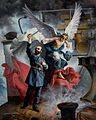
Prat guided to sacrifice for the genius of the homeland (Cosme San Martín, 1883)

Arturo Prat (Pedro Subercaseaux, hmm?)


Second spur and tackle by Serrano

In the second spurt, the Huáscar launched with a gait of eight miles towards the bow of the Esmeralda, this time to the starboard side, "[firing] the two pieces of its tower". Second Lieutenant Ignacio Serrano, revolver and sword in hand, shouted "To boarding!", going up to the monitor deck with twelve men; one shot knocked down Serrano, and the others were killed by the Gatling guns mounted on the bridge and by the musketry of the sailors on the monitor.Serrano received wounds in the genital area and his screams were atrocious; Grau had him taken to the infirmary, where he was left next to the dying Aldea.
Third spur and sinking of the Esmeralda
The third spur, this time at a speed of ten miles and in the center, was fatal for the corvette and marked its end. The last cannon shot was made by midshipman Ernesto Riquelme, who is supposed to have been killed by a Huáscar grenade.
At 12:10, after an unequal, long and merciless battle, the Esmeralda sank with all its crew members and all its flags: «that of the chief at the top of the mizzen, that of guard at the foremast, the pennant to the largest and two nationals at the top of the mizzen, since the precaution had been taken to hoist another one in case it was missing the first".
Epilogue


After the combat, Grau ordered the 63 surviving shipwrecked to be picked up in boats, who were disembarked in Iquique and housed in the fire station as prisoners of war, and had a record of Prat's belongings taken. the naval combat and the death of Prat, the Peruvian commander wrote to his sister-in-law and comadre Mercedes Cavero Núñez, wife of Óscar Viel y Toro, the following:
You will already be informed of the encounter of our ship with the old Esmeralda and Covadonga; both ships have defended themselves with an extraordinary bizarre; it touched me to beat me with the Emerald to which I was forced to step down because nothing had managed to do with the 40 cannons that had shot him in about three hours of combat [... ]
The brave Commander of the Emerald died as a Hero on the deck of this ship, at a time when he embarked on a reckless approach. I made a supreme effort to save him, but unfortunately, it was already late. His death loved me the small victory he had obtained and I spent a very afflicted day [...].
Later, Grau ordered that Prat's personal belongings—his sword, wedding ring, photographs of his wife and children, and a memorandum book, among others—be returned to his widow; Together with them, Carmela Carvajal received a letter in which the Peruvian commander expressed: "her worthy and courageous husband [...] was the victim of his reckless courage in defense and glory of the flag of his country." In response, Carmela Carvajal wrote a letter thanking her for this gesture.
On Thursday the 22nd, the bodies of Prat, Serrano and "crew members of the Esmeralda" were buried in the Iquique cemetery thanks to the Spaniards Eduardo Llanos Nava, Benigno Posadas and Jaime Puig y Verdaguer, and other foreigners residing in the city. In May 1888, Prat's remains were transferred to Valparaíso, where they were buried in a monument built by popular subscription. The greatest Chilean naval heroes rest there and it is there where, with the presence of the President of the Republic, Prat and his crew are honored with military parades and floral offerings every May 21, Naval Glories Day.
The death of Prat mobilized the Chilean population around the common cause of the war, which was one of the factors of the Chilean victory in the War of the Pacific, being the determining factor the superiority of its squadron.
Acknowledgment

.jpg)

His death transformed him into a symbol of Chile in its fight to the death with its enemies; he was admired not for his exploits but for representing his values of dedication and sacrifice.After the end of the war, his image was less revered, but it re-emerged with force during the period of the Parliamentary Republic (1891 -1925); Faced with the corruption of the political system, his figure acquired new edges, personifying civil virtues and the fulfillment of duty, rather than military values:
[Prat became] the embodiment of a dynamic leadership and spiritual superiority: the man who brought fame to Chile, the warrior who had equaled the prowess of the ancient Greeks. For a nation where venality abounded, where a small clique devalued the country's currency and corrupted its electoral system, Prat represented the incarnation of civic virtue, a man so dedicated to his duties that no personal motive prevented him from fulfilling his civic duties.
Over time, Prat came to symbolize national unity.
Law 2977 of February 1, 1915 established May 21 as the "celebration of all the glories [of] the Navy of the Republic" and as a holiday in Chile; during this festivity, the raising of the Chilean flag it is mandatory in all private and public venues in the country. The main commemoration ceremonies are those carried out in the ports of Valparaíso, Talcahuano —where the monitor Huáscar is anchored— and Iquique., May 21 became the date of the Annual Account of the President of the Republic before the full Congress between 1926 and 2016, and "Lawyer's Day" from the 2010s.
At some point it was stated that the busts of Tōgō Heihachirō, Horatio Nelson and Prat would be together at the Japan Naval War College, but this is not reliably proven as there are no images of those busts together there; what is certain is that a bust of Prat was brought to Japan from Chile in May 1966 and placed either in the Tōgō Shrine (Tōgō-jinja) in Tokyo next to that of Admiral Tōgō or in the Naval History Museum of the Naval on Etajima Island, where the Japanese Maritime Self-Defense Force honors all the Japanese heroes and two foreigners: Admiral Nelson and Commander Prat. On the Malecón 2000 in the city of Guayaquil (Ecuador), a bust was erected in his honor in front of which commemorative acts are held in his name and the Chilean Navy.
Tributes
It has been commemorated in various ways in Chile, namely:
- In the Chilean capital on May 29, 1879, the volunteers of the Fifth Company of the Santiago Fire Corps changed their name from "Bomba America" to "Bomba Arturo Prat", a name that has been kept to the present.
- Six units of the Chilean Navy have been baptized with their last name: the cruise Prat (1880-1885), which never arrived in Chile and was sold to Japan; the battleship cruise Prat (1890-1930), the Brooklyn light cruise Prat (1937-1982), Destroyer Portahelicopters Class County Prat (1966-present), the class frigate Jacob van Heemskerck Captain Prat (2006) and the Adelaide class frigate Captain Prat (2020).
- In the Maule Region on April 23, 1900, Villa Pequén was renamed Villa Prat.
- In the football field, the clubs Arturo Prat were founded in Santiago Football Club on May 21, 1903 and Gimnastics Arturo Prat on May 21, 1927, and the Arturo Prat Association (AAP) on May 21, 1905.
- In Valparaíso the Prat Pier was baptized, the Arturo Prat football club was founded in 1909, the Fortín Prat was built in 1944, and the State Naval School was baptized with its name on September 24, 1945.
- On Greenwich Island on February 6, 1947, the Antarctic naval base Captain Arturo Prat was inaugurated.
- In the Aysén Region of General Carlos Ibáñez del Campo on November 4, 1975, the province of Captain Prat was created.
- In Iquique, the capital of the Tarapacá Region, on 14 December 1984, Arturo Prat University was founded.
- There are 144 streets called "Arturo Prat", the most common odome in Chile.
His conduct and death in the naval combat of Iquique are the subject of some cuecas, among which we can mention «El Huáscar with the Esmeralda», «The brave Arturo Prat», «They shouted smoke to the north» and «The glorious Covadonga". His effigy has appeared on two banknotes: the 50-peso banknote, printed between 1975 and 1981, and the 10,000-peso banknote, produced from 1989.
Likewise, his life has been taken to the screen on three occasions: in the episode "Prat, sword of honor" (2009) of the television miniseries Heroes: Glory has its price, in the film La Esmeralda, 1879 (2010) and in the miniseries Prat, the legacy of a man (2021). In addition, he has starred in two works by Theatre: Prat (2002) and The Bronze Crew (2019).
Published work
- Prat Chacón, Arturo (1876). Observations on the subjective electoral lei. Valparaíso: Imprenta del Mercurio. p. 36. Archived from the original on 26 April 2009. Consultation on January 3, 2018.
Additional bibliography
- Basadre, Jorge (2005). History of the Republic of Peru (1822-1933) - The war with Chile (9th edition). Lima: Company Editora El Comercio S. A. ISBN 9972-205-66-5.
- Bulnes, Gonzalo (1911). Pacific War. v. 1: From Antofagasta to Tarapacá (PDF). Valparaíso: Sociedad Imprenta y Litography Universo. p. 187.
- Bulnes, Gonzalo (1914). Pacific War. v. 2: From Tarapacá to Lima (PDF). Valparaíso: Imprenta Society and Universe Lithography.
- Bulnes, Gonzalo (1919). Pacific War. v. 3: Occupation of Peru - La Paz (PDF). Valparaíso: Imprenta Society and Universe Lithography.
- Guerrero Vergara, Ramón (1879). Captain Arturo Prat: studies of his life. Santiago de Chile: Printer of the Mercy Library.
- Medina, José Toribio (1952). Captain Arturo Prat; Vice Admiral Patricio Lynch. Valparaíso: Chilean Navy.
- Paz Soldán, Mariano Felipe (1979). Historical Narration of the Chilean War against Peru and Bolivia (2nd edition). Lima: Editorial Milla Batres. pp. 150-151.
- Rosales, J. Abel (1888). Arthur Prat's apotheosis. Santiago de Chile: Imprenta de Los Debates.
- Vicuña Mackenna, Benjamin (1883-1885). The album of the glory of Chile. 2 vols. Santiago de Chile: Imprenta Cervantes.
- Vicuña, Bernardo (1879). Complete biography of Arturo Prat. 2 vols. Valparaíso: Imprenta del Mercurio. Archived from the original on March 7, 2006.
- Vicuña, Manuel (2019 [2006]). Ultrasound voices. History of Spiritism in Chile. Santiago: Taurus. ISBN 978-956-9635-33-5.